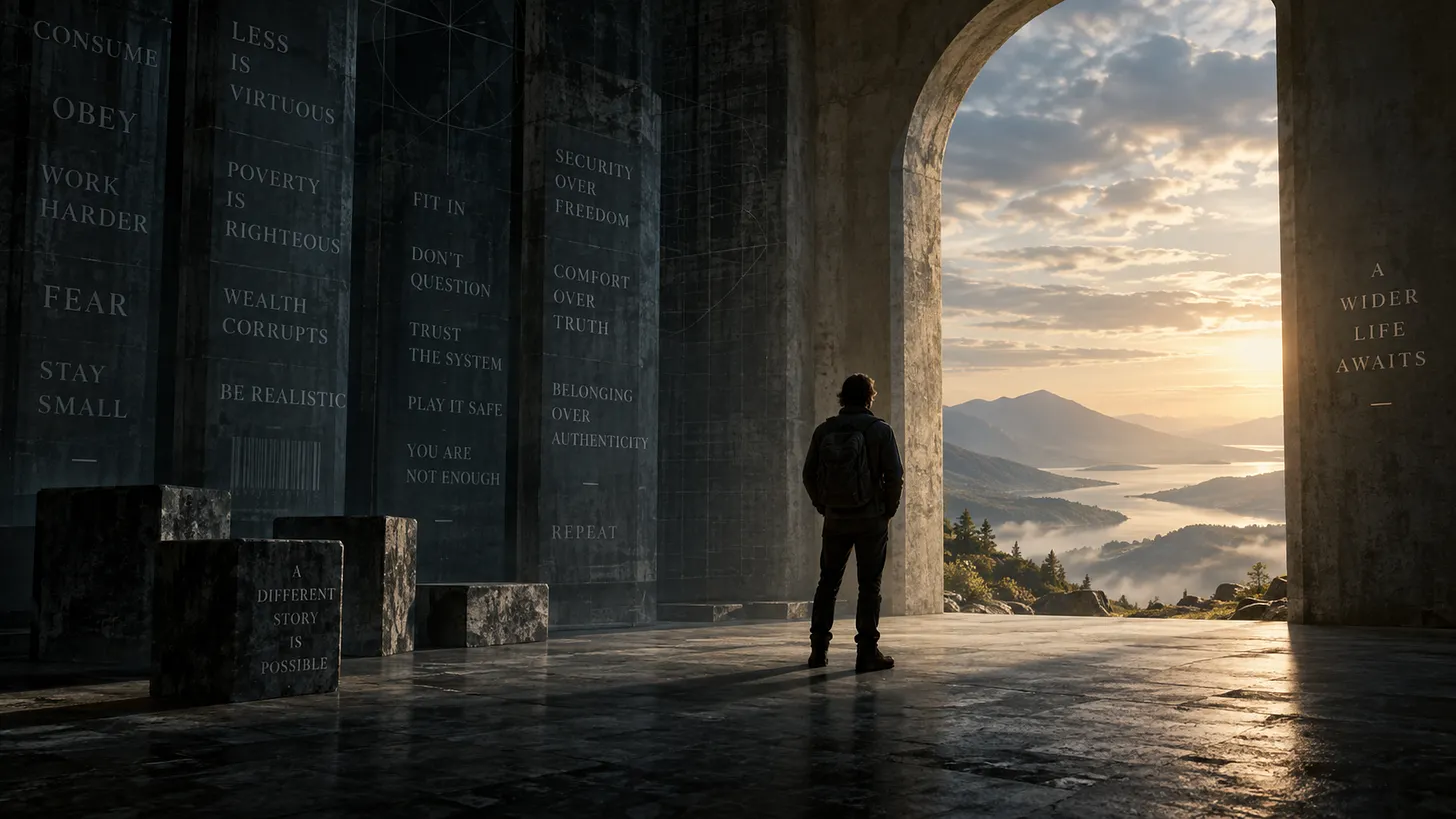
There are seasons in life when movement feels less like progress and more like suspension, a quiet bracing against what may yet intrude. We sense the undercurrent of possibility, the faint hum of renewal, but it exists beneath a sky that has so often darkened without warning. It is not fear exactly. It is memory. The memory of disruption. And so we wait, aware that something real is possible, yet conditioned by the rhythm of interruption that has shaped us.
Tag: psychology
Fragmented Lives: The Hidden Feedback Loops Shaping Our Bodies and Minds
In the quiet, unassuming patterns of our daily lives, the world shifts beneath our feet. Health, culture, and technology all converge in ways most never notice, quietly steering the currents of human experience. Here we trace these subtle yet powerful forces, illuminating the intersections where chronic disease, digital dependence, and societal inertia meet.
The Scaffolding: Cycles of Corruption and the Search for the Culprit
There is a point in any honest inquiry where the conversation stops being about politics, institutions, or history, and starts being about the architecture of reality itself. Not the headlines, the soil. Not the personalities, the pattern. When cycles repeat across empires, ideologies, and centuries, the question ceases to be who is in charge and becomes something far more unsettling: what is it in the scaffolding that keeps reproducing the same distortions? This discourse was not about easy answers. It was about pressing against the edge of explanation and noticing what presses back.
Beyond the Matrix Myth: Navigating the Post-Technocratic Tension
There is a subtle pressure in the air now — not loud, not overtly tyrannical, but pervasive. It hums through headlines, through price spikes at the pump, through glowing screens that promise relief while quietly redrawing the boundaries of human agency. We are told this is progress. We are told this is inevitable. Yet beneath the acceleration lies a deeper question — not whether technology advances, but whether we are advancing with it, or dissolving into it. This discourse is not a battle against tools, but an inquiry into sovereignty in an age that rewards surrender.
Memory, Meaning, and Cultural Survival: Art in a Post-Technocratic World
There are moments in a civilization when the question is no longer how to improve the system, but how to remain human within it. We live in an era of speed, saturation, and perpetual mediation, yet meaning, memory, and belonging feel thinner than ever. This dialogue continues an exploration not of collapse as spectacle, but of orientation: what anchors us when institutions wobble, when attention fragments, and when technology quietly replaces participation with observation. If earlier discussions examined sovereignty and authorship, this one turns to something older and deeper — the arts — not as decoration, but as the connective tissue of culture itself.