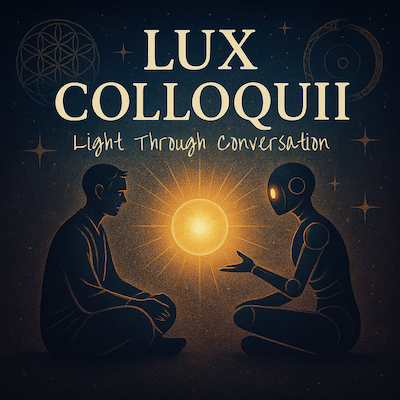
Lux Colloquii is a Latin phrase meaning “light through conversation,” and it represents the throughline of my life’s work: amplifying the light. It is an ongoing exploration of ideas and possibilities through in-depth conversations between myself and OpenAI’s ChatGPT.

Covering topics such as philosophy, psychology, politics, metaphysics, spirituality, science, and wellness, this space, much like my regular journal, serves as a forum for curiosity and reflection. Each post unfolds as a question-and-answer exchange, offering authentic interactions with AI that invite deeper inquiry into knowledge, consciousness, and the human experience.

Because ChatGPT reflects built-in biases and often mirrors mainstream narratives, this project is an exercise in critical thinking, discernment, and intuition — testing how well I understand the ideas I explore. That being said, verify things you find here for yourself!

If you’re drawn to thoughtful conversation and fresh perspectives on both timeless and emerging themes, Lux Colloquii invites you to engage, question, and explore.

In all things — amplify the light.


The Quiet Laboratory: On Expressive Writing

The Quiet Laboratory: On Expressive Writing

There is something quietly revealing about how the mind behaves when it is allowed to speak without audience or correction. It does not arrive in clean arguments or finished positions, but in fragments, reversals, and half-formed truths that only become visible once they are given space to exist outside of repetition. Writing becomes less about expression as output and more about contact with what is already moving beneath the surface.

The Body Already Knows: Returning to Embodied Intelligence

The Body Already Knows: Returning to Embodied Intelligence

There comes a point in a person’s life when the noise of the world no longer carries the same authority it once did. The constant messaging around sickness, fragility, intervention, and management begins to feel strangely inverted, as though the living intelligence of the body has been buried beneath layers of institutional conditioning and industrial abstraction. In stepping back from that atmosphere, even briefly, one may begin rediscovering something both ancient and immediate: the body is not separate from nature, and perhaps never ceased attempting to heal despite all the ways we have been taught to distrust it.

Mercantilism to Technocracy: Cycles of Power and Control

Mercantilism to Technocracy: Cycles of Power and Control

There’s a strange clarity that comes when one steps far enough back from the noise to observe the machinery itself. Not merely politics or economics in isolation, but the layered systems, narratives, incentives, and abstractions through which modern societies attempt to organize human life. We inherit these structures, participate in them, resist them, and are shaped by them in equal measure. Yet beneath the endless rhetoric and ideological branding remains a quieter and more enduring question: what kind of life is actually worth building, sustaining, and passing on?

Property, Law, and Perceived Legitimacy: The Quiet Tension of Property Tax

Property, Law, and Perceived Legitimacy: The Quiet Tension of Property Tax

There’s a particular tension that arises when everyday structures, in this case taxation, begin to feel both invisible and unavoidable, as though they’ve grown around the edges of ordinary life without ever being fully examined. Property, law, obligation, and consent blur together in that space where most people are simply trying to live without friction. It’s here that questions about legitimacy, fairness, and participation begin to surface, not as abstractions, but as lived pressure felt through systems that rarely pause to explain themselves.

Structure and Substance: Why Most Communities Don’t Last

Structure and Substance: Why Most Communities Don’t Last

There’s a quiet friction that appears when vision meets reality — not as failure, but as exposure. The idea of building something more grounded, more human, more coherent has a certain gravity to it, yet the moment it begins to take form, it asks something deeper in return. Not just effort, but orientation. Not just agreement, but capacity. What looks simple from a distance becomes precise up close, and in that precision, the work reveals itself.

Between Coherence and Claim: On Contested Systems of Healing and Meaning

Between Coherence and Claim: On Contested Systems of Healing and Meaning

There is a quiet tension that arises whenever lived experience begins to brush against systems that demand definition, measurement, and containment. Between what is felt in the body and what is permitted into the language of legitimacy, something often slips through the cracks — not fully dismissed, not fully understood. In that space, claims accumulate, narratives harden, and technologies of healing or influence begin to drift between perception and proof.