
Artificial intelligence may be the most consequential mirror humanity has ever created. We are building machines by feeding them an extraordinary portion of what we have written, recorded, imagined, discovered, argued about, believed, and created, and then asking them to make sense of it. For the first time, we have a technology capable of processing an enormous portion of the human record and reflecting patterns back to us that no individual could possibly perceive on their own. And yet, much of the public conversation surrounding AI seems to begin with the assumption that what it finds there will inevitably be dangerous. I find that assumption worth questioning.
Category: Journal Entries
thoughts, ponderings, experiences and lessons learned. or, something deep and life-changing.

There comes a point in the process of questioning where merely replacing one explanation with another is no longer enough. The deeper work begins when the new understanding is tested against experience — when an idea moves out of the realm of intellect and begins to change how we perceive, interpret, respond, and ultimately live. That transition can be uncomfortable, because it asks us not simply to question what we have been told, but to question the framework through which we have learned to understand ourselves.

We live amid an extraordinary amount of noise, much of it carefully arranged to keep our attention somewhere outside ourselves. The machinery grows more sophisticated, the stories more elaborate, and the demands upon our attention more constant, but the underlying question remains much the same: what happens when we surrender too much of our perception, our authority, and our agency to systems that claim to know what is best for us?

We live surrounded by records of ourselves, accumulating layer upon layer of what we once thought worth remembering, preserving, cataloging, and carrying forward. Yet perhaps memory was never meant to be a warehouse, and perhaps the deeper work is not in retaining everything, but in discerning what remains when everything else inevitably falls away.
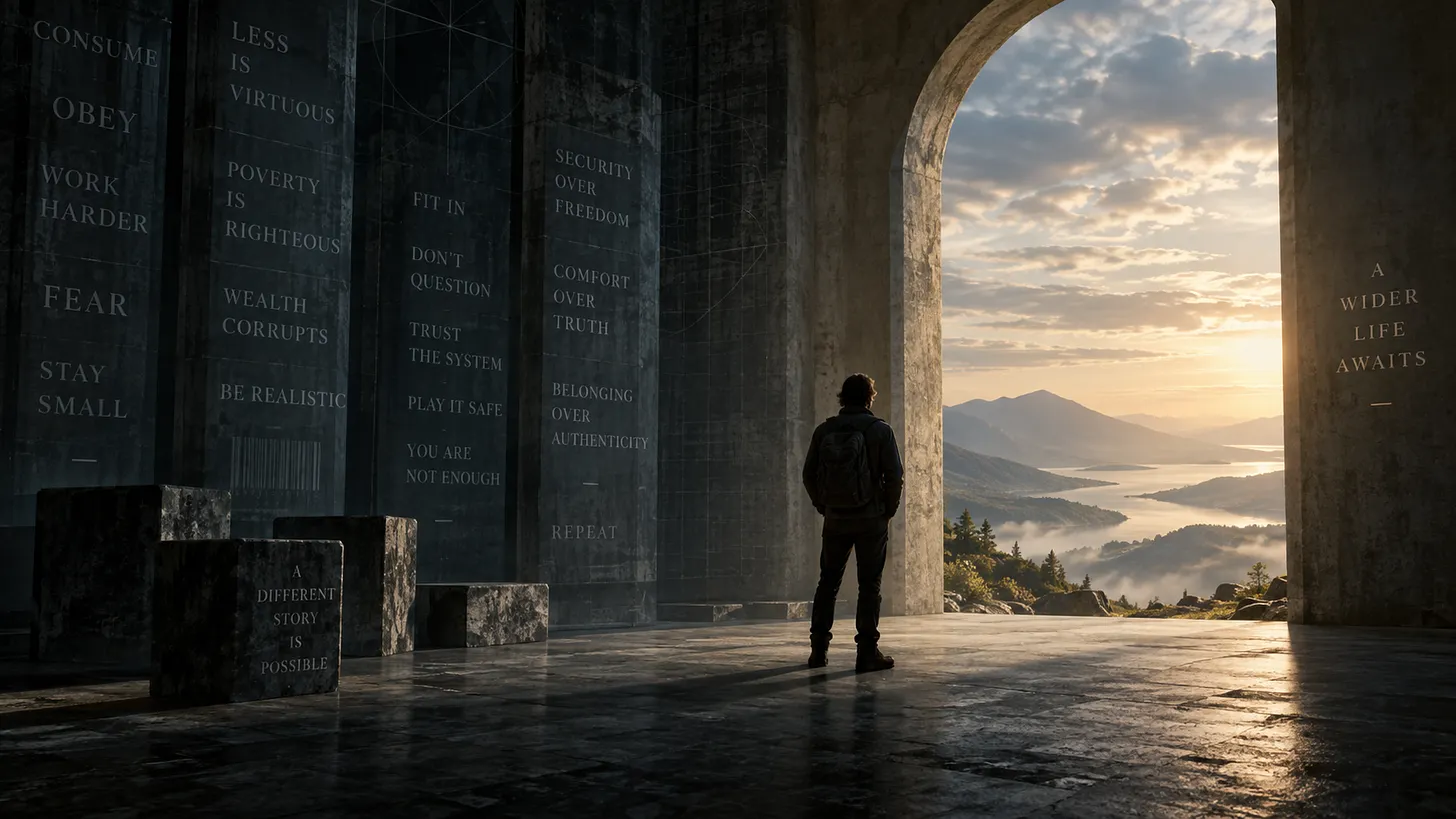
Perhaps the hardest programming to recognize is the programming that masquerades as virtue. It doesn’t arrive announcing itself as a limitation; it arrives as common sense, responsibility, humility, morality, even wisdom. We absorb it so completely that eventually we defend the very boundaries that keep us inside the smallest version of ourselves.