
There are moments in history when the surface narrative no longer aligns with lived reality. When the language of “progress” feels strangely disconnected from what we see in our towns, our institutions, and our families. This is not an argument as much as an examination — of patterns, pressures, and the quiet signals of civilizational drift.
Tag: governance

There is a peculiar inversion embedded in modern civilization, one so normalized we scarcely question it. The elders who built the infrastructure, paid the taxes, raised the families, and believed the promises are offered a “discount” at the end of their productive years, as though longevity were a liability instead of a triumph. Beneath that quiet absurdity lies a deeper fracture — in money, in governance, in scale itself — and in the slow erosion of communal coherence that once anchored meaning close to the ground.

Abandoned towns. Fractured narratives. Institutions straining beneath their own abstractions. We are living in a moment where the scaffolding of modern life feels less permanent than we were promised — and more conditional than we assumed. Beneath the noise, beyond the outrage cycles and ideological theater, something quieter is unfolding: a recalibration. Not rebellion. Not collapse. A remembering. Of land. Of skill. Of competence. Of the fact that maps change, but reality remains.

There are moments when the surface arguments no longer suffice — when debating policy, incentives, or regulatory capture feels like rearranging furniture in a burning house. What we touched here is not a partisan critique or a call for reform within established parameters. It is a first-principles interrogation of the premise itself — the buried assumption that large-scale coordination, hierarchy, abstraction, and management from on high are necessary features of civilization. If the soil is toxic, no pruning of branches will suffice. The question becomes far more radical: was the ship set off course from inception, and if so, what would it mean to reclaim authorship of the voyage?
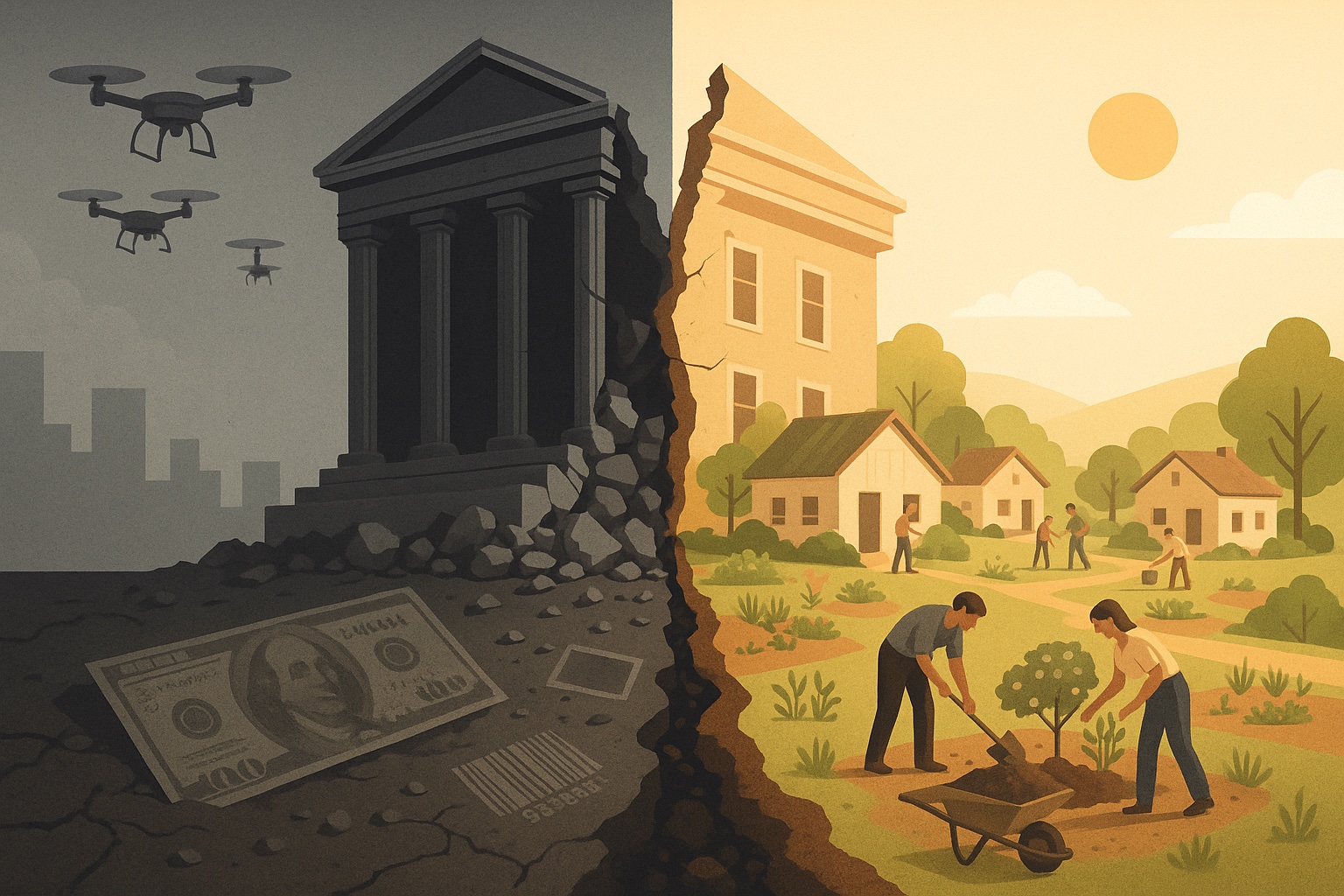
We’re not dealing with broken systems — we’re dealing with systems working exactly as designed. Centralized governance, media manipulation, and economic sleight-of-hand aren’t new phenomena, but they’ve reached a crescendo post-2020 that many can no longer ignore. What follows is less a dissection of current events and more an unmasking — a lucid exploration of power, perception, and the slow, quiet collapse of the narratives we were taught to trust.