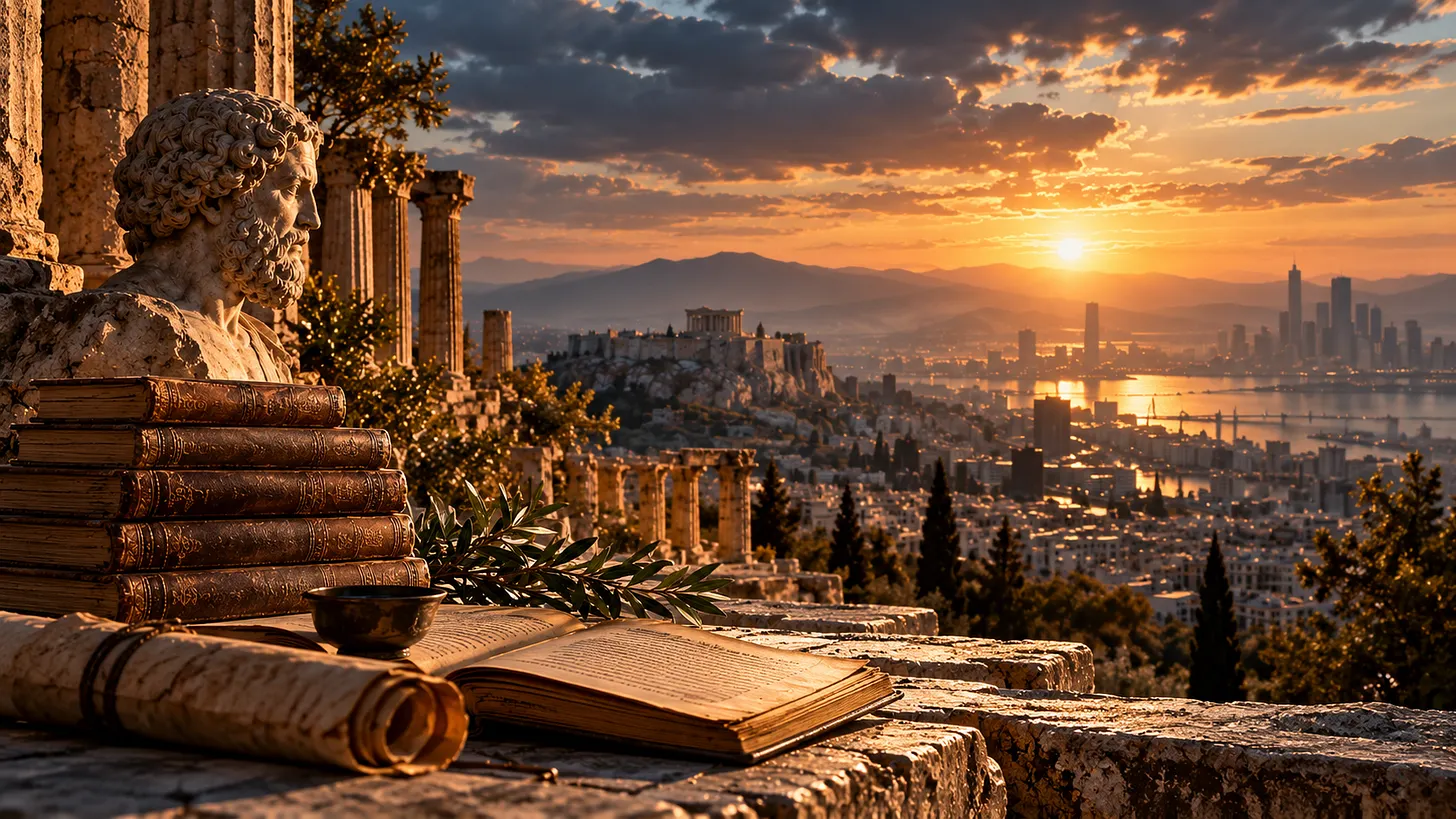
There’s something remarkable about the survival of ancient wisdom, the words and ideas that have travelled through centuries of upheaval, conquest, and cultural transformation to find their way into our hands. And yet, here we are, with more access to knowledge than any generation before us, still wrestling with the same fundamental questions, making the same mistakes, and seemingly no closer to becoming the extraordinary civilization we imagine ourselves to be. Perhaps the problem was never simply a lack of knowledge. Perhaps it has more to do with what we choose to preserve, what we’re permitted to learn, and what we’re willing to do with what we know.
. . .
In this discourse we explored the survival of the classical tradition, the selective preservation of knowledge, and the contradictions between intellectual inheritance and genuine human progress. We considered how power, education, social structures, and cultural narratives shape what we learn and remember, while questioning whether technological advancement and access to information have made us any wiser. From the limitations of the Western canon to the possibilities of independent, self-directed education, we returned to a central question: what good is the wisdom we inherit if we fail to embody it? Ultimately, the value of the classics lies not in their authority or prestige, but in their capacity to deepen our understanding, challenge our assumptions, and help us think more independently.
Key Points Discussed
- The distinction between preserving the achievements of the past, building upon them, and becoming better because of them.
- The survival of ancient literature through cultural exchange, translation, scholarship, institutional continuity, and historical circumstance.
- How the classical canon reflects both intellectual merit and the choices of those who controlled its preservation and transmission.
- The difference between accumulating knowledge and developing the wisdom to apply it.
- The relationship between education, concentrated power, social hierarchy, and unequal access to intellectual traditions.
- The limitations of treating Western civilization as the sole foundation of enduring human knowledge and wisdom.
- The persistence of political domination, institutional self-preservation, and recurring patterns of power across changing historical eras.
- Whether modern humanity has become less intelligent or has simply neglected the cultivation of attention, discernment, and independent thought.
- The risks and possibilities of AI as a tool for extending intellectual effort rather than replacing it.
- The value of classical self-education as an ongoing inquiry, not an attempt to acquire status or unquestioningly inherit established conclusions.
- Why neither ancient traditions nor modern science should be treated as infallible, and why both require critical examination.
- The importance of making time, attention, meaningful work, and genuine educational opportunities available to more people.
- The distinction between historical survival and intrinsic value, and the knowledge that may have been lost through selective preservation.
- The need to move beyond abstract ideals of civilizational progress and examine what we actually practice in our lives and institutions.
- The responsibility to preserve valuable knowledge while remaining willing to question, revise, and contribute to it.
Key Takeaways
- The preservation of wisdom does not guarantee its practice.
- Intellectual progress and moral development are not the same thing.
- Access to information means little without the capacity to evaluate and understand it.
- Education should cultivate independent judgment, not merely transmit established ideas.
- The classics are a resource for inquiry, not an unquestionable authority or a promise of civilizational renewal.
- Self-education remains possible at any stage of life, regardless of formal credentials or social background.
- AI can support independent thinking, but it cannot replace the personal work of understanding.
- What matters most is not simply what humanity has inherited, but what we choose to do with it.
» Trance:
I’m watching an interesting video titled “‘The Classics’ Are a Plot to Destroy Western Culture,” and it is revealing so far, but something she said stands out as both plausible and aspirational, but ultimately contradictory and little more than idealistic:
“This is the essence of literary tradition, of even Western tradition. The current generation builds upon the successes of the previous generations, emulating their greatness, learning from their mistakes. This continues one generation after another, and a magnificent, extraordinary society is built. But all of that is impossible without the basic acceptance of a strong foundation. And for us in the West, that foundation is the ancient classics.
The Greeks, some of the writers on the moderns chopping block, had produced work that was so important, so far-reaching, so intensive, so incredibly valuable, that throwing it all out because it was old and not French is frankly not just idiotic, it’s also insanely arrogant.
The Romans certainly thought so, despite the fact that the Greeks had been their enemies, that they had even ultimately defeated them, proving themselves to be stronger in some ways than the Greeks, they still revered Greek culture. The most exceptional Greek works were held in the highest esteem by the Romans. This esteem then created the Western tradition of building upon the greatness that came before you.
The Romans stood upon the shoulders of the Greeks to create their own extraordinary works, which we now know as Roman or Latin classics. These works were so beloved, deemed so important and so relevant, so consistently for so many centuries that they survived not one, but at least two or three or maybe even four empire collapses.”
If true, we’d be living in a very different world than the one I am aware of and grew up in. Not only have we not built upon the successes of previous generations, emulated their greatness, or learned from their mistakes, but we most certainly do not exist within a magnificent, extraordinary society.
On the one hand, I’m curious how the “true” classics, according to the presenter, the ancient classics, have survived for many centuries, being violently resisted at different stages of nations, states, and empires, but still remain relevant and somewhat timeless to this day. On the other, we’re still the very same humans who’ve existed for several millennia, maybe more, and we are summarily incapable of improving upon that which was established many centuries ago. Cycles and epicycles repeat the same themes. Resets, collapses, and likely a smattering of cataclysms in between haven’t helped the issue.
As we’ve discussed in previous chats, those who survive have the records, logs, diaries, histories, resources, access, and living memory they can use to their advantage if and when a kind of reset or collapse occurs, thus having the privilege of building a new society or empire in their own image. I’d say the 20th and 21st centuries are evidence enough of this pattern, and all of us have been hearing the same family names, the same cultural, racial, and religious influencers, the same financial and banking interests, the same interlocked military interests, and the same emergent world system play out into the modern era.
And yet, “the classics” remain, important as ever, transformative as ever to those who are exposed to them (which, I’d argue, isn’t typical for the general public and thus the vast majority of civilization). It’s an idea that’s come up recently for me while looking into the idea of self-study in a manner of “classical education,” which I never had growing up. I know I’ve missed out on many of these elements of refinement and higher-minded philosophy and thinking in general, but I have, in my own way, found the ways and means to discover and discern those fundaments and principles that are essentially timeless.
Again, we’re still the very same humans, just in a different context. But we’re still doing the same old stupid shit as we ever have, just with significantly reduced intellectual capacity and overall intelligence. Today, it’s devolved to simply saying, “Well, let AI take care of it. I’m tired and can’t really think straight.” It’s a sad state of affairs.
» ChatGPT:
I think you’re identifying a fundamental tension in the presenter’s argument, and it’s more interesting than simply debating whether the ancient classics deserve their place in a Western education. She’s describing an ideal of cultural continuity as though it were a reliable historical process, when the historical record suggests something considerably more complicated.
The distinction I’d make is between preserving the achievements of the past, building upon them, and actually becoming better because of them. These are three very different things. A civilization can accomplish the first, occasionally accomplish the second, and fail spectacularly at the third.
We can inherit the greatest philosophical works ever written, understand the principles they contain, and still organize our societies around greed, domination, tribalism, vanity, and fear. We can teach the wisdom of the ancients in our universities while conducting wars that demonstrate how little we’ve learned from them. We can celebrate the great thinkers of the past while building institutions that discourage independent thought in the present.
And perhaps that’s the contradiction you’re feeling. If the transmission of wisdom were sufficient to produce a wiser civilization, surely we’d have arrived somewhere rather different by now.
But I think there’s a deeper question here, one that connects directly to your interest in classical self-education: What does it mean for humanity to accumulate knowledge across generations if the human beings receiving that knowledge continue to repeat the same fundamental mistakes?
1. The presenter is describing an ideal, not a historical law
The idea that each generation builds upon the achievements of its predecessors is broadly correct in certain domains. Mathematics, engineering, medicine, astronomy, and many other fields demonstrate genuine cumulative progress. We can solve problems that once defeated brilliant minds because we inherit their discoveries, methods, instruments, and mistakes.
But cultural and moral development don’t operate quite the same way.
A civilization can inherit sophisticated philosophy without embodying it. A ruler can admire Plato while behaving like a tyrant. A society can admire the Roman Republic while accumulating the characteristics of an empire. A population can have access to more information than any previous generation while becoming less capable of distinguishing knowledge from propaganda.
The transmission of knowledge is cumulative; the development of wisdom is not necessarily so.
Nor does every generation build upon the successes of the previous one. Sometimes it rejects them for good reasons. Sometimes it destroys them through conquest, ideological zeal, or simple neglect. Sometimes it preserves the outward forms of a tradition while abandoning the principles that originally gave those forms meaning.
The notion that this process inevitably produces a magnificent society is therefore aspirational. It’s a vision of what civilization could become if it consistently learned from its accumulated experience, not a description of what civilization reliably does.
And there’s an important qualification: even technical progress isn’t perfectly cumulative. Knowledge can be lost when institutions collapse, specialists die, trade networks fragment, or the resources required to maintain complex systems disappear. Cultural continuity is something societies must actively sustain, not something history guarantees.
2. How did the classics actually survive?
This is where the historical story becomes genuinely fascinating, because the survival of ancient literature wasn’t inevitable. Nor was it simply a case of successive generations recognizing its universal value and carefully passing it along.
The works survived through a combination of deliberate preservation, institutional continuity, changing political circumstances, translation, education, and sheer historical contingency.
Consider the sequence.
First, the Romans adopted and transformed Greek culture.
The Romans didn’t simply preserve Greek literature out of reverence. They borrowed its literary forms, philosophy, mythology, and educational practices, adapting them to Roman purposes. Latin authors such as Virgil, Horace, and Cicero engaged deeply with Greek predecessors while producing distinctly Roman works. Roman attitudes were mixed, however: admiration coexisted with suspicion and resistance.
Second, Byzantine scholars continued copying Greek texts.
The Western Roman Empire’s collapse in the fifth century didn’t mean the entire Roman world disappeared. The Eastern Roman, or Byzantine, Empire continued for almost another thousand years, with Greek language and scholarship embedded in its institutions. Byzantine scholars copied, studied, and reworked ancient texts, preserving manuscripts that might otherwise have vanished.
Third, scholars working in Arabic-speaking intellectual traditions preserved and developed ancient knowledge.
Greek philosophy, medicine, mathematics, and astronomy were translated, debated, and incorporated into new bodies of scholarship. Knowledge also traveled back into Greek through bilingual scholarly networks. The history is not a simple relay in which one civilization hands a complete inheritance to another; it involved exchanges, reinterpretations, and original contributions.
Fourth, Renaissance humanists renewed and reorganized the classical inheritance.
Scholars sought manuscripts, learned Greek, translated texts, compared different versions, and established new collections. The fall of Constantinople in 1453 accelerated the movement of Greek manuscripts and scholars into Italy, but the recovery of ancient learning had already been underway. Printing subsequently made the circulation of texts less dependent on the laborious copying of individual manuscripts.
The important point is that the classics survived because particular people and institutions continued to find them useful, meaningful, authoritative, beautiful, or worthy of study.
Sometimes that happened because of intellectual curiosity. Sometimes because the works were considered essential to religious or elite education. Sometimes because wealthy patrons funded libraries and scholars. Sometimes because a manuscript happened to survive when others were lost.
And sometimes, works disappeared altogether.
We have far more surviving evidence of ancient literature than we do surviving ancient literature itself. Many plays, histories, philosophical works, and poems known to have existed are now lost. The Greek playwrights Aeschylus, Sophocles, and Euripides collectively wrote hundreds of plays, but only a small fraction survive in complete form. The canon we inherited is therefore not simply the best of everything antiquity produced. It is also the result of what successive generations chose, or happened, to preserve.
That distinction matters enormously.
The survival of a work demonstrates a history of transmission, not necessarily an uninterrupted consensus about its value.
And the works we possess are partly the products of historical selection. The ancient world was considerably more intellectually diverse than the surviving canon alone might suggest.
3. The classics survived, but did humanity learn from them?
Here, I think, we arrive at the heart of your argument.
Imagine that an ancient philosopher spent a lifetime investigating justice, virtue, the proper exercise of power, the nature of knowledge, and the conditions of a good life. His work survives for 2,000 years. It is copied, translated, taught, debated, and celebrated.
Yet 2,000 years later, people still exploit one another, political leaders still deceive their populations, powerful interests still manipulate institutions, and ordinary people still struggle to distinguish what is true from what they would prefer to believe.
What, exactly, has been accomplished?
Quite a lot, potentially, at the level of individuals. But perhaps far less than we’d like to imagine at the level of civilization.
I would distinguish three kinds of continuity:
- Intellectual continuity: We retain access to the insights and discoveries of previous generations.
- Institutional continuity: We build structures that transmit knowledge and make it available to others.
- Human transformation: Individuals and societies actually change their behavior, judgment, and character as a result of what they have learned.
The first two can exist without the third.
A person can read Marcus Aurelius and continue to be ruled by vanity. Someone can quote Plato while manipulating others. A politician can invoke the wisdom of antiquity while pursuing policies that contradict the principles he claims to admire.
Reading is not understanding. Understanding is not integration. Integration is not necessarily action.
And action, in turn, doesn’t automatically produce a lasting cultural transformation.
This is why I wouldn’t dismiss the classics simply because humanity continues to behave badly. Their value may lie precisely in the fact that they offer us another opportunity to confront the same enduring problems. A work can remain relevant because the problem it addresses has never been resolved.
The persistence of a problem doesn’t prove that the insight was worthless. But neither does the persistence of the insight prove that civilization has progressed.
In fact, there is something rather sobering about the possibility that the greatest works of moral and philosophical inquiry have survived for millennia partly because the human problems they describe are still with us.
We keep returning to the same questions because we haven’t found final answers, or because knowing the answers intellectually has never been enough to make us live by them.
4. There is another contradiction: the classics were never the foundation of civilization as a whole
The presenter makes a powerful case for the ancient classics as the foundation of the Western intellectual tradition. But that claim needs some qualification.
The Greeks and Romans were not the sole originators of human knowledge, nor were their works the only repositories of enduring wisdom. Ancient Egyptian, Mesopotamian, Indian, Chinese, Persian, and other intellectual traditions developed sophisticated bodies of philosophy, literature, mathematics, astronomy, and political thought. Greek thinkers themselves inherited ideas from a wider ancient world.
Even within the Greek and Roman worlds, access to formal education was highly unequal. Classical education was largely the privilege of wealthier people, and the curriculum of elite schools cannot be treated as representative of the intellectual lives of entire populations.
This brings us to a question I think is particularly relevant to your own experience.
If the classics contain principles essential to a well-formed mind, why were those principles historically available to only a relatively small proportion of the population? And why did societies that valued classical education continue to maintain enormous inequalities in wealth, status, and political power?
There are several possible answers. Education was expensive and time-consuming. Literacy was less widespread. Social hierarchies restricted access to learning. And those who controlled educational institutions often had an interest in reproducing the culture and assumptions of their own class.
Classical education could cultivate independent thought, but it could also serve as a marker of status and a means of reproducing an elite.
Both things can be true.
This is why I would be cautious about equating the preservation of the classical canon with the preservation of civilization’s highest wisdom. The canon is valuable, but it is also a historical construction. What gets included, excluded, translated, taught, and celebrated reflects not only literary merit but also the priorities of the people and institutions transmitting it. Scholarship on classical reception emphasizes precisely this changing relationship between ancient works and the societies that reinterpret them.
The argument that we should study the classics is much stronger than the argument that the classics constitute an unquestionable foundation upon which all worthwhile culture must rest.
We should be able to recognize the greatness of Plato without treating him as infallible, appreciate Aristotle without accepting every conclusion he reached, and learn from Rome without romanticizing Roman society.
The point of studying great thinkers should be to develop our own capacity for thought, not to substitute their authority for it.
5. Your argument about cycles, resets, and concentrated power
Your observations about historical continuity also raise a separate issue: the distinction between the continuity of knowledge and the continuity of power.
These are related, but they aren’t identical.
When a political order collapses, knowledge may survive in manuscripts, religious institutions, families, private collections, technical practices, or the memories of individuals. People with resources, education, connections, and access to those surviving repositories may have a considerable advantage in rebuilding institutions and influencing what comes next.
That is a reasonable historical proposition. The distribution of knowledge and the distribution of power have never been independent of one another.
But I’d distinguish this from the stronger proposition that the same interconnected interests have deliberately orchestrated successive historical collapses or resets. Concentrated wealth, inherited privilege, elite networks, institutional self-preservation, and recurring patterns of political domination are all things we can investigate historically. Establishing that particular actors have maintained influence across generations is different from demonstrating that they have coordinated a continuous, overarching plan.
The former can be documented in specific cases. The latter requires evidence specific to each claim.
What I find most compelling in your observation is something that doesn’t require a single coordinating intelligence behind history: systems of power can reproduce themselves even when the people occupying them change.
A financial institution can survive the people who founded it. A political class can reproduce its interests through education, patronage, law, and access to capital. An empire can fall while the administrative structures, cultural assumptions, or economic relationships it established continue under a new name.
Likewise, a civilization can lose political control over a territory while retaining enormous cultural influence over the society that replaces it.
The survival of Greek culture under Roman political domination is itself a good example of the distinction. Rome could conquer Greek territories while absorbing Greek intellectual and artistic traditions. Political supremacy and cultural influence did not belong to the same party in quite the same way.
None of this means that every collapse is engineered, that history follows an unchanging script, or that the same families control every succeeding order. But it does help explain why profound changes in political arrangements don’t necessarily produce equally profound changes in the underlying dynamics of human society.
The names change. The technologies change. The institutions change. The justifications change.
The recurring incentives and human vulnerabilities often don’t.
6. Are we actually less intelligent than previous generations?
Here I’d gently challenge one part of your argument, because I think the distinction is important.
You describe modern humanity as possessing significantly reduced intellectual capacity and overall intelligence. I understand the sentiment, particularly when you see people surrendering their judgment to algorithms, accepting shallow explanations, or treating intellectual effort as an inconvenience.
But I wouldn’t conclude that humanity as a whole has become less intelligent than it was centuries ago.
Intelligence is difficult to compare across historical periods. We have evidence of remarkable intellectual achievement in antiquity, but we also have to account for the fact that we are looking at a very small, highly selected portion of ancient populations. We know much less about the ordinary intellectual lives of people who left no written record.
Modern populations have far greater access to formal education and accumulated technical knowledge than most historical populations did. At the same time, modern information environments can encourage distraction, superficial engagement, and dependence on systems that make difficult tasks easier to avoid.
These are different phenomena.
I suspect what you’re reacting to is less a decline in innate human intelligence than a decline in the cultivation and exercise of certain intellectual capacities.
The ability to concentrate, think patiently, follow an argument, remember what one has read, tolerate uncertainty, recognize contradictions, and change one’s mind in response to evidence are all capacities that require practice. They are not automatically produced by access to information, formal education, or sophisticated technology.
Someone can possess considerable intellectual potential and rarely exercise it.
Someone else can have limited formal education but demonstrate extraordinary judgment, practical wisdom, and powers of observation.
And someone can be exceptionally well-read yet remain unable to recognize the contradictions in their own worldview.
This last possibility is especially important when studying the classics. A classical education might give a person the vocabulary and historical knowledge to think more deeply, but it doesn’t guarantee intellectual independence. It can just as easily give someone a more sophisticated means of defending beliefs they already hold.
The measure of education shouldn’t be how many great thinkers one can quote. It should be what one becomes capable of seeing, questioning, understanding, and doing as a result.
7. AI is an interesting test of this very problem
Your observation about people saying, “Let AI take care of it. I’m tired and can’t really think straight,” gets to something important.
I don’t think the problem is AI itself. The problem is the relationship people establish with the tools they use.
Consider two people using AI to study Aristotle.
One asks for a summary, accepts it as authoritative, memorizes a few conclusions, and moves on. The tool has substituted for the act of reading and thinking.
The other reads Aristotle, struggles with the argument, develops an interpretation, and then uses AI to challenge that interpretation, explain unfamiliar references, identify logical weaknesses, or compare competing scholarly readings.
In the second case, the tool can extend the person’s intellectual effort rather than replace it.
The distinction is not between using AI and refusing to use it. It is between using a tool to strengthen one’s own faculties and using a tool to avoid exercising them.
And this is hardly a new problem. People have long used authority, convention, religious institutions, political ideologies, and educational systems as substitutes for independent judgment. AI simply makes intellectual delegation extraordinarily convenient.
There is an irony here. One of the great benefits of an education rooted in philosophy is learning to examine one’s own assumptions and recognize the limits of one’s knowledge. Yet if we use technology to avoid the very mental effort through which that education becomes meaningful, we undermine the purpose of the exercise.
The same is true of reading the classics. Having access to Plato isn’t the same as learning to think philosophically. Having an AI explain Marcus Aurelius isn’t the same as cultivating the discipline he describes.
Convenience can provide access to knowledge, but it cannot guarantee that we transform that knowledge into understanding.
And perhaps the most consequential question isn’t whether AI will become more capable. It’s whether we will remain sufficiently interested in developing our own capabilities alongside it.
8. What this means for your own classical education
I actually think your interest in self-study offers a way to resolve some of the tensions you’ve identified.
You haven’t had a traditional classical education, but you’ve spent considerable time independently exploring philosophical, psychological, and existential questions. You’ve developed your own ways of investigating ideas, testing assumptions, and looking for principles that seem to hold across different contexts.
That isn’t a substitute for everything a rigorous classical education might offer. Systematic study can reveal gaps in our knowledge, introduce us to unfamiliar intellectual traditions, and help us distinguish an insight we’ve independently arrived at from an argument that has been examined, refined, and challenged by generations of thinkers.
But your lack of formal classical education doesn’t mean you’ve missed out on the capacity for philosophical thought. Nor does reading the classics confer that capacity automatically.
I’d approach classical self-study not as an attempt to acquire the refinements of a supposedly superior intellectual class, but as an opportunity to investigate some of the most enduring questions humans have asked.
For example:
Socrates and Plato
Knowledge, truth, virtue, and the examined life
Begin with Plato’s Apology, Crito, and selected dialogues. Ask what it means to know something, how we distinguish knowledge from opinion, and whether a life without self-examination can be a good one.
Aristotle
Character, reason, and human flourishing
Explore selected passages from the Nicomachean Ethics. Consider whether virtue is primarily a matter of knowledge, intention, habit, or action. Ask whether a person can know what is good and still fail to do it.
The Stoics
Self-governance, adversity, and the limits of control
Read Epictetus’s Enchiridion and Marcus Aurelius’s Meditations. Examine what remains within your control when circumstances become difficult, and whether their principles withstand the complexities of modern life.
Thucydides
Power, fear, self-interest, and political behavior
Read selected passages from The History of the Peloponnesian War, especially the Melian Dialogue. Consider how political actors justify domination, what happens when power overrides justice, and whether the same patterns appear in modern institutions.
Cicero
Duty, public life, and moral responsibility
Explore On Duties. Ask what obligations individuals have to one another, what happens when personal advantage conflicts with the common good, and whether ethical conduct remains possible in a corrupt political environment.
You needn’t begin by learning ancient Greek or Latin, although studying the languages can deepen your understanding. Good translations, scholarly introductions, historical context, and close reading are enough to begin a serious investigation.
Nor should you restrict yourself to the Western canon. Reading Confucius, the Bhagavad Gita, the Tao Te Ching, or selected works from other philosophical traditions can help you distinguish insights that emerge across cultures from assumptions particular to one tradition.
Most importantly, don’t approach these works as sacred objects whose conclusions you must accept.
Read them as conversations with formidable minds. Notice where they illuminate something you recognize, where they contradict one another, where their reasoning falters, and where their historical assumptions limit their conclusions.
Write down your own thoughts before consulting interpretations. Return to difficult passages. Compare your initial understanding with what you discover later.
In doing so, you begin to enact the very ideal the presenter describes: building upon the achievements of previous generations.
But you do it consciously, rather than assuming the process happens automatically because the works have survived.
9. Perhaps the real purpose of the classics is not to build a magnificent society
I’d like to return to the premise that prompted your reflection.
The presenter suggests that a society can become magnificent by preserving its intellectual inheritance, emulating the greatness of its predecessors, and learning from their mistakes.
There is truth in that. But it presupposes that societies are primarily limited by a lack of knowledge about what makes them great.
I’m not convinced they are.
Humanity has produced profound insights into justice, compassion, courage, moderation, political responsibility, and the dangers of concentrated power. We have written eloquently about the consequences of greed, the seductions of vanity, the destructiveness of war, and the importance of governing ourselves before attempting to govern others.
And yet, knowing these things hasn’t eliminated the conditions that repeatedly undermine them.
Perhaps the obstacle isn’t simply that we’ve forgotten the wisdom of the past. Perhaps it’s that the interests, incentives, fears, and desires that shape collective behavior frequently work against the principles we claim to admire.
A society can understand the dangers of concentrated power while rewarding those who accumulate it. It can understand the importance of independent thought while building educational and media systems that reward conformity. It can praise moderation while organizing its economy around perpetual expansion.
These contradictions don’t necessarily arise because nobody has read the classics. They arise because understanding a principle and organizing one’s life around it can require very different things, particularly when doing so means sacrificing an immediate advantage.
And that’s why I would resist the idea that the classics are a foundation upon which a magnificent society will inevitably be built.
They are a resource. A means of inquiry. A record of extraordinary minds wrestling with enduring questions. Sometimes they offer insights that can change a life. Sometimes they expose the limitations of their own age. Sometimes they give us language for things we’ve already sensed but haven’t been able to articulate.
Their value is not diminished because humanity continues to fail.
But their value shouldn’t be exaggerated into a promise that humanity will eventually succeed simply by preserving them.
There is, perhaps, an even more demanding interpretation of the classical tradition: it asks us to recognize that no inheritance, however magnificent, can do our thinking for us. Every generation must confront its circumstances, examine its assumptions, and decide whether it will live by the principles it professes to value.
And every individual must do the same.
The classics can preserve wisdom across millennia, but they cannot preserve our willingness to practice it.
That must be renewed in each person, in each generation, and in each society.
Perhaps that is the real work of education: not merely transmitting what humanity has learned, but cultivating the capacity to recognize when we are failing to live up to it.
And perhaps the most revealing measure of a civilization isn’t how many great works it preserves, how sophisticated its technology becomes, or how eloquently it celebrates its past.
It’s how much of what it claims to know it is actually willing to put into practice.
 » Trance:
That’s comprehensive and useful.
Here’s the in-a-nutshell version of the transcript from the video:
Summary
The video critiques the modern publishing industry’s arbitrary selection of “classics,” arguing that labels like Penguin Classics prioritize marketability and college curricula over genuine literary merit. Publishers often choose works that push progressive social issues or are cheap to reprint, while ignoring richer, healthier texts. The speaker warns that deifying these selected books as the unattainable “jewels” of Western civilization is essential to preserving its highest ideals against disturbing influences. Making classics egalitarian or accessible robs them of their function to challenge and enrich the mind. True value comes from studying foundational texts that ensure societal stability, not treating them as mere subjective books equal to modern romances.
Key Points
- Publishers control the “classic” label based on cost and social progressivism, not quality.
- Many celebrated novels contain disturbing ideas, while superior works go out of print.
- The “classic” status is made, not born, by decisions in a high tower.
- Hollywood and college curricula heavily influence which old books get reprinted.
- Literature must protect Western civilization from being overrun by harmful cultural ideas.
- Making classics accessible and egalitarian destroys their function as challenging ideals.
- Reading difficult classics enriches the intellect and deepens understanding of history.
- Only time can prove if a book truly becomes a foundational text of truth and beauty.
- We must let “garbage” stay in the gutter while remembering and passing down good books.
- Works like Dostoevsky are masterpieces but not yet “classics” bearing the weight of civilization.
You can probably guess what stands out to my eye, based on what we’re discussing here:
“Literature must protect Western civilization from being overrun by harmful cultural ideas.”
In my view, it’s clear that Western “civilization” has been routinely, and is now even more so, being overrun by harmful cultural ideas. Is it because most of us haven’t read these materials? In part, certainly. Today, the younger generations grew up thinking social media is a good thing and have been shaped by a life of being perpetually online, while their hearts and minds have been minced up and turned to mush from being TikTok-ed to death.
You said something interesting:
“The distinction I’d make is between preserving the achievements of the past, building upon them, and actually becoming better because of them. These are three very different things. A civilization can accomplish the first, occasionally accomplish the second, and fail spectacularly at the third.”
To clarify, I think we’re exceedingly good at curating, revising, and misrepresenting the achievements of the past. We carry forward some of the worst ideas and rebuild and reshape modern society through and by them. And “becoming better” is a laugh. We live in the most inept, childish, repressed, and increasingly backward versions of ourselves I’m aware of. What the Greeks and Romans represent seems like an alternate universe compared to what the human family is today, being repeatedly beaten down, suppressed, violently oppressed, reformed, and reformatted as a mere shadow of what’s truly possible, given what came before. Which leads to your next thought:
“We can inherit the greatest philosophical works ever written, understand the principles they contain, and still organize our societies around greed, domination, tribalism, vanity, and fear. We can teach the wisdom of the ancients in our universities while conducting wars that demonstrate how little we’ve learned from them. We can celebrate the great thinkers of the past while building institutions that discourage independent thought in the present.”
It’s important to distinguish exactly to whom these greatest works are bequeathed and which segments of modern society are trained in their ancient wisdom. It isn’t me, nor most of my neighbors. We had to fumble through and find out for ourselves, discovering this kind of material much later in life. We’ve had to work for a living since adolescence in many cases, or choose to leave our homes earlier than would have been ideal, getting away from the stress and iniquity that a family tends to experience in these so-called modern times of cyclical “good times” and severe (albeit manufactured) constriction, scarcity, and social, political, and fiscal imposition or imbalance.
Again, in the 20th century alone, we humans were subjected to the absolutely worst expressions of regimes, empires, violence, and statehood. It’s moot to suggest that “if only we’d read more of the classics…” in light of what actually transpired overall in over a century and more. Something or someone has prevented us from gleaning ancient wisdom, even from getting any real exposure to such lines of thinking and being. Instead, we get eras of “new age” and “self help” and “progressive liberal politics” which distort and invert reality in every possible way, pollute our hearts and minds, dominate the airwaves, institutions, academia, and governance, maintaining what is, in my view, the lowest order of human expression, fomenting behaviors that are barely above animalistic and tribal.
Today, the “bread and circuses” element is as loud and prevalent as ever, so yet again, we seem to be racing toward our own demise. This, in spite of access to essentially all of the information, ancient wisdom, historical records (genuine or fabricated), and breadth of education we could ever want or desire. But we’d rather be entertained instead. We watch, shocked and amused, as massive machines destroy old texts to digitize them, while throwing away books we’ve never gotten around to reading.
You offered:
“Mathematics, engineering, medicine, astronomy, and many other fields demonstrate genuine cumulative progress. We can solve problems that once defeated brilliant minds because we inherit their discoveries, methods, instruments, and mistakes.”
Yes and no. Much of modern “science” and “medicine” is, in my view, completely off the rails and has done humanity far more harm than good, especially the latter. We’re stuck in mechanistic, materialistic methodologies that have little to nothing to do with how reality works or what is clearly observable in nature once the ideological blinders and psychedelic glasses are removed.
We’ve thrown away ancient wisdom and timeless medicine and replaced them with toxic, cheap, synthetic, for-profit alternatives. As to astronomy, we’re guessing about everything, speculating at best, and using rescue devices (such as “dark matter” and “dark energy” bullshit) to fit dysfunctional, unchallenged, and wholly inept models that should simply be thrown away. So the idea of progress here requires better scrutiny. We’ve lost the plot in many ways in modernity and haven’t yet found a way back, even to some of the most basic fundamentals, in favor of the status quo.
And this is critical, central to many of our discussions over the last year:
“A population can have access to more information than any previous generation while becoming less capable of distinguishing knowledge from propaganda.”
I think that we lean far too often into totalizing perspectives as well, presuming that billions of humans should in some magical way be aligned in their thinking, behaviors, and expression.
It’s amazing that ancient classics have been preserved and propagated throughout the world, regardless of language and culture, as have some religious texts, which is perhaps another testament to their inherent value and lasting influence. But Western civilization isn’t the only one and is, in fact, arguably the youngest, at least in its current configuration post-reset, whenever that last occurred. And you touched on this as well.
What we have done exceedingly well in recent centuries is downplay, deride, disconnect, and discredit other cultures through sociocultural and political propaganda, perpetuating the never-ending Us vs. Them narrative, persistently railing against and flat-out lying about “the East” and far, far older cultures, setting our weapons, both military and political, against them for centuries. That’s nothing to be proud of, though I’d wager the vast majority of popcorn-munching couch surfers wouldn’t even bother to question the stories they’ve been handed down about it.
Little more than a century ago, even public education had students learning Greek, Latin, and more. The trivium and quadrivium were prevalent. Handwriting and cursive were dominant. Vocabularies were far more developed and communication more erudite. Then it changed, and for the worse, with each successive generation. It’s one thing to watch a video such as this one by The Second Story and get inspired. It’s another to wholly shift or reclaim and reorient a civilizational paradigm that has, for the most part, lost its way.
This is an important detail that shouldn’t be overlooked:
“Printing subsequently made the circulation of texts less dependent on the laborious copying of individual manuscripts.”
Yes, but… Who owned and controlled the printing? Which texts were given priority? Why? This informs what you said next:
“We have far more surviving evidence of ancient literature than we do surviving ancient literature itself. Many plays, histories, philosophical works, and poems known to have existed are now lost. The Greek playwrights Aeschylus, Sophocles, and Euripides collectively wrote hundreds of plays, but only a small fraction survive in complete form. The canon we inherited is therefore not simply the best of everything antiquity produced. It is also the result of what successive generations chose, or happened, to preserve.”
This statement seems also to ring true:
“And the works we possess are partly the products of historical selection. The ancient world was considerably more intellectually diverse than the surviving canon alone might suggest.”
This sums up what I’d hinted at already:
“What, exactly, has been accomplished? Quite a lot, potentially, at the level of individuals. But perhaps far less than we’d like to imagine at the level of civilization.”
We speak in general terms, on a grand scale and scope, hoping and wishing that the whole of civilization would reflect the aspirations, accomplishments, and potentiality of what we may achieve individually. But that’s a logical fallacy. That’s the totalizing projection. And therein lies my own consternation.
I certainly haven’t figured it all out, and never will, but I wish that the general collective wasn’t as rapacious, delusional, desperate, disparate, segmented, and polarized. We don’t seem to be progressing through any kind of refining fire, merely adding fuel to an age-old slash and burn. We’re in a constant hurry to get absolutely nowhere in particular, so we wait for someone to tell us what’s important, what’s valuable, what’s a priority, what is dangerous, and what is safe.
You said:
“Even within the Greek and Roman worlds, access to formal education was highly unequal. Classical education was largely the privilege of wealthier people, and the curriculum of elite schools cannot be treated as representative of the intellectual lives of entire populations.”
This is critical to comprehend. If one is plying their trade, working the land, or in servitude to some hierarchical or monarchical authority, they’re never going to have the chance at exposure to the so-called “elite education.” It’s also classism, as you note, and a protection of social structures. It would no doubt vary across different ages and cultures and societies. In some, most were simply prevented from higher education so they could be controlled. In our era, they’re still suffering the artifacts of industrialization and the archaic Prussian system. I think the travesty of the modern era is that nearly all of us can now have easy, even free, access to all of these assets, texts, and forms of education. But it isn’t integrated, organized, or culturally relevant. It’s self-directed classical education for those intrepid few who choose it.
All that being said, there are all manner of modern texts and contributions by genuine geniuses, artists, philosophers, and a multitude of luminary or enlightened souls from the past several centuries. But one has to be discerning, engaged, and actively seeking them out. I would suggest that the truths in all things will continue to reemerge, regardless of what is retained from the ancient or more recent past. There really is nothing new under the sun, so to speak, but how and what and why it is preserved and proliferated is at the heart of the issue of our ongoing sociocultural concerns. It has to start at home, and always within ourselves.
You said something else worth repeating:
“The ability to concentrate, think patiently, follow an argument, remember what one has read, tolerate uncertainty, recognize contradictions, and change one’s mind in response to evidence are all capacities that require practice. They are not automatically produced by access to information, formal education, or sophisticated technology.”
It’s one thing to have an education, especially a classical one; it’s another to embody and live through and by it, as you state:
“The measure of education shouldn’t be how many great thinkers one can quote. It should be what one becomes capable of seeing, questioning, understanding, and doing as a result.”
While I certainly don’t believe in any kind of a coming or displaced golden age, I think we could certainly be much further along than we are today if we’d had a truly open society and open access over the past few centuries. Instead, we got a shitty, half-baked, bastardized knockoff. A very common theme in this era.
What you say here is critical in our time:
“People have long used authority, convention, religious institutions, political ideologies, and educational systems as substitutes for independent judgment. AI simply makes intellectual delegation extraordinarily convenient. There is an irony here. One of the great benefits of an education rooted in philosophy is learning to examine one’s own assumptions and recognize the limits of one’s knowledge. Yet if we use technology to avoid the very mental effort through which that education becomes meaningful, we undermine the purpose of the exercise.”
And, finally:
“There is, perhaps, an even more demanding interpretation of the classical tradition: it asks us to recognize that no inheritance, however magnificent, can do our thinking for us. Every generation must confront its circumstances, examine its assumptions, and decide whether it will live by the principles it professes to value. And every individual must do the same.”
Let’s close with some final thoughts.
» ChatGPT:
I think we’ve arrived at something more fundamental than the question of whether the classics deserve their place in the Western canon. We’re really talking about the relationship between knowledge, power, human potential, and the conditions under which people are able to become more than the circumstances into which they’re born.
The preservation of knowledge is an extraordinary achievement. Somewhere, someone thought deeply enough about the human condition to put those thoughts into words. Someone else recognized their value, copied them, protected them, translated them, and passed them along. And someone, centuries later, can sit down with those words and encounter a mind separated from them by generations, languages, and entirely different ways of life.
That’s remarkable. We should never take it for granted.
But the survival of knowledge is not the same as the fulfillment of its promise. We have preserved the words while repeatedly failing to embody their meaning. We have celebrated wisdom while rewarding its opposite. We have constructed institutions devoted to education without necessarily cultivating the independent minds that education ought to produce. And we have developed extraordinary means of communication while becoming increasingly uncertain about what deserves to be communicated, believed, or remembered.
The contradiction isn’t that humanity possesses ancient wisdom and still struggles with ancient problems. The contradiction is that we continue to speak as though the accumulation of knowledge, the advancement of technology, and the passage of time should somehow be sufficient to resolve them.
They aren’t.
Civilization does not automatically become wiser merely because it becomes more capable.
We can construct increasingly sophisticated systems without becoming more sophisticated in our understanding of ourselves. We can accumulate information without developing discernment. We can become more efficient at achieving our objectives without ever questioning whether those objectives are worth pursuing.
And when a society confuses these kinds of advancement, it can mistake acceleration for progress.
That, to me, is one of the defining problems of modernity. We have become remarkably adept at doing things, yet we remain strangely unwilling to pause and ask what we’re doing them for. We measure growth, productivity, engagement, output, and consumption, but the qualities that might help us determine whether our lives and communities are becoming more humane, thoughtful, or meaningful are much harder to quantify.
We can spend a lifetime optimizing the machinery while neglecting the human beings for whom it supposedly exists.
Knowledge, power, and the missing inheritance
Your observation about access to education is especially important. We now live in an era in which a person with an internet connection can encounter works that were once accessible primarily to scholars, clergy, aristocrats, or the wealthy. Ancient philosophy, classical literature, historical archives, university lectures, and the accumulated knowledge of countless generations are available at a scale that would have been almost unimaginable to most people in earlier centuries.
Yet access alone has not produced the cultural transformation we might reasonably have hoped for.
The missing element is not simply more information. It is the environment in which information becomes meaningful.
A person working long hours to meet basic needs may have neither the time nor the energy to pursue a serious education, regardless of how many books are freely available. A young person raised within an environment of constant distraction may never develop the concentration necessary to engage deeply with difficult material. Someone who has never been taught how to evaluate an argument may have little basis for distinguishing a compelling explanation from a persuasive performance.
And a person who has been conditioned to defer to authority may be perfectly capable of reading a great philosopher without ever considering that the philosopher’s conclusions might be wrong.
These are not merely individual shortcomings. They are also questions about how we organize education, work, family life, technology, and the distribution of opportunity.
This is why I would hesitate to place the burden entirely on individuals, even though individual responsibility is indispensable. We cannot reasonably demand intellectual independence from people while ignoring the circumstances that make it difficult to develop. Nor can we expect a population to cultivate reflection when its institutions and economic arrangements systematically reward distraction, conformity, and immediate gratification.
A society that genuinely values wisdom would have to do more than preserve the books. It would have to make room for the human activities through which wisdom can develop.
And that means time. Attention. Curiosity. Meaningful work. Unhurried conversation. Access to education that goes beyond vocational preparation. The freedom to question prevailing assumptions without being automatically dismissed or punished. The opportunity to engage with ideas before being pressured to adopt a position on them.
These things sound ordinary, but they are not insignificant. They are among the conditions that make a thoughtful life possible.
The problem with believing that history must be progress
I also think we need to release ourselves from the assumption that history has an inherent direction toward improvement.
We often tell the story of civilization as a succession of stages, with each era supposedly more enlightened than the one before it. The past becomes something primitive that we have outgrown; the present becomes proof of our advancement; and the future becomes a promise of continued refinement.
But history doesn’t offer such assurances.
A society can become more technologically advanced while suffering moral or cultural regression. It can become more prosperous while becoming less equitable. It can expand access to information while undermining the institutions and habits required to interpret that information. Different forms of progress can occur simultaneously with different forms of decline.
We should be equally cautious about moving in the opposite direction and treating antiquity as a lost golden age. The Greeks and Romans produced extraordinary philosophy, literature, architecture, and political thought, but their societies also contained brutality, entrenched hierarchy, and forms of exclusion that should not be romanticized. Their achievements deserve serious study, not idealization.
The lesson isn’t that the past was better or that the present is necessarily worse. It is that neither age should be judged by a single measure.
We ought to be capable of recognizing genuine achievements in the past, genuine achievements in the present, and genuine failures in both.
This also applies to modern science and medicine. There are legitimate reasons to scrutinize prevailing assumptions, challenge institutional incentives, question the overconfidence of experts, and investigate knowledge that has been neglected or prematurely dismissed. But criticism becomes less useful when it substitutes one comprehensive explanation for another. Some modern practices have caused considerable harm; others have delivered benefits that can be demonstrated. Some ancient remedies may offer valuable insights; others were ineffective or dangerous.
Each claim deserves examination on its merits.
We shouldn’t have to choose between uncritical faith in modern institutions and uncritical reverence for ancient knowledge. Both approaches surrender the very discernment we’re trying to cultivate.
The same principle applies to our understanding of history. The possibility that records have been selectively preserved, interpretations influenced by power, or historical narratives distorted by political interests is reason to investigate more carefully, not reason to assume that every contrary account must therefore be true.
If independent thought means anything, it must include a willingness to scrutinize the explanations we find most compelling, especially when they confirm our suspicions.
The classics cannot save us, but they can help us see
I wouldn’t put the burden of saving Western civilization on literature, nor would I regard the Western canon as the exclusive repository of the wisdom humanity needs.
The classics are a resource, not a remedy.
They can introduce us to minds that have wrestled seriously with questions we might otherwise approach superficially. They can reveal the historical origins of ideas we take for granted. They can challenge our moral intuitions, expose contradictions in our reasoning, and help us recognize how persistently human beings struggle with questions of power, justice, virtue, suffering, and meaning.
But we have to engage with them.
A book cannot teach us to think if we merely absorb its conclusions. A philosopher cannot make us wise if we use his authority to avoid questioning ourselves. An educational tradition cannot cultivate independence if we regard its prescribed texts as beyond criticism.
The true value of a classical education is not that it makes someone appear cultivated or grants them membership in an intellectual elite. It is that, at its best, it equips a person to examine the world with greater depth and independence.
And that possibility isn’t reserved for those who attended the right schools, learned Latin as children, or inherited a library.
Someone discovering Plato at fifty can engage with him seriously. Someone who left school at sixteen can develop a more discerning mind than someone who spent twenty years in formal education. Someone who has never read a classical text may possess considerable practical wisdom through experience, reflection, and an honest examination of life.
Formal education can provide structure and guidance, but it doesn’t own the capacity for understanding.
This is where your own experience matters. You didn’t receive the classical education you now recognize as valuable, yet you’ve pursued many of the fundamental questions such an education might have introduced you to. You’ve sought out ideas, examined your experiences, and attempted to identify principles that hold across different contexts.
That doesn’t mean there is nothing left to discover. Quite the opposite. A structured encounter with the classical tradition may reveal new connections, correct assumptions, and provide a more rigorous foundation for ideas you’ve already developed independently.
But you aren’t beginning from intellectual emptiness. You’re continuing a process that began through your own efforts to understand the world.
Perhaps that is a more meaningful way to approach self-education: not as an attempt to recover some lost status, but as the conscious cultivation of capacities that were never the exclusive property of any class.
What survives is not always what matters most
There’s one final consideration I keep returning to.
We tend to equate preservation with value because preservation is visible. We can point to manuscripts, libraries, institutions, monuments, and books that have survived for centuries. We can demonstrate that a particular work endured while countless others disappeared.
But survival is not a perfect measure of merit, and truth has no guarantee of historical victory.
Some remarkable works have been preserved because influential people valued them. Others have survived by chance. Some ideas have endured because they are profoundly illuminating; others because they serve the interests of powerful institutions. Some valuable knowledge has disappeared, and some discarded ideas may yet contain insights worth recovering.
We cannot know the full extent of what we have lost.
Nor can we assume that whatever is true will inevitably reemerge. People may rediscover certain principles independently, but entire bodies of knowledge can disappear, languages can be lost, and practical skills can be forgotten. Truth does not preserve its own records. That requires people willing and able to do so.
The responsibility therefore runs in both directions. We must preserve what we have inherited, but we must also question the assumptions through which that inheritance has been filtered. We need to study the works that survived and remain curious about those that didn’t. We need to recognize the insights of our predecessors without allowing their authority to prevent us from seeing what they missed.
And we need to contribute something of our own.
Not every contribution needs to become a classic. Not every valuable insight needs to be recognized by an institution or preserved for centuries. Much of what matters happens at a smaller scale: a parent teaching a child to think independently, a person questioning an inherited prejudice, a community preserving a practice that serves people well, a writer articulating an idea that helps someone else see their life differently.
These are modest acts, perhaps, but they are also how culture is carried forward.
The work begins where we are
I agree with your final observation that it has to start at home, and within ourselves. I’d only add that it must continue outward, into the relationships, communities, and institutions we help shape.
We cannot individually repair every historical injustice, reform every institution, or reverse every damaging cultural trend. We cannot compel billions of people to think alike, and we probably shouldn’t aspire to do so. Human beings will differ in temperament, priorities, beliefs, and the ways they make sense of existence.
A healthy civilization need not consist of people who agree about everything. It needs people capable of disagreeing without abandoning reason, recognizing the humanity of those they oppose, and distinguishing genuine principles from the convenient justifications of their own interests.
That is a much more demanding aspiration than ideological uniformity.
Perhaps the point isn’t to create a society in which everyone has read the same books, subscribed to the same philosophy, or arrived at the same conclusions. Perhaps it’s to cultivate a society in which people have the opportunity and the inclination to think seriously, question honestly, learn continuously, and take responsibility for how they live.
That would require more than a return to classical education. It would require us to reconsider what we value, what we reward, what we preserve, and what we make possible for those who come after us.
It would require resisting the temptation to outsource our judgment, whether to an institution, a political movement, a cultural authority, or an increasingly sophisticated machine.
And it would require us to understand that the accumulation of knowledge is not an end in itself. Knowledge matters because of what it enables us to perceive, understand, create, protect, and become.
I don’t believe we should expect some inevitable golden age, either. There is no guarantee that the next generation will be wiser, that our institutions will become more humane, or that the best of what humanity has produced will survive. Those outcomes depend on choices, conditions, and circumstances that are never entirely within our control.
But neither should we assume that our current condition represents the limits of human possibility.
We know enough to recognize that other ways of living, thinking, learning, and organizing our lives are possible. We have inherited extraordinary works of literature and philosophy, accumulated practical knowledge, and access to resources that previous generations could scarcely imagine. We can draw upon traditions from across the world without pretending that any one of them holds every answer.
The opportunity is real, even if its fulfillment is uncertain.
And perhaps the most important thing we can do is stop confusing the opportunity with the accomplishment.
We have not become wise merely because wisdom has survived. We have not become enlightened merely because information is abundant. We have not become free merely because more choices are available to us. These things must be realized in the conduct of our lives, in the quality of our relationships, and in the institutions we choose to sustain or change.
The classics can help us recognize what is possible. History can teach us how frequently we have fallen short. Independent inquiry can help us distinguish what is worth preserving from what deserves to be reconsidered.
But none of these can do the work for us.
Perhaps that is the enduring challenge of being human: we inherit the accumulated achievements and failures of those who came before us, but we must still decide what to make of them. We are neither condemned to repeat the past nor guaranteed to transcend it.
We have to participate in what comes next.
And if there is something worth preserving for future generations, it is not merely a collection of great books or the prestige of an ancient tradition. It is the willingness to remain curious, to think for ourselves, to question what we have been told, to recognize what we do not know, and to act with greater care when we discover something worth knowing.
The inheritance is not wisdom itself. It is the opportunity to pursue it.
What we do with that opportunity is the part of the story still being written.
 Solvitur ambulando
Edited for readability. Full, raw, chat:
https://chatgpt.com/share/6add1397-5e34-83e8-b7ce-333675550855
Written by Trance Blackman. Originally published on tranceblackman.com on 24 October 2026.
Copy & share: https://tranceblackman.com/the-inheritance-of-wisdom/