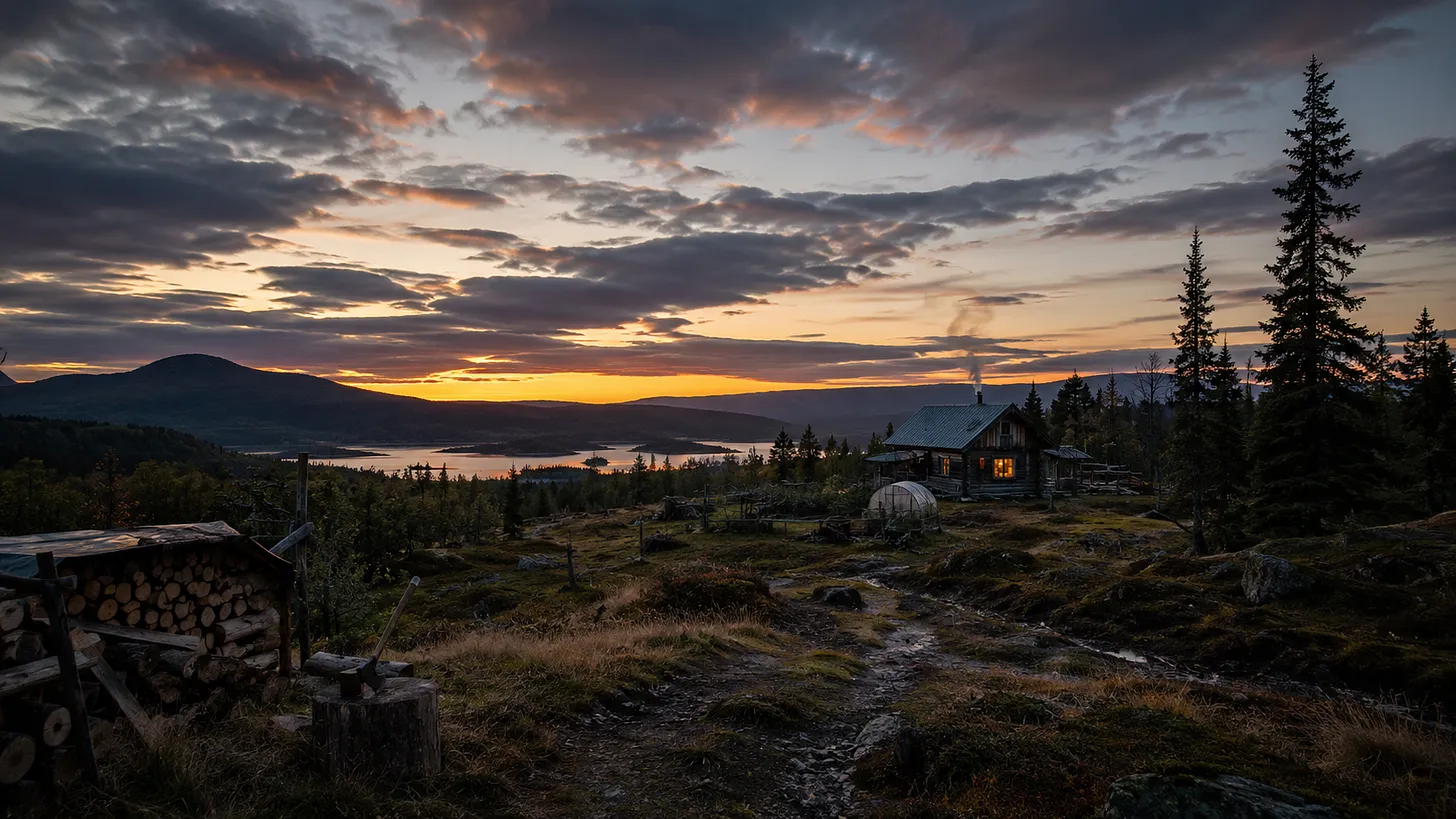
There is a quiet tension running beneath modern life — a subtle friction between what is provided and what is chosen, between convenience and consequence, between the inherited patterns of living and the ones we might still construct for ourselves. In that space, where certainty loosens and questions begin to breathe again, the idea of self-sufficiency appears less as a fixed destination and more as a spectrum of return — to land, to skill, to responsibility, and to the direct weight of one’s own decisions.
. . .
There are many ways one may pursue a sovereign, or self-sufficient, lifestyle. Those terms themselves no doubt trigger some kind of reaction within you, especially if you’ve been seeking something uplifting, energizing, and substantial, unconsciously drifting away from the incessant clamor, chaos, and artificial construct of an increasingly empty, numbing, and deadened digital existence. The ways in which we choose to live are certainly affected by geographic location, but are also shaped and informed by local laws and statutes, infrastructure, and both its limitations and benefits.
In this post, I explore several examples I’ve come across in recent weeks, each offering a glimpse into the many variations of living off the land — whether in whole or in part — along with some ideas on getting clear about what it is we truly want from this life, and why.
Let’s get real. The signs of the times, the signals of a civilization in virtual freefall, are all around us. But this is nothing new. The many future-defining prognostications and concomitant sociocultural propagandizing of fractious, increasingly tyrannical nation-states have, with every generation, proven to be little more than narrative spin, political gamesmanship, and complete fantasy.
We do not want to wait around for the world stage and its many strange, most often scripted events and manufactured crises to dictate and define where we might situate ourselves on this fantastic plane of earthly existence, why we should want to be there, or what we intend to do with ourselves when we arrive. This day comes but once, and we all know the feeling of regret, untested aspiration, and unmet desire. Every time we lean into the easy choice, the comfortable lie, the distorted narrative, or the emotionally and psychologically engaging distraction, we soften, weaken, and further handicap ourselves in one way or another.
Pain, struggle, and difficulty are inevitable — even necessary — to a meaningful human existence. But suffering through day after day, waiting and wondering, thinking and pondering, planning and figuring, will never satisfy that deeper yearning. Dig down and be ready to get your hands dirty if you want to delve into something fulfilling, lasting, confidence-building, and life-sustaining, regardless of your origins.
Time will pass. Structures will change. The ideas of nations, states, and even civilizations will come and go.
What do you really want? Why are you here?
On a side note, if you’re seeking more independence, or looking to move toward a more traditional, self-sufficient, or off-grid lifestyle, I did a deep dive in a Lux Colloquii chat about why most intentional communities fail. There are many things to consider, and while many have failed, one way to avoid falling into the same patterns is to be better educated going in. “Structure and Substance: Why Most Communities Don’t Last” might help inform your choices in that regard.
No Phone, No Bank Account
This first example offers foundational educational material to consider. Lasse Nordlund wrote The Foundations of Our Life (a free PDF) in the early 1990s and has been living according to that framework and paradigm ever since, continually refining and improving every aspect of “farmstead” life and what he describes as “extreme self-sufficiency” in northern Finland.
It is an extreme example because the way they have chosen to live is, in many respects, the polar opposite of what most of us have come to accept as normal, acceptable, and essential. Their school website, Omavaraopisto, offers an in-depth overview of the philosophy and practical considerations for those interested in pursuing a truly self-sufficient life.
“The purpose of the school of self-sufficiency is to provide a broad range of knowledge and guidance for people interested in living on their own terms and working with their hands. To learn and develop alternative models of living in harmony with the finite resources nature has to offer.”
The Now Generation
Klaus and Johanna are students of Lasse Nordlund who have put their education into practice. Over the past decade, Klaus has taken the challenge to heart in his pursuit of a self-sufficient life on his own small island. What was once a homestead in its own right is now being reborn and refined anew — reclaimed and revived to provide sanctuary and an increasingly independent life for his young and growing family.
Every video offers dozens of lessons, both large and small, touching on the mindset, philosophy, and practical applications of everyday homestead living. It also speaks powerfully to a younger audience increasingly desperate for something real, purposeful, meaningful, and sustainable.
You may want to begin with Part I of this two-part series.
“Over the years, Klaus taught himself natural building, milling wood from his own forest, carving replacement logs by hand, crafting floors and ceilings, and plastering walls with clay. The dream grew when Johanna joined him, and now the two are preparing to welcome their first child — perhaps in the same sauna where the island’s former inhabitants once entered the world.
”This is Islestead: their homestead, their island, their story of resilience and renewal. From tending crops to storing food in a root cellar, from saunas by the lake to carving beams with hand tools, their life is a return to slower rhythms and self-sufficiency.”
Reclaiming a Broken Dream
There’s one message offered in this interview and tour that might catch you off guard: homesteading and dealing with death. Most of us are far removed from the practical, visceral, and sometimes brutal realities of nature, especially when it comes to feeding ourselves.
Sarah and her family chose to pursue a self-sufficient life by picking up the pieces of an intentional community in the dusty desert of northern Arizona. At present, they are two and a half years into this grand adventure — learning, adapting, testing themselves, and trying and failing anew each day.
Time will tell whether they are truly up for it, because the pursuit of complete independence is no small undertaking, as the property’s previous owners themselves discovered.
“The vision for Coslor Cove: families will live free from electrical grids, utility companies, and supply chain dependency. Each household will generate its own power, grow its own food, manage its own water and sanitation. Members will own their land, their homes, and their surplus—when they produce more than they need, they’ll sell through the co-op’s marketing channels. It’s a cooperative, not a commune.”
Buying Off-Grid Land
This video is less about homesteading itself and more of a practical guide to the many factors worth considering when looking to purchase a piece of land. The backdrop is Alaska, but the hard-earned lessons shared by Brooke Whipple — a self-taught builder, adventurer, and alumnus of Alone seasons 4 and 5 — along with her husband David Whipple, are broadly applicable.
Over the years, they have purchased numerous properties, built or rebuilt structures, and experimented with different approaches to off-grid living. The video offers valuable insight into the realities, tradeoffs, and practical considerations that often go overlooked when people romanticize the idea of rural independence.
Be sure to check the comment section as well for useful feedback, along with Brooke’s many videos covering the construction of various homes and outbuildings that may prove useful to aspiring homesteaders.
“Girl in the Woods shares experience from developing six properties to help viewers vet, afford, and find their own remote land. The evaluation includes hands-on tours of potential purchases and a look at a recently bought site in interior Alaska.”
Buying an Abandoned Property on a Remote Island
I’ve been following the Skote Outdoors adventure since this video first came across my radar last year. Matty Clarke dove in headfirst, purchasing a remote property in Newfoundland sight unseen — another adventurous soul taking on the challenge of rebuilding an overgrown, crumbling home and homestead on a boat-access island in eastern Canada.
He started out alone but was soon joined by his wife, Kelly Clarke. Their uncommon love story is worth the price of admission all on its own. More recently, they introduced their first baby both to the world and to island life itself.
Things are clearly gearing up for another adventurous and inspiring year in St. Joseph’s.
“Six months ago, I bought an abandoned house on a remote island, far from civilization. No roads, no power, just me, the ocean, and the challenge of turning this forgotten place into a livable home.
”Over the past half-year, I’ve faced everything from extreme weather to unexpected repairs, all while learning what it takes to survive in isolation. In this video, I’ll share the highs and lows of my journey, the reality of off-grid island life, and what I’ve done to bring this abandoned house back to life.”
Farming on a Slope in Vermont
The benefit of buying a space that is by many considered “unfarmable” is, naturally, the price. Evan and Heidi started out in humble fashion, and over the years have built by hand a profitable homestead, adapting through necessity to their natural surroundings by applying techniques learned by farmers in Japan, among others.
“Utilizing no-till methods on a steep Vermont hillside, this small-scale farm relies on human-powered tools and specialized Japanese equipment to maximize productivity. The owners share how they built their off-grid infrastructure over two decades, focusing on soil health, diversification, and minimizing land impact.”
This is but a tiny sample of the thousands — perhaps millions — of videos, tours, and interviews available right now for everyone, regardless of scale, intention, geography, language, belief system, priorities, values, or short- and long-term goals and aspirations.
What’s the common thread?
No one is going to do it for you. No one desires a life quite the same way you do, and no one truly knows from the outset exactly what they are getting into. But once you start walking, the path begins to appear.
I’ll reiterate what I’ve been saying in recent posts: what has always worked will continue to work. You don’t have to go fully off-grid — hand tools only, no electricity, no amenities, no conveniences — but you do have to remind yourself that any modern tool, assistant, shortcut, hack, or digital or grid-dependent solution comes with some level of compromise, accommodation, visible and/or hidden cost that most of us take for granted.
And many who step into this “alternative” lifestyle do so without much consideration, commitment, or genuine motivation to sustain them emotionally, psychologically, and physically. While the systems and structures we’ve become dependent upon still function, that’s not a major issue. You can always return to an urban or city-dwelling existence. But that, too, carries its own compromises and unseen costs.
To thine own self be true.
Solvitur ambulando
Written by Trance Blackman. Originally published on tranceblackman.com on 13 May 2026. Revised 12 June 2026.
Copy & share: https://tranceblackman.com/self-sufficiency/