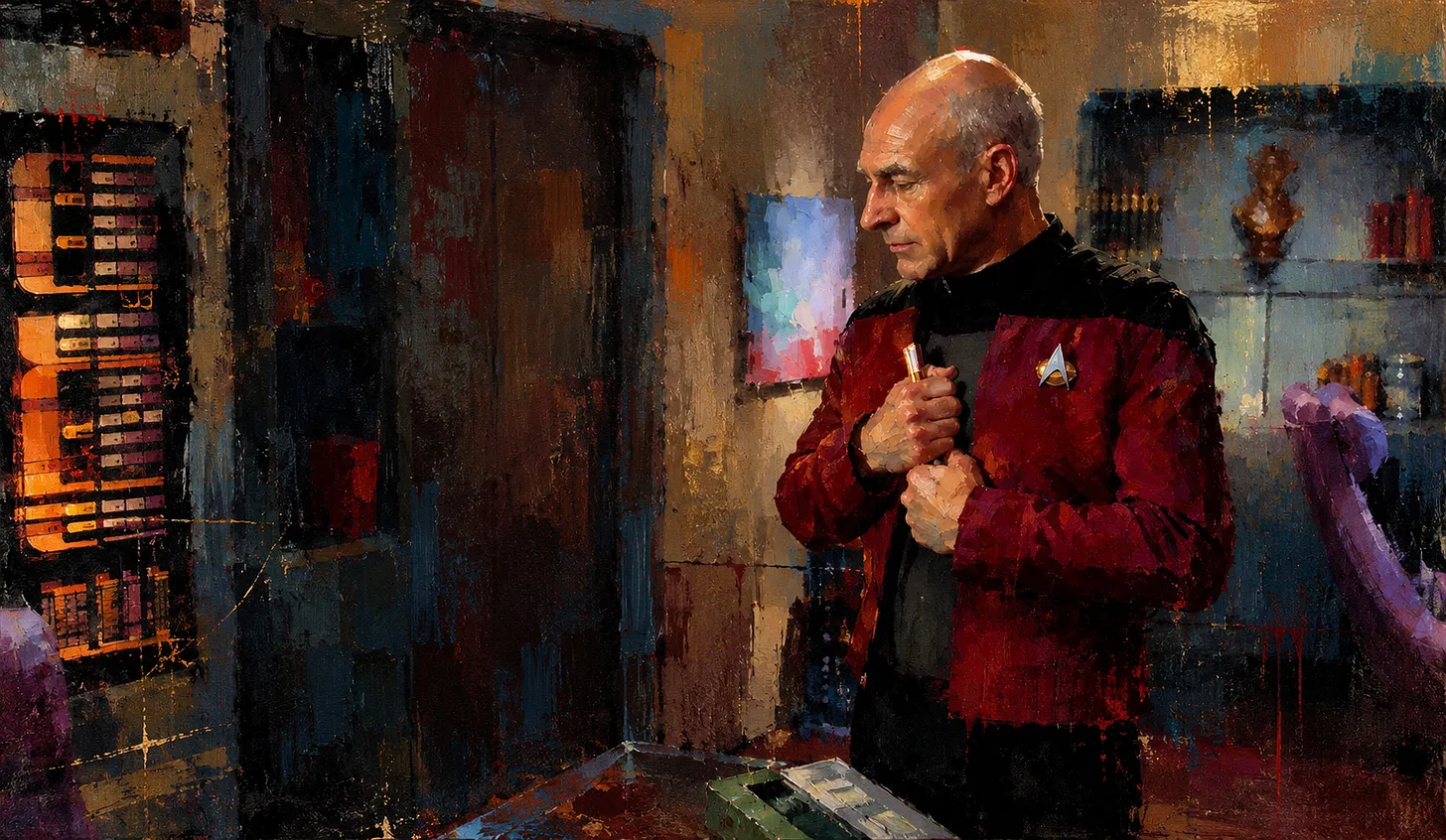
Some performers leave a mark that extends well beyond the screen. For me, Patrick Stewart was one of them. Through his portrayal of Jean-Luc Picard, he gave us something to aspire to, a character whose humanity, intellect, integrity, and quiet strength left an impression that endured long after the television was turned off. A few personal reflections on the man, the captain, and the legacy he leaves behind.
. . .
It might seem silly to be mourning the passing of a celebrity, a professional pretender no less, but I think it’s a testament to the man he was and to the influence his work had on me over the last thirty years. I think, in this case, fans would agree. Patrick Stewart was a unique individual, singular in the entertainment industry. I think we have the right, perhaps the privilege and responsibility, to grieve the loss of those who’ve touched our lives. Sir Patrick Stewart certainly did that for me, and he will be missed.
My introduction to Patrick Stewart, the actor, as it was for many millions who grew up in the ’80s and ’90s, was through Star Trek: The Next Generation. Having been produced for syndication from the get-go, it’s one of those rare shows that has existed on some network with regularity since the very beginning. It’s also a testament to its enduring quality and character that it continues to find new fans with each generation, appealing to about as broad an audience as any entertainment franchise ever has. It was on TV every day, Monday through Friday, and became a ritual during my high school years. Later, like many, I bought the DVD sets, and then, years afterward, when the series received its high-definition overhaul, purchased them anew. In 2020, we were gifted with Picard, which ran for three seasons, culminating in a proper send-off for the good captain and his crew, some 26 years after the original series ended, and 18 years after the film Nemesis somewhat disappointed us all.
Picard was a clever way to pick up the story, and while I appreciate that Sir Patrick wanted to take things in a different direction, expand on his character’s story, and, as ever, tackle real-world issues he cared about, in my view, the series did suffer from some of the same problems that many modern productions related to cherished franchises suffer from: poor writing, questionable casting, and an over-reliance on special effects, shock and awe, spectacle (and violence) over substance. Shows today aren’t given a lot of room to breathe, develop, and find their rhythm. To me, while it’s easy to pick up the original TNG series at almost any point and get lost in an episode or three, it’s not the same with the newest iterations, nor with any of the modern Star Trek series in general, most of which are, to me, essentially unwatchable. There was certainly some element of lightning in a bottle captured within those seven seasons, something that fans such as myself found inspiring and entertaining, but most importantly, transformational.
Over the years, I’ve seen a number of interviews, documentaries, convention panels, and other moments shared in which Patrick offered tidbits of his life story. Most of these related to his professional career, on and off stage, responses to specific fan or journalist questions, or promotional talking points about the latest film or series. Through all of that, with as big a spotlight shone upon him as anyone could wish for over so many years, he was remarkably consistent. It wasn’t difficult to see just how much of Patrick was evident in his portrayal of Captain Jean-Luc Picard. In recent years, through social media, as the distance between actors and audience narrowed to essentially zero and the distinction between the performative and the real person behind it became less pronounced, we got to see a little more of who the man was in real life, even if only in small ways, through short clips and his many Shakespearean sonnet recitations during the COVID… event. He was still, very much, “my captain,” as many would readily admit, even if he’d left the chair long ago.
To me, what Captain Picard represented was, and is, perhaps similar to what many young men of the era felt: partly an aspirational figure, someone generations of young men might aspire to become, and partly a refined, adopted father figure we wish we’d had growing up. He was profoundly relatable: a diplomat, a leader, deeply human, erudite, morally centered, and absolutely committed to his role as captain and all it idealistically, futuristically, hopefully represented. But he was also flawed, vulnerable, and fallible. His commitment to the uniform on screen no doubt echoed aspects of his real-life commitment to his art. It’s clear his castmates had a high standard to live up to, which no doubt raised the bar for the entire production as a whole, even if the show’s creator, Gene Roddenberry, wanted nothing to do with him in the beginning and actively pushed to have someone else sitting in the captain’s seat. Fortunately for us, things worked out for Sir Patrick, and the rest is history.
Today, I’ve finally started listening to the audiobook of his memoir, Making It So, read by the man himself. Even within the first few chapters, the humble, grounded, and, in some ways, tragic beginnings of his life story are astonishing, particularly in light of the lasting legacy he would go on to leave. It’s surreal in a way, as the news of his passing is still so very fresh. Seeing the outpouring of tributes and condolences is not surprising.
A few favorite Picard quotes:
“The first duty of every Starfleet officer is to the truth, whether it’s scientific truth, or historical truth, or personal truth!”
“Someone once told me that time was a predator that stalked us all our lives. I rather believe that time is a companion who goes with us on the journey and reminds us to cherish every moment because it will never come again… What we leave behind is not as important as how we’ve lived.”
Indeed.
Rest peacefully, Captain.
Lux et veritas
Written by Trance Blackman. Originally published on tranceblackman.com on 30 October 2026.
Copy & share: https://tranceblackman.com/what-we-leave-behind/