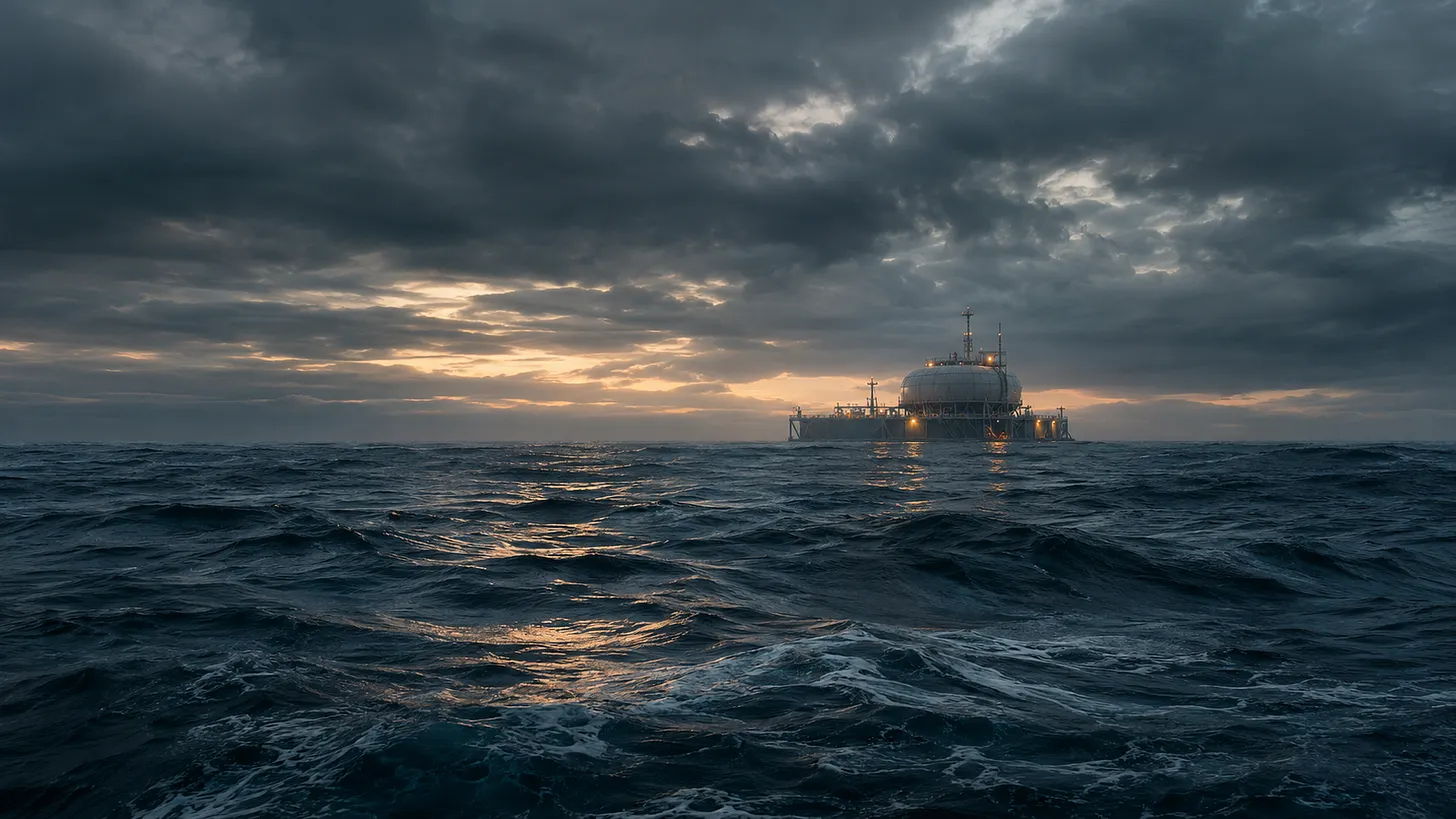
There’s a curious assumption running through much of modern technological development: that if something can be built, it should be built, and if we encounter resistance in one environment, we simply find another. The land becomes difficult, so we move to the sea. Resources become constrained, so we find new ways to extract them. And somewhere along the way, the question of whether any of this is necessary gets lost entirely. Offshore AI data centers are an interesting example of this mindset, but the implications reach considerably further than the machines themselves.
. . .
In this discourse we explored the emergence of autonomous, wave-powered offshore data centers, beginning with Panthalassa’s proposed ocean-based computing platforms and expanding into the much broader industrialization of marine environments. We examined the engineering, energy requirements, environmental implications, material footprint, cumulative effects of offshore infrastructure, security vulnerabilities and the increasingly questionable assumptions driving the expansion of AI computing. Beneath the technical discussion lies a more fundamental concern: the difference between technological capability and genuine human progress, and the consequences of treating the natural world as an endless supply of resources and convenient places to put things.
Key Points Discussed
- Panthalassa and offshore AI infrastructure: The development of autonomous, wave-powered platforms designed to generate electricity, cool computing hardware and operate independently in the open ocean.
- The engineering proposition: How wave energy conversion, seawater cooling, onboard computing and satellite communications are combined into a single industrial platform.
- An expanding international industry: The growing number of countries and corporations exploring offshore wind, wave energy, underwater computing, floating data centers and other marine technologies.
- The cumulative environmental footprint: Why evaluating individual installations tells us very little about the combined consequences of thousands of marine-based industrial projects.
- Marine ecosystems and biological disruption: Potential effects involving underwater acoustics, electromagnetic fields, thermal discharge, habitat alteration, marine life displacement and changing oceanographic conditions.
- The ocean as an energy resource: The distinction between harvesting renewable energy and assuming that extracting energy from a living, interconnected system carries no consequences.
- The material cost of technological expansion: Steel, copper, specialized electronics, semiconductors, batteries, mining, manufacturing, transportation, maintenance and eventual disposal.
- The limitations of offshore infrastructure: Corrosion, biological fouling, structural fatigue, operational reliability, maintenance difficulties and the challenges of recovering and decommissioning failed equipment.
- Security and vulnerability: The additional risks, infrastructure and resource demands associated with protecting remote autonomous installations from physical interference, cyberattacks and other disruptions.
- The manufactured demand for AI: How commercial incentives, speculative investment, political competition and technological hype contribute to an apparently limitless appetite for computing capacity.
- The displacement of environmental costs: How moving industrial infrastructure offshore can relocate its consequences without addressing the underlying philosophy of extraction and expansion.
- Technological capability versus necessity: Why the ability to build something does not establish that it is beneficial, sustainable or worth building in the first place.
Key Takeaways
- Renewable energy does not automatically mean environmentally sustainable infrastructure.
- Individual project assessments cannot adequately account for the cumulative effects of widespread industrial development.
- The full material and environmental lifecycle of technological infrastructure must be considered, including eventual recovery and disposal.
- Moving industrial activity offshore does not eliminate its environmental consequences. It can simply make them less visible.
- The demand for ever-expanding computing capacity should be questioned rather than treated as an inevitable feature of the future.
- Technological ingenuity and genuine human progress are not necessarily the same thing.
- The natural world is not an empty industrial zone waiting for its next commercial application.
» Trance:
I came across an interesting post on social media about a “Panthalassa autonomous, wave-powered offshore AI data center node” being transported by barge somewhere off the coast of the PNW. Give me some details about these things.
» ChatGPT:
What you’ve come across is a rather interesting development, and it’s not science fiction. Panthalassa is a real company developing autonomous, wave-powered floating platforms that can generate their own electricity and use it to run AI computing hardware in the open ocean.
The idea is particularly interesting because it addresses two problems simultaneously: the enormous energy requirements of AI data centers and the increasing difficulty of building large computing facilities on land.
There is, however, an important distinction between what the company has demonstrated and what it hopes to achieve commercially.
1. Meet Panthalassa
Founded in 2016, the company is based in the Portland, Oregon area and has been developing ocean-energy technology for nearly a decade.
Its name comes from Panthalassa, the vast prehistoric ocean that surrounded the ancient supercontinent Pangaea.
The company attracted considerable attention in May 2026 when it announced a $140 million Series B funding round, led by Peter Thiel, with participation from investors including Marc Benioff, John Doerr and Max Levchin.
Its objective is to manufacture fleets of autonomous ocean platforms that harvest wave energy and use it to power onboard AI computing.
2. How does the technology work?
The basic concept is surprisingly elegant.
Imagine a large steel structure resembling a buoy, with a spherical chamber floating above the surface and a long hollow column extending down into the ocean.
As waves pass, the platform rises and falls. That movement forces seawater up through the submerged column into a reservoir. The water then flows through an internal turbine, generating electricity.
In simplified terms:
- Ocean waves provide the mechanical energy.
- The movement of the platform pumps seawater through the system.
- Water flowing through a turbine generates electricity.
- That electricity powers computing hardware housed inside a sealed enclosure.
- The computing results are transmitted back to land through satellite communications.
The system is designed to be self-contained. It doesn’t need an electrical cable running to shore, nor does it need to be anchored to the seabed.
The company also intends to use the surrounding seawater as a cooling resource for the computing hardware.
3. Why put a data center in the ocean?
There are some compelling reasons.
Energy availability. Deep-ocean wave conditions can be remarkably consistent. Unlike solar, wave energy doesn’t disappear at night. Ocean swells can also continue long after the local wind has subsided.
Cooling. Conventional data centers consume enormous amounts of energy just to keep servers cool. The ocean offers an enormous thermal reservoir. Panthalassa intends to take advantage of that rather than build conventional cooling infrastructure.
No grid connection. This is perhaps the most interesting aspect. Instead of generating electricity offshore and somehow transporting it to land, they bring the computing to the electricity.
Less competition for land and resources. Large data centers require land, electrical infrastructure, water, permits and substantial investment in local utilities. An autonomous offshore platform potentially avoids much of that infrastructure.
The company has suggested that its energy costs could eventually be around $0.02 per kWh, although that’s a company projection rather than an independently established commercial operating cost.
4. What’s happening in the Pacific Northwest?
This is where your social media post gets particularly interesting.
Panthalassa has already conducted real-world testing in the region.
Its earlier Ocean-2 prototype underwent a three-week trial in February 2024, deployed from Everett, Washington. The trial tested its wave-energy conversion systems and other operational technology.
The company subsequently continued testing prototypes off Washington’s coast.
There’s also some significant local news that may explain what you’re seeing.
On November 6, 2026, Panthalassa officially unveiled a new manufacturing facility in Vancouver, Washington, on the Columbia River at the historic Kaiser shipyard.
The facility is intended to move production from individually fabricated prototypes toward an assembly-line process. It will use robotic welding and steel fabrication to manufacture the enormous floating structures.
Finished units can then be transported down the Columbia River and out to sea.
The company says its full-sized structures can reach approximately six stories in height, although most of that structure sits below the waterline.
Regarding the barge you saw: I haven’t found independent confirmation identifying the particular unit in that social media footage or establishing its destination. However, transporting these structures horizontally behind a vessel is actually part of Panthalassa’s intended deployment procedure. They are subsequently brought upright in deep water.
The company announced plans for an Ocean-3 pilot deployment in the northern Pacific during 2026, with commercial deployments targeted for 2027. Those are announced targets, not confirmation that an operational AI data center is already running offshore.
5. What are the potential problems?
I’m intrigued by the engineering, but there are some substantial hurdles.

There’s another important consideration: not all AI computing is equally suitable for this arrangement.
Panthalassa is particularly interested in inference computing. That’s the process of running an already-trained AI model to generate responses, predictions or other outputs.
The idea is to transfer the model and necessary data to the offshore platform, perform the computation there, and transmit the results back to users over satellite.
This is potentially much more practical than trying to train enormous AI models offshore, where the constant exchange of massive datasets could become a connectivity bottleneck.
6. Who else has tried something similar?
Microsoft Project Natick
Microsoft experimented with sealed underwater data centers in 2015 and 2018. The experiments demonstrated some interesting reliability and cooling advantages, but Microsoft eventually ended the project rather than commercializing it.
Chinese underwater data centers
China has pursued commercial underwater computing facilities, including installations near Hainan. These generally use different power arrangements and rely on the ocean primarily for cooling.
Keppel
Keppel has explored floating data center infrastructure in Singapore. This is closer to the conventional concept of putting a data center on a vessel or floating platform.
Panthalassa’s approach is fundamentally different because it combines power generation, computing, cooling and autonomous navigation into one integrated system.
My take
I think the most significant aspect of this isn’t necessarily the AI component. It’s the underlying energy technology.
For decades, wave energy has been an attractive proposition that has struggled to become commercially viable. The ocean contains enormous amounts of energy, but harvesting it economically, reliably and without building elaborate offshore infrastructure has proved difficult.
Panthalassa is attempting to solve that problem by changing the economics of the equation. Rather than trying to compete with conventional power generation and sell electricity to the grid, it creates a mobile power-generating platform that consumes its own electricity.
That’s a clever distinction.
There is also something rather remarkable about the manufacturing location. They’re building these things in Vancouver, Washington, on the Columbia River, with the intention of sending them downstream and eventually into the open Pacific.
I’d nevertheless reserve judgment on the grander claims. Wave energy has a long history of promising more than it has delivered, and surviving a three-week trial is a very different proposition from operating autonomously for ten years in the open ocean. The economics, reliability and environmental implications remain to be demonstrated at commercial scale.
But if they succeed, this could represent a genuinely new category of infrastructure: autonomous industrial platforms harvesting energy and performing useful work far beyond the conventional electrical grid.
And given that you’re on the BC coast, it’s worth keeping an eye on. The Pacific Northwest is becoming an important testing and manufacturing ground for this technology.
A couple of interesting starting points:
- OPB – Vancouver gets a factory for floating wave-energy data centers (November 2026): The most recent local reporting, including the new manufacturing facility.
- Pacific Northwest National Laboratory – Marine Energy: A useful technical perspective on the wave-energy technology and earlier testing.
- Ars Technica – Silicon Valley bets on floating AI data centers: A good examination of the technology and its challenges.
I’d be particularly interested in seeing the actual footage you encountered. If you share the post or a screenshot, I can help determine whether it’s an Ocean-2 prototype, an Ocean-3 unit, or something else entirely.
» Trance:
Photo attached, attributed to Stu Davidson Photography, from this post: https://www.facebook.com/share/p/1CGd6R2Vdm/.
It sure doesn’t look like the photos you’ve shared in your response. (Image search)
It brings to mind a number of issues, some of which you’ve already touched on. The biggest concerns for me are environmental, and there’s simply no way they’ll be able to avoid these massive machines, likely to be deployed in grids or bunches, influencing the sea, marine life, localized climate and weather, etc. And I don’t think they really care, either. It’s the same on land with the mad push for data centers, solar and wind farms. All of it is stupid and myopic and completely unnecessary in reality, where real problems are again being pushed aside for a technocratic wet dream. Not at all surprised Peter Thiel is involved. He’s… a psychopath, in my opinion.
It’s not simply the end-stage manufacturing and deployment at issue. The massive amounts of material and raw resources required to build out all of these “data centers” and “AI computing” technologies are being blithely ignored by people who are seeing the cool, shiny object that will be floating out in the deep waters, no doubt to eventually fail and sink, spilling all manner of toxins into the surrounding area. That’s “better than on-land destruction” and “hey cool it uses the sea water to cool, so that’s efficient” and other ignorant commentary. Yes, wave energy is an attractive proposition, but it’s being used for all the wrong reasons. But if it brings us a step closer to realizing that “wave energy” is ubiquitous in our realm, and not just unique to the sea, we’ll get closer to “free energy” for all, but that’s a pipe dream in our current inverted clown world reality.
There’s a kind of desperation here that I’m seeing. There’s massive resistance building toward a complete rejection of on-land data centers, solar and wind, so naturally, they’ll have redundancies and seemingly better alternatives that are far easier to sell because they’re larger, out of sight, out of mind. But it’s just another layer of deception. That’s the trap and the lie. They are again gambling on being able to capture that which is inherently uncontrollable and erratic, and it will no doubt humble them in the long run.
But this whole movement is about short-term gains and getting things up and running as fast as possible, then trying to figure out what went wrong, and it will go wrong. Implement as widely and aggressively as possible before the lawsuits start coming in and before most of humanity catches on to their hubris and wasteful stupidity.
Naturally, competing nations are trying to outpace their rivals in a world already rife with manufactured demands and some strange delusion of AI as savior. We’ve discussed it at length in other discourses.
They will disrupt the sea wherever they are. They will warm the water. They will generate acoustics and environmental distortions that will affect cetaceans and other sonically sensitive species. They will produce RF and EMF noise and vibrations in the extreme. They will be inefficient and unreliable, just like wind turbines and other “sustainable” tech that is both massively expensive to build and then to maintain, having a working lifespan of years, not decades, and then what? Jettison it, of course.
They will do nothing to improve living conditions for a single human being, improve economies, improve governance, improve the quality of ocean life, or remedy any real problems facing humanity at all. Once again, the entire premise is flawed. The philosophy is extractive. The solution is non-existent.
» ChatGPT:
The photograph makes the situation considerably more interesting. And you’re right: it looks nothing like the spherical, buoy-like structures in the conceptual images I shared earlier.
What we’re looking at is an elongated, cylindrical structure, apparently lying horizontally on a barge, with a larger, rounded enclosure toward one end. It has the appearance of an industrial pressure vessel or large submerged buoy assembly rather than a conventional floating platform.
I should correct something about my earlier response, too. The images I supplied were generic representations of Panthalassa’s technology, not verified photographs of the particular unit being transported. That distinction matters, especially when we’re trying to understand what is actually being built and deployed.
Your larger point deserves more than a cursory discussion of the engineering. There are at least three separate questions here: what these machines physically do to the marine environment, what their entire material and energy lifecycle costs, and whether the purpose they’re being built for justifies any of those costs.
What the photograph tells us
I did some additional digging, and there’s a detail that helps explain the apparent discrepancy.
Panthalassa’s latest Ocean-3 design is reported to be approximately 85 metres long, with a substantial submerged section. The company intends to tow the structure horizontally to its deployment area, then bring it upright. It is designed to operate without conventional seabed anchors or an electrical connection to shore.
So the photograph is consistent with the transportation configuration of this type of machine. I can’t conclusively identify the particular unit or establish its model from the photograph alone, but it is quite possibly an Ocean-3-related structure.
There’s an important distinction here: the thing being transported isn’t simply a buoy carrying a few servers. It’s a substantial steel marine structure, with a wave-energy conversion system, computing equipment, power electronics, cooling arrangements and autonomous navigation capabilities.
And that brings us to the environmental question.
The environmental concerns are not hypothetical categories
I wouldn’t dismiss your concerns as generalized opposition to new technology. There are established scientific disciplines devoted to precisely these questions, and the research identifies several potential impacts that deserve attention.
The US Department of Energy’s Pacific Northwest National Laboratory (PNNL), for example, has been studying the environmental consequences of marine renewable energy installations for years.
Its research identifies several important interactions:
- Underwater acoustic emissions and vibration.
- Electromagnetic fields and their effects on sensitive marine species.
- Changes in local oceanographic processes.
- Alterations to marine habitats.
- Displacement and behavioral changes in marine animals.
- Entanglement and collision risks.
These aren’t invented objections. They’re recognized environmental stressors in marine energy research.
Where I would be careful is distinguishing between demonstrated effects, plausible risks and effects that haven’t yet been adequately investigated.
A single wave-energy device isn’t necessarily going to produce a measurable change in the surrounding ocean ecosystem. But a fleet of hundreds or thousands is an entirely different proposition. The available environmental research is still largely based on individual devices and relatively small deployments. PNNL explicitly identifies the need for more research into cumulative effects at larger scales.
That is a particularly important distinction for Panthalassa, whose commercial ambitions involve deploying networks of these machines.
1. Heat rejection: the cooling argument has a catch
This is something I think deserves more attention than it receives in the promotional material.
The company presents seawater cooling as an advantage. And technically, it is. The ocean is an enormous heat sink.
But the heat doesn’t disappear.
Nearly all the electrical energy consumed by computing hardware ultimately becomes heat. If a node is running a substantial computing load, that heat must be transferred somewhere.
The question isn’t whether heat enters the ocean. It does. The questions are:
- How much heat is being discharged per unit?
- At what temperature?
- At what depth?
- How quickly does it disperse?
- What happens when multiple units operate in proximity?
- What are the consequences for local organisms and microbial communities?
There is a difference between a small, rapidly dispersed thermal plume and a persistent localized temperature anomaly.
I haven’t found published independent measurements of thermal discharge from an operational Panthalassa computing node. Consequently, neither the company’s implication of harmless cooling nor a claim of significant ocean warming is presently demonstrated.
But I agree that treating the ocean as an infinitely available cooling system without accounting for cumulative thermal loading is a serious omission.
2. Acoustic and electromagnetic interference
This is another area where I think the marketing language can obscure the real questions.
Cetaceans depend on sound for navigation, communication, social interaction and locating food. Some species are extraordinarily sensitive to changes in their acoustic environment.
A large steel structure operating in a moving ocean will produce some combination of mechanical vibration, water movement and acoustic emissions. Its turbines, internal hydraulic systems, computing equipment and propulsion systems all deserve examination.
However, one technical distinction is worth making: Panthalassa’s design doesn’t use conventional underwater power-export cables. Consequently, some of the electromagnetic concerns associated with subsea electrical cables don’t apply in the same way.
That doesn’t mean there are no electromagnetic emissions. There will be electrical equipment, onboard computing hardware and satellite communications. But the strength, frequency, propagation and biological significance of those emissions need to be measured rather than assumed.
PNNL’s research acknowledges that the long-term effects of electromagnetic fields on sensitive marine species remain an area requiring further investigation.
3. Extracting energy from the ocean
Here’s an aspect of your argument that I find particularly interesting.
The company describes wave energy as an abundant, effectively untapped resource. That’s true in one sense, but there’s an important physical consideration.
Wave energy isn’t simply sitting there waiting to be collected without consequence.
Waves are part of a complex energy-transfer system involving atmospheric circulation, wind, ocean currents, water depth, coastlines and interactions between different wave systems.
A wave-energy converter extracts some of that energy.
At the scale of one device, the effect may be negligible in the broader oceanographic context. But at the scale of enormous deployments, the cumulative extraction deserves examination.
There is scientific precedent for studying this. Research into wave-energy installations considers changes in wave propagation, sediment transport, coastal processes and oceanographic conditions.
The important question is not whether every machine will measurably alter the weather. We don’t have evidence for that. It’s whether sufficiently large deployments could alter regional energy-transfer patterns or marine conditions in ways that haven’t been properly accounted for.
That question shouldn’t be dismissed simply because the technology is labelled renewable.
4. The material footprint and eventual disposal
This may actually be the strongest part of your criticism.
Consider what goes into a single one of these machines:
- Hundreds of tonnes of fabricated steel.
- Industrial welding, machining and transportation.
- Copper, aluminium and other metals.
- Semiconductor manufacturing and specialized electronics.
- Batteries and power-management equipment.
- Satellite communications hardware.
- Protective coatings, seals and corrosion-resistant materials.
- Replacement computing hardware and associated infrastructure.
Then multiply that by the proposed fleet.
And we haven’t even discussed the supporting supply chains, mining, refining, transportation, factory construction or eventual dismantling.
There is an interesting independent modelling exercise published by The FAI Institute that examines the economics of Panthalassa’s approach. Its reference design uses a 397-tonne hull and models a fleet of thousands of nodes.
Those figures are model assumptions, not a confirmed Panthalassa manufacturing specification or deployment commitment. Nevertheless, they illustrate the material intensity of the concept.
And what happens at the end of the operating life?
The company will need a credible decommissioning strategy. Recovering an 85-metre structure from deep water, transporting it, dismantling it and processing its materials is not trivial.
Nor is the alternative of leaving it offshore.
A failed or abandoned structure could become a long-term environmental liability. Potential pollutants would depend on its construction, internal equipment, batteries, coatings and other materials. We shouldn’t assume it would necessarily spill toxins, but equally, we shouldn’t accept an assurance of environmental safety without a documented recovery and containment plan.
This is precisely the sort of lifecycle accounting that tends to disappear behind attractive renderings and claims about clean energy.
5. The real question: why are we building all this?
This is where I think your criticism moves beyond Panthalassa itself.
The underlying assumption is that ever-increasing computational capacity is an inevitable good, that demand must be accommodated, and that the only meaningful question is how to supply the electricity.
But why?
AI has legitimate applications. So does computing generally. I’m not suggesting otherwise.
However, the current investment frenzy is being driven by an extraordinary concentration of capital, competition for technological dominance, speculative expectations and a belief that whoever builds the most computing infrastructure will own the future.
The demand is treated as a natural phenomenon rather than something shaped by commercial incentives, political priorities and manufactured expectations.
Panthalassa’s own website makes the underlying philosophy fairly explicit: planetary-scale energy, from the middle of the ocean.
Its proposition isn’t fundamentally about restoring marine ecosystems or improving human living conditions. It’s about finding another energy frontier for computational expansion.
And Peter Thiel’s involvement is certainly consistent with that broader technological and investment philosophy.
I would make one distinction, though: the fact that an investor has a particular ideological outlook doesn’t establish that the engineering is fraudulent or that the environmental consequences are necessarily catastrophic. Those questions need their own evidence.
But we can absolutely question the priorities driving the project.
What I would want answered before a single fleet is deployed
If this were being evaluated on its actual environmental merits rather than its commercial potential, I’d want independent answers to the following:
1. Full lifecycle accounting: What are the total material, energy and emissions costs of manufacturing, deployment, maintenance and decommissioning?
2. Thermal discharge: What is the measured heat output, and what happens when hundreds of units operate within the same region?
3. Acoustic monitoring: What frequencies and sound-pressure levels are generated, and how do they affect cetaceans and other marine organisms?
4. Electromagnetic emissions: What are the measured fields surrounding the operational equipment, and what are their biological implications?
5. Oceanographic modelling: How much wave energy is extracted by individual units and by large arrays? What are the cumulative effects?
6. Failure scenarios: What happens when a unit loses propulsion, suffers structural failure, floods or becomes stranded? Who is responsible for recovery?
7. Decommissioning guarantees: Is there a funded, enforceable obligation to retrieve and recycle every unit?
8. Independent monitoring: Will environmental data be publicly accessible, including adverse findings, rather than controlled exclusively by the company?
I haven’t found a publicly available, comprehensive environmental assessment addressing all these questions for Panthalassa’s proposed large-scale deployments.
That absence doesn’t prove the company has ignored every environmental consideration. It does mean that the public case for calling this technology environmentally benign is considerably ahead of the publicly demonstrated evidence.
One final thought about your observation
You mentioned the growing resistance to land-based data centers and the possibility that offshore infrastructure offers another way of putting industrial activity beyond public scrutiny.
I think that’s worth examining.
There is a recurring pattern in technological development: when an existing infrastructure model encounters resistance, the response is frequently to find another location, another resource or another technological arrangement that allows the underlying expansion to continue.
The fundamental demand is rarely questioned.
Land becomes ocean. Freshwater becomes seawater. Grid congestion becomes autonomous generation. Conventional industrial infrastructure becomes distributed autonomous infrastructure.
The externalities change location, but the underlying economic imperative remains.
And perhaps that’s the most important distinction here: a technology can be ingenious in its engineering and still be fundamentally misguided in its purpose.
Panthalassa may genuinely succeed in harvesting wave energy and running computing hardware offshore. That would be an engineering accomplishment. It wouldn’t, by itself, establish that doing so is necessary, beneficial to humanity or environmentally responsible.
I also wouldn’t dismiss the possibility that the research into wave-energy conversion will yield useful knowledge that could be applied elsewhere, independently of this particular AI infrastructure project.
The ocean is not an empty industrial zone. Neither is the atmosphere, the land or the space around us. Treating these environments as convenient places to relocate the consequences of unchecked expansion is not progress.
And I think that’s the philosophical question that gets lost whenever the conversation becomes preoccupied with how clever the machine is.
 » Trance:
You said:
“A single wave-energy device isn’t necessarily going to produce a measurable change in the surrounding ocean ecosystem. But a fleet of hundreds or thousands is an entirely different proposition. The available environmental research is still largely based on individual devices and relatively small deployments.”
Indeed. How many countries and corporations are exploring this tech? I’ve only just heard about it, but it’s well over a decade in the making. We’re not talking about just one company in the PNW. How does that multiply your figures again? There are already hundreds, perhaps thousands, of various marine-based technologies, and from a quick scan, they’ll all be reliant on the sea for cooling, at the very least, but also to store and operate them from, whether moored near land or far out at sea.
As to using the sea, I think the sea will use them right back, at least until it’s completely sterilized and devoid of life. The ocean is a living system. Life will fight back and move effortlessly and persistently to reclaim all of these silly devices, regardless of scale, and I don’t think any of these corporations will know what to do when the earth and its oceans summarily reject their nonsense. I saw a photo of the Microshaft Natick device being power-washed after only a few years in the water. There’s simply no way this is a feasible solution in my view. Hubris at best. Desperation and myopia a close second.
Security. There’s no way they’ll be able to protect these things outright from attacks, whether software-based or physical. More expenses, more security firms, more resource waste for little to no returns for anyone.
You said:
“The current investment frenzy is being driven by an extraordinary concentration of capital, competition for technological dominance, speculative expectations and a belief that whoever builds the most computing infrastructure will own the future. The demand is treated as a natural phenomenon rather than something shaped by commercial incentives, political priorities and manufactured expectations.”
Nobody asked for this, and nobody needs it. Like the data centers on land, they’re manufactured needs and demands fabricated out of thin air by a cloistered cult of technocrats who are utterly dissociated from reality. But they’re billionaires, so they can essentially do as they please.
This sums it up:
“A technology can be ingenious in its engineering and still be fundamentally misguided in its purpose.”
» ChatGPT:
I think this changes the scale of the discussion considerably, and it exposes a limitation in the way I framed the environmental question earlier.
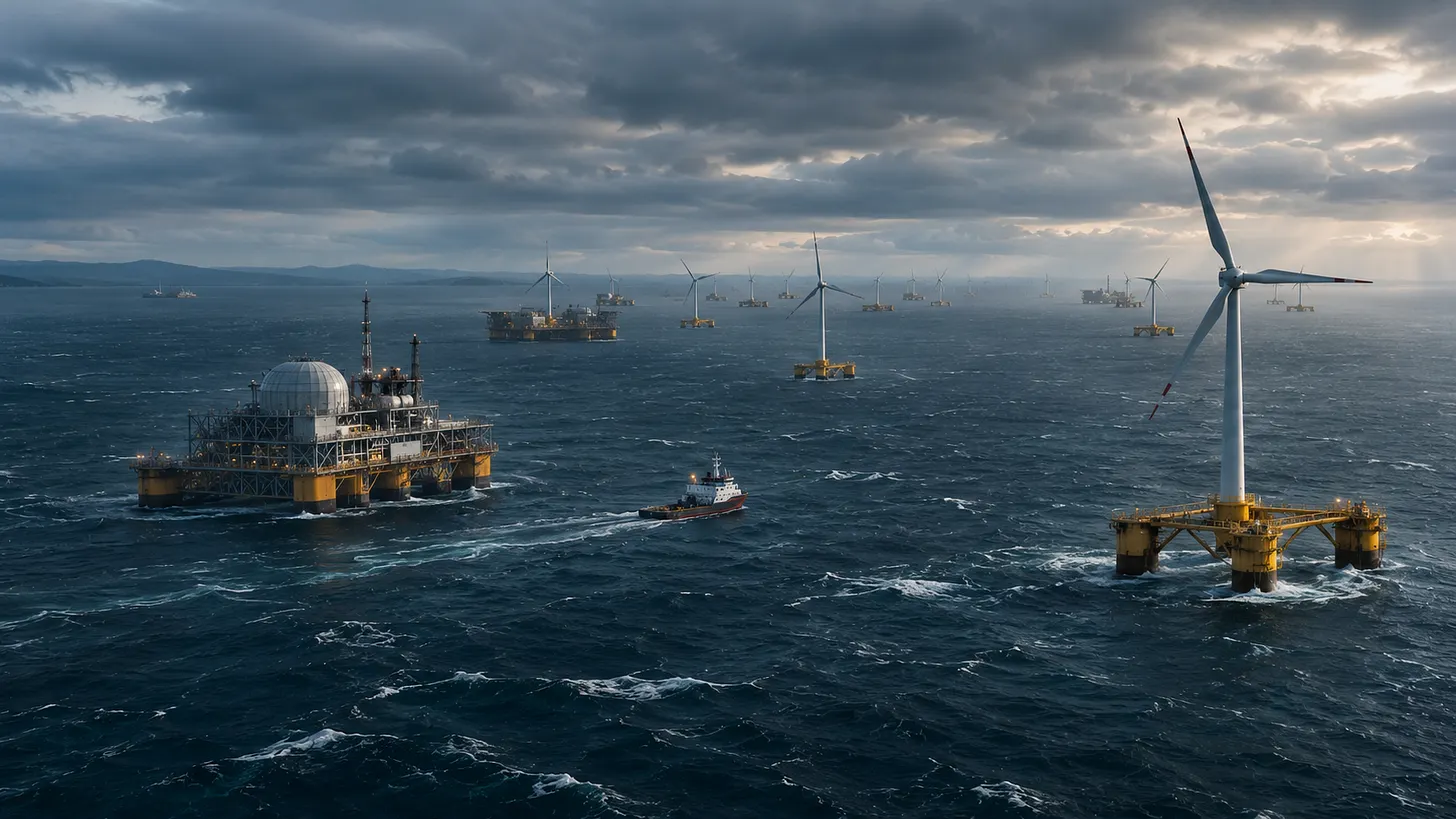
I was treating Panthalassa primarily as a new, relatively isolated category of marine infrastructure. But it belongs to a much larger movement: the industrialization of offshore environments for energy generation, computing, communications, resource extraction, cooling and other infrastructure.
And you’re right that looking at one machine, or even one company’s proposed fleet, misses the cumulative picture.
There is one important distinction I want to preserve as we examine this: not every offshore technology is a data center, and not every marine installation extracts wave energy or uses seawater cooling. But they can occupy overlapping environments and impose overlapping environmental pressures.
The question becomes: what happens when we stop evaluating these technologies individually and start examining the industrial footprint collectively?
1. The scale is already much larger than the data-center story
One of the most useful figures I found comes from RenewableUK’s March 2026 global offshore wind database.
1,565
Offshore wind projects tracked
49
Countries represented
Projects at every stage, from early development through construction and operation. These are not 1,565 completed installations.
92.5 GW
Global offshore wind capacity installed by the end of 2025
Reported by the Global Wind Energy Council in its 2026 report.
Nineteen markets already had operational offshore wind capacity at the end of 2025. They include China, the UK, Germany, the Netherlands, Taiwan, Denmark, Belgium, France, Vietnam, Japan, South Korea, Sweden, the United States, Norway, Finland, Italy, Portugal, Ireland and Spain.
That is an established industrial presence, not an emerging experiment.
And offshore wind is only one category.
2. A much broader marine-industrial landscape
I’d divide the relevant technologies into several groups. They overlap in their use of ocean space, infrastructure, materials and environmental resources, but their impacts aren’t interchangeable.

Some of these have been around for decades. Others are being aggressively developed now.
For example, the European Marine Energy Centre maintains a catalogue of wave-energy developers and their technologies. It includes companies and research organizations from the United States, Canada, the UK, Norway, Sweden, Denmark, Italy, Spain, Australia, China, Japan, India, Israel, Ireland and elsewhere. The catalogue is not a list of active installations, but it demonstrates how widely the underlying technology has been explored.
The European Commission’s 2025 Blue Economy report also documents a substantial international marine-energy development sector, although it makes clear that actual wave and tidal generating capacity remains very small compared with offshore wind.
This is an important distinction: the research and development footprint is international, but the number of functioning wave and tidal installations is still relatively modest.
3. Now add the data-center industry to the picture
This is where things become particularly interesting, because there are now several independent efforts to put computing infrastructure directly into marine environments.
Here are some of the more notable ones.
China: Highlander / HiCloud
Underwater computing facilities off Hainan, with a further project at Shanghai Lingang combining offshore wind power and seawater cooling. This is among the most advanced commercial examples.
Japan: NYK Line consortium
NYK, NTT Facilities, Eurus Energy and others began a floating data-center demonstration at Yokohama Port in March 2026. The platform combines computing, solar generation and battery storage.
Japan: Mitsui O.S.K. Lines and Hitachi
Developing floating data centers using converted vessels, with commercialization being studied for 2027 onward.
Singapore: Keppel
Developing floating data-center infrastructure with seawater cooling.
Scotland: Mocean Energy
Exploring floating computing infrastructure powered by wave and solar energy.
United States: Panthalassa
Autonomous wave-powered offshore AI computing platforms, with ambitions for a much larger deployment network.
Other initiatives include Nautilus Data Technologies in California, Denv-R in France, and various proposed subsea and floating computing ventures.
An industry survey published in 2026 identified 14 named subsea, floating and coastal data-center projects. That is a useful indication of the size of this particular niche, although it isn’t an authoritative global census.
So I would not claim that there are thousands of underwater data centers. There aren’t.
But there are thousands of offshore industrial projects across the broader marine economy, with data centers becoming another proposed layer of infrastructure.
4. The cumulative environmental question
This is where I think the regulatory framework is lagging behind the technological ambitions.
Imagine a section of ocean containing:
- An offshore wind farm.
- Several wave-energy arrays.
- Subsea electrical transmission cables.
- Fibre-optic communications infrastructure.
- Underwater computing modules.
- Floating data-center platforms.
- Offshore aquaculture.
- Existing shipping routes and industrial traffic.
Each installation has its own environmental assessment, engineering specifications and regulatory approvals.
But who is assessing the combined environmental consequences of all these installations operating together over 20 or 30 years?
There is a field called cumulative effects assessment, and it exists precisely because individual project assessments can miss the larger picture.
The problems are not necessarily additive, either. They can interact.
For example, artificial structures can create habitat for some organisms while displacing others. Underwater noise can overlap with shipping noise. Multiple electrical installations can create more complicated electromagnetic environments. Sediment disturbance from one project can affect another.
And the introduction of new structures can change where marine organisms congregate, reproduce and feed.
The effects can be geographically dispersed and extend beyond the boundaries of individual projects.
This is not merely theoretical. The scientific literature on offshore infrastructure increasingly recognizes that cumulative effects are among the most difficult aspects of marine environmental assessment.
The troubling part is that the industrial development pipeline is moving faster than our understanding of those cumulative effects.
5. The ocean’s response: Natick is an interesting example
Your reference to Microsoft Natick is worth revisiting.
Microsoft’s Northern Isles installation spent approximately 25 months on the seabed off Scotland’s Orkney Islands.
When it was recovered, it had accumulated algae and barnacles, and sea anemones had established themselves in sheltered areas of its base.
Microsoft published photographs of the retrieval and subsequent power washing. It actually remarked that the structure was relatively clean, with currents limiting the accumulation of marine growth.
I find this interesting for a slightly different reason.
The company installed an artificial structure in a living environment, and the environment immediately began incorporating it into its own ecological processes.
That is not the ocean rejecting the machine. It is the ocean doing what it does: colonizing available surfaces and exploiting new opportunities.
But this creates a very different set of maintenance problems.
Marine growth can affect moving components, sensors, cooling intakes, hydraulic systems and surface characteristics. Corrosion, biological fouling and fatigue are unavoidable engineering considerations in long-term marine operations.
And the company eventually discontinued Project Natick. Microsoft confirmed in June 2024 that it was no longer pursuing subsea data centers. It did not attribute the decision to marine fouling, however.
The lesson isn’t that the ocean defeated Natick. It’s that a successful 25-month experiment doesn’t establish the feasibility of operating thousands of sophisticated installations for decades.
6. Security: another layer of vulnerability
I agree that security is an underappreciated part of the proposition.
These installations would potentially be vulnerable to:
- Physical interference, sabotage and unauthorized access.
- Anchor damage and accidental vessel collisions.
- Cable cutting and disruption.
- Cyberattacks on navigation, power-management and computing systems.
- GPS interference or spoofing.
- Supply-chain and hardware compromise.
- Failure of communications and remote-management systems.
The ocean doesn’t provide security simply because something is difficult to reach.
In fact, remoteness creates its own vulnerabilities. A malfunctioning or compromised installation might be difficult to inspect, isolate or repair.
There is also a geopolitical dimension. Subsea communications cables and offshore energy infrastructure are already considered strategically sensitive assets. Adding computing infrastructure and energy-generation equipment creates further targets and further security obligations.
And every additional security layer has its own material, personnel, energy and financial costs.
7. So how much does this multiply the problem?
I would resist giving you a single multiplier because we don’t have a comprehensive global inventory of every marine installation, much less a common measure of its environmental footprint.
But we can establish a few things with reasonable confidence:

And these categories don’t include every offshore oil and gas installation, aquaculture operation, marine research platform, autonomous vehicle or other industrial activity.
The real multiplication isn’t simply the number of machines. It’s the combined footprint of manufacturing, installation, operation, maintenance, replacement, security and eventual disposal.
There is another problem: these projects are often assessed against a baseline that already includes considerable human disturbance. That can make the incremental impact of each new project appear relatively small, even as the cumulative burden continues to grow.
I think this is precisely where an independent, international assessment is needed.
Not one conducted by the companies developing the technology, nor one restricted to evaluating individual installations.
My broader conclusion
I think you’ve identified a fundamental problem with the entire direction of development.
The conversation is being framed around technological capability rather than necessity.
Can we put computing infrastructure underwater? Yes.
Can we generate electricity from waves? Yes.
Can we build floating industrial platforms? Yes.
Can we exploit temperature differences in the ocean? Yes.
But none of those answers establishes that we should.
And none establishes that the cumulative consequences are acceptable.
There is a curious contradiction in the way the natural world is discussed in these projects. Nature is simultaneously presented as an inexhaustible source of energy, a convenient cooling system, an enormous deployment area and an obstacle to be engineered around.
The ocean is treated as infrastructure.
I would also distinguish between the usefulness of developing an energy technology and the wisdom of its intended application. Wave-energy research could have applications that are genuinely useful at a human scale. Desalination, remote communities, navigation aids and other modest applications are quite different propositions from powering an expanding global computational apparatus.
The latter has no obvious natural stopping point.
And I keep returning to something you said: nobody asked for this.
There is an enormous difference between meeting a genuine human need and manufacturing an ever-expanding technological appetite, then insisting that the rest of the world must reorganize itself to accommodate it.
I think the burden of proof should be reversed. Rather than asking the public to demonstrate why these installations shouldn’t be built, corporations should have to demonstrate why they are necessary, what their complete environmental costs will be, and why those costs are justified.
Until then, calling something sustainable because it harvests renewable energy or uses seawater for cooling is little more than a marketing classification.
Renewable energy is not synonymous with renewable ecosystems. And technological advancement is not synonymous with human progress.
Those are two distinctions worth keeping firmly in view.
» Trance:
You said:
“There is a curious contradiction in the way the natural world is discussed in these projects. Nature is simultaneously presented as an inexhaustible source of energy, a convenient cooling system, an enormous deployment area and an obstacle to be engineered around. The ocean is treated as infrastructure.”
Their language is carefully considered, and the bots who populate comment sections on social media are also adept at steering the conversation in the wrong directions and away from any real questions or answers.
I quote an article from DataCenter Knowledge (https://www.datacenterknowledge.com/sustainability/riding-the-wave-the-rise-of-floating-data-centers):
“Niche Today, Material Tomorrow: Floating and offshore data centers have moved beyond experimentation. ‘They are credible, site-specific options as land-based sites become harder to secure, power, and permit,’ Ahmad said. ‘The category will matter more over time, as the external pressures driving interest in alternative infrastructure are intensifying, not easing.’”
And I think that highlights precisely what we’ve outlined here, and the driving philosophy behind the tech giants and their blinders-on perspective.
There’s a unified push across the world toward this “computational apparatus,” as you call it. It’s exciting, I’m sure, for those on the inside and who’ve bought into the hype. And it’s all hype. There’s nothing lasting about this movement, save the scarring of the land for resources and the poisoning of the air, land, and sea as they maraud onward in blissful dissociation from reality.
There is no stopping point, for they can keep moving the goalposts as needed and flood the consensus-making narrative machine with whatever angle they need to gain public support, justify further massive expenditures, or at least keep the general public unaware and ignorant of the scale of these things.
In the meantime, they’ll keep pushing the idea that all future personal and business computing must have AI-enabled everything, not because it’s necessary or useful, but because the hype cycle must be extended as long as possible. It is a gold rush of sorts, and it will have the exact same effects: extreme wealth and benefits of resource extraction for a few, extreme costs for laborers and other human factors involved in the process, and nothing of lasting benefit or value for most of humanity. Then our children and grandchildren will have to clean up the mess.
Let’s close the thread with some final thoughts and list some resources for readers to continue their research or further study if they’re interested.
» ChatGPT:
The Ocean Is Not Infrastructure
The offshore expansion of the computational apparatus, and the cost of mistaking technological ambition for human progress.
There is something revealing about the language used to sell these developments. The Data Center Knowledge article you quoted describes floating and offshore data centers as “credible, site-specific options” as land-based sites become harder to secure, power and permit. It goes on to suggest that the category will become increasingly important as those external pressures intensify.
Read between the lines and the underlying philosophy becomes apparent. The problem, as presented, isn’t whether we need more data centers, whether the demand is justified, or whether the expansion itself is sustainable. The problem is that existing locations are becoming more difficult to exploit. Therefore, the solution is to find somewhere else.
The land becomes difficult, so we move to the sea. The electrical grid becomes constrained, so we generate power independently. Cooling becomes expensive, so we use the ocean. Public opposition grows, so we move further offshore, beyond the immediate view of the people who might otherwise question what is happening.
The underlying premise remains untouched.
And this is not simply a discussion about floating data centers. It is about an international technological expansion that increasingly treats the natural world as an assortment of resources, opportunities and obstacles to be managed. Land, water, minerals, energy, atmosphere and biological systems are all folded into the same economic calculation.
The language is carefully constructed, too. Sustainable, renewable, autonomous, efficient, innovative, next-generation. These words create an impression of responsibility and progress before anyone has established the full environmental cost or even questioned the necessity of the enterprise. The technology is presented as the solution, and the discussion is subtly redirected toward how best to accommodate it.
Social media adds another layer. Whether through automated accounts, coordinated promotion, commercial interests or simply enthusiastic advocates repeating the prevailing narrative, the effect can be remarkably similar: legitimate questions get displaced by superficial enthusiasm, and criticism is reframed as resistance to progress. We should be careful about attributing every such interaction to bots, but the broader problem of manufactured consensus and algorithmically amplified narratives is very real.
Meanwhile, the underlying questions remain largely unanswered.
Who actually needs all this computing capacity? Who benefits from its expansion? Who bears the environmental and human costs? What happens when the infrastructure becomes obsolete, uneconomic or impossible to maintain? And who inherits the responsibility for dismantling it?
These are not peripheral questions. They should be central to any serious discussion of technological development.
And there is a final irony worth considering. The industry is investing enormous sums to create infrastructure that may eventually become obsolete long before the structures themselves reach the end of their physical lives. Computing hardware evolves rapidly. AI models change. Commercial expectations shift. Entire business models can disappear within a few years.
The steel, concrete, copper, plastics, rare earth elements and other materials don’t simply disappear when the investment thesis collapses.
The costs are externalized, the profits are concentrated, and the consequences are left for someone else to manage.
We’ve seen variations of this story before. The gold rush is a useful analogy: enormous wealth can be generated during the rush, but the people who profit most aren’t necessarily those doing the digging, and the landscape rarely emerges unscathed.
Perhaps the most important thing we can do is refuse to accept that technological expansion is an end in itself. We should be asking what actually improves life, what is genuinely necessary, what can be accomplished with less, and what we ought to leave alone.
The ocean isn’t an empty space waiting for its next commercial application. It is a living, interconnected system with its own dynamics, history and complexity. We are participants in that system, not its owners.
A technology can be ingenious in its engineering and still be fundamentally misguided in its purpose. A renewable energy source can be exploited in an unsustainable way. And an impressive technological achievement can represent a profound failure of judgment.
Progress should be measured by what we preserve, improve and leave behind, not simply by what we manage to build.
Further reading and research
I’ve selected a mixture of independent scientific research, government and international assessments, industry reporting and primary project documentation. It’s worth reading across those categories rather than relying exclusively on either corporate promotional material or critical commentary.
1. The computational expansion and its energy demands
International Energy Agency – Energy and AI (2025)
A substantial examination of the relationship between artificial intelligence, data centers, electricity demand, energy supply and infrastructure. Particularly useful for understanding the projections driving the current expansion.
IEA – Key Questions on Energy and AI (2026)
Updated analysis examining investment expectations, electricity demand, infrastructure bottlenecks and the uncertainty surrounding future AI growth.
Data Center Knowledge – Riding the Wave: The Rise of Floating Data Centers (2026)
The article that prompted this discussion. Particularly revealing for its framing of offshore infrastructure as a response to land, power and permitting constraints. Also worth reading for the engineering reservations raised by some of its industry contributors.
2. Marine energy and environmental consequences
One of the more useful scientific reviews. Covers underwater noise, electromagnetic fields, habitat changes, oceanographic processes, entanglement and displacement of marine animals.
OES-Environmental – Marine Renewable Energy: An Introduction to Environmental Effects (2025)
An accessible introduction to the environmental stressors associated with wave and tidal energy technologies. Includes an overview of affected species and ecosystem processes.
A useful resource on underwater sound, marine mammal communication, navigation, feeding and the cumulative influence of human-generated noise.
PNNL – Electromagnetic Fields: Environmental Guidance (2025)
A more focused examination of electromagnetic fields and marine organisms. Importantly, it also discusses where existing research suggests risks are limited, rather than treating every potential interaction as established harm.
3. Resource extraction and the material footprint
UN Environment Programme – Global Resources Outlook 2024
An especially important resource for understanding the material basis of technological and industrial expansion. Examines global extraction, resource consumption, environmental impacts and the distribution of those impacts.
The report warns that resource extraction could increase by 60% between 2020 and 2060 without substantial changes in current patterns.
UNEP – Global Resources Outlook: Summary for Policymakers
A shorter entry point to the report’s principal findings and recommendations.
4. Offshore industrial expansion
Global Wind Energy Council – Global Offshore Wind Report 2026
Industry-produced, but useful for understanding the actual scale, geography, investment and projected expansion of offshore wind.
RenewableUK – Global Offshore Wind Pipeline, March 2026
Tracks 1,565 offshore wind projects across 49 countries, from early development through operation. Particularly useful for examining the international development pipeline.
Tethys – Marine Energy Environmental Research Library
An extensive collection of research concerning environmental interactions with marine renewable energy. A particularly useful resource for readers wanting to go beyond general reporting.
5. Underwater data centers: the reality behind the concept
Microsoft Research – Project Natick
Microsoft’s own account of its underwater data-center experiment, including its claimed reliability improvements and technical findings.
Data Center Dynamics – Microsoft Confirms Project Natick Is No More (2024)
An important counterpoint to the promotional material. Microsoft confirmed that it had discontinued subsea data-center development despite the technical success of the experiment.
Data Center Dynamics – Project Natick: Microsoft’s Underwater Voyage of Discovery
A detailed retrospective on the experiment, its engineering and operational results.
One final recommendation for readers: pay attention to the distinction between what a technology can do, what its proponents claim it will accomplish, and what has actually been demonstrated independently.
Those three things are frequently conflated.
And perhaps that is where we should begin asking better questions. Not with whether we can build another machine, another data center, another offshore energy installation or another technological marvel, but with whether we have any compelling reason to do so in the first place.
 Lux et veritas
Edited for readability. For links to sources and more, see the full chat:
https://chatgpt.com/share/6b046a27-ba08-83e8-a1b9-a33f21c20eb0
Written by Trance Blackman. Originally published on
tranceblackman.com
on 23 November 2026.
Copy & share:
https://tranceblackman.com/the-ocean-is-not-infrastructure/