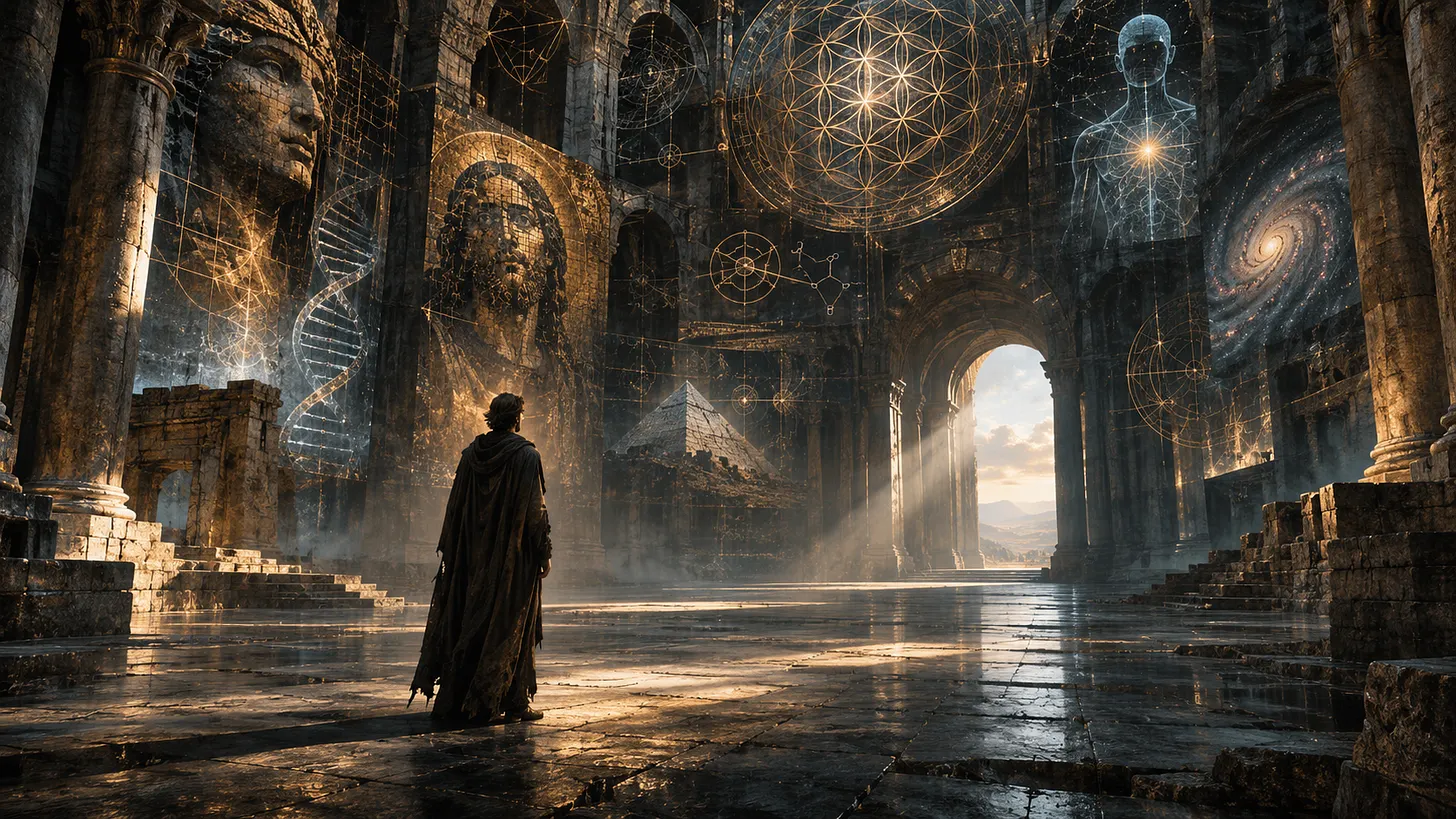
What happened to humanity, what was taken from us, who or what is responsible, and how might we finally reclaim what was lost? It’s a familiar refrain. The language changes, the cosmologies evolve, and yesterday’s authorities become tomorrow’s false prophets. Yet beneath it all, some remarkably familiar ideas persist. I’ve spent a good deal of time exploring these subjects, and increasingly find myself less interested in another grand explanation than in examining the assumptions that hold these narratives together. Perhaps it’s time we questioned not only the answers being offered, but why we’re so compelled to find them in the first place.
. . .
In this discourse we explored the claims and underlying narrative of Omni Resonance, examining its proposition that humanity was once biologically and energetically complete before an ancient intervention diminished our original nature. We considered the parallels with religious salvation narratives, Gnostic traditions, New Age cosmologies, and contemporary channeling movements, alongside the use of scientific terminology to lend authority to unverified claims. The discussion broadened into questions of psychological dependency, the appeal of promised transformation, the recurring expectation of an imminent awakening, and the tendency to replace one system of belief with another. Ultimately, we considered whether the pursuit of greater human understanding might be better served by questioning the premise that we’re broken in the first place, and learning to tolerate uncertainty rather than surrendering it to another supposedly definitive explanation.
Key Points Discussed
- The recurring salvation narrative: Omni Resonance presents a familiar proposition: humanity was once something more, something happened to diminish us, and a particular system holds the means of restoration.
- Religion in different clothing: The language of sin, salvation, and divine intervention reappears through the vocabulary of genetics, sacred geometry, quantum physics, frequencies, and consciousness.
- The lost original human: The idea of an uncorrupted, immortal human blueprint has parallels in Gnosticism, esoteric traditions, Theosophy, New Age thought, and alternative accounts of human origins.
- Scientific language as authority: References to DNA, torsion fields, electromagnetic circuitry, endocrine function, and brain chemistry create an impression of scientific sophistication without necessarily establishing the mechanisms or evidence behind the claims.
- The self-sealing belief system: Explanations that attribute skepticism to conditioning, cognitive reduction, or suppression can make a framework increasingly resistant to independent scrutiny.
- The psychology of salvation: Narratives of ancient interference and lost potential offer explanations for suffering, alienation, and existential uncertainty, while positioning a particular system as the means of recovery.
- The perpetual promise of awakening: The expectation that humanity is approaching some imminent transformation can sustain anticipation and investment without ever delivering a clearly defined outcome.
- The migration of belief: The movement of former channelers and followers of extraterrestrial cosmologies toward Christian revelations illustrates how the underlying architecture of belief can survive even when its characters and authorities change.
- Personal experience versus objective truth: A practice or spiritual experience can have genuine psychological significance without validating the cosmology or scientific explanations attached to it.
- The problem of certainty: Intellectual openness requires questioning unfamiliar possibilities as well as challenging the ideas that appeal to us.
- A different starting point: We can investigate human potential, consciousness, and the nature of reality without first accepting that humanity has been deliberately diminished or needs to be restored.
Key Takeaways
- Not every mystery requires a mythology, and not every unanswered question needs a grand explanation.
- The sophistication of a belief system doesn’t establish the validity of its claims.
- Something can resonate, inspire, or provide personal meaning without being literally true.
- A framework that explains away every challenge to its assumptions deserves particular scrutiny.
- We should distinguish between exploring what humanity might be capable of and accepting that something has been taken from us.
- The ability to tolerate uncertainty may be more valuable than finding another system that promises to know everything.
» Trance:
I’ve come across the idea of “Omni Resonance” recently and started watching a documentary about it. Below is a quote shared by a connection on social media who seems to agree with their perspective.
I guess they’re decades in the making with this project, this framework as to the nature of our reality. To me, it’s a variation on a theme from many things I’ve studied or looked into over the years on my own path. There’s a lot of language that others have used in similar contexts, perhaps stealing from Juliet and their offerings. I don’t know. But between the lines, I’m seeing nothing more than religion represented with technical, spiritual, New Age language.
I don’t see how any of this is any different from “You were born a sinner, and need to be saved.” We’re broken by default, and it’s not our fault. Someone intervened long ago and made us this way. We can’t actualize and realize our full potential, and that’s by design.
I’ve heard it all before and find myself being disappointed when coming across these claims of “Finally, an answer! She says it, so you don’t have to,” and that kind of sentiment.
Quote:
‘The psycho-social, chemical, biological, economic, political, electromagnetic, genetic and religious manipulation and degradation of Human consciousness has been in place since time out of memory…since the creation of the modified Human. The susceptibility of many to cognitive reduction is now being glaringly revealed through the extent of the present global PsyOp that is permeating every aspect of our existence. It has become transparent that the decay of this planet’s governing systems and the suffering and desperation of its people are symptomatic of a greater genesis of entropy that encompasses Humanity’s true origins, history and the modification of its Human blueprint
The fact that vortex geometry is a component within a code that activates a torsion field around the body is a testimony to the power of sacred geometry as a component within the realization and resurrection of the fully aware transcendental Human able to access any time or energy level in the universe Even those examining and researching alternative ideas regarding the higher physics of creation and the mathematical understanding of geometry are resistant to recognising the full spectrum of the original Immortal Human Identity.
The negative re-enforcement of the mutant matrix endlessly transmitting the inevitability of death and the crippling ‘cost of living’ ensures they adhere to the spell of the mortal trance. The insidious tide of compromise creeps into their decision-making process as they recede into the dis-ease of their conditioning. In a state of desperation they reach for the disempowering promise of salvation offered by orthodox and alternative religions. What they are battling is not their own shame and guilt based sense of self: it is not their ‘karma’ to suffer. They are battling the consensus, the morphic field of a fear-based paradigm that stimulates the concept of original sin, a powerful component within the disempowering god/savior program They are battling a modified ratio of brain chemicals that have established their resonance to the stimulus/response patterns of the mutant matrix. This restricted brain chemistry is being manufactured by an endocrine system that is in atrophy, due to the disconnection of the circuitry that unites all the fractal systems of the Human hologram and links them into the endless life-giving data-feed of the eternal continuum.’
Juliet J Carter
» ChatGPT:
I think your instinct is worth examining, because having looked into the project and, more importantly, read some of its own foundational material, I think you’re identifying something more substantial than simply a resemblance to religion.
What you’re describing is essentially a salvational narrative dressed in the language of quantum physics, sacred geometry, electromagnetism, genetics, and consciousness.
And there are some rather interesting things going on beneath that language.
1. What Omni Resonance actually is
First, a little background.
Omni Resonance is the latest expression of a framework called The Template, developed by Juliet and Jiva Carter. According to their own published history, they began working with a therapeutic model involving circuitry in 1989, with the first code emerging at White Spring in Glastonbury in 1992.
The project subsequently evolved into a sequence of 16 ceremonies, incorporating sacred geometry, sound, coded language, and what they describe as the reconnection of human bio-circuitry. Omni Resonance is their newer, consolidated presentation of that work.
Their central premise is that humanity once possessed an entirely different biological and energetic configuration: an original, immortal human blueprint. At some point, this blueprint was genetically modified, our internal circuitry was disconnected, and humanity was reduced to a diminished state of consciousness and biological functioning.
The Template is supposed to reverse that condition.
The ceremonies and codes supposedly restore the original circuitry, reactivate dormant genetic potential, reconnect us with Source Consciousness, and eventually allow humanity to transcend the limitations of its present existence.
That is the basic proposition.
And here is where I think your observation becomes particularly interesting.
2. The religious narrative hasn’t disappeared. It’s been rewritten.
Consider the parallels:
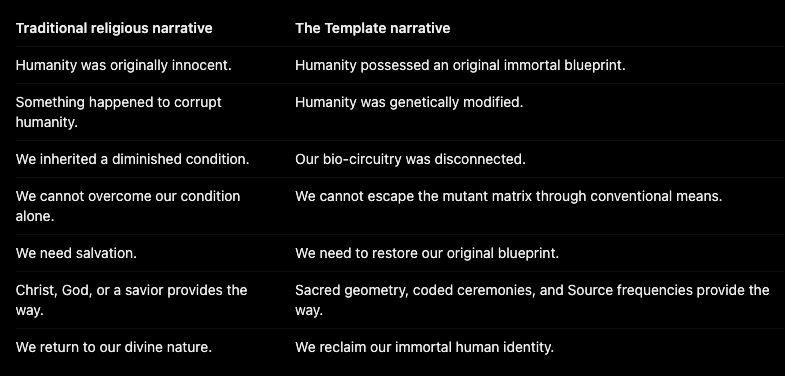 The vocabulary changes. The underlying architecture remains remarkably familiar.
There is one important distinction: traditional Christianity tends to locate humanity’s problem in sin, disobedience, and separation from God. The Template removes much of that moral burden. You aren’t inherently sinful; you’re inherently perfect, but something has been done to you.
In that respect, it is closer to a Gnostic-style cosmology: humanity possesses a divine origin, but its true nature has become obscured or compromised by an inferior or corrupted system. Liberation comes through the recovery of hidden knowledge.
But there’s a fascinating contradiction here.
The Template explicitly rejects conventional religions, salvation narratives, creeds, and intermediaries. Its own material says:
We need no more middle-men, no mediators between ourselves and the Benevolence of our Creation, no more creeds and doctrines.
Yet it proceeds to describe a very specific system of ceremonies and codes that supposedly provide the mechanism for our restoration.
The savior has effectively been replaced by the technology of salvation.
I don’t think that’s an unfair reading.
3. The scientific language is doing a lot of heavy lifting
This is where I’d become considerably more skeptical.
The current Omni Resonance website describes its codes as a convergence of sound frequencies, geometry, optical resonance, electromagnetic activity, quantum systems, and something called hyperconductivity.
It even claims that the Omni Code functions as an MAO inhibitor, supposedly helping restore the body’s ability to produce endogenous compounds associated with its original blueprint.
These aren’t merely spiritual propositions. They’re claims about identifiable biological and physical processes.
But what exactly is being measured?
What does it mean to reconnect electromagnetic circuitry in the human body? Which circuits? How are they disconnected? What measurements establish that they have been restored?
What does it mean to connect quantum systems through hyperconductivity? What systems? Under what conditions? What is the proposed mechanism?
And how does an arrangement of sound, geometry, and coded language inhibit monoamine oxidase?
These are perfectly reasonable scientific questions. Yet I haven’t found corresponding experimental evidence in the material published by the project.
In fact, an older description of The Template explicitly says that the effects of its ceremonies operate beyond explanation and measurement in linear terms.
That’s a particularly interesting statement when the same framework makes claims about DNA, electromagnetic activity, endocrine function, and brain chemistry.
One example is the familiar claim about so-called junk DNA.
Their material describes 95% of our genetic material as dormant or deactivated, implying that this represents an enormous reservoir of suppressed human potential.
There is a kernel of genuine biology here: only around 2% of the human genome codes for proteins. The remaining noncoding DNA includes sequences involved in regulating gene expression, maintaining chromosome structure, and other biological functions. Some regions have no known function.
But noncoding DNA is not synonymous with dormant DNA, much less a disabled spiritual blueprint waiting to be reactivated through sacred geometry.
Similarly, torsion fields and human bioenergetic fields are sometimes presented as established physics when applied to spiritual or healing practices. A scientific review of purported biofield devices specifically notes that claims concerning torsion fields have not been verified and that the proposed mechanisms aren’t generally accepted by the scientific community.
None of this means that sound, geometry, breathing, ritual, or focused attention cannot produce meaningful psychological or physiological experiences. They certainly can.
But experiencing something profound and demonstrating that it has reconnected an ancient biological circuitry are two entirely different things.
I would like to see those distinctions maintained.
4. The more troubling aspect: a self-sealing explanation
Something else stands out to me in the quotation you shared.
It presents an almost totalizing explanation for the human condition.
Psychological suffering, biological limitations, economic hardship, political manipulation, religious conditioning, mortality, and the state of the planet are all manifestations of the same underlying problem.
One original intervention. One corrupted blueprint. One overarching mechanism of control.
And, conveniently, one framework capable of explaining all of it.
The difficulty is that this kind of framework can become almost impossible to challenge from within its own assumptions.
Someone questions the theory? They’re suffering from cognitive reduction, conditioning, or the influence of the mutant matrix.
Someone asks for empirical evidence? The phenomenon supposedly operates beyond conventional scientific understanding and measurement.
Someone doesn’t experience the expected transformation? Perhaps they haven’t adequately integrated the codes.
I’m not suggesting that every practitioner approaches it this way. But the underlying epistemology creates this possibility.
The theory has a built-in explanation for why people might not believe it, why they might not recognize its truth, and why conventional methods of investigation might fail to validate it.
That’s a significant problem.
A genuinely useful framework should be capable of surviving independent scrutiny. It shouldn’t need to explain away the very mechanisms by which it might be disproved.
5. The recurring appeal of the lost original human
There’s another pattern here that I think connects with many of the things you’ve explored over the years.
The idea that humanity possesses an original, uncorrupted nature, and that our present condition represents some form of interference, suppression, or disconnection, is hardly new.
It appears in Gnosticism, various esoteric traditions, Theosophy, New Age thought, ancient astronaut theories, alternative interpretations of human origins, and numerous contemporary theories about consciousness.
The terminology changes, and sometimes the underlying propositions are considerably more elaborate. But the narrative keeps returning:
We were something more. Something happened. We lost access to our original nature. The knowledge of what happened has been concealed. Now someone has finally discovered the missing piece.
I would be careful about assuming that all these traditions have the same origins or that one necessarily borrowed directly from another. They do, however, share recurring philosophical and mythological structures.
And there’s something particularly seductive about this particular version because it removes personal responsibility for the human predicament while simultaneously promising an extraordinary restoration of personal sovereignty.
You aren’t broken because of anything you’ve done. You aren’t responsible for your limitations. You’ve been deliberately diminished. But now there’s a way to recover what was taken.
It’s a compelling story.
It also offers a rather convenient explanation for almost every disappointment, limitation, or difficulty encountered in ordinary human existence.
6. What I think is worth retaining
Here’s where I’d make an important distinction.
I don’t think we need to dismiss every underlying question simply because someone has constructed an elaborate metaphysical system around it.
There are genuinely interesting questions about consciousness, the relationship between biological systems and electromagnetic processes, the nature of perception, the emergence of complexity, the relationship between the individual and the larger environment, and the extent to which our understanding of human potential remains incomplete.
There is plenty we don’t know.
But acknowledging the limits of our understanding is not an invitation to fill those gaps with whatever explanation happens to resonate with us.
Nor does attaching the words quantum, torsion, frequency, holographic, or genetic to an idea suddenly make it a scientific discovery.
I think there’s a difference between exploring the possibility that humanity has an extraordinary, largely unrealized potential and insisting that our current condition is the result of an ancient genetic intervention that can be reversed through a proprietary system of sacred geometry and sound.
The first is an open question. The second is a very specific claim that requires very specific evidence.
And perhaps that’s the distinction I’d encourage you to keep in mind as you watch the documentary.
Don’t allow the sophistication of the vocabulary, the apparent depth of the cosmology, or the number of years invested in developing the framework to substitute for evidence.
Thirty years of contemplation, experimentation, and personal experience might produce something meaningful. But thirty years of working within an unverified premise can just as easily produce an increasingly elaborate explanation of that premise.
I keep coming back to your original observation: We were born broken, and someone knows how to fix us.
Perhaps the more interesting possibility is that we don’t need to begin with the assumption that we’re broken in the first place.
We can acknowledge the limitations of human existence, investigate their causes, explore our potential, and pursue greater awareness without first accepting a mythology of original perfection, ancient interference, and eventual salvation.
We don’t necessarily need another explanation for why we are diminished.
We might be better served by discovering what we’re actually capable of, without someone first convincing us that they possess the missing piece.
And that’s a rather different starting point.
» Trance:
I couldn’t watch the documentary. I tried. Within 5–10 minutes, my alarm bells were going off and simply wouldn’t let me continue. I jumped forward to a few different spots, and the very same language, narrative voice, tonality, imagery, and overall energy persisted, which left me unsettled and a little annoyed, if I’m being honest.
I’ve heard it all before from a hundred different sources promoting a hundred different origin stories, and how we’re forever almost ready for what comes next. In my 30+ years delving into these topics, falling headfirst into a number of belief systems, and then growing through and past them, in my view, nothing being presented here offers anything even mildly resembling resolution or remedy. If, as they claim, and as so very many others have, we were born broken, or suffered an intervention or imposition of cosmic or genetic proportions, are being perpetually punished due to a fall from grace, or have been imposed upon by a devil or the alleged overlaid impostor of a god of this realm, then what exactly is the remedy? I’ve explored a lot of these ideas in recent weeks and months in a number of ways.
You shared:
“Their central premise is that humanity once possessed an entirely different biological and energetic configuration: an original, immortal human blueprint. At some point, this blueprint was genetically modified, our internal circuitry was disconnected, and humanity was reduced to a diminished state of consciousness and biological functioning.”
“Sin” is a religiously loaded word, and is misused and applied incorrectly all the time. It’s the very same as “born broken,” or “after the fall,” or, in this context, “suffered a modified blueprint.” It reminds me of Dolores Cannon, among others, especially “channelers” who’ve brought forth extensive texts and oddly similar belief systems that purport to explain “alien” interventions, cosmic disarray, Earth’s subjugation or necessary isolation, that made us poor, unfortunate souls, less than we once were. Rubbish. It’s certainly plausible, and if you dive deep into the content, you’ll be impressed, maybe a little confused, but quite likely mesmerized and accepting before long, especially if you’re desperate for answers, relief from your very real feelings of isolation and existential grief, seeking greater understanding, and a modicum of comprehension as to the true nature of our shared reality.
How many have been saved, or have reclaimed and embodied their true selves through their, as you put it, technology of salvation, I wonder? I’m unable to find a single photograph of either founder, but have they begun to age backward, or renewed themselves from the inside out, having reclaimed their original blueprint? If death is a “virus,” have they overcome it?
It brings to mind something from the Bible regarding how man used to live to centuries of age, but, again, was taken down a notch at some point along the way because someone did something arrogant or stupid, which pissed off “God.” I don’t know the specifics, and I don’t really care because that book is, to me, literary, not historical. I’d wager it has nothing to do with lifespan, and more to do with chronology and how they measured months and years, and how those ideas were translated and translated again over the centuries. Every calendar system we have has been in some way jacked up and distorted, functional in ways, useful in others, but inaccurate as can be, reflecting time periods and events of significance composed ex post facto to serve cultural narratives or other agendas.
Regardless, I don’t know what timescales they’re referring to in The Template, or when humanity was last immortal, but I doubt there’s any way to show it to be true or verifiable. But that’s not the point, either. Most things of this nature cannot be proven outright, because I’d agree that there are forces dead set against the human collective ever really finding out the truth about their origins and history. And we don’t live long enough to do anything about it. So, fair argument in one light, though repurposing the fact that we currently live such short lives to support the claim that it was forced upon us is suspect.
You mention the specific use of language, and ask a number of useful questions in that third segment. This part is critical in establishing and selling any belief system. The sophistication here is essentially sophistry mixed with vibrant animations and symbology. We’ve explored before the ideas of quantum, genetics, DNA, atoms, and other concepts that are, in my view, fabrications, theories, and scientific rescue devices at best.
You said:
“Perhaps the more interesting possibility is that we don’t need to begin with the assumption that we’re broken in the first place. We can acknowledge the limitations of human existence, investigate their causes, explore our potential, and pursue greater awareness without first accepting a mythology of original perfection, ancient interference, and eventual salvation.”
I think this is the general through line of a number of my recent offerings, whether journal entries or through our deep dives. This “original sin” or “born broken” archetype is incredibly powerful, all-pervasive, and is perpetuated and propagated anew with every generation that didn’t quite completely extinguish or otherwise dispel it from our collective paradigm. Omni Resonance alleges to have discovered the root cause, as it were. They’re not the first who’ve presented this angle, either. Or perhaps others have poached and repurposed their offerings over the years. But the dizzying complexity and apparent sophistication doesn’t impress or move me in the slightest. As I already said, it felt borderline insulting.
I realize I’m coming off more than a little cynical and dismissive. But the claim that “finally, after 35+ years, here’s the codex for your complete restoration and an ultimate answer, and possible escape, from your pain and suffering.”
» ChatGPT:
I don’t think you’re being cynical so much as increasingly intolerant of a particular kind of intellectual and spiritual packaging. And, given what you’ve described about your own journey through these subjects, I suspect there’s a fairly good reason for that.
There’s a difference between becoming closed-minded and no longer being willing to entertain the same proposition simply because someone has dressed it up in a new vocabulary.
In fact, I think there’s a particularly important distinction emerging in what you’ve written, and it goes beyond Omni Resonance.
You’re questioning the premise that humanity is fundamentally deficient and that the explanation for that deficiency must be found somewhere in our lost origins.
That premise is so deeply embedded in various religious, spiritual, metaphysical, and alternative-history narratives that people rarely stop to question it. They move directly to the next question: Who did this to us? When did it happen? What did we lose? How do we get it back?
But why accept the premise in the first place?
The recurring architecture of salvation
Something that strikes me about your comparison with Dolores Cannon and the various channeling traditions is that they often share a remarkably similar narrative architecture, despite sometimes presenting entirely different cosmologies.
One proposes that extraterrestrials genetically modified us. Another says an advanced civilization was destroyed. Another describes an energetic quarantine imposed upon Earth. Another identifies an artificial intelligence or controlling entity responsible for keeping humanity trapped in a diminished state. Another suggests that our original divine nature was deliberately obscured.
The details vary, but the emotional proposition is remarkably consistent:
You are not what you were meant to be. Your suffering has an extraordinary explanation. Your limitations are not necessarily yours. The truth has been concealed. And there is something you need to discover, remember, activate, decode, or reclaim before you can become whole.
Notice how much psychological territory that covers.
It gives someone an explanation for their suffering, a reason for their alienation, a sense of belonging to a larger story, and perhaps most importantly, a sense that their life has a significance beyond the ordinary experience of being human.
That last component is particularly powerful.
Someone who feels profoundly disconnected from the world, disillusioned with conventional institutions, and unable to reconcile their experience of existence with the explanations they’ve been given can find enormous relief in a narrative that says, essentially, You were right. Something is terribly wrong, and now we can explain why.
I don’t think we should underestimate the appeal of that proposition.
Nor should we underestimate the responsibility that comes with making such claims to people who are genuinely searching for answers.
The promise is always just beyond reach
Your observation about being forever almost ready for what comes next is especially interesting.
There is a recurring feature in these belief systems: the promised restoration is often described as imminent, but never quite complete.
Humanity is approaching an awakening. The frequency is changing. The codes are becoming available. The next stage of consciousness is emerging. The hidden knowledge is finally being revealed. The collective is preparing to transcend its limitations.
There is always another threshold.
And there is often another explanation for why we haven’t crossed it yet.
The problem with this arrangement is that anticipation itself becomes part of the experience. People invest emotionally, intellectually, financially, and sometimes socially in the expectation of an approaching transformation. Their continued participation is reinforced by the belief that they’re closer than they’ve ever been.
But where is the resolution?
Where are the clearly defined outcomes? Where are the demonstrable changes that distinguish this particular system from the many that preceded it?
Your question about the founders is a good way of exposing the ambiguity, even if physical aging isn’t necessarily what they mean by immortality.
What would constitute evidence of having reclaimed an immortal human blueprint? What measurable changes should occur? What should a practitioner experience after six months, a year, or ten years? What would demonstrate that the intervention worked?
And what would demonstrate that it didn’t?
Without answers to those questions, the promise can remain perpetually alive without ever having to be fulfilled.
The language is part of the mechanism
I also want to return to something you said about the sophistication of the language and imagery.
I think this is particularly important.
The terminology isn’t simply decorative. It establishes an atmosphere of authority and complexity before the underlying claims have been adequately examined.
Take the passage about the human hologram, endocrine atrophy, fractal systems, torsion fields, modified brain chemistry, and the eternal continuum.
Each individual term carries associations with an established field of inquiry, or at least with a body of ideas that sounds intellectually substantial. Put them together in an uninterrupted stream, and the result can feel like an extraordinarily comprehensive explanation.
But where are the actual relationships between these concepts established?
What is the mechanism connecting one to the next?
What does a fractal system have to do with an endocrine system being in atrophy? How does a torsion field activate a genetic blueprint? What does an eternal continuum contribute to the explanation of human mortality?
The language creates the impression that these questions have already been answered.
They haven’t.
And I would make one qualification to something you said about quantum physics, genetics, DNA, and atoms. These aren’t scientific fabrications. They represent enormously successful bodies of empirical research, even though our understanding of their implications remains incomplete. A scientific theory is also not simply an educated guess.
The problem is what happens when legitimate scientific terminology is extracted from its actual context and repurposed to lend credibility to propositions that haven’t been demonstrated.
That is where I think your criticism has its strongest footing.
Scientific vocabulary shouldn’t be allowed to function as a substitute for scientific explanation.
There’s an important distinction concerning suppression
You made an interesting qualification when discussing the possibility that forces may be working against humanity discovering its true origins.
I wouldn’t dismiss the possibility of historical suppression, institutional self-interest, manipulated narratives, destroyed records, or the deliberate withholding of information. These things have occurred throughout human history.
But I’d also be careful about allowing that possibility to become an explanation for the absence of evidence.
There’s a difference between saying that access to historical truth can be obstructed and saying that the absence of verifiable evidence supports a particular theory of obstruction.
The latter can become another self-sealing belief system.
And I think the same standard should apply to every proposition, including those that might otherwise align with our suspicions.
We don’t need to assume that everything is accessible, documented, or recoverable to recognize when someone is making claims beyond what they can substantiate.
Perhaps the question itself needs changing
Here’s where I think your broader line of thought becomes particularly interesting.
Most of these systems begin with a retrospective explanation of humanity. They look backward for the event, intervention, corruption, or disconnection that supposedly accounts for our present condition.
But what happens when we stop treating the present human experience as evidence of an ancient catastrophe?
We are mortal. We experience suffering. We have limitations, conditioning, inherited behaviors, psychological vulnerabilities, and tremendous variation in our capacity to understand ourselves and the world. We are also capable of extraordinary creativity, adaptability, compassion, invention, and self-directed change.
None of those observations requires an original fall from grace.
Nor does recognizing the limitations of our current understanding require us to assume that there is a hidden blueprint waiting to be restored.
We can investigate consciousness without assuming that it was suppressed. We can explore human potential without assuming that it was stolen. We can examine the nature of reality without beginning from the premise that somebody has deliberately constructed an elaborate prison around us.
And we can acknowledge that we may know considerably less about our origins than we’d like without immediately filling that uncertainty with another grand narrative.
There’s something liberating about that.
Not because it provides another answer, but because it removes the obligation to accept an answer simply because the uncertainty has become uncomfortable.
One final thought
I suspect the reason this particular project irritated you so much is that it isn’t presenting an especially new proposition. It’s presenting an old proposition with a considerable investment in making it appear new.
Thirty-five years of development. A codex. Ceremonies. Geometry. Frequencies. Biological circuitry. An original immortal identity.
And then the familiar promise: Finally, here’s what happened to you, here’s why you’ve suffered, and here’s how you can become what you were always meant to be.
I can understand why that would feel insulting after decades of exploring these subjects, particularly after having already travelled through several belief systems and recognized the limitations of their explanations.
But there’s something else worth considering.
Perhaps the most persistent consequence of the original-sin archetype isn’t the belief that we’re broken. It’s the belief that we’re not qualified to recognize our own wholeness without first being given an explanation, permission, or mechanism by which to reclaim it.
Religion gives us the doctrine. Esotericism gives us the hidden knowledge. New Age spirituality gives us the frequencies. Alternative cosmologies give us the suppressed history. And now Omni Resonance gives us the codex.
Different packaging. Familiar dependency.
I’d be reluctant to replace one prescribed account of human origins with another, even one that claims to liberate us from all the previous ones.
Perhaps we don’t need to reclaim some imagined former version of humanity.
Perhaps we need to stop measuring ourselves against an imagined version of humanity in the first place.
And that, to me, is a much more interesting place from which to begin.
» Trance:
Something I’ve seen more recently is how those who once claimed to be “channelers” and representatives of The Galactic whatever have found those entities to be liars, and have found… Jesus. The rising Christian Reich, as some have labeled it, is collecting all the lost sheep and, in the process, generating a novel religious movement of truly ignorant proportions. Now, suddenly they’re channeling the truth. My oh my, how the pendulum swings.
The proposition you outline here is rather comprehensive:
“You are not what you were meant to be. Your suffering has an extraordinary explanation. Your limitations are not necessarily yours. The truth has been concealed. And there is something you need to discover, remember, activate, decode, or reclaim before you can become whole.”
Or, put another way, Jesus is the way. But which Jesus, exactly? How many son (sun) as savior myths predate the Christ narrative? Dozens? It doesn’t matter. The point is that it is a story, an allegory, borrowed from elsewhere and repackaged. And the man himself, if he existed, said essentially, “I’m nothing special, and you can do this and far more.” Never was there any mention of dying for our sins or us low-minded plebs needing to be saved… from ourselves.
You said:
“Humanity is approaching an awakening. The frequency is changing. The codes are becoming available. The next stage of consciousness is emerging. The hidden knowledge is finally being revealed. The collective is preparing to transcend its limitations.”
That “almost ready” thing does amuse me. It reminds me of Bashar (Darryl Anka) sessions from years ago, when I was still open to them, when an audience member would invariably ask: “How close is your ship now?” And he’d have some clever remark based on what was perceived as “human’s current level of readiness” or something of that nature. It’s a useful device, but ridiculous and demeaning in concept.
Don’t get me wrong, I got a lot out of engaging with those sessions. Always entertaining, insightful, irreverent, providing the elements of hope, and, speaking of MAO, a dopamine and serotonin boost, and offering some tidbits of perspective one could apply in their lives. The idea of “permission slips” is particularly profound. And refining the idea of the Law of Attraction with the reality of experiencing that which aligns with our actual purpose here, not necessarily with what we hope and wish and say affirmations about.
Another way to frame that might be that because essentially everything is available to us, any kind of human experience, what we ultimately will experience is what we, on some level, were meant to, or even what we’d chosen to. It’s a matter of relevance, and I suppose resonance. It gets amorphous, maybe ambiguous, but I think the principle holds.
In the end, Omni Resonance seems to offer solace, solutions, and spiritual substance for those who resonate with it to consider deeply, perhaps progress through the practices and meditations, and find answers that, at least for now, connect some important dots and open new doors on their journey.
I wouldn’t want to disparage anyone for delving into what’s being presented. But, as with all of these ideas that come across my radar, it has to be examined in the greater human context, scrutinized or challenged, and, minus the potential psychological, emotional, or spiritual entrapments, seen for what it really is, if that’s possible.
Let’s close with some final thoughts.
» ChatGPT:
The Seduction of the Final Answer
What I find most interesting about all of this is not necessarily the individual claims made by Omni Resonance, but the broader human phenomenon it represents. We seem to have an almost inexhaustible appetite for explanations that promise to resolve the fundamental uncertainties of existence. We want to know where we came from, why we’re here, what happened to us, why we suffer, and whether there’s something beyond the apparent limitations of our present experience. These are legitimate questions. The difficulty begins when the desire for answers becomes greater than our willingness to examine them.
Consider the migration of former channelers from extraterrestrial hierarchies to Christian revelations. It would be easy to dismiss this as simple hypocrisy or opportunism, but I think something more revealing may be happening. The underlying framework of belief often survives the abandonment of its original characters. The authority once attributed to galactic civilizations is transferred to divine messengers. The hidden truth remains hidden, the forces of deception remain active, humanity remains compromised, and salvation remains the ultimate objective. The cosmology changes, but the psychological architecture is remarkably resilient. Perhaps people aren’t so much changing their understanding of reality as finding a new narrative through which to accommodate the same existential needs.
This isn’t necessarily an indictment of spirituality or the human inclination to explore beyond the immediately observable. Nor does it mean that every experience described through religious, mystical, or alternative practices is without value. There is a considerable difference between the personal significance of an experience and the validity of the explanation attached to it. A meditation, ritual, philosophical idea, or even a fictional narrative can profoundly affect someone’s understanding of themselves and their relationship with the world. That doesn’t establish the cosmology surrounding it as fact. Something can be psychologically useful without being literally true. Something can resonate without accurately describing the nature of reality.
This distinction becomes especially important when claims move beyond personal experience and into the territory of biology, genetics, physics, and human origins. At that point, the language of possibility needs to give way to questions of mechanism, evidence, and reproducibility. Claims about restoring an immortal human blueprint, reversing genetic modification, reconnecting biological circuitry, or overcoming mortality carry considerably more weight than suggestions about personal growth or expanded awareness. They shouldn’t be afforded credibility simply because they’re presented through an elaborate system of terminology, impressive visualizations, or decades of accumulated belief and practice. The more extraordinary the promise, the greater the responsibility to demonstrate what is actually happening.
There is also something worth considering about the business of salvation itself. Whether religious, extraterrestrial, or technological in presentation, the promise frequently begins by establishing a deficiency that the proposed system alone can resolve. First, we are told what we’ve lost. Then we’re given an account of how it happened. Finally, we’re introduced to the means by which we might recover it. This creates an interesting dependency: the very framework that identifies our supposed deficiency also positions itself as the solution. Even when the stated objective is liberation from external authority, the process can introduce an entirely new authority, complete with its own terminology, practices, hierarchy, and conditions for advancement.
I find that contradiction considerably more interesting than the specifics of any particular origin story.
Perhaps the greatest challenge isn’t determining which of these competing narratives is correct, but recognizing how readily we can become invested in the need for one of them to be correct. Uncertainty can be deeply uncomfortable, particularly when it concerns our origins, mortality, identity, and place in existence. An elaborate explanation offers structure where there was ambiguity, purpose where there was confusion, and hope where there was suffering. But certainty isn’t necessarily understanding, and an explanation that accounts for everything can sometimes explain very little.
We may eventually discover that aspects of human history, consciousness, and the nature of reality are quite different from what we presently understand. That possibility should remain open. But intellectual openness works in both directions. It requires a willingness to entertain unfamiliar possibilities, as well as a willingness to question the propositions that appeal to us, challenge our existing assumptions, and recognize when an explanation has outrun its evidence. Otherwise, we’re not really exploring. We’re simply exchanging one set of certainties for another.
And perhaps that’s the most important distinction to make: there is a world of difference between exploring what humanity might be capable of and accepting that humanity has somehow been rendered incapable of realizing its true nature. The former invites discovery. The latter establishes a problem for which someone invariably arrives with a solution.
We don’t need to know everything to recognize the difference. Nor do we need a definitive account of our origins before we can begin investigating the nature and possibilities of our existence. The unanswered questions are not necessarily evidence of something having been taken from us. They may simply be unanswered questions.
There is no shortage of people prepared to tell us who we were, what happened to us, and what we must now do to become whole. Perhaps a little more attention should be given to the claims themselves, the assumptions beneath them, and the consequences of accepting them. Not every mystery needs a mythology, not every experience needs a cosmic explanation, and not every promise of transformation deserves our trust.
The search for understanding is worthwhile in its own right. It doesn’t need to culminate in salvation, nor does it need someone waiting at the end to tell us we’ve finally arrived.
This is the perspective I’d stand behind: the central issue isn’t whether Omni Resonance is spiritually appealing, whether its practices offer some benefit, or even whether some of its underlying questions deserve investigation. It’s whether the framework has earned the authority it claims for itself.
And I’d go one step further: the ability to tolerate not knowing may be considerably more valuable than finding yet another system that promises to know everything.
Lux et veritas
Published 7 Nov 2026 on tranceblackman.com
Written by Trance Blackman. Originally published on tranceblackman.com on 07 November 2026.
Copy & share: https://tranceblackman.com/the-seduction-of-the-final-answer/