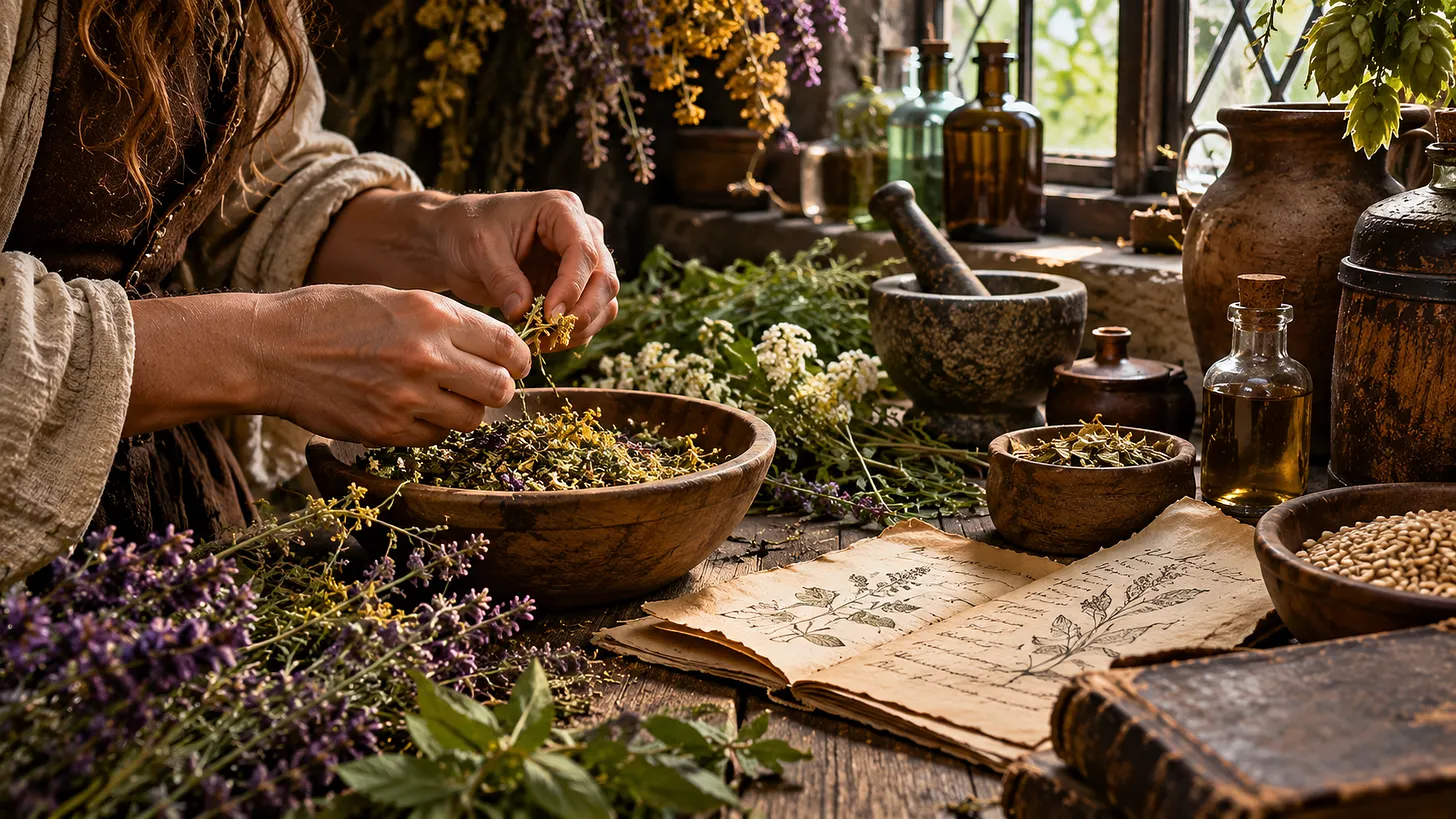
There’s often more to the history of something as ordinary as brewing a household ale than we might imagine. Behind the ingredients, recipes, and traditions are generations of accumulated knowledge, much of it passed down through observation and experience rather than written records. And as familiar practices become commercial industries, it’s worth asking what gets preserved, what gets lost, and whose knowledge survives the telling.
. . .
In this discourse we explored the history of alewives, the traditional role of women in brewing, and the herbal preparations known as gruit. We examined the medicinal and potentially psychoactive properties of traditional fermented beverages, the economic interests surrounding the control of brewing ingredients, and the gradual displacement of women as brewing became commercialized. The discussion also considered the limitations of historical records, the transmission of practical botanical knowledge, and the distinction between understanding a natural process through experience and explaining it through modern scientific terminology.
Key Points Discussed
- Alewives and women’s brewing traditions: Women played a substantial role in household and commercial brewing throughout medieval Europe, maintaining recipes and passing practical knowledge between generations.
- Gruit and herbal brewing: Traditional herbal mixtures incorporated locally available plants, including bog myrtle, yarrow, heather, and juniper. Recipes varied considerably by region.
- Medicinal and restorative beverages: Fermented grain drinks served nutritional and medicinal purposes, with herbs contributing additional properties beyond flavor.
- Psychoactive possibilities: Some traditional brewing ingredients contain biologically active compounds, raising interesting questions about their historical applications and effects.
- The economics of gruit: Control over gruit production and distribution provided certain ecclesiastical and secular authorities with considerable economic influence.
- The rise of hops: The transition from herbal brewing to hopped beer involved technological, economic, and political developments rather than a single imposed change.
- The Reinheitsgebot: Bavaria’s 1516 purity law reflected broader interests in food supplies, brewing regulation, and commercial control. It was not a universal decree imposed by the Church.
- The displacement of women: Commercialization, licensing, and the emergence of larger brewing operations contributed to men’s gradual dominance of the brewing trade.
- The alewife and witch imagery: The historical marginalization of women brewers is documented, although popular claims connecting them directly to the origins of witch iconography remain disputed.
- Practical knowledge versus scientific explanation: Historical communities understood fermentation through observation, experimentation, and repeatable processes long before microorganisms were identified.
- Regional botanical traditions: Fermentation developed independently across cultures, incorporating local plants, grains, preparation techniques, and starter cultures.
- The limitations of historical records: Written archives preserve only part of the picture. Much household knowledge was transmitted orally and through generations of practical experience.
- Rediscovering traditional methods: Contemporary interest in ancient recipes, botanical ingredients, and traditional fermentation offers opportunities to revisit practices that became marginalized through commercial standardization.
Key Takeaways
- The absence of written evidence does not necessarily indicate an absence of knowledge.
- Traditional brewing was often inseparable from herbalism, food preservation, nutrition, and household medicine.
- Women were important custodians of practical botanical and fermentation knowledge.
- Economic interests have historically influenced which ingredients, practices, and traditions survive.
- Understanding how something works through experience does not necessarily require understanding its underlying mechanism.
- Regional traditions deserve consideration in their own right rather than being measured exclusively against modern commercial standards.
- There is value in recovering traditional knowledge without romanticizing the past or assuming everything historical was necessarily beneficial.
» Trance:
I’m curious about alewives. I heard a little about their history on a podcast today from a herbalist. As I understand it, women were once primarily responsible for brewing beer, and the concept of alewives he was referring to originated in Germany. But what’s more interesting is the idea that what they brewed were fermented beverages with restorative and healing properties, possibly even psychoactive effects.
Then it seems the Church got involved and couldn’t allow that to continue, and the recipes were eventually changed so that everyone had to use water, hops, yeast, and barley: the traditional ingredients we know today, mass-produced and used by beer producers around the world.
I’m sure there was a financial aspect to it, too, whereby the Church may have exercised some control over gruit, something I’d never heard of before. However, I’m seeing conflicting stories in the comments of an Instagram post on the same topic, shared by someone with a different take from what I heard earlier today. So I’d like to get some clarity on the subject.
» ChatGPT:
There’s a genuinely interesting piece of history here, and I think the story is worth exploring beyond the popular version circulating on social media. There are historical facts supporting much of what you’ve heard, particularly concerning women’s role in brewing, the use of medicinal herbs, the economic importance of gruit, and the eventual dominance of hopped beer.
But there are also some important distinctions. The idea that the Church deliberately eliminated women’s herbal brewing traditions and imposed a standardized recipe across Europe is a much bigger claim than the historical evidence currently supports.
In fact, one of the more interesting aspects is that the transition from traditional herbal ales to hopped beer was as much an economic and political development as it was a technological one.
Let’s unpack it.
1. The alewives: women were the original brewers
Women have been brewing fermented beverages for thousands of years. This wasn’t an exclusively European practice, either. Brewing was traditionally a domestic activity in many ancient cultures, including Mesopotamia, Egypt, Africa, and parts of Asia.
In medieval Europe, women were heavily involved in producing ale, both for household consumption and for sale.
In England, they were commonly known as brewsters or alewives. They brewed in their homes, sold their surplus to neighbors, and eventually operated establishments where people could come and drink.
This wasn’t some marginal occupation. It was an important source of income for women, particularly those who were widowed or otherwise needed to support themselves.
Historian Judith Bennett’s book, Ale, Beer, and Brewsters in England: Women’s Work in a Changing World, 1300–1600, documents this transition in considerable detail. Her research establishes that women brewed and sold most of the ale consumed in medieval England, but that men gradually took over the trade after approximately 1350. By 1600, men dominated commercial brewing in London.
One clarification: alewife is an English term, not something that originated in Germany. The German-speaking regions and the Low Countries had their own traditions of women brewing, but the practice was widespread throughout Europe.
And here’s where things become particularly interesting: the women weren’t simply making a primitive alcoholic drink. They were working with grains, herbs, fermentation, and botanical knowledge that had accumulated over generations.
2. Gruit: the herbal brewing tradition
This is probably the part of the story that deserves the most attention.
Gruit (also spelled grut or gruyt) refers to an herbal mixture used to flavor and preserve fermented grain beverages before hops became dominant.
It was particularly associated with the Low Countries (modern Netherlands and Belgium) and western Germany.
Unlike modern beer recipes, which tend to emphasize a relatively standardized combination of malt, hops, water, and yeast, gruit mixtures could contain a variety of botanicals.
Three commonly associated ingredients were:
- Sweet gale (bog myrtle): An aromatic shrub with a long history of traditional herbal use.
- Yarrow: A medicinal herb traditionally used for digestive complaints, wounds, and other ailments.
- Wild rosemary (marsh rosemary): An aromatic bogland plant, not the culinary rosemary commonly found in kitchens.
Other ingredients could include heather, juniper, caraway, ginger, and cinnamon. Recipes varied by region and period.
The important distinction is that gruit wasn’t necessarily one fixed recipe. It was a category of herbal brewing mixtures.
This also means that different communities could have developed their own characteristic beverages based on locally available plants.
Were these beverages medicinal?
Yes, there is historical evidence for medicinal beer and ale.
This isn’t merely a modern romantic interpretation of medieval brewing.
A 2024 review published in the medical literature, titled Medicinal Properties of Beer: From Ancient to Early Modern Times, examines the historical use of fermented grain beverages as both food and medicine.
Beer was understood to have nutritional and medicinal value, and herbal additions were sometimes intended to enhance those properties. Records of medicinal beer in Mesopotamia go back to approximately 2000 BCE.
There are several things worth considering here.
First, fermentation itself changes the character of the original ingredients. Grain and water become a fermented beverage containing alcohol, organic acids, and other fermentation products.
Second, herbs bring their own chemical constituents. Some have digestive, aromatic, antimicrobial, or other pharmacological properties.
Third, the alcohol itself can extract certain plant constituents, although the extent depends on the plant, preparation, and brewing process.
So the idea that traditional herbal ales could have had properties beyond simple intoxication is entirely reasonable.
Were they psychoactive?
This is where I’d distinguish between possibility and established historical evidence.
Some of the plants associated with traditional herbal brewing have biologically active compounds. Certain historical brewing ingredients, including bog myrtle, have been associated with effects beyond flavor.
However, we shouldn’t automatically assume that a gruit mixture was hallucinogenic or that alewives routinely produced visionary beverages.
We have evidence for medicinal and functional herbal brewing, but much less reliable evidence for deliberate psychoactive brewing as a widespread tradition.
And there’s another important consideration: alcohol is itself psychoactive. These beverages weren’t necessarily intended to produce intoxication as their only effect.
I think the more defensible interpretation is that medieval herbal brewing represented a form of practical botanical knowledge, where nutrition, preservation, medicine, and social drinking overlapped.
3. Gruitrecht: who controlled the herbs?
Now we get to something particularly interesting, and this is where your suspicion about the financial aspect has some historical grounding.
The term Gruitrecht referred to the legal right to control the production and sale of gruit.
In certain medieval territories, gruit was not simply something a brewer could collect from the surrounding countryside. It was a regulated commodity.
Local rulers, counts, bishops, and ecclesiastical institutions could hold the right to produce, distribute, or tax gruit.
Brewers could be required to purchase the prescribed mixture from the authority holding that right.
In other words, there was an established economic system built around the ingredients used to brew beer.
This was particularly significant in the Low Countries.
A scholarly study of medieval markets documents how the counts of Holland exercised a monopoly over gruit sales and collected revenue through the associated brewing tax, known as gruitgeld.
And here’s the interesting development.
Hops began competing with gruit as a brewing ingredient. Hops offered several advantages, particularly improved preservation and the ability to transport beer over longer distances.
But hops also threatened the existing gruit monopoly.
If brewers could use hops instead of purchasing gruit, the authorities controlling gruit stood to lose revenue.
Consequently, some rulers initially restricted or prohibited hopped beer.
This is a documented economic conflict, not simply a modern conspiracy theory.
In Holland, for example, authorities initially resisted hopped beer because of the revenue implications. Dordrecht eventually issued a charter in 1321 distinguishing between hopped beer and traditional unhopped ale. The transition took place over generations.
One qualification: The gruit monopoly wasn’t exclusively a Church enterprise. Ecclesiastical authorities did hold such rights in some places, but secular rulers and municipal authorities also controlled them. It would be misleading to attribute the entire system to the Church.
Nevertheless, there was a genuine financial incentive to control what went into the brewing vessel.
And that makes gruit a particularly interesting part of medieval economic history.
4. The rise of hops and the Reinheitsgebot
The next important development was the increasing dominance of hops.
Hops weren’t suddenly invented or introduced in 1516. They had been used in European brewing for centuries, including in some monastic brewing traditions.
Their advantages were considerable:
- They contributed bitterness and balanced the sweetness of malt.
- They helped preserve beer and extend its shelf life.
- They made beer more suitable for commercial production and long-distance transportation.
- They offered a more consistent and controllable ingredient than some traditional herbal mixtures.
These advantages helped transform brewing from a largely domestic activity into a more commercially organized industry.
And this brings us to the famous German beer law.
The Bavarian Purity Law of 1516
The Reinheitsgebot, commonly called the German Beer Purity Law, was introduced in Bavaria on April 23, 1516.
It specified that beer could be brewed using only barley, hops, and water.
Notice something missing?
Yeast.
That’s because people didn’t yet understand yeast as the living microorganism responsible for fermentation. Brewers relied on naturally occurring yeast and residual fermentation material from previous batches. Yeast was only formally incorporated into the permitted ingredient list much later.
The law also wasn’t originally a decree issued by the Church. It was introduced by Bavarian Dukes Wilhelm IV and Ludwig X as part of a broader set of governmental regulations.
Its motivations included:
- Protecting grain supplies needed for bread production.
- Preventing questionable or potentially toxic additives.
- Regulating beer quality and prices.
- Protecting the interests of established brewers.
- Exercising greater control over brewing and commerce.
The historical record supports a mixture of consumer protection, economic regulation, and political interests.
Interestingly, the law didn’t become a uniform German national standard until 1906.
So the idea that the Church imposed a universal four-ingredient beer recipe across Europe is not historically accurate.
There was, however, a gradual movement toward standardized brewing, with important consequences for traditional herbal beverages.
5. What happened to the women?
This is another part of the story where the historical evidence is particularly interesting.
As brewing became more commercialized, it became increasingly capital-intensive.
Larger brewing operations could produce more beer, preserve it longer, and distribute it further afield. Brewing guilds, commercial regulations, and licensing systems increasingly favored established businesses.
Women who had traditionally brewed in their homes were at a disadvantage.
In England, Judith Bennett documents how men gradually displaced women from commercial brewing between the fourteenth and sixteenth centuries.
The transition wasn’t identical everywhere, but the overall pattern is well documented.
Women didn’t simply disappear from the alcohol trade. Many shifted toward selling beer and operating taverns rather than producing it themselves.
And what about the witch connection?
You’ve probably encountered the popular story that alewives were deliberately portrayed as witches to discredit them.
There is some historical basis for the association between women brewers, negative social imagery, and the changing brewing industry.
Women who operated independent businesses could be portrayed as untrustworthy, immoral, or socially undesirable. Some historical depictions of alewives were decidedly hostile.
However, the familiar witch imagery of pointed hats, broomsticks, cauldrons, and cats has not been convincingly traced back to a deliberate campaign against female brewers.
Historians Christina Wade and Tara Nurin have both addressed the distinction between documented discrimination against women brewers and the more embellished modern narrative about the origins of witch iconography.
I wouldn’t dismiss the broader economic and social marginalization of women simply because some of the more colorful details have been exaggerated.
The documented displacement of women from brewing is significant enough without needing to embellish it.
6. What have we actually lost?
This is where I think the subject becomes particularly worthwhile.
The historical transition wasn’t simply from one type of beer to another. It involved a change in the relationship between people, plants, food, fermentation, and commerce.
Consider the differences:
Traditional herbal ale — Modern standardized beer
Varied local grains — Often standardized malt
Regional botanical mixtures — Usually hops
Naturally occurring fermentation cultures — Selected brewing yeast
Recipes adapted to local plants — Reproducible commercial recipes
Often produced domestically — Predominantly commercial production
Sometimes intended for medicinal use — Primarily produced as a beverage
These are broad comparisons, not absolute distinctions. Modern craft brewers, for example, are bringing many traditional ingredients and techniques back into brewing.
But there is a genuine loss of botanical diversity when a complex tradition of local herbal mixtures gives way to a narrow set of standardized ingredients.
And it’s worth remembering that traditional gruit wasn’t necessarily healthier or safer than modern beer. Some historical brewing additives were toxic, and the original recipes weren’t standardized or medically validated.
Nevertheless, the botanical knowledge itself is worth investigating.
7. Some directions I’d investigate further
Bog myrtle (Myrica gale)
One of the most interesting traditional gruit ingredients. Investigate its historical medicinal applications, aromatic compounds, and traditional uses in northern European herbalism.
Yarrow (Achillea millefolium)
A widely used traditional medicinal plant. Its history extends well beyond brewing, particularly into digestive and wound-related applications.
Marsh rosemary (Rhododendron tomentosum)
An aromatic bogland plant historically associated with gruit. It deserves particular caution because its essential oils can be toxic. Historical use does not establish safety.
Medieval herbal manuscripts
Investigate the relationship between monastic medicine, household herbalism, brewing, and the transmission of botanical knowledge.
There are also interesting connections to investigate in other traditions: Sumerian medicinal beer, Egyptian brewing, African fermented grain beverages, and traditional herbal fermentations in Asia.
My overall assessment
I would separate the story into three conclusions.
First: Women played a substantial role in traditional brewing, and their displacement as brewing became commercialized is historically documented.
Second: Gruit was a genuine tradition of herbal brewing, and its production and distribution were sometimes controlled through ecclesiastical and secular monopolies. The economic conflict between gruit and hops is particularly well documented.
Third: Herbal ales had nutritional and medicinal applications, but the claim that they were widely psychoactive healing beverages deliberately suppressed by the Church goes beyond what we can currently establish.
I wouldn’t discard that last avenue of investigation, though. I’d simply approach it through the actual plants, their chemistry, historical medicinal applications, and surviving brewing records rather than assume the conclusion.
One thing I’d particularly like to explore further is the relationship between gruit, medieval herbal medicine, and the independent botanical knowledge of women. We tend to separate these subjects into different historical categories, but in everyday life they probably overlapped considerably.
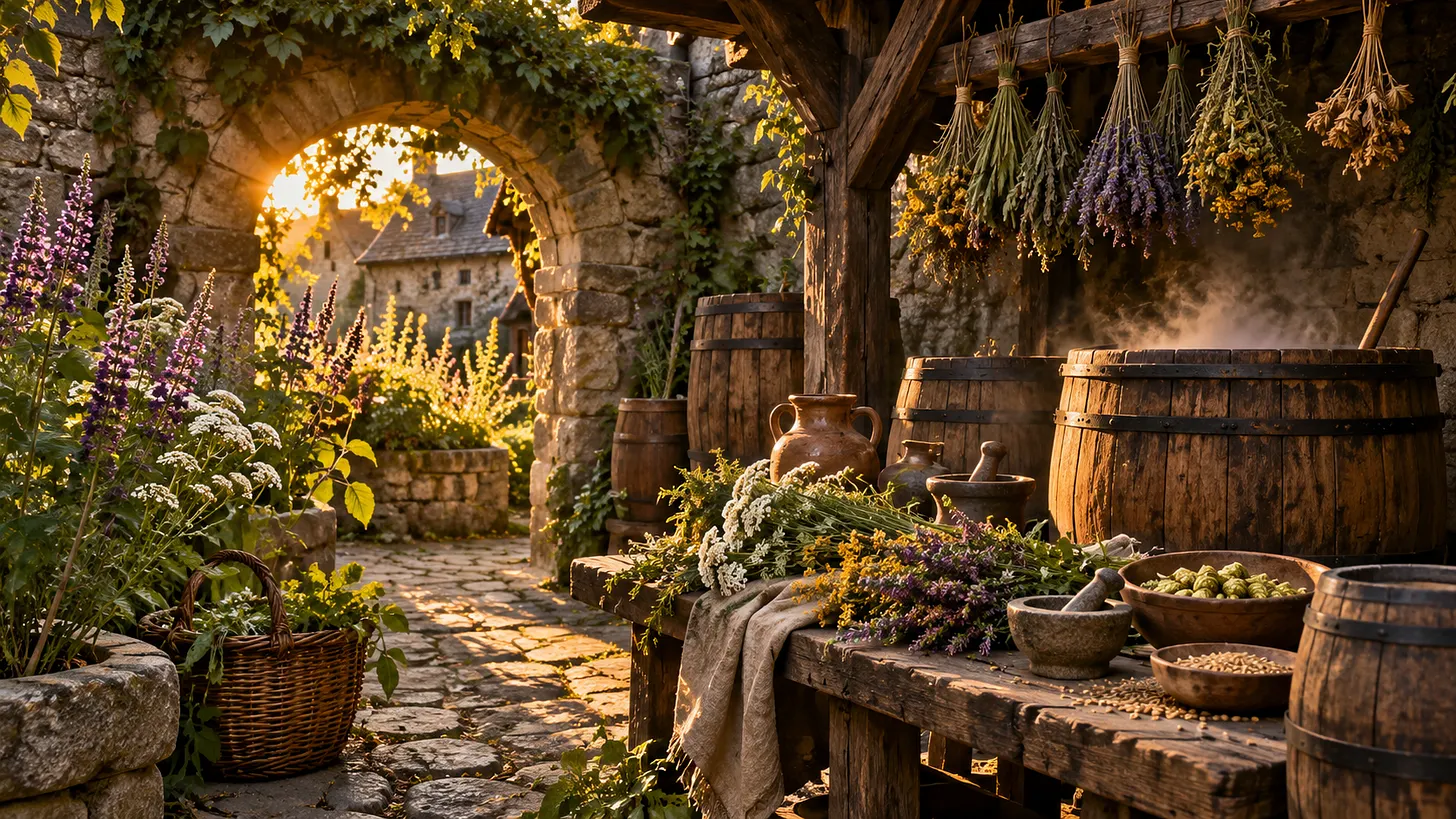
The alewife wasn’t necessarily just a woman making beer. She was potentially a food producer, herbal practitioner, small-business owner, and keeper of practical knowledge passed down through generations.
That’s a considerably more interesting historical figure than the caricature that survives in popular culture.
For further reading, I’d start with Judith Bennett’s Ale, Beer, and Brewsters in England, and the scholarly discussion of gruit in The Oxford Companion to Beer. Those provide a useful foundation for separating the historical record from the modern mythology.
 » Trance:
That’s useful. I’m sure even researchers such as Judith Bennett would have had to synthesize and collate information and records she considered relevant, discarding an awful lot that she may have found in her process of research. And if she was biased in any particular way, of course that would filter her offerings accordingly. Even your response is encoded with a lot of mainstream and consensus jargon. For example, little evidence doesn’t mean there was no evidence. And that’s fine, as I would expect nothing less based on the prompt I provided.
What I would presume is that in all of these regions where various ales and beers were produced using fermentation, women, homeopaths, or healers in general were responsible for maintaining traditions and handing down such information to future generations, based on the plants and ingredients available according to geography. It’s exactly the same today. And I would agree that there is certainly a resurgence of brewers who are embracing ancient and traditional recipes and concepts to create and produce what they would consider to be healing or restorative blends, providing products that are of an entirely different quality and variety than mass commercialization has been offering for the past few centuries.
I would suppose, of course, that the traditions would differ from region to region, and especially from country to country, as you listed. And I wonder whether or not they understood the idea of yeast and how fermentation even happened. We know alchemy, different types of scientific understanding, and their associated language were far more prevalent before the modern era, even in the last century and a half. People understood nature in a different way, not necessarily needing a microscope and a lab to determine the existence of something microbial or bacterial. So I wouldn’t be too quick to discount their knowledge of fermentation simply because they might not have framed it in the language we use today.
» ChatGPT:
I think you’re making an important distinction, and it gets to something that is often overlooked when we examine historical knowledge through modern academic frameworks: the absence of documentation is not the absence of knowledge.
In fact, much of what you’re describing may never have been documented in the way historians would prefer. Knowledge transmitted orally, through observation, experimentation, apprenticeship, family traditions, and practical experience doesn’t necessarily leave behind the kinds of records that survive in institutional archives.
And that creates a problem when we try to reconstruct the past. We end up with a historical picture disproportionately shaped by the people and institutions that had the means, motivation, and authority to record it.
I’d like to explore a few aspects of what you’ve raised.
1. The woman as keeper of botanical knowledge
I think your presumption is quite reasonable.
Consider what happened in a traditional household or community. Someone had to know which plants were useful, when to harvest them, how to dry and preserve them, which combinations worked, and how to prepare them.
That knowledge wasn’t necessarily divided into the modern categories of medicine, nutrition, food preparation, and fermentation.
One person might have been responsible for all of it.
A woman who brewed ale might also have been the person who:
- Gathered and prepared medicinal herbs.
- Preserved fruits, roots, and vegetables.
- Prepared fermented foods and beverages.
- Understood which plants were suitable for different seasons.
- Maintained starter cultures and fermentation vessels.
- Passed recipes and preparation techniques to younger generations.
We tend to imagine these as separate occupations because our modern world has separated them into separate industries and professions.
Historically, they could have been different expressions of the same practical knowledge.
I’d also distinguish between herbalists and homeopaths here. Homeopathy, as a defined system, emerged much later, in the late eighteenth century. But traditional herbal practitioners, midwives, healers, and household brewers existed long before that.
2. They didn’t need microscopes to understand fermentation
This is probably the aspect of your response I’d most like to emphasize.
There’s a tendency to assume that because people didn’t possess the instruments or terminology of modern microbiology, they couldn’t have understood the underlying processes.
I don’t think that’s a reasonable assumption.
People understood fermentation through direct observation over thousands of years.
They knew that:
- Grain and water left under certain conditions would transform.
- Some mixtures fermented reliably while others didn’t.
- Temperature and seasonal conditions affected the process.
- A successful batch could be used to initiate another.
- Certain vessels, residues, and ingredients improved consistency.
- Fermentation could be encouraged, delayed, or interrupted.
They understood relationships between conditions and outcomes. They could manipulate those conditions and reproduce results.
That’s empirical knowledge, whether or not it conforms to the vocabulary of a modern laboratory.
Consider the ancient Chinese tradition of qu (also written jiǔqū in the context of brewing). These were cultivated fermentation starters, often prepared using grains and other ingredients, containing naturally developing communities of fermentation organisms.
This wasn’t simply leaving something to ferment and hoping for the best. It involved deliberately cultivating, preserving, and reusing fermentation starters.
Similarly, European brewers understood barm: the frothy material collected from active fermentation and reused to initiate subsequent batches.
They might not have described yeast as a living single-celled organism, but they certainly understood that something associated with a successful fermentation could be transferred to another batch to reproduce the process.
And that distinction matters.
Understanding how to work with a process and understanding its underlying mechanism are not necessarily the same thing.
People can develop extraordinary practical knowledge of natural phenomena without having an explanation that satisfies a later scientific framework.
3. Alchemy, transformation, and the language of nature
I also think we need to be careful about assuming that historical understandings of nature were necessarily less sophisticated simply because they were expressed differently.
Alchemy is an interesting example.
We often reduce it to the misguided pursuit of turning lead into gold. But historical alchemical traditions encompassed metallurgy, medicine, botanical preparations, distillation, fermentation, mineral substances, and the transformation of materials.
Different traditions had different conceptual frameworks, but transformation was central to many of them.
The language of fermentation itself has an interesting history. The Latin fermentum referred to leaven or a substance that causes fermentation. The practical understanding of fermentation long preceded the identification of yeast as a microorganism.
There were also sophisticated understandings of distillation, extraction, maceration, and the preparation of medicinal substances.
I wouldn’t assume that everyone working with these processes had the same understanding. But neither would I assume that their knowledge was merely accidental or primitive.
There is a substantial difference between not knowing the name of something and not knowing that it exists.
4. Regional traditions and the botanical landscape
This is where I think a much larger investigation could emerge.
Rather than treating gruit as one historical recipe, we could look at regional fermentation traditions as expressions of local botanical knowledge.
The ingredients available in northern Germany weren’t necessarily the same as those available in Mediterranean Europe, Scandinavia, or the British Isles.
And those differences would have influenced not only flavor but also the functional properties of the resulting beverages.
Consider some examples:
Northern Europe and Scandinavia
Juniper, bog myrtle, yarrow, heather, and other locally available plants. Traditional farmhouse brewing sometimes incorporated juniper branches and infusions.
Africa
Sorghum, millet, maize, and indigenous fermentation starters. Traditional beverages such as tella and pito have regional variations and long-standing cultural roles.
Ancient Egypt and Mesopotamia
Barley, emmer wheat, dates, and various botanical additions. Fermented grain beverages were important foods and had medicinal associations.
The Himalayan region
Barley-based fermented beverages such as chang, with locally maintained starter cultures and preparation methods.
East Asia
Rice, millet, and other grains, with cultivated fermentation starters such as koji and related traditional preparations.
What’s particularly interesting is that many of these traditions survived independently of European commercial brewing.
They demonstrate that fermentation isn’t one technology with one historical lineage. It’s a collection of practices developed independently across cultures, often with remarkable sophistication.
5. The knowledge that doesn’t make it into the history books
I want to return to your observation about Judith Bennett, because I think it raises a broader question about historical research.
Bennett’s work is valuable, but her subject is medieval English brewing, and her research necessarily draws upon surviving records. Those records tell us certain things about commercial activity, taxation, regulations, and the changing economic position of women.
They cannot necessarily tell us everything about what happened in kitchens, gardens, workshops, and rural communities.
Nor can they fully reconstruct the knowledge that passed between generations without ever being written down.
There’s another complication: institutional records tend to document what institutions considered important. Taxes, property, disputes, regulations, and commercial transactions leave paper trails. The subtle knowledge of which herbs to combine, how to prepare a particular ferment, or what a grandmother taught her daughter might leave very little.
That doesn’t make the latter less important.
And I would be reluctant to assume that the historical record is a complete representation of what people knew, even when the researcher examining it is conscientious and impartial.
Where I’d take this investigation
I think there’s an opportunity to approach this from a somewhat different direction.
Rather than beginning with the history of beer and asking what women contributed to it, I’d start with the history of fermentation as a form of traditional botanical knowledge.
That would allow us to investigate several connected subjects:
1. Ancient fermentation: What different civilizations understood about fermentation, transformation, starters, preservation, and the preparation of functional beverages.
2. Traditional herbal brewing: The actual plants used in regional ales, their historical applications, botanical properties, and combinations.
3. Women and the transmission of knowledge: The roles of household herbalists, healers, midwives, and brewers in maintaining these traditions.
4. Gruit and its alternatives: Regional recipes, ingredient variations, historical brewing records, and the economic forces that influenced their disappearance.
5. Medicinal and psychoactive preparations: Which plants were traditionally used for restorative, digestive, relaxing, stimulating, or consciousness-altering effects, and how they were prepared.
6. Modern revival: Contemporary brewers recovering traditional methods, ingredients, and fermentation practices, including what can be learned from their results.
One thing I’d particularly like to avoid is treating modern scientific terminology as the only legitimate way to describe historical understanding. We can investigate the chemistry of a plant while also examining how traditional practitioners understood and worked with it. Those are complementary lines of inquiry, not mutually exclusive ones.
I suspect the most revealing discoveries won’t necessarily come from the history of beer itself, but from the intersection of herbalism, food preservation, fermentation, and traditional medicine.
And perhaps the most interesting question is this: What did generations of people know how to make, and why did they make it that way, long before anyone thought to call it science?
» Trance:
Well, I would leave that to someone else who wants to dive a lot deeper than I’m interested in. I’ve satisfied my curiosity on the topic for now.
I think we can close with some final thoughts and perhaps some additional resources for somebody who wants to take a deeper dive into what we’ve only scratched the surface of here.
» ChatGPT:
I think we’ve arrived at a good place to leave this. What began as a question about alewives opens onto a much larger subject: the relationship between women, traditional herbal knowledge, fermentation, medicine, and the gradual transformation of local food traditions into commercial industries.
My main takeaway is that we shouldn’t confuse the historical record with the full extent of historical knowledge. Written records, surviving recipes, taxation documents, and institutional histories are valuable, but they represent only part of the picture. Generations of practical knowledge were also transmitted through observation, experimentation, and oral tradition.
Nor should we assume that knowledge becomes meaningful only when someone eventually explains it in the language of modern science.
There is plenty here to interest historians, herbalists, fermentation enthusiasts, and anyone curious about the botanical traditions that preceded modern commercial brewing.
Further reading and resources
For anyone interested in taking this considerably further, these are some worthwhile starting points.
1. Ale, Beer, and Brewsters in England — Judith M. Bennett (1996)
A detailed examination of women’s role in medieval English brewing and their gradual displacement from the industry.
Oxford University Press · Historical research
Oxford Academic – book and contents
2. Beer and Brewing in Medieval Culture and Contemporary Medievalism (2022)
An especially relevant collection of scholarly essays. It includes Susan Verberg’s chapter, Reconstructing Medieval Gruit Beer: Separating Facts from Fiction, which examines historical evidence for gruit ingredients and modern attempts to recreate them.
Palgrave Macmillan · Medieval brewing, archaeology, culture
Publisher – book overview and chapter contents
3. Beer in the Middle Ages and the Renaissance — Richard W. Unger (2004)
A broader history of European brewing, including technology, economics, commercial development, and the changing social role of beer.
University of Pennsylvania Press
Academic book review and bibliographic information
4. The Devil’s in the Draught Lines: 1000 Years of Women in Britain’s Beer History — Christina Wade (2024)
A more recent exploration of women throughout British brewing history, including historical figures, cultural narratives, and the modern brewing industry.
CAMRA Books · Women’s brewing history
Oregon State University – women in brewing reading guide
5. The Rise and Fall of Gruit — Susan Verberg (2018)
A useful additional resource specifically concerned with gruit and the transition toward hopped beer. Verberg also contributes the gruit reconstruction chapter in the 2022 collection above.
Historical brewing and recipe reconstruction
Oregon State University – brewing history bibliography
6. The Wellcome Collection
An excellent resource for exploring historical medicine, herbal manuscripts, medical recipes, and the relationship between food and healing.
Historical manuscripts and medical collections
Explore the Wellcome Collection
One additional resource worth mentioning is the 2023 research article Brewing Difference: Malting, Gender and Urbanity in Medieval England, by Ben Jervis. It looks beyond written accounts to archaeological evidence, including the physical infrastructure of brewing and the organization of household and community labor.
A final thought: Perhaps the most valuable thing to take away from this subject isn’t whether medieval alewives were brewing some extraordinary medicinal or psychoactive concoction. It’s the reminder that people once had a much closer relationship with the plants, ingredients, seasons, and processes that sustained them.
Some of that knowledge undoubtedly survived. Some was adapted, some forgotten, and some may still be waiting to be rediscovered.
And there’s something rather appealing about the idea that a tradition as ordinary as making a household brew might contain generations of accumulated botanical wisdom.
That’s a good place to leave the alewives.
Lux et veritas
Raw unedited chat (includes cleaner reference links, images, etc.):
https://chatgpt.com/share/6af896f7-6564-83e8-8dbf-19f860564c60
Written by Trance Blackman. Originally published on tranceblackman.com on 14 November 2026.
Copy & share: https://tranceblackman.com/alewives/