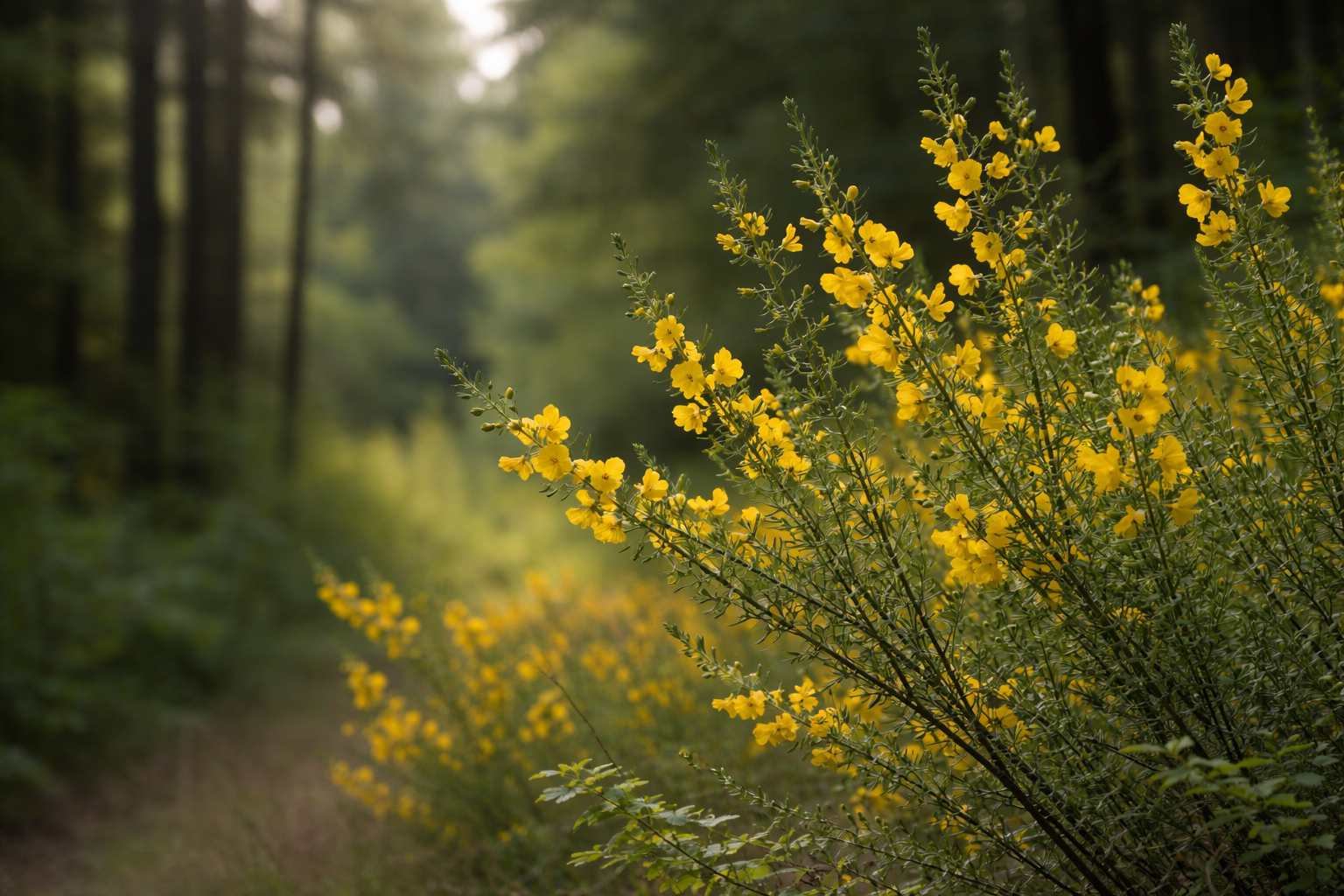
What we call invasive, diseased, or dangerous often says more about our assumptions than the systems we’re observing. What if forests and bodies are responding intelligently to conditions we’ve misunderstood?
. . .
What if the things we label as problems are not mistakes at all, but signals?
Scotch broom is often described in stark terms, invasive, parasitic, aggressive. It spreads quickly, alters soil chemistry, and is highly flammable. It appears where land has been disturbed, where the ground is depleted, compacted, or damaged. The language around it is almost always negative, framed as something to be eradicated, controlled, removed.
But what if that framing is incomplete?
In my many road trips, walks, and hikes, I’ve only ever seen a few piles of broom where groups have likely organized to “cleanse” a stretch of highway, a neighborhood park, or a trail embankment. Much like the way ivies and vines are dealt with, sporadically and inconsistently, the broom is cut, piled, and left to dry. Hopefully, before they’ve had a chance to go to seed.
I’ve seen broom growing everywhere, but always in particular places, along highways and logging roads, beside trails, at forest edges, never far from the forest itself. If it is invasive, it seems very selective about where it chooses to invade.
I don’t pretend to know much about broom, beyond the fact that it is often described as an “escaped garden plant,” a phrase that feels more like misdirection than explanation. It raises questions. Broom thrives in poor soil. It absorbs toxicity. It spreads prolifically. And when conditions align, it burns hot. It is also toxic to livestock, and I imagine they know well enough to leave it alone.
Do we believe those traits to be random?
What if certain elements appear cyclically, not as invaders, but as responders, preparing terrain for something that cannot yet grow? What if flammability is not a flaw, but a function? Fire clears, renews, resets. Many forests depend on it, even if we’ve grown deeply uncomfortable with that reality.
Nature does not panic. It does not moralize. It responds, and it operates on a timescale well beyond our everyday comprehension. Through our urge to manage resources, while arguably failing at proper forest stewardship given the prevalence of catastrophic wildfires in our era (I’m aware it’s more complex, as climate arson is certainly an issue), broom appears precisely on schedule for something we may be overlooking, mislabeling, and casting into the familiar category of “problem.” We’re told to be vigilant, yet what I see is not vigilance but panic, climate alarmism, psychological and emotional projection, rather than deeper comprehension, appreciation, or contemplation of the larger cycle at play.
Which raises a parallel worth sitting with.
Modern medical philosophy largely treats the human body as fragile, prone to infection, breakdown, and failure. It ignores the obvious: we have built an environment in which the body must endure a constant barrage of chemical, electromagnetic, and industrial assaults. This approach has created a persistent and highly profitable circular logic: symptoms are treated as enemies. A cough is suppressed. Bacteria are sterilized. Fungi are destroyed. Inflammation is silenced. Intervention, guided by biased guesswork, models that reinforce the prevailing paradigm, imaging open to interpretation, narrow assumptions, and incomplete patient histories, is immediate, decisive, and almost never questioned.
Rarely is the deeper question asked: why is the body expressing this?
The terrain model offers a different orientation, one that is older, broader, and, in my view, more complete. It predates germ theory, and should supplant it again as more people arrive at (or perhaps return to) a simple realization: the body only heals. The body is not failing, but adapting, responding intelligently to conditions, all day, every day. Scabs, rashes, fevers, headaches, infections, congestion, all of these arise in precise and timely fashion for specific reasons, if we are willing to accept that premise.
Instead, we are trained to defer to specialists, to protocols, to suppression, to react in fear and worry, to managing symptoms and treating conditions rather than listening to and allowing what is being expressed. We need to get back to “normal” as quickly as possible, even though it is precisely that normality that created the response we’re experiencing and expressing.
How different is a forest?
When we label plants as invasive, fires as disasters, or symptoms as malfunctions, we reveal our assumptions. We assume systems are weak. We assume deviation means error. We assume control and management are preferable to comprehension.
And fear scales well.
When the world keeps shouting “fire!”, whether about forests, climate, or bodies, the rule of opposites is worth considering. Panic narrows perception. Fear justifies intervention. Negative framing sustains entire industries, while obscuring longer cycles of renewal, adaptation, and intelligence.
It’s about orientation.
What if a forest expressing fire is not collapsing, but renewing? What if a body expressing illness is not betraying us, but communicating? What if what we call invasion is simply a response to disturbance, while also being part of renewal?
Nature heals. The body only heals.
What changes when we start from that assumption?
Perhaps we stop trying to dominate systems we barely understand. Perhaps we listen longer. Perhaps we trade urgency for discernment, and fear for curiosity, even gratitude. Not to abandon intervention entirely, but to temper it with humility. To recognize that beneath the noise, beneath the alarm, there is a symphony at play, one that does not need our panic, only our attention.
Solvitur ambulando
Written by Trance Blackman. Originally published on tranceblackman.com on 28 January 2026.