
This essay is part of a three-part exploration into the forces that shape modern belief, technology, and human behavior. Each piece builds on the previous: first, exposing the hidden material and ecological costs of widely celebrated technologies; second, revealing the symbolic, mythic, and psychological machinery that elevates “saviors” and narratives above reality; and third, offering a framework for discernment, ethical engagement, and reclaiming human agency.
Reading the essays together provides a full arc: from revelation, through deconstruction, to practical awareness and empowerment. Patterns repeat throughout history, and understanding them is essential if we are to navigate the modern theater of symbols, hype, and manufactured salvation.
 The Electric Vehicle as Idol — Hype, Hubris, and the Machinery Beneath the Myth
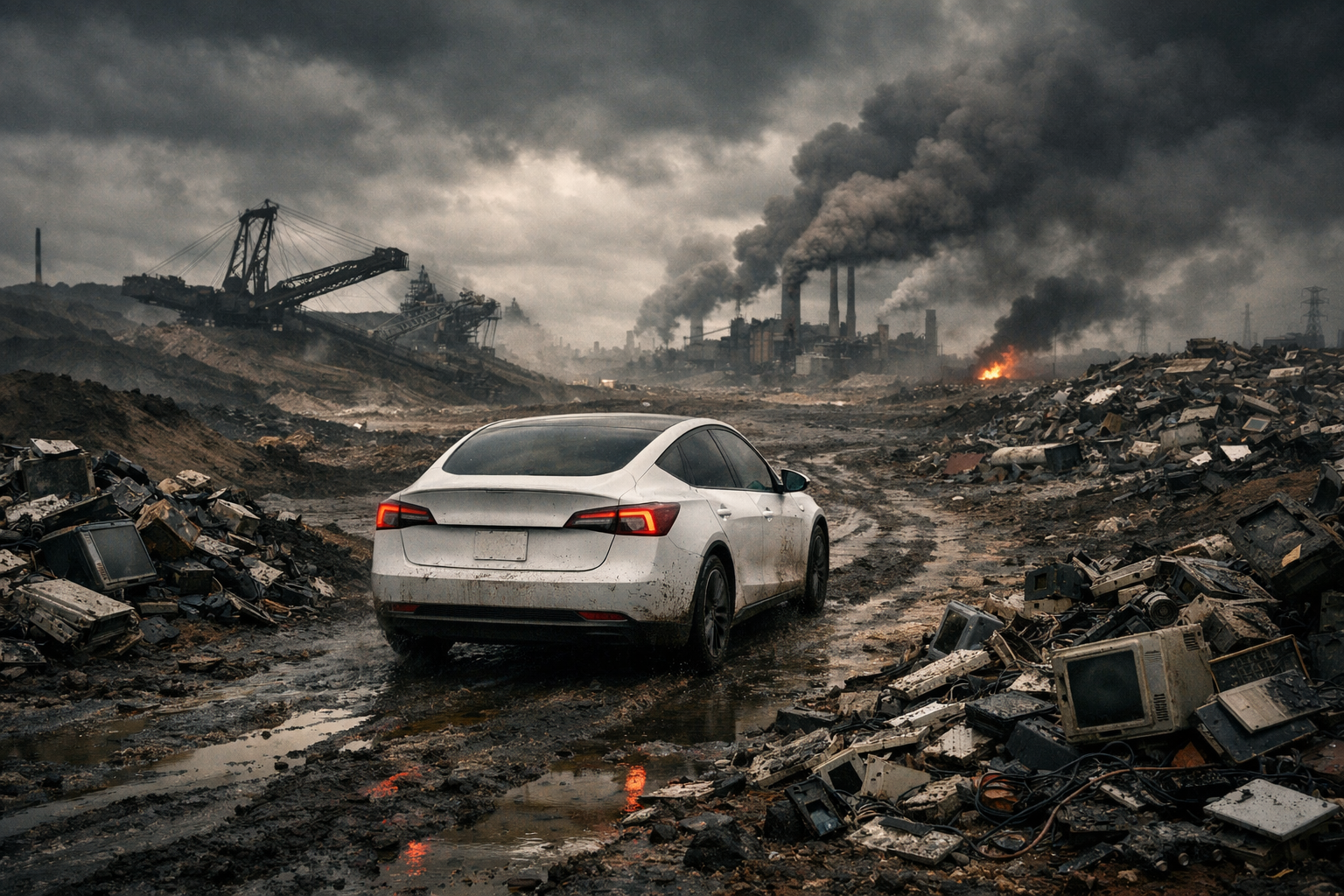
The electric vehicle has become something far greater than a car. It is now a symbol — a moral artifact, a cultural signal, a technological idol placed at the center of a story about salvation. It is framed not merely as an alternative mode of transport, but as proof of ethical alignment, a visible declaration that one stands on the “right side” of history. To question it is no longer a technical inquiry, it is a moral transgression.
This alone should give us pause.
The EV narrative is sustained less by open examination than by repetition, emotional leverage, and institutional alignment. Governments, regulatory bodies, corporate interests, and technocratic planners have converged on a single message: electrification equals virtue. Subsidies flow. Mandates follow. Media echoes the refrain. Alternatives fade from view. Complexity is smoothed into slogans. What remains is not a debate, but a doctrine.
And doctrines tend to fracture under the weight of reality.

Beneath the polished surfaces and glowing dashboards lies a material world rarely acknowledged in public discourse. Electric vehicles do not emerge from clean air and good intentions. They are born of mines — cobalt extracted under brutal conditions, often involving child labor in the Congo; rare earth minerals ripped from landscapes and ocean floors; lithium operations that drain aquifers and leave long-term ecological scars.[1][2] These materials are refined, transported, assembled, and eventually discarded, leaving behind toxic waste streams that do not vanish simply because they are geographically distant from the consumer.
The promise of “zero emissions” depends entirely on what one chooses not to count.
Battery production alone is energy-intensive, resource-hungry, and environmentally disruptive. Lifespans are finite. Recycling remains technologically limited and economically marginal at scale. Vast numbers of depleted batteries already accumulate, stored in conditions that pose long-term contamination risks.[3] Meanwhile, the electrical grid required to support mass electrification strains under growing demand, driving infrastructure expansion and rising electricity costs that are socialized across populations — including those who will never own an EV.
This is not an oversight. It is structural.

Bureaucracies do not optimize for truth; they optimize for continuity. Corporations do not pursue sustainability; they pursue growth. When these forces align, narratives are curated. Complexity becomes inconvenient. Dissent is reframed as ignorance, malice, or “anti-science” sentiment. The EV is no longer evaluated as a system — it is marketed as an identity.
Solar and wind energy follow the same arc. Celebrated as clean and inexhaustible, they too depend on mining, land transformation, rare materials, and extensive infrastructure. Their intermittency necessitates storage systems that replicate the very extractive and material problems they claim to solve. Power density — a physical constraint, not an ideological one — is quietly ignored.[4] The environmental footprint is fragmented across regions and supply chains so that no single community confronts the full cost.
This pattern is familiar because it is not new.
Every industrial age produces its saviors. Each promises efficiency, cleanliness, and moral advancement. Each is accompanied by a hype cycle that accelerates belief ahead of understanding. What cannot be denied is deferred. What cannot be deferred is rebranded. The truth eventually breaks through the cracks — not all at once, but enough to destabilize the story.
Economics, in particular, are carefully glossed over.
If electric vehicles were genuinely superior — cheaper to build, easier to scale, naturally cleaner end-to-end — they would not require perpetual financial scaffolding. Markets adopt what works without sermons. Yet most EV programs remain deeply unprofitable, sustained by subsidies, regulatory credits, and cross-subsidization from internal combustion vehicles.[5]
Legacy automakers tell the clearest story. Ford, General Motors, and Volkswagen have lost billions on their EV divisions year after year. In many cases, each vehicle sold represents a five-figure loss quietly absorbed elsewhere in the business.[6] EV startups have fared worse — burning extraordinary amounts of capital before collapsing or surviving only through continued investor infusions. If profitability were inherent to the technology, these failures would be anomalies rather than the norm.
Even the apparent exceptions demand scrutiny. Tesla’s profitability has relied heavily on scale, vertical integration, regulatory credit sales, and favorable policy environments.[7] BYD’s success is inseparable from state support, protected markets, and deep integration into China’s industrial planning. These conditions are not easily replicated, nor are they acknowledged in popular narratives.
This is why mandates replace markets. This is why timelines are perpetually revised. This is why profitability is always just over the horizon.
Hype cycles do not function because people are unintelligent. They function because they are psychological. They compress time, amplify fear, and weaponize empathy. They tell people they must act now, invest now, comply now — or bear responsibility for catastrophe. Nuance is framed as denial. Caution is reframed as cruelty. Identity becomes entangled with belief.
This is not persuasion. It is epistemic capture.[8]

Desire to “do the right thing” is monetized. Anxiety is converted into compliance. Responsibility is outsourced to technology while deeper questions — consumption, scale, restraint, human behavior — remain largely untouched. The system offers redemption without limits, solutions without humility, and progress without self-examination.
If there is a path forward, it will not be found in trading one extractive system for another and calling it evolution. It will not be delivered by centralized technologies that demand ever-greater complexity, surveillance, and control. And it will not emerge from narratives that treat human beings as a blight to be managed rather than participants capable of discernment and restraint.
The first step is philosophical, not technological. People must learn to recognize how stories are constructed, how emotions are manipulated, how incentives shape what is presented as truth. Without that awareness, every new “solution” will simply be another turn of the same machine — extracting wealth, attention, freedom, and peace of mind while claiming moral authority.
The electric vehicle is not the savior it is sold as. It is a symbol, not of reconciliation with the natural world, but of a system that has learned how to sell virtue while avoiding responsibility.
And until we are willing to see that clearly, the pattern will repeat, as it always has.
References & Footnotes
- Kara, Siddharth. Cobalt Red: How the Blood of the Congo Powers Our Lives. St. Martin’s Press, 2023.
- United Nations Environment Programme (UNEP). Environmental and Social Impacts of Mining Critical Minerals.
- International Energy Agency (IEA). Global EV Outlook — battery lifecycle and recycling limitations.
- Smil, Vaclav. Power Density: A Key to Understanding Energy Sources and Uses. MIT Press, 2015.
- International Council on Clean Transportation (ICCT). EV cost and subsidy dependency analyses.
- Ford Motor Company, General Motors, Volkswagen Group — annual reports and earnings calls, 2020–2024.
- Tesla, Inc. — regulatory credit disclosures in SEC filings.
- Ellul, Jacques. The Technological Society. Vintage Books, 1964; Postman, Neil. Technopoly. Knopf, 1992.
Resources for Those Willing to Look Deeper
On Rare Earths, Cobalt, and Mineral Extraction
- Cobalt Red — Siddharth Kara
- The Devil’s Metal — R. Max Wideman
- United Nations Environment Programme — reports on critical mineral extraction
- Amnesty International — investigations into cobalt mining and child labor
On Energy Systems and “Renewables”
- Vaclav Smil — Energy and Civilization, Power Density
- International Energy Agency — critical minerals and grid infrastructure reports
- Michael Moore / Jeff Gibbs — Planet of the Humans (documentary, with caveats and critiques worth examining)
On Hype, Psychology, and Technocratic Power
- Jacques Ellul — The Technological Society
- Neil Postman — Technopoly
- Edward Bernays — Propaganda
- René Girard — on mimetic desire and mass belief formation
These are not comfortable reads. They are not meant to be. But comfort has never been a reliable guide to truth.
Continue to Act II: Theater of the Savior
Written by Trance Blackman. Originally published on tranceblackman.com on 31 December 2025.
Copy & share: https://tranceblackman.com/symbols-and-reality-i/