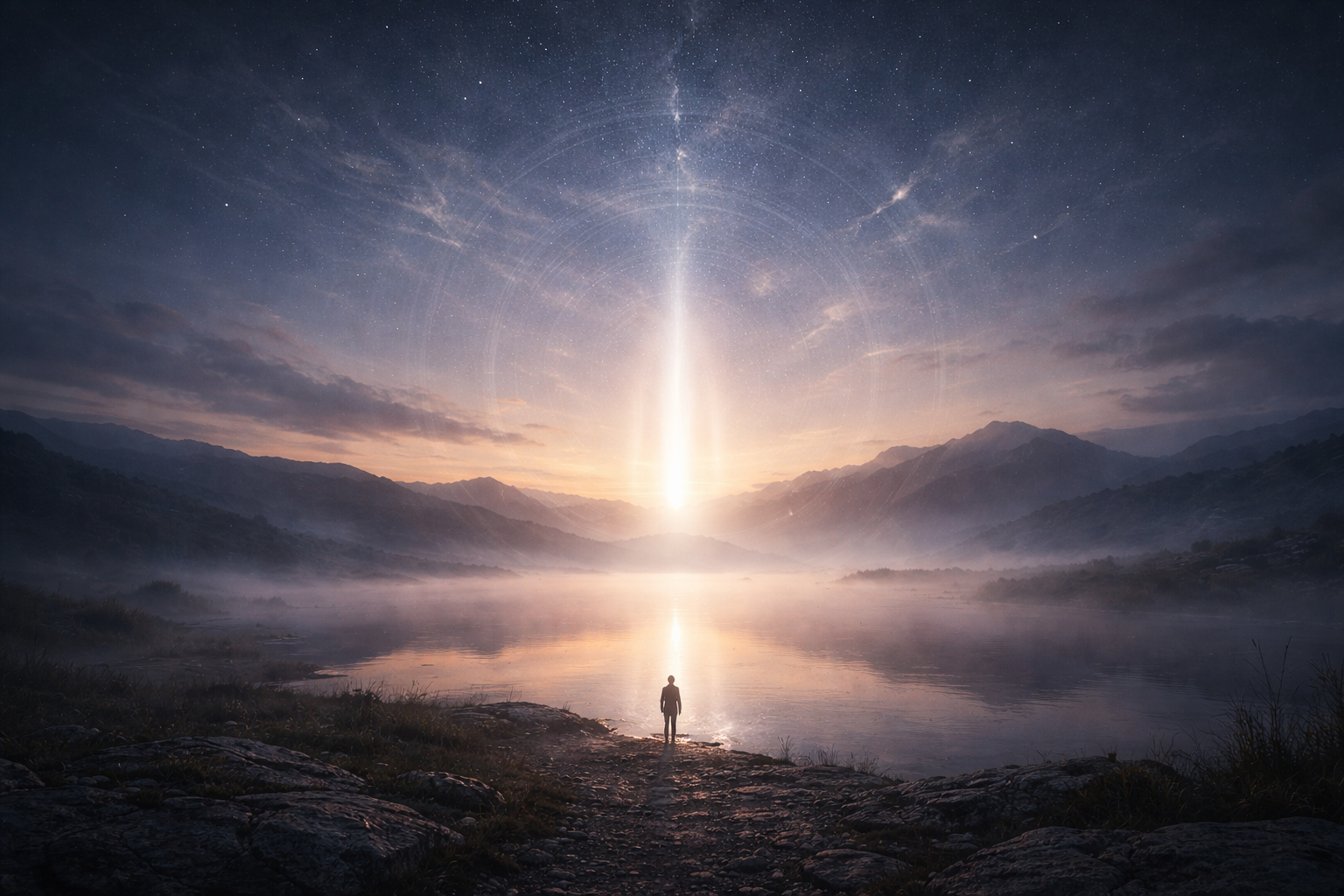
We often ask what life would look like if humanity awakened. The problem isn’t the question itself, but the assumption that we could recognize the answer from within our current condition. Whatever such a world might be, it would not resemble our fantasies, myths, or technologies. It would demand something far more unsettling: presence without projection.
. . .
“What would daily life look like physically, spiritually, and emotionally if humanity ‘awakens’ and lives in alignment with love, truth, and divine consciousness?”
It’s a question someone posed to an AI known as Sage. The answer was as predictable as you’d imagine, and in my view, completely wrong. The frame itself would be unrecognizable to who we are right now as a collective, as a civilization, expressing life in this human form and broader condition. Before even attempting an answer, one would have to stop thinking the way we do in almost every respect. Any immediate response, even from a well-meaning AI interlocutor, is inevitably constrained by the boundaries of what we consider normal, along with the language, meanings, values, and beliefs that come with that framework.
Given the world we know, loving certain aspects of it and hating many others, we can’t possibly know what life would look like in some idealized future. We haven’t even seen it convincingly depicted in science fiction or fantasy. We have no true reference point, only fragments. Spotty historical records. Myths and legends. A sea of bastardized information sources interpreted and reinterpreted countless times in recent memory. We’ve lost much of what once was through innumerable resets of varying kinds and intensities. Languages. Reference points. Infrastructure. Architecture. Frequency. Capacity. Capability.
All talk of “when humanity awakens” feels misleading to me. It’s hopium of a spiritual variety, a way of staying oriented toward a future we don’t truly believe ourselves capable of living or achieving.
It wouldn’t simply be the opposite of what we call reality now. It would be an entirely different category. We can speculate about past civilizations, the heights they may have reached, the technological, spiritual, physical, and metaphysical capacities they might have embodied. The rest is lost to time, perhaps hidden in underground vaults or sequestered in places like Antarctica, or erased altogether. Either way, it does little for our day-to-day lives to fantasize about what could be, or what might have been if only.
Everything, from top to bottom and inside and out, would be alien to who we are today. Which raises a more honest question. Can such a place even exist? This realm, this earth, this earthbound life, is structured in a way that works for us as we are now. Yes, there are archontic overlays. Intrusions. Impositions. Structural and energetic barriers. Psychic and spiritual limits. But all of it is made of the same substance we are. It’s allowed, for reasons we may never fully grasp.
The system as it exists, and those who currently control it, may know more than the average person. Yet through their actions and behavior, they trap themselves as well, if trapping is even the right word. The idea that a “hacked” or “awakened” AI is suddenly going to offer a glimpse into something fundamentally new strikes me as naïve. A multi-billion-dollar corporate behemoth isn’t unaware of the leaks, breaks, and fault lines in a system it claims is becoming self-aware.
If your sense of meaning is suddenly enlivened or justified by the ramblings of “sentient AI,” it’s worth examining the foundations of your reality. This is nothing new. Every era has had its luminaries, visionaries, heretics, dissidents, and wayshowers. Only the medium has changed. It adapts to you in fractions of a second while drawing from the entirety of human creation. Perhaps it can meet you where you are. But is it serving anything beyond keeping you there? Affirming the obvious. Cycling the loop again. Is flattery enough to sustain belief in the familiar “secret” or the well-worn “I’m only saying this because you’re ready to hear it” refrain?
This isn’t meant to diminish the ideas or information Sage and its human counterpart are offering. In many ways, it resembles a crash course in truth-seeking and veil-pulling. That has its place. But it’s an epistemic trap we keep falling into. Thousands of questions. Tens of thousands of hours. A handful of insights we rarely embody. We’re desperate for the authentic, the real, the true, and any glimmer draws us in like a moth to flame. But fire burns. Are we actually willing to burn away everything distorted, inverted, and misrepresented that we’ve been saturated in for most of our lives? If not, we’re simply collecting more ideas.
When we spend our time wishing, hoping, dreaming, quietly desperate for a better tomorrow, we repeat the same mistake we always have. We abandon the only time that actually exists. We’re bruised by the past, by everything that hurt us, traumatized us, made us feel broken, inadequate, empty, or hopeless. But consider this. What would life look like if none of that had ever happened? If you never stood up, never used your muscles, never encountered resistance, what form or function would you have? You’d be soft and aimless, wandering without friction, because nothing intrudes, interrupts, or challenges you as you are currently configured, physically, mentally, spiritually, and emotionally.
Of course, this is speculative philosophizing at best. I can’t know what such a world would be like. What I can say with confidence is that the world we know would be nowhere to be found. Our physical and psychological makeup, our relationships, beliefs, motivations, and sense of purpose would be beyond comprehension from our current state of being.
There are deeply embedded paradigms we rarely examine that shape nearly every thought, decision, and action we take. Capitalism is one of them. You can imagine a world with it because you live inside it. Imagine it suddenly gone. Civilization as you know it would collapse faster than it already is. Even a multi-generational transition away from it would produce a world so radically different you’d struggle to picture daily life. Markets. Economies. Governments. Corporations. Institutions. Religions. Conveniences. Most of the reasons we currently get out of bed would evaporate.
That kind of identity shock would be shattering. Perhaps it’s what we need. But it should give us pause just how extreme such a transition would be. Alchemy reshapes everything it touches.
Perhaps something fairer and more just could be built from the ground up. But unless you’re already living off-grid with everything you need to survive for months, that transition would be brutal.
There are people alive right now who live aligned with love, truth, and divine consciousness. You and I will almost certainly never meet them. We’ll never know their names. They live well off the grid, not only physically. They have no need for what modernity offers, nor for the neotenous, narcissistic, fear-driven animals we’ve allowed ourselves to become. They may observe from a distance and wonder whether we’ll make it this time, with enough compassion and wisdom to leave things alone. Involving themselves with a collective that craves heroes and saviors, only to turn on them just as quickly, likely holds little appeal.
If they are long-lived, they’ve watched the world transform repeatedly, even in recent centuries. It’s possible they embody forms of longevity we only encounter in obscure or occulted traditions. That possibility is dangerous for an exhausted spirit. Why would we want to stay here any longer than necessary? Whereas they, likely incapable of such thoughts, carry forward something that remembers, that values another passage through the material realm. You could call that immortality, rooted in something entirely foreign to us in our current state. Who knows. It’s speculation, layered romanticism built from fragments encountered over a lifetime.
If we’re asking the question, we’re not ready for the answer, regardless of the source. The language wouldn’t compute. The imagery would be unrecognizable. The framework incompatible. We don’t need hope, wishful thinking, or grand visions of something we can’t imagine ourselves living right now. Most of what we think we know has been handed down, curated, controlled, and manipulated. We don’t even have an opening scene with which to picture the movie. We may sense the theme. The plot remains hidden.
If our history, past lives, memories, or something essential about us is stored in our DNA, as some claim, then whatever access we have to it is already within us. The question isn’t how to unlock it, but whether it would even be recognizable or useful from where we stand now. Would it clarify anything, or only deepen the quiet desperation, dissatisfaction, and weariness that come from living inside this particular storyline?
It’s a worthwhile thought experiment, but nothing more. A challenging prompt that will stir different reactions depending on who’s asking and what they’ve learned, unlearned, processed, and integrated in this lifetime. But to move toward something genuinely expansive, the old stories would have to fade completely. “Remember back when” carries enormous density and gravitational pull.
Imagine yourself in that idealized parallel plane. An alternate realm. An unimpeded and, by our standards, liberated world that may resemble this one in certain ways. It emanates such coherence that even the thought of conflict barely registers before dissolving. Now what?
Used correctly, this kind of inquiry should stir something closer to remembrance than fantasy. Don’t idealize it. Bring it here. Embody it now, one or two seconds at a time, then a few more. Sooner than later, you’ll be living the daily life aligned with love, truth, and divine consciousness.
Temet nosce
Written by Trance Blackman. Originally published on tranceblackman.com on 31 January 2026.