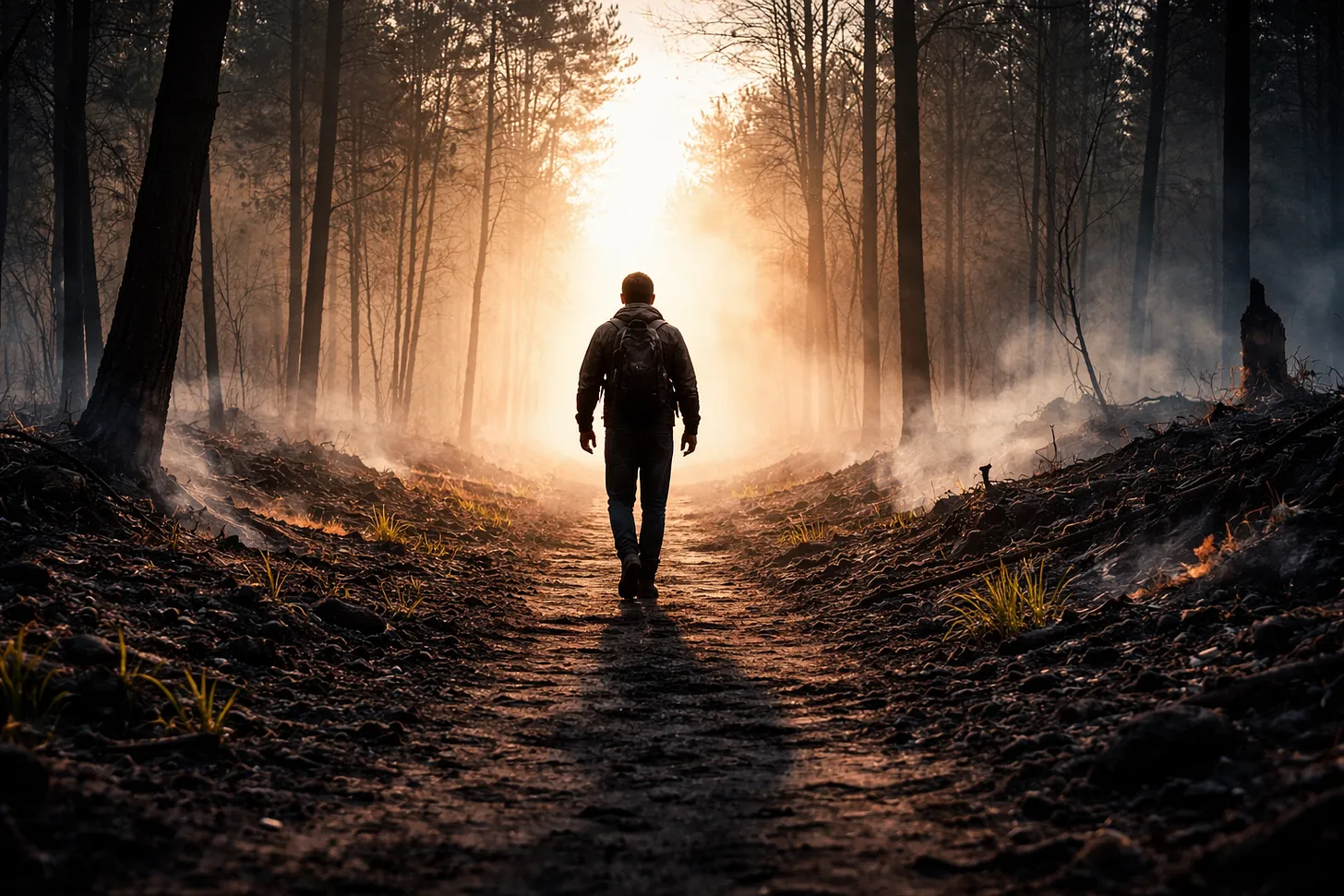
Those who are forged in struggle, shaped by hardship, are propelled by the friction of life itself toward a trajectory most will never know. It is in the fire of difficulty that momentum is born, and in that momentum, the possibility of greatness.
. . .
There is a pattern that shows up more often than people care to admit: those who achieve something meaningful are rarely the ones who had it easy in the beginning.
The vast majority pass through a difficult early stage, sometimes several. A trial by fire. Through that process, one that may have nearly ended their journey, they are pushed to a limit where they may have wished more than once for it all to be over, convinced they could not go on.
Yet it sets something in motion. A trajectory most will never know, not even in part. It creates a slingshot effect that, whether swift or slow, propels them toward a higher ideal, a broader vision, or a purpose that carries weight beyond themselves. From the outside, it looks distant, almost abstract. What it takes to get there is rarely understood.
Is this a prerequisite? I don’t know. But the pattern appears often. Look closely at those who have overcome immense odds and profound setbacks, and you will find many who go on to generate great works, wealth, influence, or power within the world system. Some of that influence is fabricated, installed into cultural narrative as a tool of persuasion. I am speaking of those who arrived there through lived experience, if that is still possible.
After watching a video titled “8 Canadian Families That Quietly Own Canada,” the pattern appeared again, at least in one variation. We all know the zero-to-hero story: the author, actor, musician, or industrial figure who rises from nothing. Many of these stories are manufactured. They serve a purpose. They humanize power and make it more digestible.
But for those who are genuine, who actually lived it, there seems to be a reality in which enduring hardship in pursuit of something meaningful generates momentum. Something ethereal about life responds.
There are layers to this. Coddled or overprotected children often grow into adults marked by infantilism: dependent, easily attached, uncertain even in basic decisions. Overprotection does not preserve innocence. It arrests development, leaving behind a quieter form of immaturity that presents as independence while avoiding responsibility.
Further along are those raised in grounded environments: rural settings, farms, homesteads. From an early age, they engage with the real, with dirt, work, and consequence. They develop competence, self-reliance, and the ability to decide and follow through.
This extends to elite athletes and high performers, those who obsess, train, and structure their lives with a level of discipline most would not tolerate or even think to entertain.
Then there are those forged in harsher conditions: slums, fractured urban environments, unstable homes. They navigate impossible choices and take on responsibility early. For them, it is often do or die. Some rise. Not many, but enough to illustrate the pattern. They endure, adapt, and break through. Their names may outlast them. They become symbols.
Of course, this is a generalization. Some take shortcuts. Some “sign the contract,” as it were. That is another discussion. The focus here is on those who do not, those who harness something fundamental, consciously or not, and shape a life others envy, resent, or dismiss as unattainable.
Success brings another battle: resentment, scrutiny. The tall poppy is cut down. Every detail is magnified — appearance, words, choices. Those who build nothing often become the loudest critics. You are either idolized or vilified, and the shift can be instant.
A mindset rooted in lack is corrosive. It shapes perception, behavior, even biology. It defines how people engage with reality.
Those who do not grow through challenge, who inherit or stumble into wealth without understanding it, often lose it just as quickly. There is no refinement of character, no earned relationship to what they possess. They attempt to speak a language they never learned.
We are shaped by our environments. Through immersion, we absorb skills, values, and ways of seeing, often unconsciously. We fall into patterns, traps, and distortions, navigating a world that is both beautiful and brutal. Many adopt a version of the victim mindset, often paired with narcissism, and carry it for life. It shows in posture, language, relationships, and in the story they live and project.
There is also the matter of time, or rather, the illusion of it slipping away. Many believe they are too late, too far shaped by what has already been, that the window has closed. But that does not hold up. No one is ever truly behind. As long as there is another day, there is the possibility of a different direction. A new trajectory can begin at any point.
The difficulty is not time, but identity. The longer one lives a certain way, believes certain things, and reinforces a narrative, the more disorienting it becomes to step away from it. The shift can feel abrupt, even unnatural. Terrifying. That friction is part of the process. It does not mean you are too late. It means you are breaking pattern.
Life may be generous, but it is never gentle. Its love is ruthless, uncompromising, and exacting. Free will is no soft gift. It is the foundation of existence, direct and unflinching. It does not grant permission to wander without consequence; it is the very instrument through which reality is shaped.
Which brings us back.
If meaningful success requires an equal and opposing force — the will to commit, endure, and transform through difficulty — then delay becomes the barrier. The longer we hesitate, the longer we postpone the process that opens doors, builds relationships, and reshapes perception.
And something else: the more tightly we try to control how everything unfolds, the more resistance we meet. This is not about faith or submission to something external. It is about alignment, trust, and action. About deciding, then moving. There is a kind of knowing beyond analysis that only responds once you begin.
At some point, it becomes a decision, not a feeling, not a hope, but a decision to move, to stay with it, to see it through. Most will wait. Some will drift. A few will act. The difference compounds over time. Most is out of your control, but not all of it.
That part is enough.
Solvitur ambulando
Written by Trance Blackman. Originally published on tranceblackman.com on 26 March 2026.