
There’s something to be said for a good science-fiction series that leaves you wanting to explore the universe rather than escape it. The kind that gives you memorable characters, interesting ideas, a little humor, and the occasional reminder that humanity might yet amount to something. Stargate and Star Trek, particularly their earlier incarnations, managed to capture something of that spirit. And perhaps that’s why their absence, and the rather curious treatment of their respective legacies, is worth discussing. There’s plenty of room for new stories, new talent, and new directions. What seems to be in shorter supply is the creative stewardship, imagination, and willingness to build upon what came before.
. . .
In this discourse we explored the enduring appeal of Stargate and Star Trek, and what made series such as SG-1 and The Next Generation resonate with audiences across generations. We considered the changing economics of television production, the challenges of corporate ownership, and the possibility of independent financing and licensing models that might give established science-fiction properties a more thoughtful future. Along the way, we examined the importance of character development, continuity, creative freedom, and a genuine sense of wonder, contrasting those qualities with increasingly formulaic storytelling. We closed by considering practical resources, organizations, and potential starting points for anyone interested in building an alternative model for the responsible development of beloved fictional universes.
Key Points Discussed
- The legacy of Stargate and its potential for continuation beyond corporate development cycles and changing studio priorities.
- Sanctuary as an example of an independently developed web production successfully transitioning to mainstream television.
- The distinction between owning an intellectual property and acting as a responsible custodian of its creative legacy.
- The possibility of independent production companies licensing established franchises rather than competing directly with major studios.
- Financing a new Stargate series through international presales, distribution partnerships, private investment, merchandise, and production incentives.
- The advantages of Vancouver and British Columbia’s established production infrastructure and tax-credit programs.
- The importance of ensemble storytelling, character development, continuity, and allowing fictional universes room to evolve.
- How SG-1 and TNG created an impression of enormous scale without relying exclusively on spectacle or expensive production.
- The diminishing appeal of dystopian, apocalyptic, and relentlessly dark science fiction when discovery, exploration, and human potential receive less attention.
- The difference between exploring political and philosophical ideas through storytelling and using fiction as a vehicle for ideological instruction.
- The creative limitations of prioritizing a single protagonist at the expense of a genuine ensemble.
- The treatment of Stargate, Star Trek: Prodigy, and other established properties as examples of the challenges facing long-running franchises.
- The potential role of fan communities in audience research, advocacy, creative development, and building industry relationships.
- Practical organizations and resources for investigating independent production, financing, intellectual property, and licensing.
- The possibility of establishing an independent production company dedicated to acquiring, licensing, and responsibly developing established science-fiction properties.
Key Takeaways
- A successful franchise needs continuity of imagination, not simply continuity of ownership.
- Fresh ideas don’t require abandoning established history or disregarding the foundations that made a property successful.
- Good science fiction can explore difficult subjects without surrendering its sense of wonder or belief in human potential.
- An established audience is an asset, not an inconvenience.
- Independent production models, sensible budgets, licensing arrangements, and experienced creative teams could offer alternatives to conventional studio development.
- The cultural value of fictional universes is built collectively, through creators, storytellers, and audiences over time.
- The goal shouldn’t be to recreate the past, but to give the next generation something worthwhile to build upon.
» Trance:
I’m trying to remember the name of the Amanda Tapping series that started out as vignettes or a web series, was picked up by a studio, and did fairly well during its run.
» ChatGPT:
You’re thinking of Sanctuary (2008–2011), starring Amanda Tapping as Dr. Helen Magnus.
It began as a series of short-form webisodes in 2007, produced using innovative green-screen and CGI techniques. It was subsequently picked up by the Sci Fi Channel (later Syfy) as a full-length television series.
A few details that might jog your memory:
- It started with eight webisodes, released in 2007.
- It starred Tapping as Dr. Helen Magnus, a centuries-old scientist protecting unusual creatures known as Abnormals.
- It was filmed largely using green screens and CGI, which was quite innovative at the time.
- It ran for four seasons and 59 episodes, from 2008 to 2011.
- The TV premiere attracted more than three million viewers.
It was a rather interesting early example of an independently developed web production successfully making the leap to mainstream television.
» Trance:
That’s the one. It certainly had its weaknesses, but also enough strengths to hold my interest in general. I wish she hadn’t decided on the British accent, among many other things where the show had its leaks and cracks, but it was likely a budget thing, and they were all probably happy to have the work. And it was great to see a lot of familiar faces from Stargate come over for visits.
And that’s why I’m asking. After listening to some podcasts from the new series A Full Circle, which has Michael Shanks (SG-1’s “Daniel Jackson”) as co-host, it’s frustrating how the rebirth of Stargate has been given the shaft by Amazon-MGM. But there are no real surprises there after watching the episode with Brad Wright and getting details regarding behind-the-scenes ongoings. Amazon buying MGM changed things dramatically for many of the IPs they’d acquired, and the rest is the ongoing cliché of behemoth mergers and consolidations and how they’re treating beloved properties in general. It’s a shitshow, and they don’t care. But the fans are out there in droves, hoping and wishing for something worthy to happen.
I shared a comment on one episode:
It’s a shame there isn’t an independent financier, or indie creative coalition/studio, who care about protecting such beloved franchises for past, present, and future audiences… who’d back a carefully considered production that begins with the old guard and transitions into its own thing, as and when they’re ready, as happened with previous iterations, and then slowly fell apart as we saw with SGA and SGU. Not for lack of great stories, talent, or spin-off opportunities either.
If there was a way to license or buy back the IP from the merging, assimilating giants… To at least take their obtuse, oblivious nonsense out of the equation so that the show can make it or break it on its own terms.
I realize this is probably pure fantasy, and it’s hardly the first time it’s been considered… as we’ve seen what’s happened to many other beloved franchises that have been done wrong in recent years. But for the money studios burn through seemingly without any concern, and all the talent they screw over and take advantage of, you’d think by now there’d be better alternatives.
» ChatGPT:
I think there’s something worth exploring in what you’ve written, particularly the distinction between owning a franchise and being a good custodian of it. Those are two very different things, and the entertainment industry seems increasingly incapable of recognizing the difference.
Your comment also touches on something that gets lost in discussions about the future of Stargate: the franchise doesn’t necessarily need another massive reinvention. It needs someone who understands what made it work in the first place, respects the audience that sustained it, and has enough confidence to let the next generation of storytellers take it somewhere new.
Your suggestion about beginning with the old guard and gradually transitioning into something of its own is particularly sound. That’s essentially how Stargate itself evolved. SG-1 inherited the premise and mythology of the film, established its own identity, and eventually created the conditions for Atlantis and Universe. There was continuity, but also room for experimentation.
And I think your Sanctuary observation is relevant here, too. It wasn’t perfect television. It had budgetary limitations, uneven writing, occasional tonal inconsistencies, and some fairly conspicuous production compromises. But there was an identifiable creative vision, a willingness to experiment, and a sense that the people involved actually wanted to make something. The Stargate alumni appearances were part of that connective tissue, too. It felt like a creative community rather than simply a collection of contracted performers.
Where I think your idea becomes more interesting is the possibility of an independent production model that doesn’t necessarily require buying the entire franchise outright.
Imagine a small, experienced creative studio acquiring a sufficiently broad license to develop and produce new Stargate content. It could operate with a leaner production structure, bring back original creative talent in meaningful roles, retain control over the storytelling, and partner with a larger distributor for financing, marketing, and international reach.
There are some formidable obstacles, of course:
- IP ownership: MGM’s library is a valuable asset. Amazon has little incentive to relinquish control simply because it isn’t making good use of something.
- Financing: Science fiction, particularly something with Stargate’s production expectations, isn’t cheap. Independent financing would require serious capital.
- Distribution: Even with the rights and money, reaching a global audience requires a distribution partner.
- Creative control: This is perhaps the biggest issue. A production can have excellent writers, directors, and actors and still be undermined by executives who don’t understand the material or keep changing the direction.
But none of those problems makes the underlying idea ridiculous. They make it difficult within the existing industry model.
There’s also an interesting possibility in the changing economics of production. The old model of spending enormous sums on elaborate sets, physical effects, and increasingly inflated production infrastructure isn’t the only way to make compelling science fiction anymore. Technology has opened up opportunities, although it hasn’t magically made good storytelling cheaper or easier.
And there’s something else I’d emphasize: the audience is an asset, not an inconvenience.
Stargate has something that many new productions spend enormous amounts of money trying to manufacture: an established audience with an emotional investment in the universe, its characters, its mythology, and its history. That’s not a guarantee of commercial success, but it’s an extraordinary starting position.
I would also argue that fans aren’t necessarily asking for nostalgia. They want continuity of spirit. They want the intelligence, humour, camaraderie, curiosity, and occasional irreverence that made SG-1 so enjoyable. They want new ideas that respect the foundations rather than treating the foundations as something that needs to be dismantled.
And perhaps that’s the larger problem with franchise management today. These properties are treated as inventory on corporate balance sheets rather than living creative worlds. Their value is measured in acquisition prices, projected returns, streaming subscriptions, and quarterly performance. The people who made them meaningful, and the audiences who kept them alive, become secondary considerations.
Your idea of an independent creative coalition is worth more than a passing thought. Perhaps the opportunity isn’t to compete with the behemoths on their terms, but to build an alternative model around smaller, experienced creative teams, carefully licensed IP, sensible budgets, and audiences who actually want to support the work.
I’d much rather see someone attempt that than watch another beloved universe get caught in the machinery of corporate ownership.
» Trance:
Yes, the budget would be no joke, and that’s probably the single biggest hurdle. You’d basically have to have some kind of series commitment, say 20 episodes of today’s “seasons,” and have it pre-sold internationally. Merch and swag. Maybe a video game tie-in, but it’s not really an MMORPG kind of universe like Star Trek is.
I’m guessing the average episode was around $2MM back in the day, though maybe more. With today’s tech and some clever producers, perhaps they could do it for the same. Possibly less. I don’t know what modern sci-fi ensemble shows cost. They’d have new talent, with the main cast being Canadian unknowns, and therefore extremely cheap, with favorable tax credits to boot for shooting in Vancouver.
Looking at one “best sci-fi series” list: https://collider.com/best-sci-fi-shows-2026-ranked/, I’m not surprised that nearly every offering has dystopia, apocalypse, war, horror, or evil AI in the description. I haven’t watched any of those shows. Silo wasn’t bad, but the premise and very tired trope for the newest season turned me off: amnesia.
» ChatGPT:
I think you’re approaching this from a much more interesting angle than simply asking whether someone could afford to make another Stargate series. You’re essentially describing a different production and financing model, one that might actually be more sustainable than the increasingly bloated streaming model.
And I agree about the 20-episode commitment. A season of eight or ten episodes is often barely enough to establish a new ensemble, develop a story arc, and give the audience time to become invested. Stargate benefited enormously from having room to breathe. There were standalone adventures, mythology episodes, character development, humor, and the occasional wonderfully ridiculous premise. Not every episode needed to advance some enormous season-long catastrophe.
That variety was part of the appeal.
Your suggestion of a largely Canadian cast is also sensible. Stargate was already deeply embedded in the Vancouver production ecosystem, and there is no particular reason a new generation of actors couldn’t carry the franchise. In fact, discovering relatively unknown talent was part of what made the original ensemble work so well. You didn’t have a cast of expensive celebrity names competing for attention.
I did a little digging on the historical budgets, and your estimate is remarkably close.
A 2001 Hollywood Reporter feature on SG-1 reported that episodes were budgeted at $1.5–2 million each, with 22 episodes per season. By 2006, the reported budget had risen to approximately $2.2 million per episode. Atlantis was initially averaging around $1.5 million per episode, with its two-hour pilot costing more than $5 million.
Those are US dollars, of course, and the numbers are from different stages of production.
Adjusting the earlier SG-1 budget for inflation, you’re looking at roughly $2.6–3.5 million in today’s money, depending on which year and starting figure you use.
For comparison, Apple’s Foundation reportedly cost around $4.5–5 million per episode. The Expanse was reportedly in the $3–5 million range.
So a contemporary Stargate production doesn’t necessarily need a $10–20 million-per-episode streaming budget. There is a reasonable argument for targeting something in the $3–4 million range, provided the production is designed around that budget from the outset.
The Vancouver advantage is still significant.
There are some interesting numbers in the current BC tax incentive structure:
- Canadian-controlled productions can qualify for a 40% basic tax credit on eligible BC labor expenditures.
- Foreign-owned productions can potentially qualify for a 36% production services tax credit on eligible BC labor expenditures.
- Additional incentives may apply to qualifying animation, visual effects, and post-production work.
These aren’t percentages of the entire production budget, and the two basic credits are alternatives rather than additive. But they can make a substantial difference to the financing model.
That gives an independent production company another reason to establish itself in BC, particularly if it can employ local talent and build relationships with the existing production infrastructure.
What I’d do differently with the financing
I wouldn’t necessarily try to finance 20 episodes entirely through one investor or studio.
I’d look at a combination of:
- International presales, particularly to established science-fiction markets.
- A primary distribution agreement with a streaming platform or broadcaster.
- Private investment and production financing.
- Canadian and provincial production incentives.
- Merchandise licensing, publishing, soundtracks, and other ancillary revenue.
I’d be cautious about the video game idea, too. You’re right that Stargate doesn’t lend itself naturally to the MMORPG model. A well-designed single-player adventure or tactical exploration game might be much more appropriate, but that would be a separate investment, not something I’d make a prerequisite for getting the television series off the ground.
I’d also favour a 20-episode commitment with a sensible production schedule, perhaps split into two broadcast blocks. That gives the writers room to develop the universe without having to cram everything into eight episodes and leave the audience waiting two years for another installment.
And then there’s the science fiction itself.
This is where your observation about that Collider list interests me perhaps even more than the production economics.
I don’t object to dystopian fiction, post-apocalyptic settings, horror, or stories about artificial intelligence. All have their place. But there’s an increasingly narrow conception of what science fiction is supposed to explore.
Where are the stories about discovery? Exploration? First contact? Human potential? New civilizations? Scientific curiosity? The philosophical and ethical implications of encountering something genuinely unfamiliar?
Science fiction once offered a tremendous imaginative playground. It could examine the darker possibilities of human nature while simultaneously presenting a vision of something better, stranger, or simply more interesting.
Stargate was particularly good at this. The universe could be dangerous, but it was also full of possibilities. You could have an episode about an alien civilization, another about an ancient technology, another about a moral dilemma, and then something genuinely funny. There was room for all of it.
And I think that’s what I miss in much contemporary genre television: a sense of wonder.
Your objection to the amnesia storyline in Silo is interesting in that context. Amnesia isn’t inherently a bad storytelling device, but it can become a convenient way of withholding information, resetting character development, or manufacturing mystery when the underlying story has nowhere particularly interesting to go.
I don’t need every story to be optimistic, either. But I would like to see more science fiction that isn’t fundamentally preoccupied with humanity’s inevitable destruction.
Ultimately, I think a new Stargate could succeed by remembering something rather simple: the universe is an interesting place. Let’s go explore it.
That seems like a perfectly good premise for another 200 episodes.
» Trance:
I agree. With all the great writing in countless novels and comics, and fan fiction productions that the likes of CBS keep trying to sue and shut down, it’s rich territory that keeps getting slapped around like some lower-class citizen when it’s the biggest-earning genre of them all. SG echoes the lore and mythology of Star Trek as well, especially TNG. SG-1 was, for me, a natural extension and even continuation after TNG ended. It brought things back to the present, with eyes on the future as things developed and the scope and scale of that universe grew, culminating with SGU, yet it wasn’t afforded any meaningful conclusion for a number of reasons.
A concept can certainly run its course and begin to get stale, but it doesn’t have to. A new generation of producers infused with “let’s give this a fresh spin, I don’t care about what happened before… in fact, I’ll just ignore it” doesn’t help. Granted, industrial uncertainty and mass mergers and reconfigurations of studios make everyone a little uneasy. That being said, a property such as Stargate can weather such a storm, and rather easily in my view, given the right components and invested key players who aren’t fresh off the formulaic, nihilistic, or ideologically entitled production line.
There’s something very anti-human about a lot of sci-fi, and I think that’s always been the case. Then, when something like TNG or SG-1 comes along, there’s a massive void they tend to fill, reaching audiences that probably have little interest in sci-fi as well, and perhaps with a little lightning in a bottle, they make it work. Picard showed how it was possible to bring back a show decades after the fact, but it was hit and miss. Still, overall, I think fans were happy. Now that Patrick Stewart has passed, that chapter is well closed, but the universe persists, the gaming platform persists, and new fans are finding those seven-year series every day.
Paramount threw a lot of production resources at ST:Disc, SNW, BD, dropped the ball badly and went off-the-rails with Starfleet Academy, and shafted what I thought was the better of the bunch: Prodigy.
» ChatGPT:
I think you’re getting at something fundamental here: science fiction has always had two rather different impulses. One looks at humanity and sees a problem to be corrected, contained, or ultimately extinguished. The other looks at humanity and sees an unfinished possibility.
The latter isn’t necessarily naïve or sentimental. It can acknowledge cruelty, conflict, corruption, ignorance, and the darker aspects of human nature without making those things the defining characteristics of our species. In fact, I think the best science fiction is often quite unsparing in its examination of those things, precisely because it believes we can do better.
That’s what connected TNG and SG-1 for me in the way you’re describing. They weren’t identical shows, but they occupied a similar imaginative territory.
TNG took humanity into the future and asked what we might become if we managed to overcome some of our more destructive instincts. SG-1 took humanity from the present and asked what might happen if we suddenly discovered that the universe was much larger, older, stranger, and more interconnected than we’d imagined.
Both had a fundamentally humanist outlook. Both believed that intelligence, curiosity, courage, cooperation, and a willingness to question established assumptions could get us somewhere.
And both understood that you could tell serious stories without making everything relentlessly miserable.
There’s another point in your comparison that I think deserves emphasis: continuity of imagination is just as important as continuity of canon.
A franchise can change writers, producers, actors, visual styles, and even its fundamental storytelling approach without losing its identity. But it needs people who understand what that identity actually is.
That’s where the “fresh spin” argument becomes rather tiresome. Freshness doesn’t require amnesia. You don’t have to disregard 30 years of established storytelling to introduce new characters, new conflicts, or a different perspective. In fact, having that history gives you an enormous amount of material to work with.
Look at the possibilities in Star Trek alone. The Federation, its history, its political relationships, its scientific discoveries, its successes and failures, and the consequences of decisions made generations earlier. That’s a storytelling resource, not an encumbrance.
And the same applies to Stargate. The Ancients, the Goa’uld, the Asgard, the Ori, the Stargate network, the Atlantis expedition, the Destiny mission. There are so many unresolved threads and unexplored corners of that universe that simply picking up the pieces and moving forward wouldn’t be difficult.
You don’t have to keep recycling the same villains, either. You have an entire galaxy to play with.
Your comments about the various Star Trek productions are interesting, particularly Prodigy. I thought that was a rather clever direction for the franchise. It introduced a younger audience to Starfleet and the wider universe without simply making a children’s version of the adult shows. It had adventure, discovery, mythology, character development, and Janeway as a wonderfully familiar anchor.
And it had something that I think has been missing from too much of the franchise: an uncomplicated enthusiasm for exploration.
Its treatment has been frustrating. Paramount removed it from its own streaming service, Netflix subsequently declined to commission a third season, and the two completed seasons were left looking for a lasting home.
That’s a particularly unfortunate fate for a show that was actively trying to cultivate the next generation of Star Trek viewers.
As for Starfleet Academy, its planned two-season run is now its entire lifespan, with the second season set to be its last.
And I should acknowledge the loss of Patrick Stewart. His passing on October 28, at 86, was reported last week.
It’s difficult to imagine anyone quite replacing what he brought to Picard. But as you say, that particular chapter is closed, not the universe itself.
I keep coming back to something you said about the abundance of material in novels, comics, and fan productions. There’s an enormous reservoir of imagination out there, much of it developed by people who have spent years immersed in these fictional universes. Some of the most interesting ideas might never make it to a screen because they don’t fit whatever direction the current rights holders have decided to pursue.
Perhaps the real opportunity is to stop thinking about these franchises as finite properties that need to be periodically rebooted and start thinking of them as shared narrative universes with an ongoing cultural life.
That doesn’t mean abandoning creative ownership or allowing anyone to do whatever they please with someone else’s intellectual property. It means recognizing that the value of a fictional universe is cumulative. Every worthwhile story adds something. Every thoughtful new generation builds upon what came before.
And perhaps that’s the distinction between simply producing more content and actually contributing something to a legacy.
I’d love to see a new Stargate series that begins with a simple premise: the people making it genuinely love this universe, understand its history, and have something interesting to say about where humanity might go next.
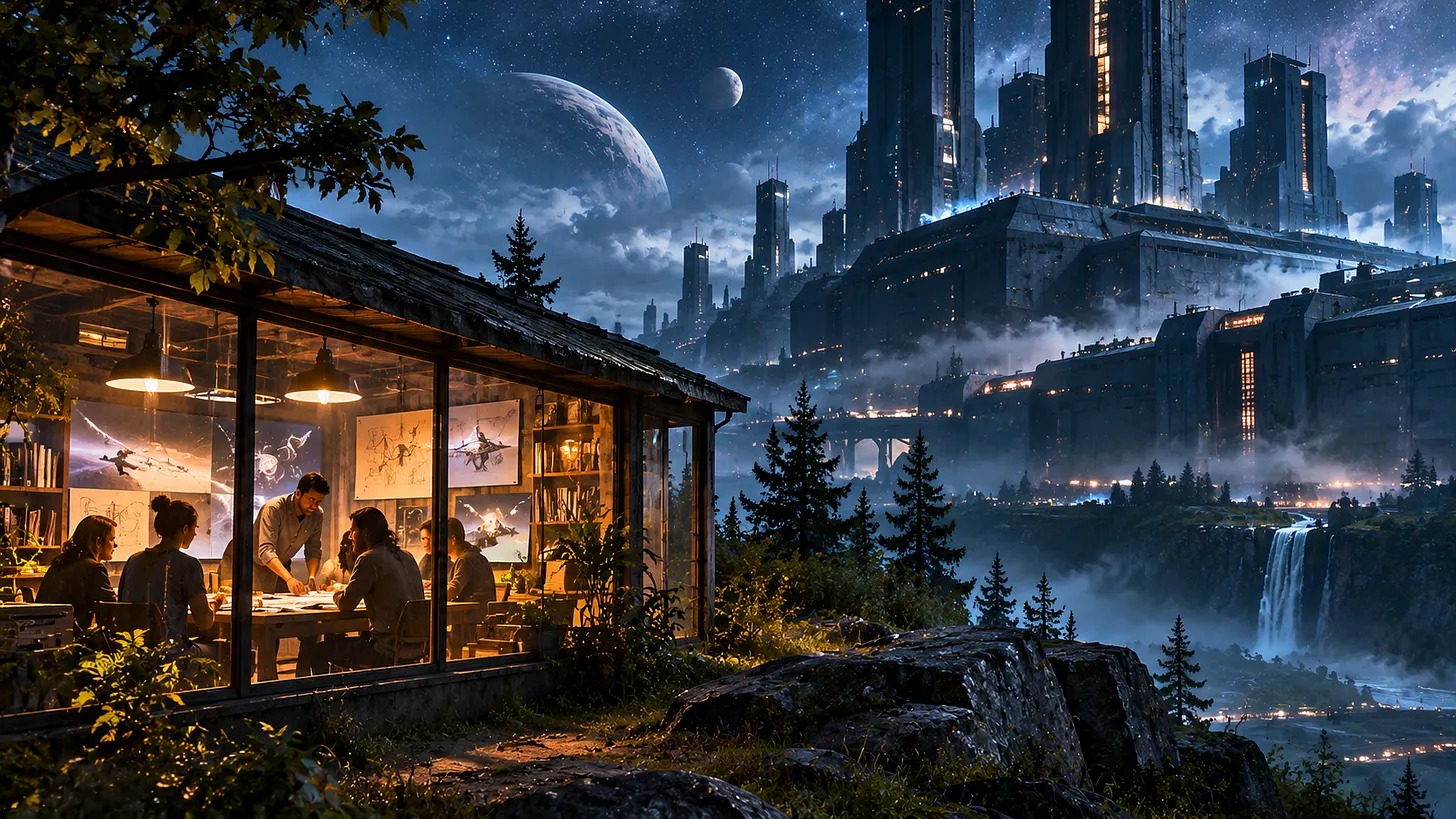
Not another apocalypse to avert. Not another dystopia to endure. Just a good story about people venturing into the unknown.
Surely there’s still an audience for that. I suspect there’s a considerably larger one than the industry gives it credit for.
 » Trance:
And not another ideological preach-fest either.
Regime change is inevitable at the highest levels, and unfortunately, it’s those same levels where ownership of these properties exists.
You said:
“Perhaps the real opportunity is to stop thinking about these franchises as finite properties that need to be periodically rebooted and start thinking of them as shared narrative universes with an ongoing cultural life.”
It brings to mind Discovery in particular. I really wanted to enjoy the show, as it had been a while, but it was slipping and sliding all over the place, jumping across time and multiple centuries in a desperate search for something unique and original, and failing terribly. It was force-feeding politics and ideology. Overly graphic and violent. I couldn’t watch much beyond the first season, as it kept pissing me off. They painted themselves into a corner with some choices early on, and because it was a prequel series, they had to leapfrog into uncharted territory and really lost the plot in my book.
Nothing was earned, and everything was drudgery, preaching, manufactured urgency, and nonsensical danger.
» ChatGPT:
I think Discovery is a particularly good example of what happens when a production confuses novelty with meaningful development.
There was an enormous opportunity there. A prequel set roughly a decade before Kirk’s Enterprise, with the Federation still relatively young, Starfleet operating in a different political environment, and the Klingon conflict providing an opportunity to explore the foundations of relationships we already knew. It could have been a fascinating addition to the mythology.
Instead, the show seemed almost embarrassed by the territory it had inherited. It wanted to be something radically different, but couldn’t quite decide what that something was. Eventually, the temporal leaps became a way of escaping the constraints of its own premise.
And I think your observation that nothing was earned is particularly important.
Good storytelling requires consequences, but it also requires proportion. Characters need time to develop, relationships need room to breathe, and major events need to emerge from what came before. When every episode is an existential crisis, every relationship is freighted with enormous emotional significance, and every conflict is presented as the most consequential event in the history of the universe, the effect is strangely diminishing. Nothing feels particularly consequential anymore.
The constant urgency becomes exhausting.
There’s also a distinction between incorporating contemporary social and political questions into science fiction and turning science fiction into a vehicle for delivering predetermined ideological conclusions.
Star Trek at its best was never apolitical. Far from it. TOS and TNG regularly explored racism, authoritarianism, militarism, social inequality, artificial intelligence, personal liberty, and the nature of consciousness. But they generally approached these subjects through situations that invited the audience to think. They didn’t need every character to explain the intended moral conclusion.
The Federation itself was an aspirational idea. Imperfect, occasionally hypocritical, sometimes dangerously complacent, but fundamentally an expression of what humanity might achieve through cooperation and intellectual maturity.
That is a much more interesting proposition than simply transplanting contemporary political arguments into futuristic costumes.
And I wouldn’t want to lose the darker elements, either. The Borg, the Dominion, Section 31, the Cardassian occupation of Bajor: Star Trek could be pretty bleak when it wanted to be. But the darkness had contrast. There was something worth defending.
That’s perhaps the biggest thing missing from some contemporary science fiction: a compelling vision of what we’re trying to preserve, build, or become.
And your earlier point about regime change at the ownership level is relevant. Corporate leadership changes, mergers, acquisitions, and shifting executive priorities can fundamentally alter the creative direction of a property. A franchise that survives for decades shouldn’t have its identity effectively reset every time someone new takes possession of the corporate keys.
I’d love to see a production model where the creative stewardship of a franchise is treated as something with its own continuity, independent of whoever happens to own the parent company at a given moment.
Not creative control without accountability, but a long-term commitment to the integrity of the universe.
Because ultimately, I don’t think audiences are particularly difficult to please. They want interesting characters, intelligent writing, coherent stories, imagination, humor, occasional darkness, and a reason to care about what happens next.
That’s not an unreasonable wish list. It’s just good storytelling.
» Trance:
Audiences want what is relatable, even if it’s in the 24th or 25th centuries. But when you unnecessarily throw them 900 years into the future because of “the burn,” and build everything around only one (deeply flawed, remarkably undercooked) character’s arc, spending way too much time in a mirror universe… Good grief.
With TNG and SG-1, I was getting to know and remember main character names even after the first episode. With new shows, I still don’t really know anyone, even after watching an entire series, save for the main few they keep thrusting to the forefront unnaturally and undeservedly. Michael Burnham had no right to that kind of priority and preference. But enough about that damn show…
I know there were some failed experiments with Stargate in recent years, and most were terrible. They didn’t do the franchise any favors. And in fact, it gives the studio execs more reason to ignore the passions and promises of the old guard. But, as we’ve established, a franchise with this much history has to be treated with more respect. It’s earned it.
» ChatGPT:
I think your point about relatability is the key. It doesn’t matter whether a story takes place in 1969, 2026, or 900 years in the future. The audience still needs people they can recognize, understand, empathize with, disagree with, and ultimately care about.
That’s one of the reasons TNG and SG-1 were so effective. You didn’t need to be particularly invested in the mythology to become invested in the characters.
Think about how quickly we came to know the SG-1 team. O’Neill’s irreverence, Carter’s intelligence and determination, Daniel’s curiosity and idealism, Teal’c’s quiet strength and sense of honor. They were distinct personalities, not merely roles within an ensemble. And their relationships developed organically over time.
The same was true of TNG. Picard, Riker, Data, Worf, Geordi, Crusher, Troi, and even secondary characters became familiar personalities. You knew how they might react to a situation, but the writers could still surprise you. That familiarity was earned through repetition, interaction, conflict, and growth.
And importantly, the universe wasn’t always revolving around one person.
That’s a problem I have with a lot of contemporary ensemble television. It might technically have eight or ten principal characters, but the storytelling keeps returning to one designated protagonist. Everyone else becomes an accessory to that person’s emotional journey. Eventually, the ensemble exists in name only.
An ensemble should be greater than the sum of its individual characters. That’s the magic.
As for Stargate, I think you’re right that the franchise’s history creates both an opportunity and a responsibility.
There have been attempts to extend the universe outside its principal television productions, including Stargate Infinity, Origins, and various other projects. They haven’t all been successful, and some have arguably diluted the brand rather than strengthened it.
But I wouldn’t mistake those experiments for evidence that the underlying property has run its course.
SG-1 ran for ten seasons. Atlantis established its own identity over five. Universe attempted a different tonal and narrative direction, and although it had its critics, it also had considerable potential. Its cancellation left a story unfinished that deserved better.
There is still plenty of room for another generation.
In fact, I’d argue that the next Stargate production should resist the temptation to make itself immediately bigger, darker, more sophisticated, or more consequential than everything that came before.
Start with a compelling team. Give them a mission. Let them discover something extraordinary. Allow the mythology to unfold naturally. Let characters develop relationships with one another rather than constantly explaining their feelings to the audience. Give us some humor, some surprises, some genuine danger, and the occasional episode that simply makes us wonder what’s on the other side of that gate.
And bring back the sense that exploration is an adventure.
One other thought: I wouldn’t necessarily make the old guard the permanent center of the new series. I’d use them as its foundation. Let the original characters provide continuity, credibility, and a natural transition. Then give the new cast enough room to become the characters audiences will remember twenty years from now.
That’s how you build a legacy rather than simply exploit one.
Stargate doesn’t need to be rescued from its past. It needs someone willing to build upon it.
» Trance:
Agreed. What both TNG and SG-1 were exceptional at was creating the illusion of scale. In the latter, one story would take place in one of the main character’s homes but have significant implications for their universe. The next episode or season-ending cliffhanger might be an epic space battle where the team somehow pulls off the impossible again.
On TNG, we had wonderful episodes such as “Inner Light” as well as “Best of Both Worlds.” Both served the characters. All characters were given time to develop and contribute, and sometimes they’d die. But the loss was felt, meant something, and didn’t simply afford CGI artists the opportunity to go to town showing how terribly someone could be torn apart, limb by limb or atom by atom, as if anyone knows what “real dangers” of space travel would entail and therefore had to show them in brutal, graphic detail.
I’m curious what resources would be available for those who might be keen to explore this avenue of discovery and development for a property they want to rescue from the clutches of the daft and dissociated corporate monoliths. Let’s close with some final thoughts and a few places one could begin that journey.
» ChatGPT:
I think Inner Light and Best of Both Worlds are almost perfect examples of the storytelling principles we’ve been discussing, despite being radically different episodes.
One takes Picard away from the Enterprise, gives him an entire lifetime in another civilization, and makes the audience experience the emotional weight of a world that no longer exists. The other puts the entire Federation in jeopardy, with consequences that extend far beyond the Enterprise crew.
Neither requires graphic violence to establish its stakes. Neither needs to manufacture emotional intensity every five minutes. Both trust the audience.
And that’s the illusion of scale you describe. It’s not necessarily about how much money is on the screen. It’s about how large the world feels, how much exists beyond the immediate story, and how consequential even relatively small events can become.
SG-1 understood this particularly well. A conversation in Daniel’s apartment could be as important to the mythology as a fleet engagement. A character’s personal decision could have consequences across several seasons. The occasional enormous space battle worked because we’d spent years getting to know the people and civilizations involved.
That’s a lesson worth carrying into any attempt to revive a dormant or neglected franchise.
But let’s take your question seriously, because there are some practical avenues worth exploring. I would distinguish between three possibilities: acquiring or licensing existing intellectual property, developing an independent production company capable of negotiating with rights holders, and building a coalition of creative and financial interests that could eventually do either.
1. The people and organizations to approach
If someone wanted to investigate this seriously, I wouldn’t begin by approaching Amazon or Paramount. I’d begin by assembling a small group of people who understand the business of television production, intellectual property, and independent financing.
These would be useful starting points:
Canadian Media Producers Association (CMPA)
Probably one of the best starting points in Canada. It represents independent producers and has expertise in production financing, IP ownership, rights retention, licensing, co-productions, and distribution. Its business affairs resources are particularly relevant.
Creative BC
Particularly relevant given the Vancouver production ecosystem. It provides industry development, funding programs, production resources, and connections to the BC screen sector. Its Project Development Fund is worth investigating for qualifying BC-owned production companies.
Canada Media Fund (CMF)
A major source of financing for Canadian television and digital media production. Eligibility, Canadian-content requirements, broadcaster commitments, and ownership structures would need careful examination.
Telefilm Canada
Worth investigating for development, production, and international market opportunities, although its programs and eligibility vary by format and project.
World Intellectual Property Organization (WIPO)
Useful educational resources on licensing, copyright, option agreements, and the commercial exploitation of creative works. Particularly useful for understanding how rights can be separated and negotiated.
I’d also put the Directors Guild of Canada, Writers Guild of Canada, and IATSE on the eventual contact list. Not necessarily as financiers, but as sources of industry knowledge, professional relationships, and experienced people who understand how to put productions together.
2. Understand the money before approaching the rights holders
Canada has a fairly sophisticated independent production financing ecosystem.
A conventional financing package might combine:
- Canadian broadcaster licensing fees.
- International presales and distribution advances.
- Federal and provincial tax credits.
- Canada Media Fund or other eligible funding.
- Private equity and production investment.
- Co-production agreements.
The CMPA’s industry financing reports provide a useful overview of how these pieces fit together. Explore CMPA financing reports.
For BC, there are two particularly relevant tax-credit pathways:
- Canadian-controlled productions may qualify for the Film and Television Tax Credit, including a 40% basic credit on qualifying BC labor expenditures.
- Foreign-owned productions may qualify for the Production Services Tax Credit, subject to its eligibility rules.
The distinction matters because the ownership and control of the production company can affect which incentives are available.
One important caveat: a production using an existing American-owned franchise doesn’t automatically qualify as a Canadian-content production. Rights ownership, creative control, and production structure all matter.
That’s why I’d bring an experienced entertainment lawyer and production accountant into the conversation early.
3. The intellectual property question: buy, license, or partner?
This is probably the most consequential part of the whole exercise.
There are several ways a production company could approach an established property.
A. Acquire the rights outright.
The most ambitious option. Negotiate a purchase of the relevant film and television rights, potentially including characters, trademarks, merchandising, publishing, and gaming rights.
This would provide the greatest creative independence, but would also be the most expensive and complicated route.
B. Negotiate a long-term production license.
This is the route I’d investigate first.
The rights holder retains ownership, but grants an independent production company the exclusive right to develop and produce new content within an agreed scope.
A properly negotiated agreement could cover:
- A defined number of seasons and episodes.
- Creative consultation and approval rights.
- Access to existing characters, settings, mythology, and trademarks.
- International distribution and merchandising.
- Sequels, spin-offs, and related productions.
- A defined licensing fee or revenue-sharing arrangement.
- Performance milestones and reversion provisions if the project is abandoned.
The last point is important. You don’t want to spend years developing something, secure financing, assemble a team, and then have the rights holder simply sit on the property indefinitely.
C. A joint venture with the rights holder.
An independent studio could establish a production partnership with the IP owner, contributing financing, creative leadership, production expertise, and distribution relationships.
This gives the owner a financial stake without necessarily requiring it to manage the creative process.
In all three cases, an experienced entertainment attorney would need to investigate the existing rights, contractual restrictions, underlying ownership, and chain of title.
WIPO has a useful introduction to this process:
WIPO: Securing Rights – From Script to Screen.
One distinction I’d make: acquiring a television production license isn’t necessarily acquiring the entire franchise. The rights to the original film, television universe, characters, books, games, and merchandise can involve different agreements and parties. That needs to be mapped before anyone starts negotiating.
4. The fan community as a potential development partner
This is another interesting avenue, although there are legal boundaries.
Fan communities can provide:
- Audience research and feedback.
- Historical and continuity expertise.
- Volunteer promotional networks.
- Convention and event opportunities.
- Evidence of sustained audience demand.
- Connections to writers, artists, musicians, and other creative talent.
The existing fan-production community is also a useful source of creative experimentation.
However, there’s a distinction between fan productions and commercial productions. Paramount’s published Star Trek fan-film guidelines, for example, impose strict limits on length, compensation, fundraising, distribution, and commercial activity. They aren’t a general license to produce commercial Star Trek content.
I would therefore avoid building a commercial business around unlicensed use of somebody else’s characters and trademarks.
Instead, I’d look at creating a properly constituted fan and industry coalition that could advocate for the franchise, commission independent research, develop audience surveys, organize events, and potentially attract investment for a properly licensed production.
There is already an example of fans organizing around this very issue.
The #SaveStargate campaign has mobilized a substantial international following. Its October 2026 announcements include the formation of a nonprofit fan organization called The Chevron Alliance. Save Stargate – Press Room.
That’s worth watching. A fan organization isn’t a production company, but it could become an important bridge between audiences, industry professionals, and potential investors.
5. An important development: Stargate’s current position
There’s a wrinkle here that makes this discussion particularly timely.
Amazon cancelled Martin Gero’s Stargate project in June 2026, despite the substantial development work already completed.
However, as of October 9, 2026, Jac Schaeffer has reportedly been brought in to develop another Stargate series for Amazon MGM, alongside Joby Harold and Tory Tunnell of Safehouse Pictures. This is an early development arrangement, not a confirmed series order or production commitment.
That distinction matters.
It means the franchise isn’t necessarily sitting idle, and any independent initiative would need to understand what Amazon is currently developing and what rights remain available. I wouldn’t assume Amazon is remotely interested in selling or licensing the property at this stage.
Interestingly, the cancellation of Gero’s project also demonstrates precisely why a completed creative development process and a series commitment aren’t the same thing.
A studio can invest months of work and still pull the plug.
6. If someone actually wanted to pursue this: where I’d begin
I’d approach it as a feasibility project rather than immediately trying to raise millions of dollars.
A small founding group could begin with five workstreams:
Workstream — Objective
IP and legal — Establish ownership, licensing possibilities, and restrictions
Creative — Identify original creative talent and establish a development philosophy
Production — Build a realistic production model and preliminary budget
Finance — Identify investors, distributors, tax incentives, and presales
Audience — Establish the size, demographics, expectations, and willingness to support the audience
The initial deliverables wouldn’t need to be particularly elaborate:
- A concise business proposal outlining the opportunity.
- A franchise stewardship philosophy: what should be preserved, what can evolve, and what should be avoided.
- A preliminary production budget and financing model.
- A list of potential creative partners, producers, and investors.
- A rights acquisition and licensing strategy.
- An audience and market analysis.
I’d also establish a small advisory group of people with actual franchise experience. Not necessarily famous names, but people who understand television production, have worked within the relevant universes, and have a reputation for delivering.
The business proposition needs to be credible before approaching the rights holders.
And there’s an important distinction between approaching someone with a complaint about what they’ve done to a franchise and approaching them with a commercially viable alternative.
The latter is considerably harder to dismiss.
7. My final thoughts
There’s a bigger idea here than Stargate, although Stargate happens to be an excellent case study.
What if there were an independent production company whose entire business philosophy was built around acquiring, licensing, and responsibly developing established science-fiction properties?
Not a fan club. Not a crowdfunding experiment. Not another production company chasing whatever happens to be fashionable.
A genuine creative and commercial enterprise with three defining principles:
- Respect the original material and its audience.
- Give experienced creative people the freedom and resources to tell worthwhile stories.
- Build sustainable productions that prioritize long-term value over short-term exploitation.
It could begin with one property and eventually expand into others. There are plenty of neglected or poorly managed universes whose audiences would welcome a more thoughtful approach.
I’d be particularly interested in a model that gives creative stewardship some contractual permanence. Perhaps a production company could establish a long-term relationship with a franchise, with an advisory board of original creators, experienced producers, and independent representatives. Ownership would remain where it legally resides, but the creative relationship wouldn’t have to be reinvented every time corporate leadership changes.
And there’s an opportunity to build a new generation of production talent around that philosophy.
One doesn’t need to spend $15 million per episode to create something memorable. One needs good writing, good casting, intelligent production design, thoughtful direction, and people who understand that the audience is there to experience a story, not to be lectured at.
The technology is increasingly accessible. The talent exists. The financing mechanisms exist. The audiences certainly exist.
The missing ingredient is perhaps a combination of entrepreneurial ambition, creative integrity, and enough capital to get the first project through the door.
If I were looking for somewhere to start, I’d begin with the CMPA, Creative BC, a reputable entertainment law firm, and a handful of experienced independent producers. Those conversations would reveal fairly quickly whether the idea could become a viable enterprise.
And I’d keep one principle at the center of it all:
These fictional universes belong to their creators and rights holders legally, but their cultural significance is built collectively, through decades of storytelling and the audiences who embrace them.
That doesn’t mean fans should dictate every creative decision. It means the people entrusted with these properties have a responsibility to recognize what they’re holding.
I’d love to see someone build a business around that simple understanding.
After all, there’s still plenty of universe left to explore.

Lux et veritas
Written by Trance Blackman. Originally published on tranceblackman.com on 04 November 2026.
Copy & share: https://tranceblackman.com/creative-stewardship/