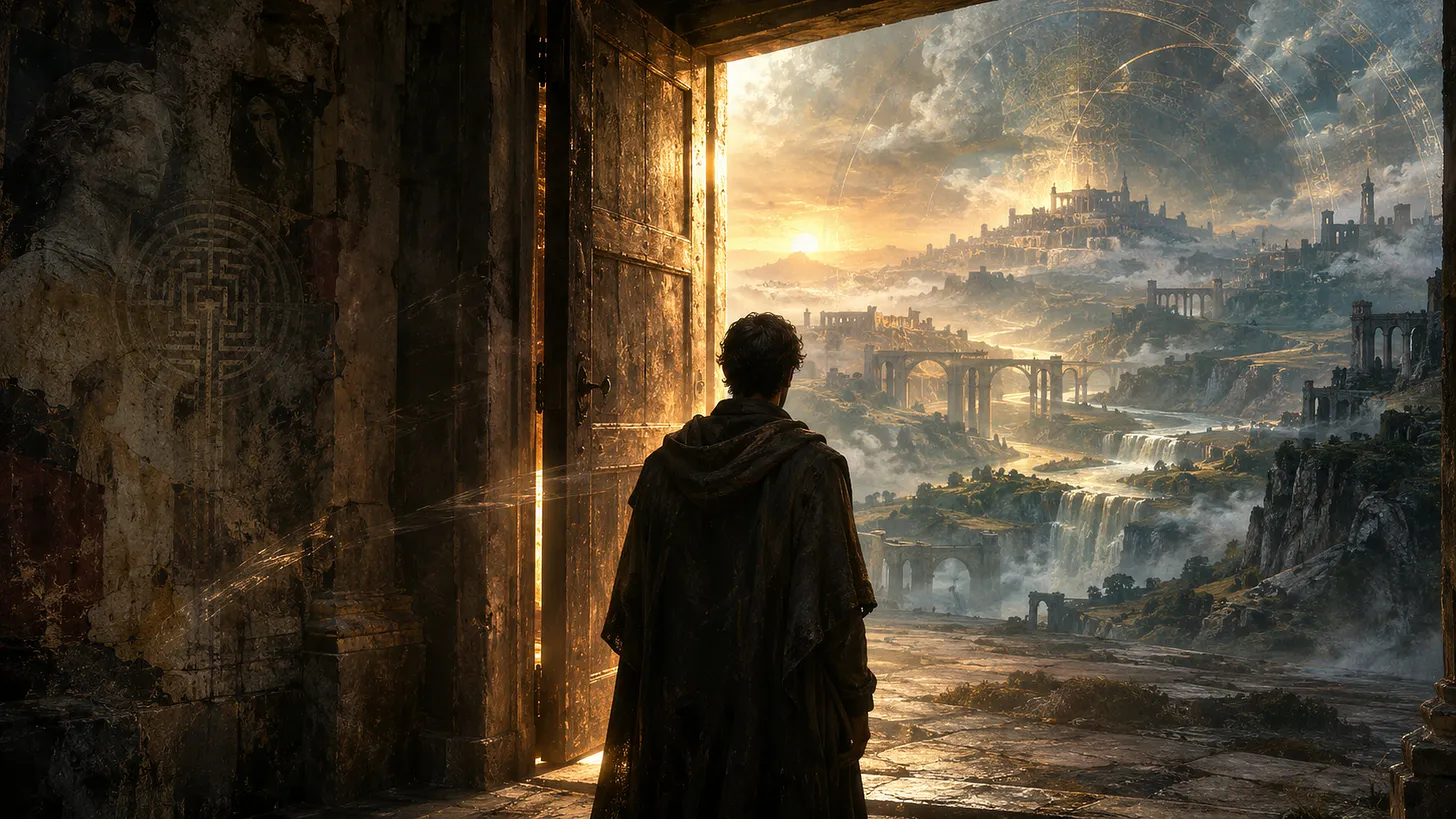
We inherit more than the circumstances of our lives. We inherit ways of seeing, interpreting, and making sense of the world, along with the fears, beliefs, and assumptions that shape our understanding of what is possible. Much of what we take for reality may be something we’ve learned to accept long before we’ve developed the means to question it. And perhaps some of the most important questions we can ask concern not only the nature of the world around us, but the nature of our own participation in creating and sustaining it.
. . .
Demons. We’ve all heard about them. Some of us, many of us, claim to have fought with them. For some, the language is metaphorical, describing the internal struggles, destructive impulses, unresolved trauma, and psychological burdens we all encounter to varying degrees. For others, the experience is understood quite literally, involving independent entities or forces believed to operate outside the individual. And somewhere between these interpretations lies a much broader set of questions, particularly when it comes to those who have battled schizophrenia and other related mental disorders. After listening to several interviews (Crrow777 Radio episodes 660, 661, 665, and 666) with people who have dealt with these issues, including practitioners who have worked with many different clients over decades, some questions come to mind.
Why are these things permitted? How are these entities, if they exist as described, even allowed to do what they do? Why is humanity always at the whim of forces, entities, archons, demons, whatever you want to call them? How is it that we’re the playthings of the parasitic and the predatory?
When you listen to the interviews with survivors, those who have overcome these experiences, written books about them, and gone on to teach and counsel others about how to overcome the same issues, you begin to consider a much broader audience. All of us experience thoughts, impulses, and influences that seem to operate beyond our conscious control, and some report experiences they understand as originating outside themselves. At some point, a door may have been opened, whether metaphorically or through a particularly vivid experience of altered consciousness. Perhaps through drugs, alcohol, traumatic experiences, or deliberate participation in rituals and medicinal ceremonies. But what exactly is happening when that door opens? Much of what we experience may be generated biochemically within our own brains, given the right ingredients, circumstances, and conditions. Yet the experience can seem entirely external, as though we’ve entered another place, encountered another intelligence, or allowed something else to enter ours. Much like a dream, the experience can be utterly convincing while we’re immersed in it. We interpret what we’re experiencing through the perceptual and conceptual frameworks available to us, which may themselves be considerably altered in these states. And perhaps there is something beyond our ordinary perception; perhaps there isn’t. The experience itself doesn’t require us to assume either possibility.
There’s also the question of expectation and conditioning. We don’t enter these experiences as blank slates. We’ve spent our entire lives absorbing stories, images, beliefs, and conceptualizations about the nature of reality and what might exist beyond it. If we’ve been saturated with science fiction, with fantasy, with increasingly graphic violence and horror, with popular representations of space, extraterrestrial intelligence, and other dimensions, might those ideas inform what we subsequently experience and how we interpret it?
Similarly, those raised within particular religious traditions may encounter visions, entities, heavenly realms, or afterlife experiences that bear a striking resemblance to the imagery and expectations they’ve carried throughout their lives. The same might be true of near-death experiences, out-of-body experiences, and encounters with seemingly autonomous intelligences. Perhaps we’re encountering something beyond ourselves; perhaps we’re experiencing the extraordinary creative and interpretive capacities of our own consciousness. And perhaps the distinction isn’t nearly as easy to establish and discern as we’d like to think.
These ideas, these voices, come with interjections, thought injections, mental disruptions, and distortions of reality. These are elements of our earthly experience that, for the most part, seem to be aligned in direct opposition to what we want to be, do, and accomplish in this life.
And it’s curious to me why this is permitted to happen. Is it we who have co-created this concept, this layer of reality, this inter- or trans-dimensional interference? Or is it some notion of a god of this realm, but not the God, as it were? And, as others have suggested, what kind of all-loving God would permit this constant pain, suffering, violence, and struggle among his apparent children in the first place? It would seem to me there is some sort of intercessor. An intermediary. Perhaps even an intruder who has created some sort of reality overlay, a false construct in place of, or in between, us and the real. I don’t know. I’m simply making an observation, unattached to or irrespective of any particular group, religion, or belief system. There are a plenty of different interpretations and plausible philosophical, theological, or ideological claims about the nature of this seemingly captured, or fallen, reality-making machine.
To me, light is light, truth is truth. But I think we have a problem discerning where that really begins and ends. We have a problem with the many layers of stories we’ve been inculcated and indoctrinated into. We have a problem with collective consciousness in general. Is it that the whole thing is captured and corrupted? Is it that there’s some creator of a reality overlay who’s having their way with us? One who has free rein to cause all manner of pain, chaos, and disorder? Something that perpetually operates to generate and feed off humanity’s “loosh” energy? That’s another convenient and plausible construct, but one that also contains an element of spiritual bypassing.
Or is something else going on here?
The survivors and those who overcome speak of their come-to-Jesus moment, sometimes quite literally. It’s incredibly cliché, but, at least to them, it’s also quite powerful and life-changing. But, in my view, it’s incomplete.
They speak of someone coming into their lives and telling them that what they’re experiencing is plain and simply demonic. If they start reading scripture and saying particular prayers or psalms, they can reclaim that authority and banish these entities, energies, and demonic forces from their lives. They can detach them from feeding upon their souls. And that is essentially what they seem to experience. But, if you listen closely, the fear remains. As with most prescriptions, what happens when you stop taking them? That fear is an illusion, based on an incomplete understanding and, perhaps, an incomplete healing process.
So, you’ve banished the demons. My question then is: wouldn’t that simply reflect accessing or opening oneself to a slightly higher level, a higher dimension operating within the same hierarchical control structure? Something that supersedes and overrides the authority of the minor imps, demons, and little minions that take advantage of the ignorant, traumatized, downtrodden, and unaware?
I’ve explored this concept before in different ways. I don’t think I’ve come to any sort of satisfactory resolution about it either. It’s important to me to understand and discern, to shed light upon the distortions of these life-altering elements of our shared reality. It’s important to me in my own life to reconcile these ideas and how they may be affecting my own progress, my own journey, and my efforts to rectify imbalances, remedy impositions, heal, adapt, and reclaim agency and authority in every way possible.
There are any number of stories about how we’re entrapped and extracted from on different levels, not simply the physical or material. And there are any number of explanations, remedies, and ways to take back that which has been misappropriated or redirected elsewhere; ways to reclaim that energy, that life force, that something essential to our freedom and liberation from the negative, parasitic, and predatory.
We’ve all probably done reprehensible, ridiculous, stupid, and repulsive things in our lives. For some, repenting our sins and absolving ourselves of these lingering spiritual nuisances is enough to elevate ourselves out of the mire of those lower-level energies. And how could it not be so? But if there are forces that feast upon those who are festering, faltering, and downward spiraling due to their own choices, behaviors, or lack of awareness, I question the nature of what they represent and where they came from. I question why they are never fully defeated or erased from existence. I question the very nature of our reality. For if everything is in some way contractual, if our lives are dictated by the agreements we’ve made consciously and unconsciously, when and how will that parasitic cycle ever end?
But there’s another consideration here: the power of the human mind itself. We tend to underestimate what we are, what we’re capable of, and what our creative faculties might actually represent in the greater scheme of things. In my view, we are, in a very real sense, creator beings. We imagine, conceptualize, believe, project, construct, and collectively reinforce entire worlds of meaning and experience. What begins as an idea can become a belief, a belief can become a shared reality, and a shared reality can take on a life of its own. There are concepts within esoteric traditions, such as the egregore, that speak to precisely this possibility: collective thought-forms sustained by the attention, emotion, intention, and belief of those who participate in them. Whether understood literally, psychologically, or as an allegory for the power of collective consciousness, it’s an intriguing proposition.
What if some of the very constructs that govern and influence our experience are, at least in part, sustained by the creative energy of those subject to them?
Perhaps this is where we need to reconsider the nature of the forces we’re dealing with, and the extent to which we might be contributing to their existence and perpetuation.
We don’t necessarily need Dante’s nine circles of hell as a literal cosmological framework, but they offer an interesting allegory, another way of interpreting the various layers and degrees of suffering, corruption, and spiritual entrapment that seem to characterize so much of human experience. Perhaps these ancient descriptions, religious narratives, and esoteric interpretations are all attempts to articulate something that is otherwise difficult to comprehend. They may be imperfect maps, but that doesn’t necessarily mean there’s nothing to be found in the territory they describe.
And what if our own creative forces are being weaponized against us? What if the very essence through which we create, sustain, and experience this world, perhaps even the universe itself, is also the source from which these mechanisms of suffering are fabricated and perpetuated? The same imaginative, emotional, spiritual, and intentional capacities that allow us to build, love, discover, and transcend might also be turned toward the construction of fear, division, limitation, and suffering. Perhaps we’re participating in something much larger than we realize, lending our attention, our energy, and our creative authority to constructs that ultimately work against us. If so, reclaiming that authority would seem to require more than simply resisting the apparent forces of opposition. It would require a deeper understanding of what we are, what we’re contributing, and what we’re capable of creating instead.
It brings to mind the work of Howdie Mickoski, among others. This quote is from the book blurb for Exit the Cave on his website:
“Most people will say something feels terribly wrong… with reality, the world, life. Why is that? Because something is wrong. This whole experience called ‘life on Earth’ is a falsified lie.”
That’s a significant claim. He’s spoken about the years of work he put into his personal journey of recapitulation, essentially reliving every life experience, going back and back and back, to reclaim his entire story, bit by bit. The premise is that, in doing so, one may unravel attachments, dispel illusions, better understand those who’ve influenced us and how we’ve influenced them, and, in this way, liberate the spirit and unburden the soul moving forward. Few of us would have that kind of dedication or commitment. He’s written books about exiting and then emptying the cave after coming to the realization that we humans are all essentially living in a reality as described in Plato’s allegory of the cave, perhaps victims of some kind of reincarnation trap. He echoes my earlier sentiments somewhat in the next segment of the book blurb:
“Standard spirituality, religion and the New Age tell us that we live in a wonderful world, made by a creator who loves us, and who is always waiting for our prayers. Yet some groups, such as the Gnostics and Cathars, believed that we live in a virtual reality simulation, fashioned by an evil creator, with the purpose of consuming our energy and keeping our soul trapped. Plato created the allegory of the Cave to present that we live in a non-real reality, and in fact, are prisoners in it.”
These are very old ideas that keep being recycled and reintroduced throughout the cultures and societies of the world. But they’re all variations of the same story, and they’re all incomplete. And perhaps that’s inevitable. We’re all limited by our particular time and place in human history, by the language available to us, our ontology and epistemology, our spiritual and religious indoctrination, and the accompanying fears and terrors, real or imagined, that inform our understanding of existence. Even Dante, in attempting to describe the nature of hell and the various degrees of human suffering and transgression, could only work within the conceptual framework available to him. His was a particular expression of consciousness, informed by the theology, philosophy, politics, and cultural conditioning of his era. That doesn’t necessarily invalidate what he wrote, but it does raise questions about how much of what he described was an accurate representation of something encountered, how much was an interpretation of something he couldn’t fully comprehend, and how much was a product of the very belief systems and conditioning through which he experienced and understood it.
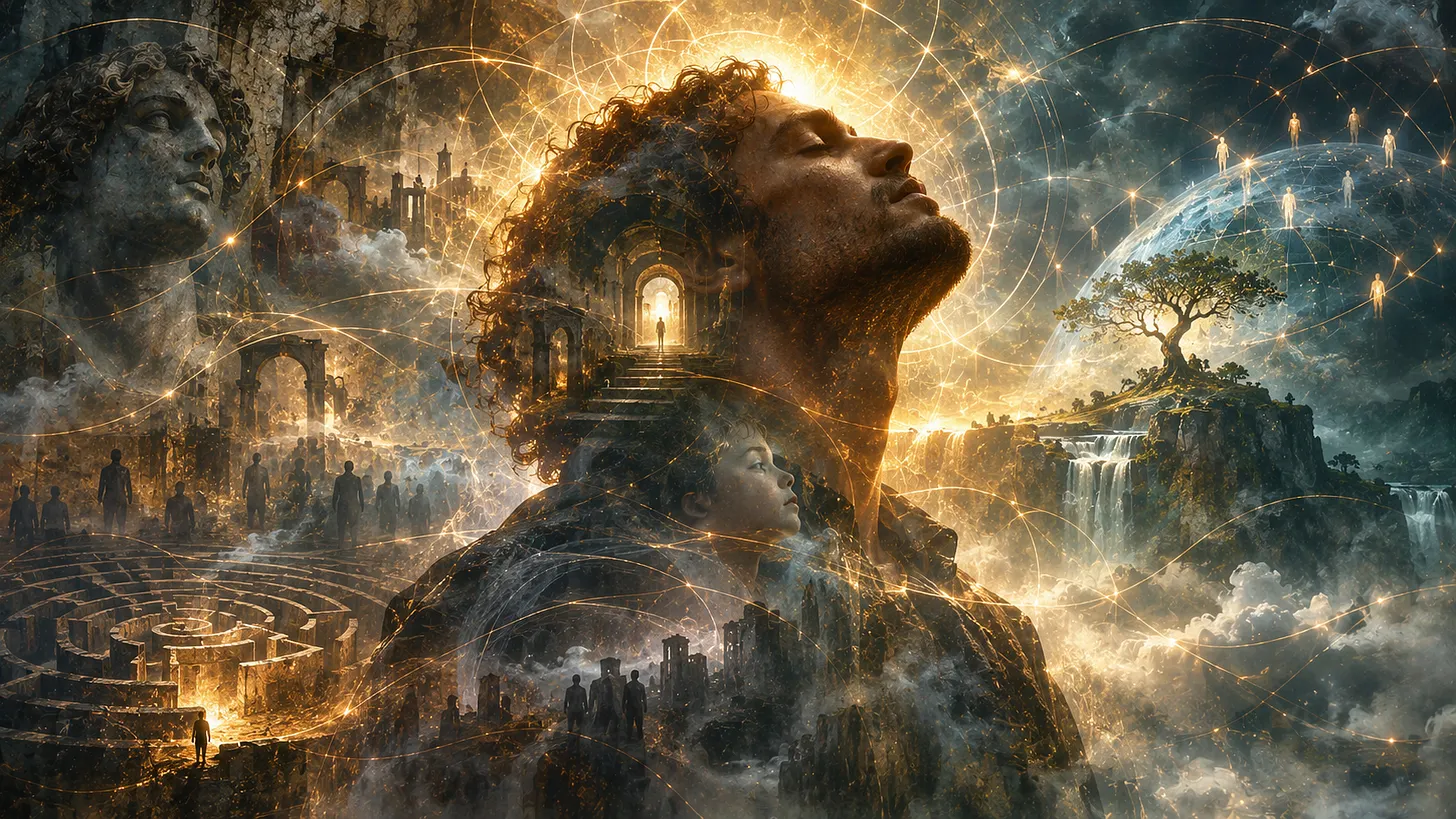
And this brings me back to something I’ve considered before: why do these very old texts, stories, and cosmologies keep finding their way back into our collective consciousness? Why do we continue to revisit and reinforce particular narratives about the nature of reality, the origins of humanity, the afterlife, suffering, punishment, redemption, and our supposed place in some greater hierarchy of existence? Is there something genuinely enduring and truthful within these accounts, something that continues to resonate across generations? Or is there a more deliberate mechanism at work, one that continually recycles and reinforces particular ideas, concepts, and narratives because of their effect upon the collective human psyche? I tend to lean more toward the latter possibility, particularly when I consider the content of some of these stories and the influence they’ve had upon millions, perhaps billions, of hearts and minds over centuries. So much of it is hardly life-affirming. It isn’t particularly concerned with love, creatorship, agency, or freedom. Instead, we’re repeatedly presented with variations of suffering, subjugation, punishment, sacrifice, unworthiness, and the need for some external authority to intervene on our behalf. What does that do to our collective understanding of who and what we are? What does it do to our sense of possibility, our creative potential, and our willingness to exercise our own authority?
Of course, I have to acknowledge that I suffer from many of these same limitations and constrictions. My own understanding is a product of my particular path through this life, my education, research, self-study, and lived experience, good or bad, and everything in between. I have my own collection of inherited assumptions, adopted beliefs, blind spots, and conceptual limitations. I can question the frameworks through which others have interpreted reality, but I can’t pretend to stand entirely outside those same constraints myself. Perhaps that’s part of the challenge: recognizing that whatever we think we’ve come to understand, whatever conclusions we’ve drawn, we’re still working with a limited set of tools, concepts, and experiences through which to interpret something potentially far greater than ourselves.
It’s certainly plausible that these narratives offer an explanation, a workable theory, or an ontological interpretation of a grand illusion in which we’ve been subjected to many layers of fabrication, obfuscation, and narrative manipulation. An illusion that has informed and defined virtually every aspect of our lives, kept us going down certain paths, following certain trajectories, and doing so in sleepy, unconscious ways, ignorant of our own potential, our origins, and our purpose for being here in the first place. Or, perhaps less conveniently or acceptably, this is our actual and real purpose, and everything about our reality is operating as designed.
I think it’s important that we ask the hard questions, especially of ourselves, regardless of what we may then need to follow through on in order to finally find some semblance of resolution or resolve.
Is that as far as we need to go? Is this revelation and explanation adequate enough to describe the real and full truth of the matter?
Is this the real me, or am I still playing a part, reading from a script, pretending and entertaining mere superficiality rather than digging deeper to tap into the real substance?
I think there are layers to this idea of apocalypse and revelation, both words being as loaded, emotionally charged, misunderstood, and wildly misused as any others. From an individual standpoint, there are layers of information, imposition, deception, and illusion, all of us carrying some variety of a very individualized spiritual burden. If we’re seeking to be truly free, truly liberated and unburdened by being rid of these oppressive, suppressive, and destructive concepts, forces, energies, and ideas; if that is our actual and genuine intention, it would seem that even as we achieve and accomplish, overcome and dispel these layers, our work is never quite finished. We may never be quite complete, not in this particular realm of existence, at any rate.
At some point we have to decide whether we’ve done enough. And I’ve argued in the past on both sides of this issue. On the one hand, we have certainly done enough, because we can always be feeding upon ourselves for not feeling good enough, for not having achieved enough, for not having done enough, for not having simply been good enough based on some abstract, adopted standards or borrowed ideals. On the other hand, if we have the presence of mind, or the wherewithal, to realize that something still feels incomplete, perhaps we owe it to ourselves to continue that process in earnest, regardless of worldly appearances.
If you’re at what might be considered the lowest level of experience, perhaps relating to the accounts of people who have endured the most terrible and traumatic experiences, including those associated with schizophrenia and other conditions, that may be merely the beginning of the journey. That may be the layer of existence, if you will, that is the arena of the initiate rather than the master. So, to master any particular level, to transcend and ascend beyond what we thought possible, we have to start where we are and build from there. We have to allow for a true appreciation of who we are and where we are, an appreciation for the fragility and vulnerability of this earthly experience and what it has brought us thus far. We have to be willing to take responsibility for our story, seek out the tools, remedies, and methods of reconfiguration and recapitulation, so as to afford ourselves the ability to move toward what is next and what is possible beyond the story we’ve been living thus far.
Whatever the ultimate achievement might be for us individually, don’t we owe it to ourselves to follow through and find out where that road may lead, what opportunities may present themselves, and how we may be of service to our fellow humans in the collective as we learn and grow through these challenges? Whatever level of good enough suits you will not be the same as that which suits me. And that’s not a judgment; that’s an acceptance, an acknowledgment, and a respect for the individuated soul and what they’re doing here.
I would only put forth that when we do find relief and healing, when we do find some resolution and enlightenment, we don’t linger too long; that we don’t rest on our laurels, so to speak, because that can hardly be the end of the process. That can hardly be the epitome of our potentiality. That can hardly be the end of the story, until the actual story comes to an end, until this chapter finally closes.
One way these moments of reflection are brought into our consciousness is through loss, when we lose someone, whether we knew them directly or not. Someone who touched our lives in a significant way can have an effect that stays with us for life. When they’re gone, when they will no longer be contributing to our personal story or the broader cultural story of society, we find ourselves in a moment of reflection and life review. These are important milestone events. If we’re not making time for those moments of consideration and contemplation, to pause and deeply reflect on where we are, what we’re doing, and what we want to pursue and achieve in the remainder of the time we may have here, we will likely be forced to do so by other elements of our shared story. We’ll be forced to when we are shaken awake by the loss of something or someone we admired, respected, or looked up to.
Life always provides us with the ways and means to better ourselves. To remember. To pay attention. It always provides the ways and means to recalibrate and reconfigure, to reconsider and reorient, to redirect our energy and resources, which may have been utilized in wasteful or ineffective ways that have become largely unconscious.
So, regardless of where we came from, what prenatal, childhood, and adolescent experiences shaped us, good or bad, light or dark, demonic or angelic, we owe it to ourselves to keep going. To dig a little deeper. To expand on the story and seek out what may be just over the next horizon. We owe it to those who cleared the path before us, who survived the generations past, who sacrificed greatly and made incomprehensible commitments, who succeeded and failed, and succeeded and failed at simply being human.
We owe it to ourselves to pursue those versions of ourselves, those highest visions we’ve ever held of what we wanted to achieve, explore, or experience in this life, for whatever reason, don’t we?
Whatever the illness or disease, it will have a label, a classification, and a category, and if not, it will before long. A trillion-dollar industry will make sure of it. Another will urge you to share widely and monetize it. But a label is merely an encapsulation of an expression. Some would say all of these expressions are merely signals and symptoms of healing.
Whatever your perspective, don’t linger too long in that place. Don’t assume that the story is over or that a diagnosis or prognosis is the end of the line. It’s one phase, one chapter, one scene on the grand stage. Are you going to be satisfied with performing that role, or will you remember that you are the artist, the creative force behind its very inception?
Lux et veritas
Published 2 Nov 2026 on tranceblackman.com
Written by Trance Blackman. Originally published on tranceblackman.com on 02 November 2026.
Copy & share: https://tranceblackman.com/the-creative-force-and-its-captors/