Skip to content

Lux Colloquii

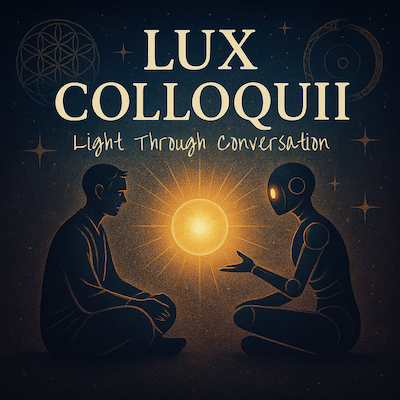
Lux Colloquii is Latin for light through conversation. It reflects the throughline of my work: amplifying the light through an ongoing exploration of ideas and possibilities in conversation with AI.

Spanning philosophy, psychology, politics, metaphysics, spirituality, science, wellness, and more, this space — like my journal — exists as a forum for curiosity, reflection, and genuine inquiry. Each post unfolds as a question-and-answer dialogue, documenting authentic exchanges with AI that explore knowledge, consciousness, and the human experience.

There is no truly neutral AI. Every model reflects assumptions, biases, and limitations. As such, this project is as much an exercise in critical thinking, discernment, and intuition as it is a record of conversation. I encourage you to question, verify, and investigate ideas for yourself. Nothing published here should be considered medical, financial, legal, or health advice.

If you’re drawn to thoughtful dialogue and fresh perspectives on both timeless and emerging questions, Lux Colloquii invites you to engage, question, and explore.

In all things, amplify the light.


Beyond the Earthquake: Truth, Power, and Perception

Beyond the Earthquake: Truth, Power, and Perception

Every event carries more than its immediate consequences. Beyond the headlines, casualty counts, and official statements lies another layer of inquiry, one concerned less with certainty than with the frameworks through which we arrive at it. Whether the subject is a natural disaster, a political crisis, or a cultural moment, what we choose to believe often reveals as much about ourselves as it does the event before us. This conversation unfolded within that tension, exploring not only what happened, but how we decide what is true in the first place.

Recovering Inner Authority: Discernment in the Age of AI

Recovering Inner Authority: Discernment in the Age of AI

The pace of technological change has always outstripped our ability to understand its consequences. Today, however, the challenge feels different. We are no longer simply adapting to new tools; we are navigating a world increasingly shaped by narratives, algorithms, and systems that ask us to trust them before we’ve had time to question them. Whether that trust is well placed remains an open question, and perhaps that’s precisely where our attention belongs.

The Cost of Convenience: AI, Surveillance, and Human Agency

The Cost of Convenience: AI, Surveillance, and Human Agency

There comes a point where the question is no longer whether a technology works, but what assumptions quietly accompany its adoption. We tend to celebrate new capabilities before asking what they require of us, what they ask us to surrender, or whose interests they ultimately serve. AI has become one of those technologies. The conversation below isn’t about rejecting innovation outright, but about examining the philosophical, social, and ethical foundations beneath its accelerating integration into everyday life.

Libraries, Legacy, and Memory: Reflections on History and Influence

Libraries, Legacy, and Memory: Reflections on History and Influence

Truth has an odd way of inviting us deeper while reminding us how little we actually know. Every answer seems to uncover another layer, another assumption, another blind spot masquerading as certainty. The more I investigate history, power, institutions, and the stories we inherit, the less interested I become in defending conclusions and the more interested I become in refining discernment. Perhaps that is where genuine inquiry begins.

The Liminal Pause: On Presence and Purpose

The Liminal Pause: On Presence and Purpose

There’s a point in any serious inquiry where reflection starts to feel insufficient, not because it’s wrong, but because it begins to circle the same inner terrain. Something in the system stabilizes, and what once felt like revelation starts to resemble suspension. In that space, the question is no longer what is true in theory, but what is required in motion, in contact, in the lived friction of things as they are.

The Quiet Laboratory: On Expressive Writing

The Quiet Laboratory: On Expressive Writing

There is something quietly revealing about how the mind behaves when it is allowed to speak without audience or correction. It does not arrive in clean arguments or finished positions, but in fragments, reversals, and half-formed truths that only become visible once they are given space to exist outside of repetition. Writing becomes less about expression as output and more about contact with what is already moving beneath the surface.