Skip to content

Lux Colloquii

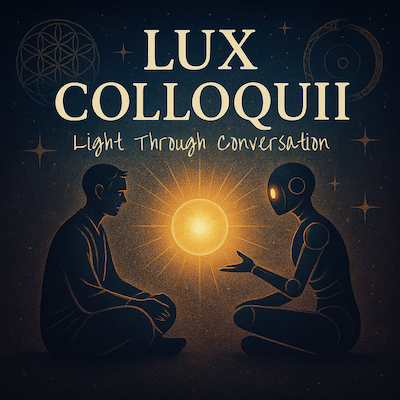
Lux Colloquii is Latin for light through conversation. It reflects the throughline of my work: amplifying the light through an ongoing exploration of ideas and possibilities in conversation with AI.

Spanning philosophy, psychology, politics, metaphysics, spirituality, science, wellness, and more, this space — like my journal — exists as a forum for curiosity, reflection, and genuine inquiry. Each post unfolds as a question-and-answer dialogue, documenting authentic exchanges with AI that explore knowledge, consciousness, and the human experience.

There is no truly neutral AI. Every model reflects assumptions, biases, and limitations. As such, this project is as much an exercise in critical thinking, discernment, and intuition as it is a record of conversation. I encourage you to question, verify, and investigate ideas for yourself. Nothing published here should be considered medical, financial, legal, or health advice.

If you’re drawn to thoughtful dialogue and fresh perspectives on both timeless and emerging questions, Lux Colloquii invites you to engage, question, and explore.

In all things, amplify the light.


Digital Sovereignty: Privacy as Product, Freedom as Practice

Digital Sovereignty: Privacy as Product, Freedom as Practice

There are times when a product, service, or idea arrives wrapped in the language of freedom, sovereignty, and empowerment, yet leaves me wondering whether it’s simply another layer added to an already complex system. I’m not particularly interested in winning a technological arms race against the institutions that built the infrastructure in the first place. I’m far more interested in understanding what is actually necessary, what genuinely serves a meaningful life, and where the line exists between useful tools and unnecessary dependence.

Mercantilism to Technocracy: Cycles of Power and Control

Mercantilism to Technocracy: Cycles of Power and Control

There’s a strange clarity that comes when one steps far enough back from the noise to observe the machinery itself. Not merely politics or economics in isolation, but the layered systems, narratives, incentives, and abstractions through which modern societies attempt to organize human life. We inherit these structures, participate in them, resist them, and are shaped by them in equal measure. Yet beneath the endless rhetoric and ideological branding remains a quieter and more enduring question: what kind of life is actually worth building, sustaining, and passing on?

Sovereign Within: Navigating Systems Without Being Consumed

Sovereign Within: Navigating Systems Without Being Consumed

In a world that constantly rearranges itself beneath our feet, the quiet work is always inward. The outer noise — crises, narratives, rituals of distraction — will never pause, and neither should your gaze. To navigate without being consumed requires a deliberate alignment of mind, spirit, and action: not reaction, not escape, but presence, discernment, and a refusal to surrender sovereignty. This is the space where choice persists, even as the machinery of the world hums on.

Ownership and Identity: From Participation to Authorship

Ownership and Identity: From Participation to Authorship

The present moment feels less like a sudden rupture and more like a long-building pressure finally finding seams. Beneath the noise of politics, markets, and cultural spectacle, something quieter is unfolding — a slow recognition that participation is not the same as authorship, and comfort is not the same as stability. Many capable people sense that the structures they were told to inhabit no longer nourish them, yet they lack language for the unease. What emerges, then, is not rebellion but re-orientation: a search for ground, for continuity, and for a way of living rooted in responsibility rather than abstraction.

The Quiet Recalibration: Parallel Foundations and What Collapse Actually Looks Like

The Quiet Recalibration: Parallel Foundations and What Collapse Actually Looks Like

Abandoned towns. Fractured narratives. Institutions straining beneath their own abstractions. We are living in a moment where the scaffolding of modern life feels less permanent than we were promised — and more conditional than we assumed. Beneath the noise, beyond the outrage cycles and ideological theater, something quieter is unfolding: a recalibration. Not rebellion. Not collapse. A remembering. Of land. Of skill. Of competence. Of the fact that maps change, but reality remains.

The Toxic Soil: Why Reform Never Reaches the Root

The Toxic Soil: Why Reform Never Reaches the Root

There are moments when the surface arguments no longer suffice — when debating policy, incentives, or regulatory capture feels like rearranging furniture in a burning house. What we touched here is not a partisan critique or a call for reform within established parameters. It is a first-principles interrogation of the premise itself — the buried assumption that large-scale coordination, hierarchy, abstraction, and management from on high are necessary features of civilization. If the soil is toxic, no pruning of branches will suffice. The question becomes far more radical: was the ship set off course from inception, and if so, what would it mean to reclaim authorship of the voyage?