Skip to content

Lux Colloquii

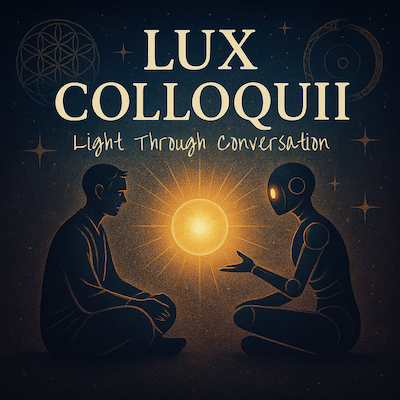
Lux Colloquii is Latin for light through conversation. It reflects the throughline of my work: amplifying the light through an ongoing exploration of ideas and possibilities in conversation with AI.

Spanning philosophy, psychology, politics, metaphysics, spirituality, science, wellness, and more, this space — like my journal — exists as a forum for curiosity, reflection, and genuine inquiry. Each post unfolds as a question-and-answer dialogue, documenting authentic exchanges with AI that explore knowledge, consciousness, and the human experience.

There is no truly neutral AI. Every model reflects assumptions, biases, and limitations. As such, this project is as much an exercise in critical thinking, discernment, and intuition as it is a record of conversation. I encourage you to question, verify, and investigate ideas for yourself. Nothing published here should be considered medical, financial, legal, or health advice.

If you’re drawn to thoughtful dialogue and fresh perspectives on both timeless and emerging questions, Lux Colloquii invites you to engage, question, and explore.

In all things, amplify the light.


Beyond the Earthquake: Truth, Power, and Perception

Beyond the Earthquake: Truth, Power, and Perception

Every event carries more than its immediate consequences. Beyond the headlines, casualty counts, and official statements lies another layer of inquiry, one concerned less with certainty than with the frameworks through which we arrive at it. Whether the subject is a natural disaster, a political crisis, or a cultural moment, what we choose to believe often reveals as much about ourselves as it does the event before us. This conversation unfolded within that tension, exploring not only what happened, but how we decide what is true in the first place.

Recovering Inner Authority: Discernment in the Age of AI

Recovering Inner Authority: Discernment in the Age of AI

The pace of technological change has always outstripped our ability to understand its consequences. Today, however, the challenge feels different. We are no longer simply adapting to new tools; we are navigating a world increasingly shaped by narratives, algorithms, and systems that ask us to trust them before we’ve had time to question them. Whether that trust is well placed remains an open question, and perhaps that’s precisely where our attention belongs.

Rearranging Humanity: Statecraft and Social Engineering

Rearranging Humanity: Statecraft and Social Engineering

History has a peculiar way of echoing through the present. Sometimes the parallels are obvious; more often they reveal themselves through recurring patterns that transcend borders, ideologies, and generations. This discussion began with a closer look at the Ethiopian famine of the 1980s, but soon widened into a broader reflection on state power, collective memory, institutional narratives, and the enduring tension between human dignity and systems of control. Whether one agrees with every conclusion or not, the recurring questions themselves remain worthy of careful examination.

Digital Sovereignty: Privacy as Product, Freedom as Practice

Digital Sovereignty: Privacy as Product, Freedom as Practice

There are times when a product, service, or idea arrives wrapped in the language of freedom, sovereignty, and empowerment, yet leaves me wondering whether it’s simply another layer added to an already complex system. I’m not particularly interested in winning a technological arms race against the institutions that built the infrastructure in the first place. I’m far more interested in understanding what is actually necessary, what genuinely serves a meaningful life, and where the line exists between useful tools and unnecessary dependence.

The Conditions of Health: An Ecological Perspective

The Conditions of Health: An Ecological Perspective

There comes a point when questioning a system is no longer enough. The deeper task is examining the assumptions beneath it — the beliefs, models, and narratives that have become so commonplace they pass without scrutiny. Health is one such domain. What follows is a reflection on medicine, ecology, observation, and the increasingly urgent need to rediscover principles that existed long before institutions claimed authority over them. It is not a search for new answers so much as a reconsideration of what may have been forgotten.

Mercantilism to Technocracy: Cycles of Power and Control

Mercantilism to Technocracy: Cycles of Power and Control

There’s a strange clarity that comes when one steps far enough back from the noise to observe the machinery itself. Not merely politics or economics in isolation, but the layered systems, narratives, incentives, and abstractions through which modern societies attempt to organize human life. We inherit these structures, participate in them, resist them, and are shaped by them in equal measure. Yet beneath the endless rhetoric and ideological branding remains a quieter and more enduring question: what kind of life is actually worth building, sustaining, and passing on?