We live surrounded by records of ourselves, accumulating layer upon layer of what we once thought worth remembering, preserving, cataloging, and carrying forward. Yet perhaps memory was never meant to be a warehouse, and perhaps the deeper work is not in retaining everything, but in discerning what remains when everything else inevitably falls away.
Tag: truth
Perhaps the first thing worth questioning is not what we have been told about the world, but why we have been taught to fear it in the first place. So much of what passes for certainty seems to depend upon our willingness to accept the premise before we ever examine it, and so much of what follows becomes inevitable only because we have agreed, consciously or otherwise, that it must be. Somewhere beneath all of it remains a simpler possibility: that we have far more agency than we’ve been led to believe, and that the story is not yet finished.
There is something strangely comforting in the realization that permanence may never have been the point. We spend so much effort trying to hold everything in place, to preserve every trace, every photograph, every word, every fragment of experience, as though existence itself might be made durable through sufficient storage. But perhaps what matters most was never meant to remain intact. Perhaps it was only meant to pass through us.
Fortress America: Beneath the Political Spectacle
The Architecture Beneath the Narrative
There are certain conversations that begin with a seemingly straightforward political question and quickly reveal themselves to be about something much larger. “Fortress America” is one of those ideas. Not because Trump himself is particularly interesting, but because following the structure beneath the rhetoric raises questions about power, sovereignty, narrative, and the systems within which we all operate.
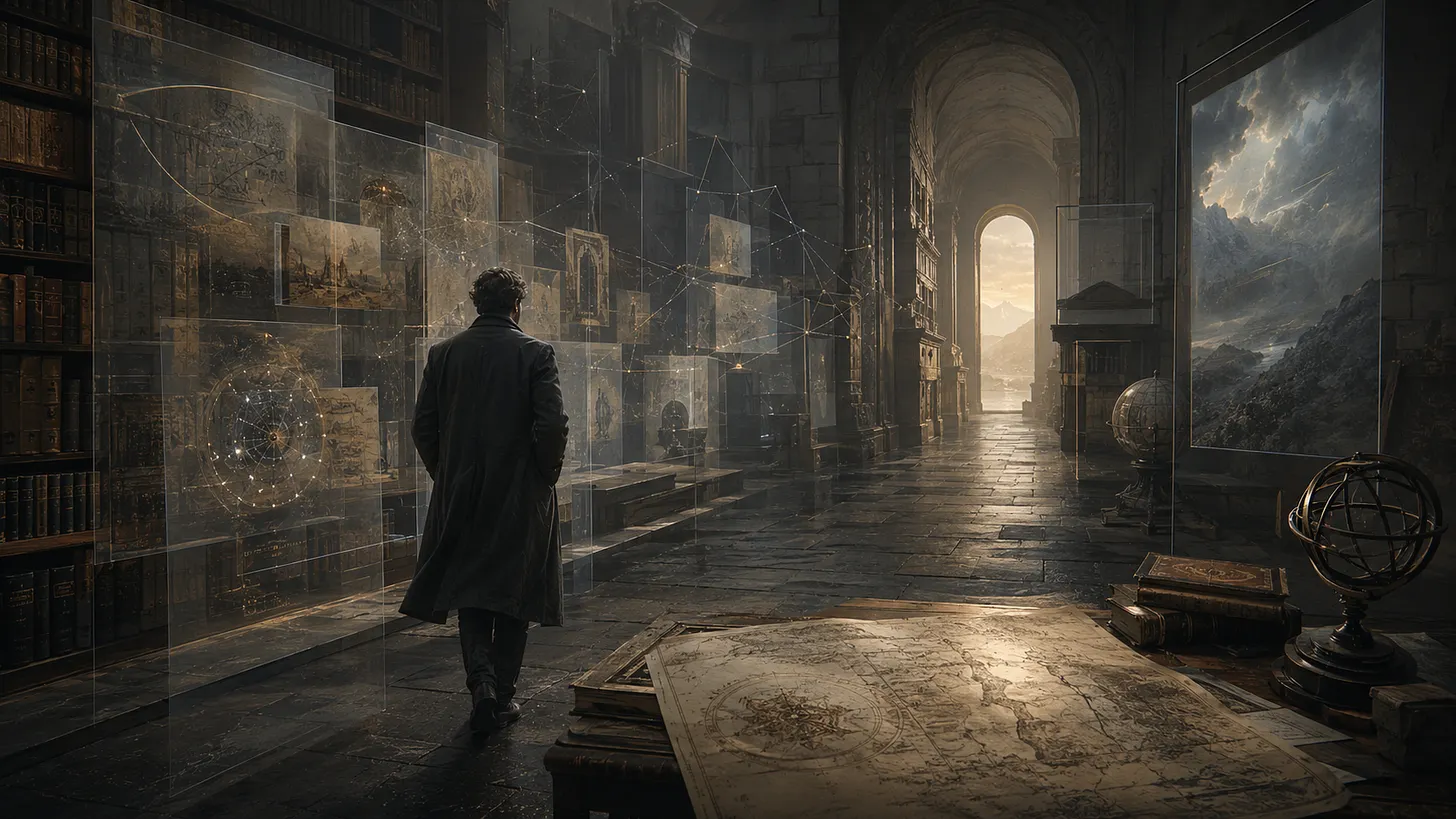
Beyond the Map: Paradigms, Perception, and the Limits of Certainty
On Inquiry, Utility, and the Discipline of Letting Go
It often seems that the deeper one goes into any subject, the less the matter hinges on isolated facts and the more it reveals itself as a question of orientation. What are we really looking at, and just as importantly, what are we looking through? Somewhere between inherited certainty and independent inquiry lies a more difficult path — one that asks not only whether a claim is true, but what framework made it appear obvious in the first place. That, perhaps, is where this discussion properly begins.