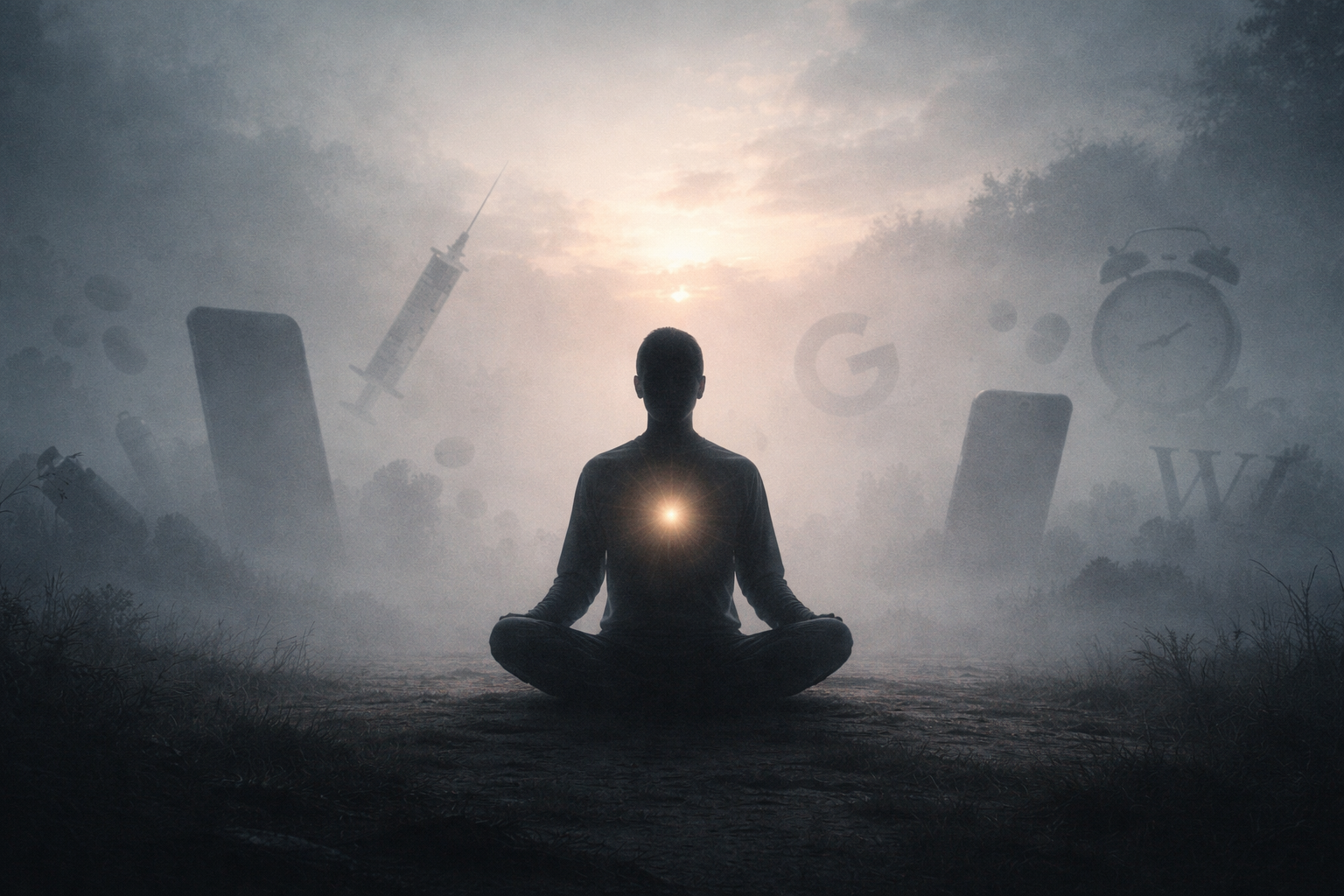
There is a particular kind of decay that does not announce itself through violence or ruin, but through forgetfulness. It is the forgetting of how to listen inwardly, how to sit with uncertainty, how to sense truth without being told what to think. Over time, this forgetting hardens into habit — reliance on systems, experts, devices, and doctrines that promise clarity while dulling discernment. The events of recent years did not create this condition; they merely revealed it. What we are facing is not a crisis of information, but a crisis of mind, spirit, and attention.
. . .
Over the past thirty years or so, it has become clear that humanity has slowed down in many ways and grown far lazier in others. We’ve become enamored with technology — the internet, Google, smart devices, and now AI. With every added layer of learned dependence and deference to information services, we’ve grown softer, slower-thinking, less able to comprehend big ideas, less capable of discernment, and increasingly dumb, daft, and oblivious.
The events of 2020 were a perfect illustration of how these conditions had been accumulating in the zeitgeist for a generation or more. The speed with which the world was shut down — effectively locked indoors within two weeks — still astounds me more than five years later. I was both impressed and bitterly disappointed. It became difficult to deny the conclusion that humanity is, for the most part, remarkably stupid.
But why? The answer is not difficult to see once one recognizes the patterns and programming that both created and continue to sustain this cognitive incongruence within the collective. Years of persistent mind control, state propaganda, and nefarious media messaging worked extraordinarily well — effortlessly and almost instantly pitting humans against one another as they devolved into terrified, paranoid, anxious, cowardly, and isolated animals.
None of this was unprecedented. It has all happened before — many times. The so-called powers that be are adept at revising history, promoting fiction, and shaping sanitized narratives about past events that ultimately form the backbone of our modern consensus reality.
Channels of communication were shut down, blocked, censored, or erased. Dissenting voices were derided, canceled, ostracized, defunded, and ultimately silenced. The meanings of words were redefined in real time. Public rituals of blame, shame, and guilt were swift, coordinated, and highly effective.
All it took was a well-funded, unified, and relentless assault from every direction, twenty-four hours a day — confusing, bewildering, terrifying, tyrannizing, dividing, and deceiving billions of hearts and minds. In the modern era, it is exceedingly easy to stage an event of this nature and convince a vast portion of civilization of an alleged “pandemic,” even when nothing of the sort was occurring in reality.
Of course, the event also served to awaken many, as these things often do. There are multitudes of freshly converted “truthers” now — so be wary. Over the past five years, countless people have faced their fears, been snapped out of cognitive stupor, suffered injury or maiming from medical interventions, and lost friends and loved ones as a result of what are now well-documented frauds in virology and vaccination.
This unfolded alongside a dramatic rise in mental health crises and suicides, driven by forced isolation, separation, and prolonged psychological and emotional abuse — all brought on and sustained by the state and the psychopathic medical–financial–industrial complex. In Canada, the MAiD (medical assistance in dying) “service” is quietly ending the lives of increasing numbers of people each year. How this is framed as progress is difficult to comprehend.
The clearest targets were the elderly, children, and youth, while working-age adults were left scrambling to avoid financial ruin. Businesses and careers were lost. Families were fractured. Lives were senselessly snuffed out.
So how did it happen?
As the title of this essay suggests, it happened because we have become lazy — in mind, in spirit, and in our overall capacity for comprehension. This condition is the result of systemic flaws and deliberate distortions, through which institutions are appropriated and repurposed to break human beings inside and out — inverting reality and our understanding of it, and remaking people into inorganic, dysfunctional, emotionally and psychologically debilitated halfwits.
The more certifications, accreditations, accolades, and academic achievements one accumulates, the worse off one often becomes — a fact rarely recognized until something arrives to shatter identity at its core. We are increasingly incapable of reading between the lines, instead reacting defensively and emotionally, without engaging in genuine research, analysis, discussion, or debate.
We remain largely ignorant of what truly makes us ill, having relied on lifelong programming provided by the medical–financial–industrial complex — conditioning us from our earliest days to believe in “germs” and “contagion,” and to mindlessly roll up our sleeves to be injected with industrial byproducts, laboratory experiments, and toxic substances that have never been conclusively proven to do what they are claimed to do.
In the broader sense, we no longer know why we are here, where we are cosmologically, what our true purpose might be, or why we do most of the things we do.
Fear is a powerful motivator, and the parasitic class profits from it with ruthless efficiency. Time and again, they reintroduce paradigms and belief systems that have only ever harmed humanity and suppressed our deeper knowing. Whether religion, medicine, finance, education, or nutrition, everything has been inverted, perverted, corrupted, and captured — all in service of power, profit, and control of humanity en masse.
So how do we reverse the trend?
It must be through a gnostic approach — through personal, spiritual, and shadow work. Through silence, meditation, and a deliberate withdrawal from the incessant habit of outsourcing our authority to external institutions of any kind. It must come through re-engaging the soul — individually and collectively — via contemplation, self-inquiry, and a willingness to challenge our presuppositions, assumptions, and beliefs.
Google, Wikipedia, and ChatGPT are not authorities on truth. At best, they are tools. At worst, they are mechanisms for preserving a status quo — an obedient, oblivious consensus that leads us further from our own inner knowing. Content curation wears many disguises, and we must recover the conscious awareness that has been neglected and allowed to atrophy through disuse.
We have lost the muscles of discernment, spiritual sense-making, epistemic comprehension, and cognitive awareness. This erosion is not solely the result of technology — but technology is undeniably a significant contributor.
Consider how quickly you reach for a device when you wake in the morning — and worse, how you reach for it again before sleep, sabotaging your ability to enter a complete and restorative rest cycle. It was nothing like this thirty years ago. Yet the ubiquity of devices, the internet, and now non-human intelligence has convinced us that this is normal — that our lives have been fundamentally improved through the mass adoption of toys, tech, and endless data streams.
I would argue the opposite. The proof lives in your own subjective experience of life.
Rather than establishing a healthy rhythm aligned with your circadian biology — going to bed at the same time each night so your body can detoxify, repair, and regenerate — you consume garbage foods, sugary or alcoholic drinks, and stare at glowing screens late into the evening. You scroll endlessly through YouTube or Netflix in search of novelty, when nothing would nourish you more than slowing down with a good book and allowing yourself an organic shutdown into genuine rest.
Rather than preparing a simple, nourishing breakfast, you rummage through the pantry for packaged, ultra-processed filler — sold to you by thousands of ads you believe you’re ignoring across the media streams you willingly ingest all day long. “Fortified” this, “enriched” that. Your alarm jolts you awake, flooding your system with stress hormones, and you rush to Starbucks or another drive-through for caffeine — a mind- and mood-altering toxin — convinced you need it to function.
In reality, you are merely disrupting adenosine signaling in your brain, further degrading your ability to sleep later that night. Dinner is something fast and convenient. You’re too busy to cook. Your partner is too disengaged to help. Organic or grass-fed feels too expensive. The frozen foods aisle will have to suffice. Then come the filler snacks throughout the evening — eating long after you should have stopped, preventing the body from entering its nightly restorative cycle.
Rather than engage in real, embodied conversation, you text, DM, and post — slowly losing the ability to initiate or sustain meaningful dialogue. Over time, this has stunted our capacity for discussion, let alone disagreement or debate. Today, there is little discourse. Arguments are not heard. Opinions are not examined.
If we feel offended — and everything now offends us — we shut down, change the subject, dominate the conversation so others cannot speak, or simply walk away. We have lost depth, temperance, patience, and much of what once passed for intelligence.
We can reclaim our lazy minds and spirits, but not overnight. It has taken decades to weaken, suppress, and waste away what we were born with. The machine wants you dumb, daft, compliant, and easy to manage.
Stop making it so damn easy.
Temet nosce
Written by Trance Blackman. Originally published on tranceblackman.com on 30 December 2025.