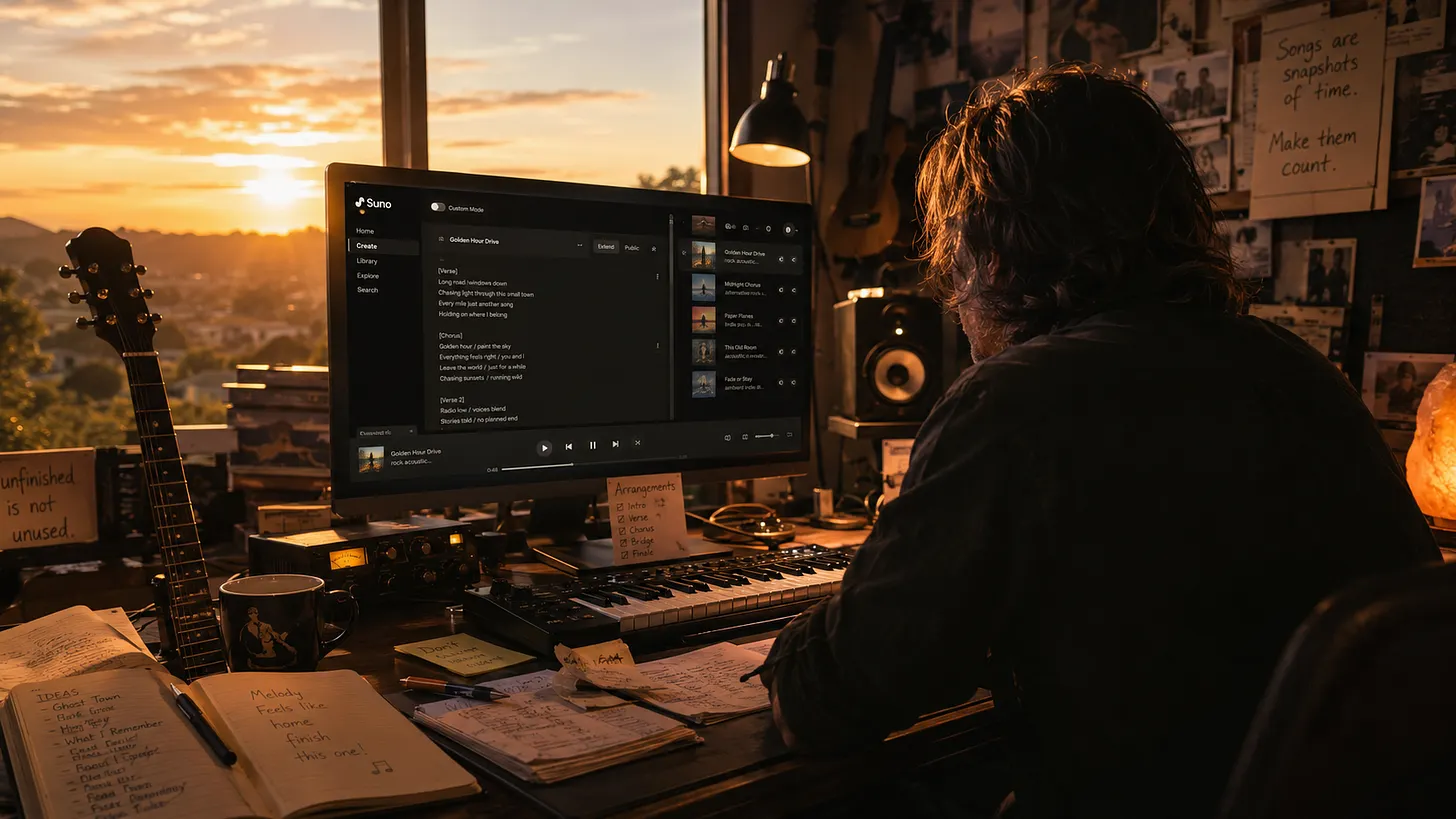
Say what you want about AI-assisted music production, but I haven’t had this much fun, motivation, and inspiration making music in over a decade.
Over the past year or so, I’ve been exploring the capabilities of Suno in particular, and I’ve produced several albums from that experiment that will find their way into the world in various forms over the coming months. If nothing else, it captures a moment in time for me as an artist in this particular technologically infused era we’re living through. It has also allowed me to bring forward and finally make use of 30-year-old songs, as well as newer material, in a somewhat cohesive fashion. Most of the “new” material is based on rough ideas, partial demos, and full-length recordings, some of which have already been released over the years as singles and smaller projects.
Back in 1994, I was gifted a keyboard workstation that allowed me not only to come up with ideas — four bars, eight bars, or however many measures were useful at the time — but also to piece together song concepts and save them. As many artists, and perhaps musicians in particular, will tell you, ideas aren’t the issue. In those early years, I was writing and composing three or four songs a day. Not all of them were complete songs, of course, but many were. Inspiration came fast and furious, and I was grateful to have a tool that allowed me to explore, experiment, and preserve those moments. Before long, I had accumulated several hundred songs in various states of completion. And I didn’t stop writing and composing new material after all that.
Some were recorded to cassette on an old portable stereo that even allowed me to dub in vocals with a cheap microphone so those melodies could be immortalized in their own way. For the most part, however, the songs were committed to memory through repetition and practice. In 2001, I finally invested in two PCs so I could set up my first proper DAWs and begin recording “for real” in the digital domain. Since then, I’ve released about a dozen albums, but as ever, I have at least another dozen projects that never received the time, energy, or focus they needed to reach any meaningful sense of completion.
As a result, I’ve kept most of these unfinished ideas and projects to myself. I’ve listened to them thousands of times over the years, usually singing along in the car and enjoying them as one might enjoy any favorite music. But I’ve often felt guilty — perhaps even ashamed — for not releasing more of it.
Part of that was financial. I couldn’t afford to hire professionals to properly mix and master the recordings, nor did I feel I had comparable skills to offer in trade. I’ve handled every aspect of the process myself from the beginning: recording, production, artwork, distribution, and what little promotion followed. It was never quite enough. I’ve also never put together my own band to perform and promote the music live, which remains a difficult pill to swallow. I don’t know if there are specific reasons for that, save the clichéd lack of confidence or courage, but the absence can still be felt from time to time.
I’ve been part of several bands over the years and had the opportunity to contribute and co-create in meaningful ways, but it wasn’t quite my music, and that always left me wanting something more. That’s not to say those experiences weren’t valuable. Quite the opposite. Many songs and ideas emerged from those collaborations, helping me expand and refine my own creative voice along the way.
Now, in 2026, some 34 years after I started writing and composing my own music, I have an impressive new tool to play with. I’ve been able to explore different genres and entirely unexpected directions, some of which have worked surprisingly well and others not at all. Does a song work better with a baritone voice or a tenor? What about a female lead vocalist? It’s a rock song, but would it work as an orchestral instrumental or a Celtic pop track?
The challenge isn’t a lack of options — it’s having too many. That presents its own problems. Suno has a personality, however, and like all AI tools it comes with quirks, limitations, and plenty of opportunities to waste time chasing results that never quite materialize. But with patience, editing, reiteration, and the occasional restructuring or refinement of lyrics or arrangement, it provides a platform for bringing music back to life that has been sitting on hard drives, in drawers, and in storage totes for far too long. And I don’t mind that I’m not singing them or performing them, stepping more into a producer role utilizing the “guest artists” offered by the Suno system. Again, a contentious issue for some. For me, it makes me wonder what would have been possible if I’d been open to broader collaborations in the past. And it’s still an option going forward. So who knows! Music is one of those avenues of expression one can pursue their whole lives in one form or another.
It’s fascinating to see how a song structure or lyric either succeeds or falls apart, and then to be able to quickly refine it, move sections around, and experiment with different interpretations. Sometimes all it takes is a slight adjustment to a prompt or configuration before something unexpectedly rewarding emerges. Other times, the best approach is to provide no prompt at all and let the model work with the original material free from preconceived filters or biases.
Perhaps the most surprising aspect is the quality of the recordings. They often approach a studio-level standard and achieve results far beyond what I’ve been able to produce on my own in the past — or, perhaps more accurately, beyond what I was willing to dedicate the time to learn, or could afford to pay someone else to achieve.
I’ve always enjoyed writing and producing music. Today, I have a new tool that affords me a much broader field of view, and while it’s available, I intend to make the best use of it that I can. I know it isn’t for everyone, and there are certainly legal and ethical questions worth considering given the nature of large language models and how they’re trained. But for me, overall, it has been an incredibly enjoyable, frustrating, inspiring, maddening, and overall creatively rewarding experience.
First up is Love Songs, Vol. I: Groovy House Mixes. For fans of house, club, dance pop music. Naturally. This one went rather well so I chose to release the “remixes” edition of the album before the project that inspired it.
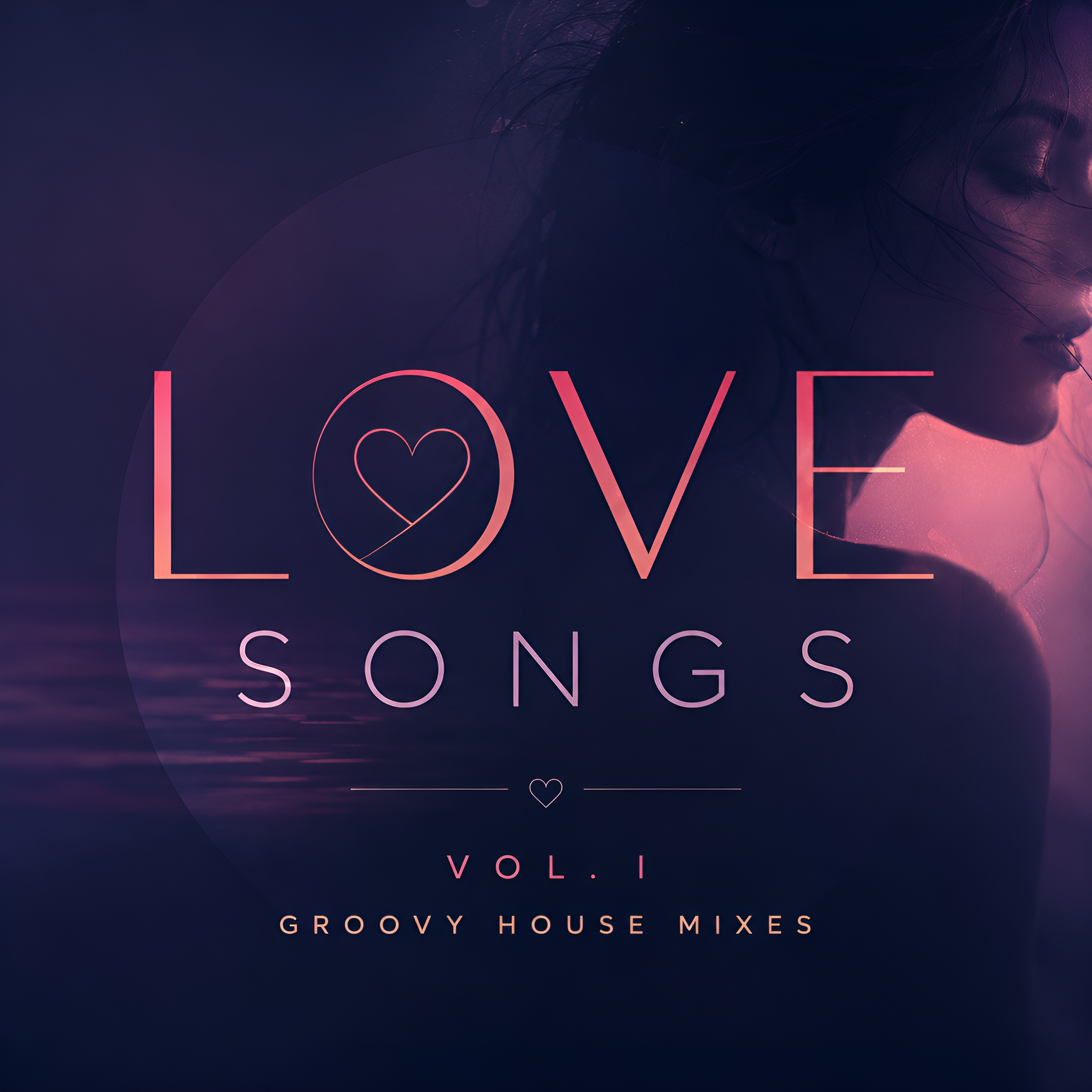
Spotify, Apple Music, YouTube, Amazon, Bandcamp, and wherever you prefer to get your music these days.
Stream or download the album for free at Archive.org.
Music is life.
Written by Trance Blackman. Originally published on tranceblackman.com on 12 June 2026. Revised 02 July 2026.
Copy & share: https://tranceblackman.com/suno-sessions/