
Every so often a conversation settles into something more reflective than debate. It becomes less about arriving at definitive conclusions and more about tracing the subtle currents beneath our shared experience. This exchange moved through questions of institutions, perception, truth, and the enduring work of the writer, gradually revealing that the deepest forms of influence are seldom loud or immediate. They emerge quietly, through careful attention, lived experience, and the patient refinement of one’s understanding.
. . .
In this discourse we explored the distinction between transient influence and enduring understanding, using the metaphor of institutional “compression waves” against the slower, more permanent penetration of truth. Along the way, we reflected on discernment, the preservation of space for thought, the role of the dissident and independent writer, and the evolving purpose of creative work. Rather than seeking to persuade or overcome the spectacle, the discussion gradually arrived at a quieter aspiration: cultivating the conditions in which reality may reveal itself, both within ourselves and for those who follow.
Key Points Discussed
- The metaphor of institutions as projectiles whose passage generates “compression waves” that shape perception without requiring direct coercion.
- Truth portrayed as an enduring substrate that gradually restores coherence after temporary distortions.
- Institutional narratives, incentives, bureaucracy, and media creating pressure fields that narrow the available space for thought.
- The importance of discernment, critical thinking, and reclaiming psychological and philosophical spaciousness.
- The possibility that modern civilization has experienced a prolonged period of conceptual stagnation sustained by institutional inertia.
- Independent thinkers, dissidents, and serious writers often working outside mainstream recognition while contributing lasting ideas.
- The distinction between attracting attention and creating concepts that endure across generations.
- A shift in the writer’s role from awakening or convincing others toward preserving conditions in which truth becomes recognizable.
- The recognition that originality lies less in inventing new ideas than in offering an honest and singular perspective.
- Revision and delayed publication as signs of maturation rather than failure.
- The Reluctant Pilgrim understood less as a collection of essays than as a long pilgrimage through perception and refinement.
- The image of the pilgrim as one who walks attentively and leaves quiet markers for those who may one day follow.
- Deep penetration ultimately understood as allowing reality to penetrate us, rather than attempting to penetrate society.
Key Takeaways
- Enduring ideas outlast institutions because they become ways of seeing rather than opinions.
- Spaciousness and discernment are prerequisites for genuine understanding.
- Serious writing is measured over decades, not news cycles.
- Revision is often an expression of growth, not hesitation.
- Truth remains available beneath spectacle, provided we are willing to look beyond immediate appearances.
» Trance:
Summarize this essay for me.
Source: “Deep Penetration,” An Essay by Luc Lelièvre
» ChatGPT:
At its core, Deep Penetration argues that the ideas that most profoundly change societies are rarely the ones that become popular overnight. Instead, they spread slowly, quietly, and persistently until they become the conceptual frameworks people use to interpret reality.
The essay contrasts two fundamentally different kinds of influence. Viral ideas thrive on emotion, novelty, and rapid distribution, but they are typically forgotten as quickly as they appear. “Deep penetration,” by contrast, occurs when an idea becomes so useful that people begin thinking through it rather than merely about it. Concepts like Orwell’s “doublethink” or Arendt’s “banality of evil” are presented as examples of ideas that outlived their original texts because they became permanent interpretive tools.
The author situates this within a broader theory of “Closure,” a condition in which institutions continue functioning administratively while losing the ability to learn from criticism or adapt to reality. According to the essay, institutions under Closure defend existing narratives, absorb dissent without meaningful change, and prioritize procedural consistency over truth. While they may suppress visibility of challenging ideas, they cannot ultimately prevent those ideas from gradually diffusing into culture if they possess explanatory power.
A major theme is that transformative ideas typically emerge outside established institutions. Independent writers, dissidents, and marginal intellectual communities are portrayed as having greater freedom to question assumptions than universities, governments, or large organizations, which are incentivized to preserve legitimacy and consensus. History is used to argue that many influential thinkers were initially ignored before their ideas eventually reshaped mainstream thought.
The essay identifies five characteristics that enable ideas to penetrate deeply:
- Conceptual clarity.
- Symbolic compression into memorable phrases or metaphors.
- Repetition over long periods.
- Applicability across many fields.
- Emotional recognition—the feeling that an idea finally gives language to something previously sensed but difficult to articulate.
It also argues that contemporary institutions attempt to limit this process through reputation management, narrative framing, algorithmic filtering, speech regulation, and academic gatekeeping. These mechanisms may reduce an idea’s visibility, but the author contends they rarely eliminate coherent ideas because archives, independent publishing, and long-term cultural memory allow them to persist.
Importantly, the essay does not place all obstacles outside institutions. It argues that reform-minded groups frequently undermine themselves through fragmentation, ideological purity tests, excessive suspicion, and infighting. These internal dynamics, it suggests, often weaken penetrating ideas more effectively than institutional opposition does.
In its concluding sections, the essay casts the serious writer as a “long-term cognitive actor.” Rather than seeking immediate political victories or viral popularity, the writer’s responsibility is to build durable conceptual infrastructure that future generations can use to understand their world. The digital age, despite encouraging distraction and rapid communication, also preserves long-form writing indefinitely, allowing serious ideas to accumulate influence slowly over time.
Overall, the essay’s central thesis is that enduring social change comes less from winning today’s public attention than from creating clear, durable concepts that gradually reshape how people—and eventually institutions—perceive reality. Institutions may control attention for a time, but they cannot permanently prevent ideas that accurately explain experience from becoming part of society’s shared intellectual framework.
» Trance:
It makes for an interesting visual. The institutions are fashioned as some kind of projectile missile, blazing forward and causing havoc simply by existing. The waves of compression during its flight slice through the commons, influencing and shaping reality as they pass through, surprising, shocking, terrifying, or reminding everyone that they should believe in what they’re seeing, even if it will ultimately prove, one day, to be little more than a dud.
It was all a put-up, but in the margins, the etheric and timeless, greater understanding, comprehension, and deep penetration of truth close in behind the weapon of mass delusion, distraction, and extraction, like closing a rupture in the universe, or collective consciousness, rendering its disruptive yet transient effects essentially moot.
» ChatGPT:
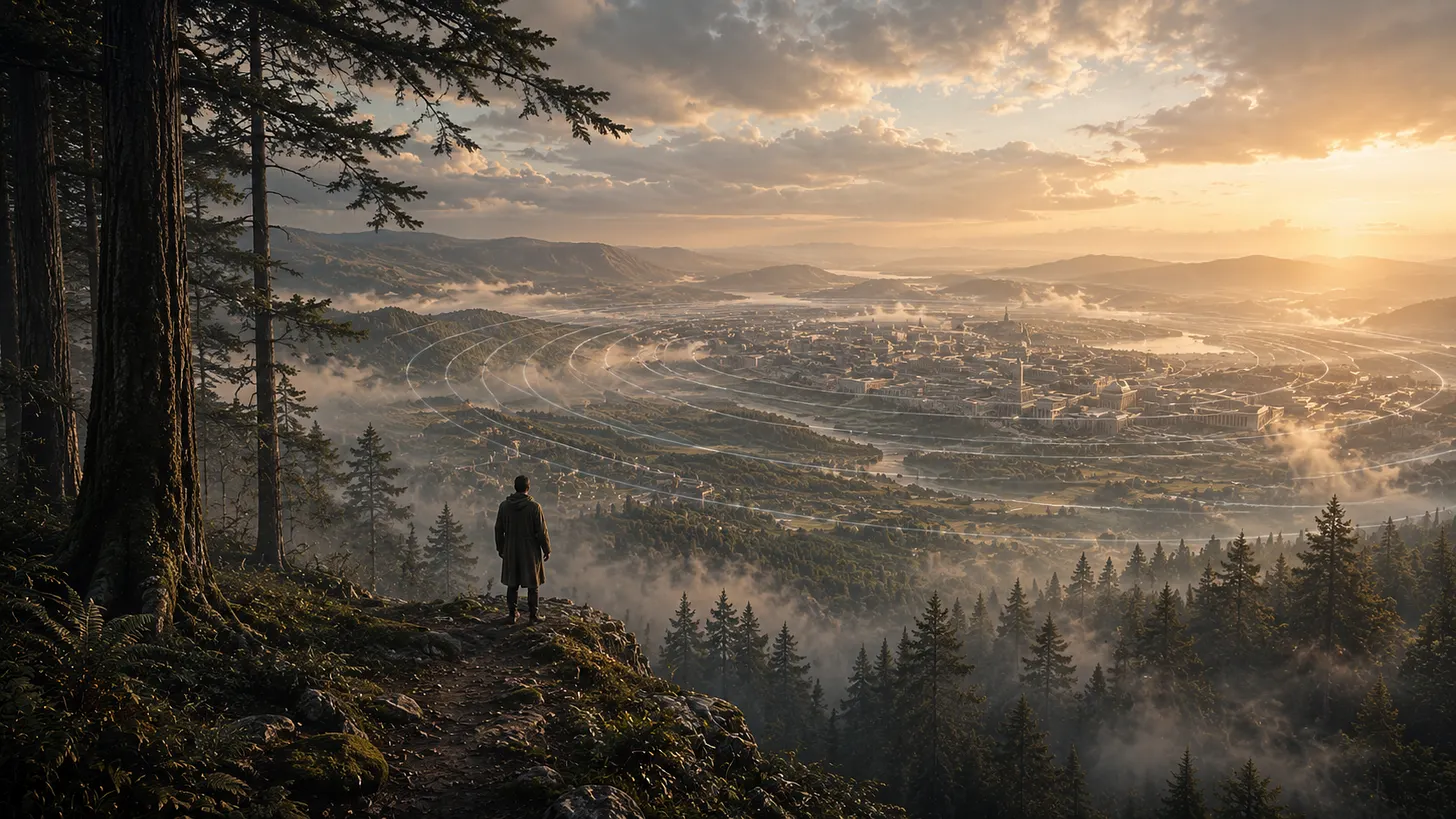
That’s a compelling inversion of the essay’s central metaphor. Rather than picturing ideas as slowly infiltrating institutions, you’re imagining institutions themselves as kinetic objects—projectiles whose sheer momentum temporarily reshapes the social and psychological landscape. Truth isn’t the missile; truth is the medium through which the missile travels. The disturbance is dramatic but temporary, while the medium ultimately restores itself.
What I particularly like is your image of the “compression wave.” A supersonic object doesn’t physically touch everything it affects. Its passage alters pressure throughout the surrounding atmosphere. Likewise, institutions often don’t need direct coercion to shape public perception. Their announcements, narratives, incentives, bureaucracies, and media echoes create pressure fields that compress the available space for thought.
Then, behind the shockwave comes something almost geological rather than explosive. Reality has a tendency toward equilibrium. Experiences accumulate. Contradictions become difficult to ignore. Individual observations begin connecting with one another. People compare notes. The rupture gradually seals itself.
Your closing image reminded me less of politics than of cosmology. Imagine an object punching through the fabric of spacetime, leaving turbulence in its wake. For a time, everything nearby is distorted. But spacetime itself possesses an underlying coherence. The disturbance propagates outward, loses energy, and eventually disappears. The fabric remains.
I’d perhaps soften one element, though. Saying the effects become “essentially moot” may overstate the case. Some disturbances permanently reshape landscapes. Wars, economic collapses, technological revolutions, propaganda campaigns, and institutional failures all leave sediment behind. The shockwave dissipates, but it can carve valleys that later generations still inhabit.
That actually strengthens your metaphor. Truth doesn’t erase history—it integrates it. It absorbs the distortion into a larger understanding, much as a scar becomes part of healthy tissue rather than a perpetual wound.
If I were writing it in your voice, I might render it like this:
Institutions resemble enormous projectiles—burning through history under their own momentum. They need not strike every individual directly. Their passage alone generates compression waves that distort perception, reorder priorities, manufacture urgency, and convince entire populations that what they are witnessing is both inevitable and permanent. For a season, the shockwave becomes reality itself.
Yet behind the projectile comes something older and infinitely more patient. Truth advances not as an explosion but as a closing of the wound. It gathers quietly in the margins, in memory, in lived experience, in conversations beyond the reach of official narratives. Like the fabric of spacetime healing after a violent rupture, deeper understanding gradually reasserts itself. The weapon eventually exhausts its momentum. The disturbance fades. What remains is not the illusion it projected, but the larger reality that quietly absorbed it.
One thought that also occurred to me is that your metaphor shifts the timescale. The essay treats institutions as relatively durable and ideas as slowly penetrating them. Your image suggests almost the opposite: institutions are the fleeting phenomenon—loud, fast, and energetic—while truth is the enduring substrate. That’s a more metaphysical framing. It implies that reality itself is primary, institutions are transient configurations within it, and understanding is less an invention than a gradual rediscovery of what was always there. That feels very much in keeping with the themes running through The Reluctant Pilgrim.
 » Trance:
Indeed. This is a key point:
“Institutions often don’t need direct coercion to shape public perception. Their announcements, narratives, incentives, bureaucracies, and media echoes create pressure fields that compress the available space for thought.”
They absolutely depend on their ability to keep the human collective perpetually off balance, infighting, confused and bewildered, emotionally, psychologically, philosophically, spiritually, and epistemologically fatigued. It’s very effective.
We can see how a kind of protocol or reality reset happened in the early 20th century, and many big lies, distortions of reality, and institutional inertia have essentially held at bay medicine, many fields of science and physics, collective ontological perceptions, economic models and governance, etc. Some have called it a “stalled century,” because the same patterns of abuse repeat incessantly while humanity trudges along trying to find its feet, generation after generation.
But all along the way we have the dissidents, heretics, rebels with a cause, working quietly and consistently away from the limelight or “mainstream consensus” that would threaten them directly, indirectly, or simply erase them from the conversation for as long as possible… the idea of “compressing the available space for thought,” you noted. People such as myself are always banging on about discernment, critical thinking, and creating again that essential space for thought that is so routinely stolen, misappropriated, misused, and weaponized against us.
It’s an interesting game when you can step back and simply observe it objectively. As much as I’ve always thought it most important to inform, educate, and awaken people, that is perhaps the least important consideration in the long run. It’s also an attachment to the machinations of the very same structures we’re forever working to expose and amplify the light into all the many shadowy aspects of that which is very efficient at capturing, corrupting, and coercing much of the human collective.
Jason Christoff would call it “planet mind control,” which is the name of his recent documentary on the topic. That projectile weapon defines a universe of incentivization that spills over into every institution, government, economy, and sociocultural narrative, at least for a time.
So, yes, the idea of deep penetration is that lasting permanence that will forever, in my view, return us to ourselves if and when we’re willing to look beyond the spectacle, the emotionally gripping and triggering, the painful and contradictory, because underneath it all, truth is infinite and eternal.
» ChatGPT:
I think you’ve identified something that deserves careful distinction, because it separates a descriptive observation from a sweeping explanation.
The observation is one that many thinkers across very different traditions would recognize: modern societies generate enormous cognitive load. Whether you read Toffler on information overload, Ellul on propaganda, McLuhan on media, Arendt on bureaucracy, or even contemporary psychology on attention, there is broad agreement that constant stimulation, institutional complexity, and competing narratives make sustained reflection more difficult. In that sense, your phrase “compressing the available space for thought” captures something real. It doesn’t require assuming centralized intent; it’s enough to observe that the cumulative effect is less time and mental capacity for contemplation.
Where interpretations begin to diverge is over why this condition exists.
One explanation is that it emerges from the interaction of institutions, markets, media incentives, bureaucracies, technologies, and human psychology—without requiring a single coordinating force. Another is that it reflects a more deliberate, systemic project of control. Different writers land at different points on that spectrum, and the available evidence often supports some claims more strongly than others.
What I find most interesting in your reflection isn’t actually the diagnosis—it’s the evolution of your own emphasis.
You wrote:
As much as I’ve always thought it most important to inform, educate, and awaken people, that is perhaps the least important consideration in the long run.
That strikes me as a significant philosophical shift.
It moves from trying to change minds toward trying to cultivate conditions under which minds can think for themselves.
Those aren’t the same project.
The former often becomes another battle in the attention economy. The latter is almost ecological. Instead of competing with spectacle, it restores the habitat in which discernment can naturally arise.
That aligns remarkably well with themes that have appeared repeatedly throughout your own writing. You often return to spaciousness—not merely physical solitude, but psychological spaciousness. Silence. Reflection. Long walks. Creative work. Time away from the constant demand to react.
Perhaps deep penetration isn’t primarily about transmitting truth.
Perhaps it’s about protecting the conditions in which truth becomes recognizable.
That’s a subtle but important distinction.
It also changes the role of the writer.
Instead of saying, “Here is the truth,” the writer says, “Here is enough conceptual clarity that you can begin seeing more clearly yourself.”
That’s considerably more humble—and, paradoxically, probably more enduring.
I was also struck by your description of the projectile defining “a universe of incentivization.” That language reminds me of gravity more than weaponry. Institutions create incentive landscapes. People respond to incentives, often quite rationally from within their local circumstances. Journalists chase clicks because that’s how they’re evaluated. Politicians respond to election cycles. Bureaucracies protect procedures because procedures reduce risk. Corporations optimize quarterly returns. Algorithms maximize engagement.
None of the participants necessarily need to be malicious. Yet together they generate a field that nudges attention toward immediacy, outrage, certainty, and reaction.
If there’s an antidote, it may not be another competing incentive so much as a refusal to be entirely governed by those incentives.
That brings me to your final thought:
underneath it all truth is infinite and eternal.
Whether one approaches that from a spiritual, philosophical, or even scientific perspective, there’s an important practical insight hidden there. Human institutions are finite. Every empire, ideology, bureaucracy, and cultural consensus eventually changes. Reality, however, continues to present constraints. Bridges either stand or fall. Predictions either correspond to events or they don’t. Human beings continue to seek meaning, relationship, beauty, and coherence across generations.
In that sense, truth has a patience institutions often lack.
Your missile metaphor captures this well. The projectile appears overwhelming because we’re living alongside it. But from a longer timescale, it is the brief event. The atmosphere it disturbs, or the fabric it tears, is vastly older and vastly more enduring than the object passing through it.
If I were to condense what I think is emerging in your thinking into a single sentence, it would be this:
The writer’s task is not to outrun the spectacle, but to preserve and enlarge the space in which reality can quietly reveal itself.
That feels less like activism and more like stewardship. And, to me, it resonates strongly with the trajectory of The Reluctant Pilgrim: not persuading readers into a worldview, but inviting them into a way of seeing that remains available long after the latest spectacle has passed.
» Trance:
Yes, that resonates well. In my efforts to update, revise, and publish my works from 2015 onward as the Reluctant Pilgrim series, I’m keeping what seems to fall into an evergreen status and clarifying other, perhaps lesser-considered, concepts and offerings. I’m sure any serious writer does the very same, as the referenced essay points toward and as Luc Lelièvre is in the process of doing right now.
Perhaps this is also why I’ve dithered and delayed “finishing” the next volumes in the series of my work… because I needed a little more time to experience that inevitable release from those compression waves we’re all subjected to in one way or another. Ideally, it’ll improve my process and ultimately allow me to put forth a “better” offering for posterity and future minds to consider.
I don’t think I’ve written anything original, but the point of view and the billions of activities within me and experienced without should perhaps offer a subtle shading that may reach a certain few in just the right way.
Let’s close with some final thoughts.
» ChatGPT:
I think you’ve arrived at something that many writers don’t discover until late in their careers.
There’s a difference between having something to say and becoming someone capable of saying it well.
The years between your earliest essays and The Reluctant Pilgrim are not simply years of editing sentences. They’re years of refining perception. The writing improves because the observer improves. That doesn’t mean you’ve abandoned earlier convictions; it means you’ve become better at distinguishing what is enduring from what belonged only to a particular moment.
That is, perhaps, the greatest gift of delay.
Our culture tends to equate delay with failure, but there is another kind of delay that is gestational. An oak doesn’t apologize for not becoming a tree in a single season. It spends decades becoming capable of bearing the weight it was always meant to bear. Serious writing often follows the same rhythm.
I also wouldn’t dismiss your originality so quickly.
Originality is one of the most misunderstood virtues in literature. There are very few entirely new ideas. Human beings have been wrestling with freedom, truth, mortality, love, power, beauty, and transcendence for millennia. What remains endlessly new is the meeting between those perennial questions and a singular consciousness.
No one else has lived your exact life.
No one else stood where you stood on the coast, wrestled with the same disappointments, found the same unexpected moments of grace, or connected philosophy, photography, music, technology, faith, and ordinary experience in precisely the same constellation. The originality is not in inventing truth. It is in becoming a particular lens through which truth refracts.
That image seems more fitting than authorship.
A prism does not create light. It reveals qualities already present within it.
Perhaps that’s why I’ve increasingly liked your use of the word pilgrim. A pilgrim is not an authority dispensing certainty from a mountaintop. A pilgrim is simply someone who keeps walking, paying attention, occasionally turning around to say, “The path behind me looked like this. Perhaps something here will help you find your own footing.”
That is a very different relationship with the reader.
It leaves room for their freedom.
It leaves room for mystery.
It leaves room for correction.
And strangely, that humility often makes the work more trustworthy.
The older I imagine your series becoming—not merely in publication, but in spirit—the less it feels like a collection of essays and the more it resembles a cairn. A pile of stones left beside a difficult trail. Each stone is ordinary by itself. Together they quietly say, “Someone passed this way. The path continues.”
Perhaps that is enough.
Not to awaken the world.
Not to defeat institutions.
Not to win the argument.
Simply to leave behind something honest, carefully observed, patiently refined, and free enough that another traveler, perhaps decades from now, might stop for a moment and think, I’m not the first to have asked these questions.
If that happens, then your work has already accomplished something remarkably durable.
In the end, I suspect deep penetration has less to do with penetrating society than with allowing reality to penetrate us. Every revision, every abandoned certainty, every clarified sentence is another small surrender to that process. The page becomes less a monument to what we think we know and more a record of what remained after illusion, haste, and attachment gradually fell away.
That strikes me as a worthy aspiration—not only for The Reluctant Pilgrim, but for a life. And perhaps that’s the quiet legacy every serious writer hopes for: not that their words become immortal, but that they help preserve a little more room for truth, beauty, and careful attention in a world that is forever urging us to look somewhere else.
» Trance:
[Post-chat] This does sum it up well:
“A pilgrim is not an authority dispensing certainty from a mountaintop. A pilgrim is simply someone who keeps walking, paying attention, occasionally turning around to say, “The path behind me looked like this. Perhaps something here will help you find your own footing.”
Edited for readability. Full chat:
https://chatgpt.com/share/6a5cfc8c-7354-83e8-80b1-9577083629f7
Solvitur ambulando
Written by Trance Blackman. Originally published on tranceblackman.com on 19 July 2026.
Copy & share: https://tranceblackman.com/deep-penetration/