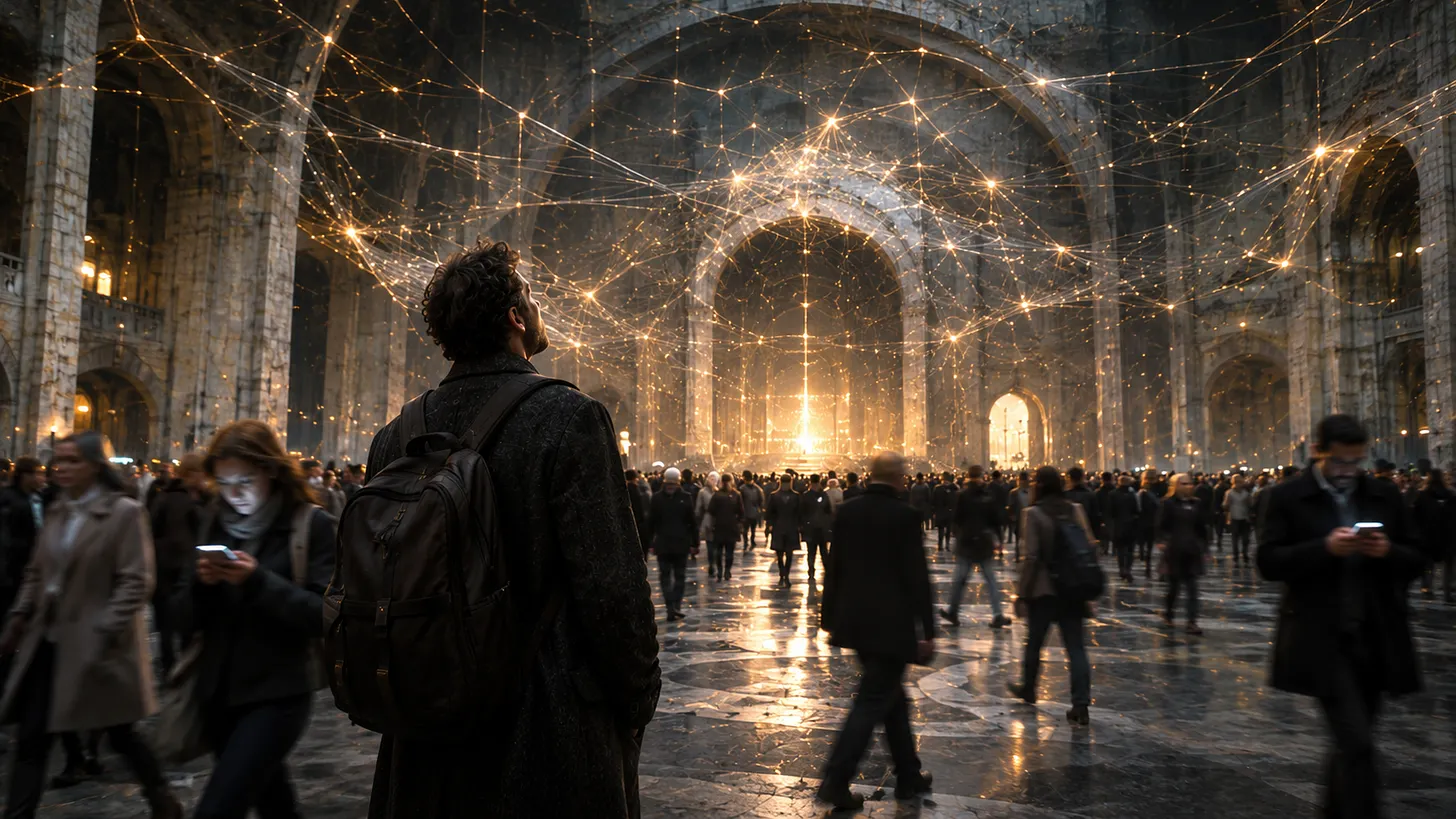
What if the greatest influence over our lives isn’t necessarily what happens to us, but what we’re conditioned to believe, fear, accept, and ultimately contribute to creating? There are forces at work in the human experience that deserve considerably more scrutiny, not least because we may be participating in their perpetuation without ever recognizing it. Perhaps understanding spiritual warfare requires us to look beyond the apparent opposition and examine the very nature of our own creative authority.
. . .
Preface
In my previous article, The Creative Force and Its Captors: On Demons, Egregores, and the Human Condition, I explored the possibility that humanity is subject to various influences, forces, and constructs that operate beyond our ordinary understanding of reality. I questioned the nature and origins of these influences, the possibility that some might be parasitic or predatory, and, perhaps more importantly, whether we might be contributing to their existence and perpetuation through our own creative faculties.
I’d like to take some of those ideas in a different direction, moving from the individual experience toward the collective and considering how these same dynamics might manifest throughout society, through our institutions, cultural narratives, technological infrastructure, and the ways in which we’re conditioned to perceive and participate in the world around us. If there is something to this idea of spiritual interference, perhaps we need to look beyond the entities themselves and consider the broader environment in which they operate, how it’s sustained, and what role we might be playing in creating it.
I’ve written recently about schizophrenia, and in exploring the connections to that subject, the concept of a spiritual element emerged, as it so often tends to in explorations delving into root causes and the origins of pain and suffering. These inquiries inevitably lead toward a greater understanding of the nature of humanity, our purpose in this realm, and what gets in the way of a human being reaching their fuller potential in all areas of life.
Three separate sources, each describing cases in which people have found remedies and resolution for various experiences associated with this most terrible of psychological disorders, have arrived at remarkably similar conclusions. Rather than attributing these experiences to an alleged (and disproven long ago and elsewhere) chemical imbalance, they point to something energetic. Something spiritual. Whether you believe in demons and angels, tulpas and egregores, doesn’t really matter at this stage. It’s about the nature of the experiences, the influences described, and the ways in which they appear to manifest in people’s lives.
Naturally, their explanations differ considerably from those of the mainstream medical paradigm, challenging the assumption that such conditions can only be managed rather than resolved. We’ve all been subjected to that institutional rhetoric and misleading marketing for our entire lives, and it has undoubtedly had an effect. Regardless, I can’t independently verify every account or conclusion, but I find the similarities compelling. And it doesn’t have to be schizophrenia. That’s a fairly well-documented disorder, though it would seem rather misunderstood, and the people behind these accounts believe they’ve found real solutions. That’s what matters most. But their approach requires a different mindset, one that takes into consideration causative factors that are more than likely going to sound a little outside the box. As we know, many of the solutions we seek for what ails the human family may require us to look beyond the established frameworks, institutional interests, and gatekeeping mechanisms that have come to define what we’re permitted to consider.
But what if these experiences represent something larger? What if the influences described by those who have endured such things aren’t confined to particular individuals or circumstances? What if some of the same dynamics are playing out on a much broader scale, across families, communities, and entire populations? This is where the subject of spiritual warfare becomes increasingly important to understand.
When we look at the broader society and the culture that has developed over the last century around mental health, biological health, and our overall well-being, there are some troubling patterns worth examining. I’ve tried to do so over the past decade and more, through dozens of essays, articles, and deep-dive discourses with AI. Many others have as well, because there is clearly something terribly wrong with the way these issues are being handled by those whose interests are tied to dogma, profit, marketability, and control.
In our era, we have an incredibly wealthy and influential medical industrial complex, deeply integrated with news, entertainment, corporate and social media, and certainly with governments worldwide. The covid event of 2020–2022 and beyond brought many of those institutional relationships and dynamics into public view. Many, myself included, were very vocal and active during that time, much to our stress, anxiety, attacks, and isolation. I still can’t believe how rapidly the world was shut down, and for what I regard as little more than a grand deception. Millions of hearts and minds were captured, coerced, and corrupted. To me, it was the very definition of spiritual warfare, and it was, in many ways, terrifying. But at the same time, revealing and transformational. I regard the entire episode as a worldwide hoax that provided a distraction from something else we weren’t privy to, and I believe its consequences are still being felt. That being said, it was but one event in a long line of similar events, ranging from minor and regional to shocking and worldwide, throughout the past century. Each has consistently altered the trajectory of the human collective, and, it could also be argued, not at all to our improvement or benefit.
As with previous events, what happened in 2020 — what I’ve many times labeled a manufactured crisis — resulted in significant numbers of injuries, both physical and psychological, and tragic losses of life — none of them, in my view, correctly attributed to a mythical contagion. But there’s another layer to all this existential noise. When we consider how people are subjected to chronic stress, trauma, manipulation, and psychological conditioning, I think it’s more than reasonable to ask what effects these influences might have beyond the purely physical.
What happens to the human spirit when people are continually subjected to fear, uncertainty, division, and the perception that they’re powerless to change their circumstances?
[On a side note, I explored the concepts of “soul” and “spirit” in a five-part series, Soul, Spirit, and Purpose, which delves deeply into these oft-conflated ideas, their meaning, our greater purpose here on Earth, and how we might reclaim agency over these essential aspects of our lives.]
My interpretation is that there’s a spiritual dimension to this broader pattern, and that the conditions being created may offer opportunities for something more predatory to take hold.
And perhaps this is where we need to revisit the idea of the egregore and the collective creative force explored in my previous article.
We’re conditioned to underestimate the power of our own minds, our imagination, our emotional investment, and our capacity to construct and reinforce entire worlds of meaning and experience.
An idea becomes a belief. A belief becomes an expectation. An expectation informs our behavior, our relationships, and the way we interpret everything around us. Sit with that for a minute and let it percolate.
When enough people share those same beliefs and expectations, something else begins to happen. The collective expression takes on a momentum of its own. It becomes a shared framework through which people interpret reality, often without recognizing the extent to which they’ve contributed to its creation.
This is what makes the concept of the egregore so interesting. As I explored previously, the idea describes a collective thought-form sustained by the attention, emotion, intention, and belief of those who participate in it. Whether we understand such constructs as literal energetic entities, psychic or psychological phenomena, or an allegory for the power of collective consciousness, there’s something worth considering here. What begins as an idea can become a shared conviction, a movement, an institution, or an entire cultural reality. It can acquire its own rules, expectations, and mechanisms of reinforcement. People begin to identify with it, defend it, and contribute to its perpetuation, sometimes to the point where questioning it becomes almost unthinkable.
You may recall how things played out in 2020, and how so many were swept up in that particular egregore. Think of how many people, even within your own family or circle of friends, seemed to completely lose their minds, only to act today as though none of it ever happened. As of this writing, on 6 November 2026, I still see the odd person walking around wearing a mask, or more accurately, a face diaper. This phenomenon is no joke.
And what if some of these constructs aren’t simply emerging organically? What if they’re being deliberately cultivated, reinforced, and directed? What if the very creative faculties through which we imagine and construct our experience are being redirected toward something that works against our own interests?
While we’re on the topic of 2020, I’d be remiss not to touch on something critical. In my view, there exists today entirely avoidable impositions, and specifically medical impositions. Like many others who’ve done extensive research on the subject, I have serious concerns about many, if not most, medical interventions humans are subjected to, sometimes even in the womb, the nefarious justifications behind these arguably useless practices, and their “potential” effects on human development. I’ve explored this problem at length elsewhere. But there’s a further question I’m exploring: might these interventions, beyond their well-documented biological and psychological consequences, also contribute to what could be described as an energetic or spiritual imbalance? My answer would be yes.
What’s particularly interesting in the accounts I’ve encountered is how often the experiences described appear to have their beginnings in early childhood — and really, how could they not? The formative years are when we’re learning how to understand ourselves, our families, our relationships, and the world around us. We’re absorbing beliefs, expectations, fears, and behavioral patterns long before we have the experience or discernment to question them. The innocence and purity of a new life are systematically subsumed by the system we’re born into. One might presume that an innate knowing, sensing, and inborn spirit, along with its capacity for comprehension, becomes obscured, occulted, or otherwise suppressed along the way. Add to that the family environment, the surrounding culture, and the authority figures entrusted with our development, all of whom contribute to the foundations upon which our individual understanding of reality is built.
If we consider the possibility that these forces, entities, demons, or whatever terminology we choose to use, can gain some sort of inroad into a family, gradually influencing and corrupting it from within, the consequences could be cumulative. That’s one interpretation of the accounts I’ve been listening to. Some describe a progression that eventually leads to a person’s self-inflicted and untimely demise. As you can imagine, such a loss has a profound and traumatic spillover effect, not only on the closest friends and family but throughout the wider community. My suspicion is that these experiences, whether understood psychologically, energetically, or spiritually, contribute to a broader pattern of pain and suffering. And, again, manufactured crises the world over keep pounding on us through that same vibrational or energetic frequency spectrum, ad nauseam. It’s chronic and systemic.
But there’s another possibility worth considering. We don’t necessarily need to assume that every destructive pattern originates with an external entity or influence. Families, like communities and societies, can become caught in cycles of inherited trauma, dysfunctional relationships, fear, resentment, and unexamined beliefs. Some believe these patterns can be passed along from one generation to the next, often becoming so familiar that nobody recognizes them for what they are. If there is an energetic or spiritual dimension to these experiences, perhaps it operates alongside these more readily observable dynamics, rather than being entirely separate from them.
In the bigger picture, these patterns affect communities, then scale upward and outward from there. What begins as an individual experience can become a family dynamic, a cultural expectation, or an accepted feature of collective life. And this brings us back to the idea that the human creative faculty may be involved in far more than we realize. We don’t simply inherit the world around us. We continually participate in its construction and perpetuation.
But, let’s be clear here. The ideas of generational trauma, karma, and similar concepts are frameworks; they’re maps to guide you toward potential understanding, and perhaps even remedies for healing. They are not the whole story, the whole spiritual territory, nor a victim mindset to linger in or latch on to.
Just think about how often the ideas of outbreaks, epidemics, pandemics, and other fear-inducing narratives are brought into the mainstream, sometimes weekly or monthly. Some of these concerns may have legitimate foundations, but I question the accuracy, framing, and constant repetition of many of the narratives presented to us. What interests me is their cumulative psychic and psychological effect. Whether the subject is so-called viruses and contagion, cancer or heart disease, the weather and extreme weather, or the ever-present specter of so-called climate change, there’s a recurring emphasis on fear, uncertainty, fragility, and our supposed vulnerability.
It can be about wars and conflicts in places you’ve likely never been and may never visit, involving people and cultures you know very little about, yet who are, in all likelihood, very much the same as you. It can be about finances, economic uncertainty and instability, changes to currency, and the digitization of everything under the sun. It can be about the fear of who or what will ultimately decide when and whether you can spend your money, and how. Whatever the subject, there always seems to be another reason to be concerned, another threat to anticipate, another impending crisis demanding our attention.
How or why is that even possible? What is it that perpetuates this formula, informing, outlining, and structuring a significant portion of our lived experience?
I’m not suggesting that every concern is fabricated, that every warning is without merit, or that we should simply disregard the circumstances unfolding around us. But I think we need to pay considerably more attention to the way information is presented, the emotional responses it generates, and the cumulative effects of being continually immersed in narratives of impending disaster.
There is a difference between being informed and being conditioned to respond with fear.
There is a difference between exercising discernment and surrendering our emotional state to whatever happens to be dominating the headlines.
And this is where the institutional dimension becomes especially relevant. Governments, corporations, media organizations, medical authorities, and other concentrations of power don’t necessarily need to understand or acknowledge the metaphysical implications of what they’re doing to participate in these dynamics. They operate through their own interests, incentives, agendas, and institutional priorities. They develop narratives, establish frameworks, define acceptable boundaries of discussion, and influence the ways in which people interpret their circumstances. Some of this may be deliberate; some may simply be the consequence of systems reinforcing their own interests and perpetuating the conditions upon which they depend.
The result, however, can be remarkably similar: people become increasingly dependent upon external authorities to explain their experiences, assess their circumstances, and determine what they should believe, fear, accept, or do next. The more this happens, the less inclined they may become to exercise their own discernment or trust their own capacity to make sense of the world around them.
Through modern technology, individuals can be surveilled, targeted, and influenced with a degree of precision and reach that would have been difficult to imagine in previous generations. Our attention has become a valuable commodity, and our emotional responses are increasingly measurable, predictable, and subject to manipulation. The same technology that allows us to communicate, create, learn, and connect can also be used to fragment our attention, reinforce our existing fears, isolate us within ideological enclaves, and continually present us with material designed to provoke a particular response.
And, as already stated, individuals can very easily be coaxed into mob mentalities and a progressively negative, fearful hive mind. They give up their individual rights and responsibilities for the sake of fitting in with the crowd. They conform and obey to avoid being shunned, judged, or ostracized. Their identities become entangled with particular narratives, movements, and belief systems, sometimes to the point where questioning those things feels like a betrayal of themselves or their community.
There’s a very good reason for this, and those who excel in marketing, public relations, and mind control understand it well. Psychologically speaking, isolation can feel like a form of social death. Being alone and left to fend for one’s self can be terrifying, even when that threat exists only in our minds. The desire for acceptance and belonging is powerful, and this can make people remarkably susceptible to influences that promise safety, security, certainty, and a sense of shared identity.
Even when those influences are destructive, the need to remain part of the group can override individual discernment.
We see this in political movements, religious institutions, social trends, online communities, and virtually every other environment where collective identity becomes more important than independent thought.
It seems to me that these same vulnerabilities may have significance beyond the purely psychological.
If we return to the possibility of egregores and collective thought-forms, perhaps this is one of the ways in which they are sustained and perpetuated. Fear, anger, resentment, outrage, division, and uncertainty are not simply passing emotions. They command attention, generate reactions, and encourage continued engagement. What does this remind you of? It is precisely how social media operates.
People feed into these dynamics through their thoughts, conversations, behaviors, and emotional investment. They share the narratives, defend the positions, reinforce the divisions, and contribute to the collective atmosphere that surrounds them.
And what happens when those collective expressions begin to take on a life of their own? What happens when the very things we create through our attention and participation begin to influence us in return?
Perhaps this is one way of understanding the relationship between the individual and the collective, and the possibility that something more is operating beneath the surface of our shared experience. Whether these constructs are independent energetic entities, self-reinforcing psychological phenomena, or something that exists somewhere between those interpretations, the implications are considerable. What may begin as a human creation can eventually become something that appears to operate beyond our individual control. We can find ourselves living within systems of belief, expectation, and behavior that we helped create but no longer know how to question, much less dismantle. And once these systems are socioculturally normalized and widely adopted, we may no longer even be aware of them.
These are the patterns I observe. They can all become vectors of spiritual attack or, perhaps more accurately, manifestations of something that has already taken hold. If physical and material expressions are downstream solidifications of influences operating at the psychic, energetic, and spiritual levels, perhaps this framework offers another way to consider the relationship between the individual, the collective, and the conditions of our shared existence.
On a more expansive level of existence, one that goes beyond the physical, it seems to me there may be forces, entities, and other interests that benefit from keeping humanity weak and confused, fragmented and isolated, self-centered and narcissistic. Perhaps their influence is exerted directly, perhaps indirectly, or perhaps through the very constructs and systems we’ve created and continue to sustain. I don’t pretend to know the precise nature of these influences, or the extent to which they might operate independently of our own psychological and social mechanisms. But it seems to follow that the conditions of human suffering are not entirely disconnected from the ways in which we collectively direct our attention, energy, and creative faculties.
 There’s also the question of agency and personal responsibility, one I’ve written about extensively over the years. One pattern that seems to emerge across these different lines of inquiry is the extent to which individuals and communities defer their authority to something or someone else. In my view, the more we surrender that agency, the more vulnerable we become to outside influences, whether institutional, psychological, or spiritual. Conversely, the more individuals and communities reclaim their agency and take responsibility for their own lives, the less opportunity there may be for such influences to take hold.
We have to be willing to examine our own participation in the stories we’ve accepted, the beliefs we’ve adopted, and the constructs we’ve helped sustain. We have to consider where our attention goes, what provokes our strongest emotional responses, and how much of our energy is being directed toward things that ultimately diminish rather than expand our experience of life. We have to recognize the difference between genuine understanding and the endless consumption of information, between discernment and suspicion, between healthy skepticism and becoming so defined by opposition that we lose sight of what we’re actually working toward.
How people approach that process will differ. For some, it might be scripture; for others, rite, ritual, or some entirely different means of reconnecting with their own spirit. Perhaps it involves revisiting the experiences that have shaped us, reconsidering the stories we’ve been telling ourselves, and undertaking the kind of personal recapitulation that allows us to recognize and reclaim what we’ve given away, consciously or otherwise. Whatever the approach, the underlying principle is to become less dependent, less fearful, and less susceptible to manipulation.
I would argue that we are, in a very real sense, creator beings. So perhaps the work isn’t simply about defending ourselves against the things that seek to influence or control us. Perhaps it’s about understanding the creative responsibility that comes with being here in the first place.
What are we creating through our thoughts, beliefs, intentions, and actions? What are we contributing to the collective human experience? What kinds of realities are we reinforcing through our attention and emotional investment? And, perhaps most importantly, are we satisfied with what we’re helping to create?
The same imaginative, emotional, spiritual, and intentional capacities that allow us to build, love, discover, and transcend can also be directed toward fear, division, limitation, and suffering. Look at the world around you and see how these capacities have been misappropriated, misused, and weaponized against us. Perhaps the struggle isn’t simply between humanity and some external force, but also between different expressions of our own creative potential. We can contribute to the perpetuation of constructs that keep us fearful, fragmented, and dependent, or we can begin to direct those same faculties toward something more life-affirming.
We can spend an entire lifetime trying to identify every possible influence, every entity, every institutional deception, and every mechanism of control, without ever arriving at a satisfactory explanation for the whole of it. There will always be another layer to uncover, another theory to consider, another interpretation to reconcile. And while there’s nothing inherently wrong with pursuing those inquiries, we can become so consumed by the search for what’s working against us that we lose sight of what we’re capable of creating instead.
What if that’s another form of spiritual entrapment? Not necessarily because the questions are unimportant, but because the pursuit itself can become an all-consuming exercise in fear, suspicion, and opposition. We can become so preoccupied with the darkness that we inadvertently continue to give it our attention, our emotional investment, and our creative energy. We can become defined by the very things we’re trying to overcome.
I don’t think the answer is to ignore what’s happening around us, pretend that everything is wonderful, or adopt some superficial version of positivity that denies the reality of suffering. Quite the contrary. I think it requires a deeper appreciation of the human condition, a willingness to look honestly at the things we’ve inherited, the things we’ve experienced, and the ways in which we’ve been influenced. It requires us to become more discerning, not less; more conscious of our participation, not less; and more deliberate about where we direct our attention and energy.
I come back again to the same questions raised in my previous article. What are we? What are we capable of? What is our relationship to the reality we inhabit, and what role do we play in its creation and perpetuation? If there are forces, entities, or constructs that benefit from our confusion, division, and suffering, then perhaps the most important thing we can do is begin to understand the extent to which we’ve been contributing to those conditions, and what it might take to stop.
The creative force we seek to reclaim isn’t something external to us, waiting to be bestowed by some higher authority or discovered through the latest explanation of how reality supposedly works. As I’ve said many, many times before, it is something we already possess, something expressed through our thoughts, our intentions, our relationships, and the choices we make every day. Perhaps it has been obscured, misdirected, conditioned, or appropriated in ways we don’t yet fully understand. But that doesn’t mean it has been extinguished.
This is where the real work begins: not simply identifying the forces that may be working against us, but remembering what we are, recognizing what we’re contributing, and becoming considerably more deliberate about what we choose to create.
If there is a spiritual warfare taking place, perhaps one of its most important battlegrounds is the human creative faculty itself.
Lux et veritas
Written by Trance Blackman. Originally published on tranceblackman.com on 06 November 2026.
Copy & share: https://tranceblackman.com/spiritual-warfare/