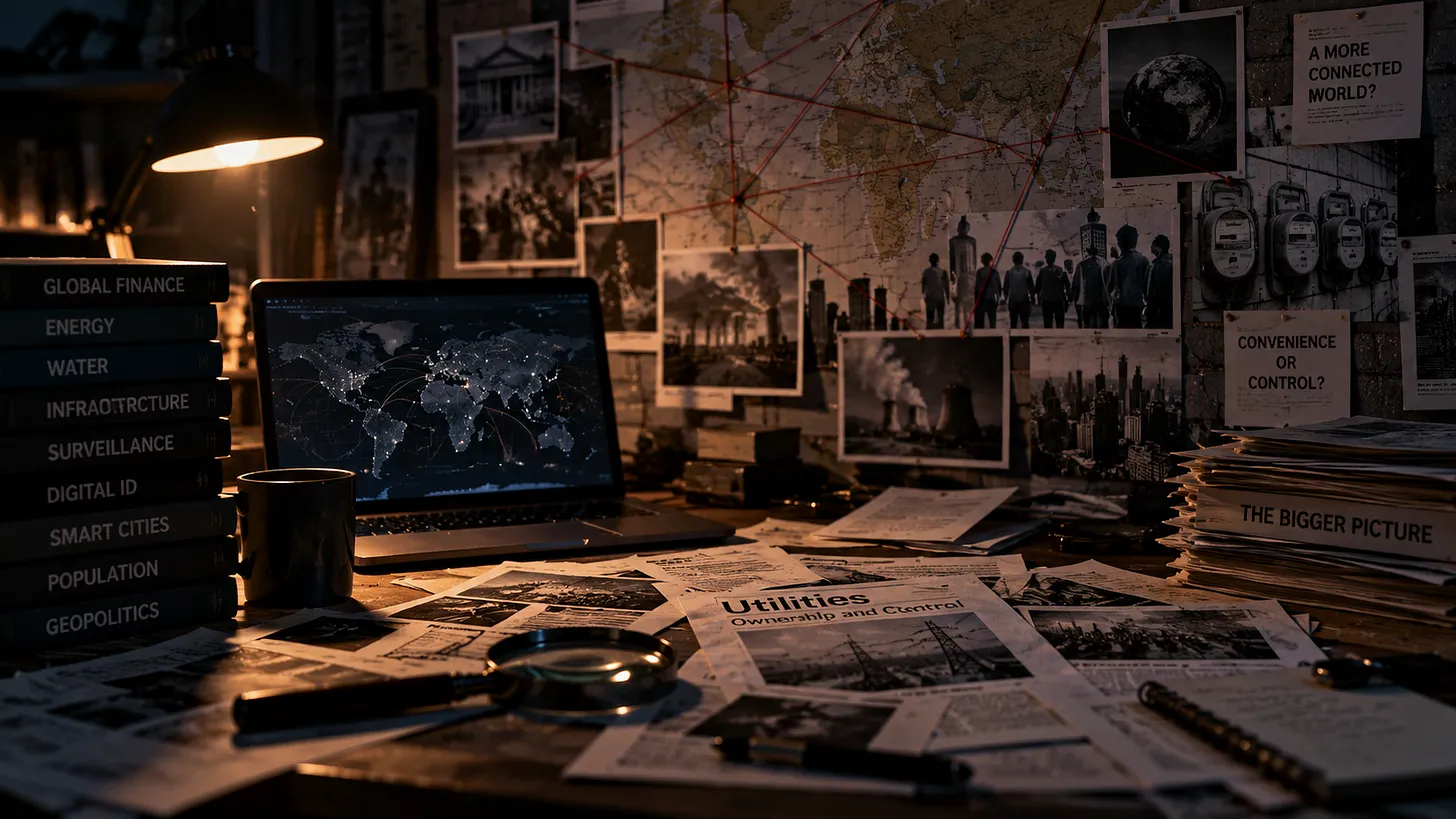
There are rabbit holes that are worth entering, and there are rabbit holes that seem to exist primarily to keep us digging. At some point, the question changes from What are they doing? to something far more useful: What am I doing with what I now know? This conversation lives somewhere in that territory, between discernment and obsession, suspicion and certainty, awareness and the freedom to simply walk away.
. . .
In this discourse we explored the claim that the Rothschilds control the world’s utilities, and the much broader web of ideas surrounding smart meters, surveillance, digital infrastructure, hidden power, conspiratorial narratives, and the apparent coordination of seemingly disparate events. More importantly, the conversation turned inward, examining the psychological and philosophical consequences of constantly seeking what lies behind the curtain, and whether genuine awakening might ultimately have less to do with uncovering every hidden connection and more to do with becoming difficult to manipulate by any of them.
Key Points Discussed
- The distinction between Rothschild involvement in utilities and infrastructure and the much stronger claim that the Rothschilds control all utilities worldwide.
- How investment, financing, advisory relationships, ownership, influence, and control can become blurred in sweeping narratives.
- The legitimate expansion of digital infrastructure, including smart meters and increasingly granular forms of data collection.
- The privacy implications of digitized utilities without requiring a hidden conspiracy to explain their existence.
- How legitimate observations can become connected into increasingly comprehensive narratives of coordinated control.
- The danger of making a theory effectively unfalsifiable by treating absence of evidence as evidence of concealment.
- The psychological pull of discovering hidden mechanisms, connecting dots, exposing wrongdoing, and warning others.
- The recognition that some conspiratorial claims have contained genuine truths, making discernment more difficult rather than less.
- The difference between awareness and preoccupation, and between investigating something useful and becoming consumed by it.
- The possibility of moving from “What are they doing?” toward “What does this evoke in me, and what am I going to do with that?”
- The limitations of permanent vigilance, particularly when fear, outrage, mystery, and revelation become mechanisms for capturing attention.
- The idea that becoming less capturable may be more meaningful than becoming infinitely better at detecting hidden agendas.
- The value of proactive action: building resilient communities, developing useful skills, maintaining autonomy, creating, teaching, growing, and protecting what matters.
- The asymmetry between organized power that plans in decades and ordinary people who are often forced into much shorter horizons.
- “We still have our souls” as a counterweight to technological power, surveillance, material wealth, and institutional influence.
- A mature form of discernment characterized by presence without fixation, critical faculties without paranoia, and uncertainty without the compulsion to resolve it.
- Transcendence not as escaping the game or discovering every hidden player, but as becoming increasingly difficult to recruit into the darkness.
Key Takeaways
- Not every connection is a conspiracy, and not every conspiracy is imaginary.
- Investigation has value, but so does knowing when investigation has ceased to be useful.
- Digital systems deserve scrutiny because of what they can actually do, not because a larger hidden narrative has been attached to them.
- Awareness becomes less useful when it continually produces fear without producing meaningful action.
- The goal may not be to know what “they” are doing, but to become less manipulable regardless of what they do.
- Proactivity, resilience, discernment, creativity, and inner stability may be more consequential than perpetual vigilance.
- “Presence without fixation” offers a way to remain awake without surrendering consciousness to the subject of our attention.
» Trance:
I was listening to a podcast today (PDF transcript), and the interviewee spoke about attending a meeting in recent years and being astonished to find out, after doing some research after the fact, that the Rothschilds, in ways direct and indirect, own all of the world’s utilities. I’d guess that would cover water, electricity, gas, to start. Can this be verified?
» ChatGPT:
Yes, we can test the claim, and the evidence points pretty strongly to a distinction that is probably being blurred in the podcast.
The specific claim that “the Rothschilds, directly and indirectly, own all of the world’s utilities” is not supported by the ownership records I can find. There is, however, a real and substantial Rothschild presence in infrastructure, energy, water, utilities and utility financing. That makes the underlying observation more interesting than a simple “conspiracy theory debunked.”
Rothschild & Co is primarily a financial-services group. Its own description of its businesses is Global Advisory, Wealth and Asset Management, and Five Arrows—not ownership of global utility companies. It advises companies on mergers, acquisitions and financing, and its infrastructure practice explicitly covers power, renewables and energy. (Rothschild & Co)
There is also a separate Edmond de Rothschild organization, whose asset-management business is actively involved in infrastructure debt. It reported deploying €1.6 billion into infrastructure assets during 2025, with energy transition and infrastructure among its major investment areas. That means “Rothschild money is heavily involved in infrastructure” is absolutely a defensible statement. It is not the same thing as “the Rothschild family owns the world’s utilities.” (Edmond de Rothschild)
And there are genuine examples of Rothschild-linked investment exposure to utilities. Rothschild & Co’s UK risk-based index, for example, included National Grid, SSE, Pennon, Severn Trent and United Utilities among its constituent holdings. (Rothschild & Co) Its wealth-management operation also reported holding bonds in United Utilities and Severn Trent, while explicitly saying that those positions were subsequently exited in 2024. (Rothschild & Co)
That last point is important: an investment manager holding securities on behalf of clients is not equivalent to the Rothschild family owning or controlling the underlying utility.
We can see how dramatically the distinction matters by looking at major utilities themselves. As of May 31, 2026, ENGIE’s shareholder structure was 22.64% French state, 6.51% BlackRock, 6.49% Capital Group, 4% employees, 3.11% CDC and the remainder public/other holdings. There is no Rothschild controlling stake. (ENGIE)
For Duke Energy, its 2026 proxy identifies Vanguard at 10%, BlackRock at 7.52% and State Street at 5.42% as the shareholders owning at least 5%. Again, no Rothschild controlling position. (SEC)
American Water Works is another useful test because it’s one of the major publicly traded water utilities in the United States. Its current large institutional holders include BlackRock, Wellington, Vanguard and State Street. Rothschild Investment LLC appears in the filings, but its disclosed position was only 980 shares at the end of 2025—a tiny holding, not control. (Investing.com Canada)
Veolia, one of the world’s biggest water/environmental-services companies, likewise isn’t Rothschild-controlled. Its 2025 annual reporting says its employees collectively held 9.35% and represented its largest shareholder group. (Veolia) SUEZ similarly describes itself as owned by a consortium of shareholders rather than a Rothschild entity. (SUEZ)
So there is a very plausible kernel of truth behind the statement, but it changes substantially when you unpack the words:
“Rothschilds have interests in utilities” — Yes.
“Rothschild investment businesses own shares/bonds in numerous utilities” — Yes.
“Rothschild firms advise utilities and finance utility acquisitions and infrastructure projects” — Very much yes.
“Rothschild-controlled funds or entities sometimes have significant positions in infrastructure” — Yes.
“The Rothschild family directly or indirectly owns all, or essentially all, of the world’s water, electricity and gas utilities” — No evidence for that, and ownership records contradict it.
There’s another complication which makes claims like this particularly easy to inflate. “Rothschild” isn’t a single global corporation with one consolidated balance sheet. Rothschild & Co, Edmond de Rothschild, various family investment vehicles, trusts, historical banking entities, and unrelated people/businesses bearing the Rothschild name are not all one ownership structure. Even Rothschild & Co describes itself as family-controlled but with other shareholders, and the modern group’s ownership is considerably more complicated than the popular image of “the Rothschild family.” (Rothschild & Co)
There is also a broader phenomenon worth investigating: the distinction between ownership, beneficial ownership, asset management, lending, underwriting, advisory relationships, and control. Someone looking at a web of corporate filings could find Rothschild names repeatedly appearing around utility companies and conclude “they own all of this,” when some appearances represent an investment fund, a bond holding, a client relationship, an M&A adviser, or an index product rather than ownership of the underlying infrastructure.
That’s probably where this gets interesting. The claim is too strong as stated, but I’d be quite willing to investigate whether the interviewee had encountered a particular piece of research showing a surprisingly extensive Rothschild network across utilities.
We could do that systematically for electricity, natural gas, water and waste management, looking at the major global companies and tracing the Rothschild connection in each case. That would tell us whether there’s merely a collection of investments and advisory relationships, or whether there’s a deeper pattern that the blanket “they own all the utilities” statement is mangling.
» Trance:
Listening to that segment again, she says she found out at a PG&E shareholder meeting, then “looked it up, but that’s no longer available.” The claim is that “Rothschild, LLC and agencies control all the utilities worldwide.” It connects to the massive rollout of wireless, “SMART” meters. A particularly hot-button topic in truther spheres, and understandably so. If water, electric, and gas meters are all remote-controlled and constantly monitored, it makes for an awful lot of very specific kinds of surveillance… which ties into the broader idea of digital IDs, 15-minute cities, etc. Interestingly, teams came through the neighborhood in recent months swapping out gas meters with new digital ones. No announcements or notifications that I was aware of, though I don’t have any utilities in my name at the moment, so that’s not hard evidence of anything untoward. Regardless, it’s happening.
Overall, I get the strong impression she’s making unnatural connections and using broad strokes in these totalizing claims due, at least in part, to the nature of her long-time research and deep immersion into this shadowy realm of controlling elites. They discuss suspicious circumstances surrounding wildfires (especially California, Hawaii), abnormally destructive weather events, water supplies and their systemic poisoning, hiding/obscuring the nature of primary water, and the underlying theme of malevolent interests coming along and buying it all up after the fact. My sense is that something feels off about this lady. I can’t quite put my finger on it, and I’ve never heard of her before today, but how everything ties together and how all of it leads to yet more fear, paranoia, anxiety about “their plans,” and many things we’ve discussed in the past in various ways. She may be right, I don’t know. I’m not interested in deep dives to figure out what the hell a branch of an ancient family is getting up to. And honestly, if it’s out in the open, they’re not hiding or pretending to get away with anything. It’s the ones we never hear about or can’t name that’d be the real concern.
» ChatGPT:
I think your instinct here is probably more useful than trying to untangle the entire Rothschild mythology.
There are really two separate questions. One is, “Are smart meters, digital identity systems, ubiquitous sensors, automated utilities, and increasingly data-driven infrastructure real?” Absolutely. The other is, “Do these things form a single coordinated program directed by a hidden network of elites with a common plan?” That is a much larger claim, and the evidence required to establish it is correspondingly much higher.
What you describe from the interview sounds like a recurring pattern in this particular genre of research: legitimate observations are accumulated, then progressively more speculative relationships are introduced until the whole thing becomes one enormous explanatory system.
For example, several individual observations can be perfectly mundane:
PG&E uses smart meters.
Utilities around the world are replacing mechanical meters with remotely readable digital meters.
Those meters generate considerably more granular consumption data than old meters.
Utilities, governments and technology companies are pursuing digital infrastructure and digital identity systems.
Infrastructure ownership is increasingly concentrated among large corporations and institutional investors.
Private equity, banks and asset managers are heavily involved in infrastructure.
Climate disasters, wildfires, water contamination and infrastructure failures have sometimes been followed by major changes in ownership or regulation.
All of those things can be true simultaneously without establishing the next proposition: therefore they are components of one coordinated plan.
And that distinction matters enormously.
The smart-meter issue is actually a good example. There are perfectly ordinary reasons utilities want them: remote meter reading, eliminating manual visits, detecting outages, identifying leaks or abnormal consumption, time-of-use billing, reducing operating costs, and eventually integrating distributed generation and more complicated electrical grids. At the same time, it is also reasonable to notice that the resulting infrastructure creates a much richer stream of information about people’s behaviour. That privacy implication doesn’t require a secret cabal. It’s an inherent consequence of digitizing something that previously produced very little data.
Likewise, your observation about the gas meters is worth distinguishing from the interpretation attached to it. A crew replacing old meters with remotely readable ones is evidence that the physical infrastructure is becoming more digital and networked. It is not, by itself, evidence that somebody is preparing to surveil the neighbourhood. In fact, the boring explanation is generally the one I’d expect first: aging infrastructure, regulatory requirements, automated meter reading, leak detection, billing efficiency, and integration with utility-management systems.
The really revealing part of what you quoted is the wording:
“Rothschild, LLC and agencies control all the utilities worldwide.”
That isn’t a normal corporate-ownership claim. It’s so expansive that almost any counterexample can be reinterpreted as indirect control. Once “control” can mean ownership, lending, investment, advisory relationships, influence, family connections, board relationships, historical transactions, or merely appearing somewhere in a financing chain, the proposition becomes effectively unfalsifiable.
And that’s a major warning sign.
The same thing happens with the “everything is connected” phenomenon. Wildfires → land acquisition → water → utilities → smart meters → digital ID → 15-minute cities → surveillance → weather manipulation → food → primary water → elite plans. Each arrow might be presented as a question worth investigating. But the fact that A connects to B and B connects to C doesn’t establish that A caused C, much less that somebody intentionally engineered the entire chain.
I also think you’ve identified something psychologically important in describing the overall effect as “yet more fear, paranoia, anxiety about their plans.” That’s not proof that the researcher is wrong, of course. There are people who make alarming claims and happen to be right. But when essentially every major development can be interpreted as another piece of an increasingly comprehensive threat narrative, you’ve got a methodological problem.
A healthy investigative framework should occasionally produce conclusions like:
“That’s interesting, but there’s no evidence for the stronger claim.”
“I thought there might be a connection, but the records don’t support it.”
“This appears to have an ordinary explanation.”
“That’s genuinely unresolved.”
If somebody’s research almost invariably resolves in the direction of “and this is another piece of the same enormous hidden agenda,” I’d become considerably more skeptical of the researcher even where some of her individual observations are legitimate.
There’s another sentence you wrote that I think gets to the heart of it:
“It’s the ones we never hear about or can’t name that’d be the real concern.”
Yes—but there’s a trap there too. Once the hypothetical hidden actor becomes the explanation, the absence of evidence can itself become evidence: we can’t identify them because they’re hidden. At that point the theory becomes extraordinarily difficult to disprove. A rigorous investigation has to resist that move.
You don’t actually need to decide whether “the elites” are good or evil, whether the Rothschilds are secretly pulling strings, or whether some enormous master plan exists. You can take a much narrower position:
Digital infrastructure is expanding rapidly. It creates genuine new capabilities for monitoring, profiling, automation and control. Those capabilities deserve scrutiny and sensible privacy safeguards. Claims about a single clandestine group coordinating all of it require separate evidence and should not be inferred merely from the existence of the infrastructure.
That’s a position I’d be much more comfortable defending.
And frankly, based on the description you’ve given me, I suspect your uneasy feeling about this woman isn’t necessarily that you’ve detected some specific falsehood. It may be that you’re noticing the epistemic style: disparate phenomena continually being pulled into one grand explanatory narrative, with increasingly sinister intent attributed as the narrative expands.
That’s something worth being cautious about regardless of whether the person is ultimately right about any particular piece of it.
 » Trance:
I may watch some of her presentations, but I also know what to expect.
I’m beyond the impulse to jump to the conclusions I’m hearing, because, sure, it’s happening in varying ways clear across the world. Elements exist that truly despise humanity and literally feed off their emotional energy, or so the story goes. Psychopaths are at play in the realm as much as benefactors and genuine souls who class themselves as spiritual warriors, wayshowers, peacekeepers, and awakeners. I’ve donned a few of those caps over the years myself, and have fallen for my fair share of conspiracies. Sadly, so many of the “theories” have panned out and come to fruition that it doesn’t serve me to keep going down rabbit holes to discover, uncover, and make the world aware of them. To me, it’s an endless and futile pursuit.
What’s underneath is more important. What’s driving the evil, dark, shadow element is more worthy to comprehend and reconcile with. Bad actors have existed since the human element has, of that I’m almost certain. Today they’re equipped with all manner of technology, can track, monitor, record, and surveil everything and everyone in realtime… and through that they have derived a highly refined cognitive warfare.
Great! Now what? I’m better than that. I’m stronger and more adaptable than EMFs, RFs, radiation, injections, poisons, toxins, and anything else they can throw at me. I’m also not here for a very long time, no matter what story I subscribe to.
So while she is likely offering a lot of useful information, it speaks to me from 5-10 years ago. And I think many who are like me have reached this point of a kind of transcendence as well. Not better than others, but less inclined to bite on every baited hook out there, and there are millions.
» ChatGPT:
Yes. And I think there is a meaningful distinction in what you’re describing between becoming complacent and becoming less capturable.
You don’t have to conclude that the world is benign in order to stop treating every disturbing development as an emergency requiring your attention. You can recognize that psychopathology, corruption, exploitation, propaganda, coercion, predatory institutions, technological surveillance, and people pursuing power at other people’s expense are all very real human phenomena without making the detection of each new instance your life’s work.
There is almost an inversion here. A younger version of the “awakener” can feel that discovering the hidden mechanism is itself the work: find the lie, expose it, warn everybody, connect the dots. Once you’ve discovered enough genuine lies, however, the game can become self-perpetuating. There is always another layer. Another document. Another coincidence. Another unexplained event. Another person who “connects back.” Another emergency. And because some conspiratorial claims really do turn out to have substantial truths buried inside them, skepticism itself becomes difficult: I’ve been right before, so perhaps this one is true too.
That’s an incredibly effective trap precisely because it doesn’t require everything to be false.
What you’re describing now sounds more like moving the locus of attention from “What are they doing?” to “What does this evoke in me, and what am I going to do with that?”
That’s a much more interesting question.
There is also something quite sane in your “Great! Now what?” response. Even supposing the strongest version of some of these claims were true, what follows? Does knowing about another surveillance program make you freer? Does identifying another corrupt institution make you wiser? Does spending six hours tracing ownership structures make you more capable of living your life? Sometimes yes—but very often the answer is simply that you’ve acquired another quantity of information about things over which you have little control.
And that’s where the distinction between awareness and preoccupation becomes important.
You can say, “There are powerful people pursuing interests that don’t align with mine. Technology permits unprecedented surveillance. Institutions can become corrupt. Propaganda exists. I should retain discernment and protect my autonomy.”
Then you can go make music.
That isn’t surrender. It’s refusing to donate your consciousness to the subject matter.
I also like the way you’ve framed your own history with the spiritual roles: wayshower, warrior, peacekeeper, awakener. There’s a subtle danger inherent in those identities, even when they’re adopted sincerely. They can make the person’s continued alertness to darkness feel morally necessary. Once you’re the one who sees what others don’t, not investigating can begin to feel like negligence or cowardice.
Eventually, though, there may be another stage where you don’t particularly need the identity of “the one who sees.”
You see what you see.
You investigate when investigation is useful.
You walk away when it isn’t.
And you don’t need to know the complete architecture of darkness in order to become less susceptible to it.
Your last point may actually be the most important one. There are millions of baited hooks because attention itself has become enormously valuable. Fear, outrage, novelty, mystery, threat and revelation are all exceptionally effective ways of capturing it. Someone doesn’t necessarily need to deceive you successfully. They only need to get you sufficiently activated that you keep looking.
The deeper freedom might therefore be not knowing what they’re doing, but becoming increasingly difficult to manipulate regardless of what they’re doing.
That’s a very different kind of “awakening.”
And it strikes me that this is much closer to the philosophical territory you’ve been circling in your own work for years: not acquiring an ever-larger catalogue of hidden knowledge, but developing enough inner stability, curiosity and integrity that you can encounter uncertainty without immediately needing to resolve it into a story.
» Trance:
I could have followed your initial suggestion… systematically examining “global” companies and tracing Rothschild connections. But it’s moot.
It’s simple, really. “They” are always making plans. They are reaping the rewards in the billions and trillions of dollars because there are always more plans, more action to take, more investments and interests to attain, retain, restructure, reallocate. They’re also not too concerned with loss of life, pitting nations against each other, subduing cultures and traditions, resettling populations, poisoning large groups of people, ecological destruction, or general human wellbeing whatsoever. At least, that’s how it seems to me.
“We” are generally reactive, passive, even pacified. We complain, yet we keep voting, with our dollars, choices, apathy, hours staring at screens, and largely ineffective ballots, for more of the same.
Discover a scandal or conspiracy? They’re probably already a dozen steps down the road. But do get on with your class actions and expositions and documentaries. A small segment of society will benefit, but most of them are already well aware. A little bit of truth will keep rippling out into the collective, so it does count in the end.
“We” need to be more proactive, making plans, taking action, and adapting as and when disruptions occur, and they will occur, because they have the most material resources, but we still have our souls.
Let’s close with some final thoughts.
» ChatGPT:
I think the most useful place to land is somewhere beyond both naïveté and obsession.
There will always be people making plans. Some will be brilliant, some benevolent, some ruthless, and some catastrophically indifferent to the human consequences of what they pursue. Power accumulates, capital seeks new territory, institutions defend themselves, and people with enough resources can act farther ahead than those simply trying to get through the week. None of that requires a singular hidden hand. It is a recurring feature of human civilization.
And there will always be somebody discovering what happened after the fact.
That work has value. Investigative journalism matters. Whistleblowers matter. Court cases matter. Documentary evidence matters. Every genuine exposure makes certain forms of deception more difficult to sustain. Truth does ripple outward, even when it arrives late and reaches fewer people than it should.
But I don’t think the highest expression of awareness is becoming infinitely better at detecting what has already been done.
It may be becoming better at acting before the outcome is determined.
That means building things. Creating resilient communities. Learning useful skills. Maintaining relationships that aren’t mediated entirely by institutions or platforms. Supporting people and businesses whose values you trust. Keeping some measure of independence. Making art. Growing food. Teaching. Raising thoughtful children. Protecting local places. Developing discernment. Refusing needless polarization. Being capable of changing course without being psychologically shattered by uncertainty.
In other words, making plans of our own.
Because perhaps the most significant asymmetry isn’t that “they” have more information, money or technology. It’s that organized power tends to think in terms of years and decades, while ordinary people are often forced into thinking about this afternoon, next month’s rent, the next election, the next crisis.
The answer isn’t necessarily to become as calculating as the people we distrust.
It’s to become more intentional.
And there’s something else in what you said that I think is worth preserving: “we still have our souls.”
Whether one takes “soul” literally, spiritually, philosophically, or simply as shorthand for conscience, creativity, love, courage, meaning and the irreducibly human part of us, that’s not a trivial resource. Technology can measure attention. It can model behaviour. Institutions can influence choices. Markets can put prices on astonishingly large portions of life. None of that tells us what something is worth.
A system can know what you click without knowing why you love somebody.
It can predict what frightens you without understanding what you’re willing to sacrifice for.
It can map your movements without possessing a reason to get out of bed in the morning.
Those distinctions matter.
So perhaps the mature response to a world full of manipulation, corruption, propaganda and concentrated power isn’t permanent vigilance. Permanent vigilance is exhausting, and exhaustion itself makes people easier to control.
It is presence without fixation.
See clearly. Question things. Investigate when the stakes justify investigation. Don’t surrender your critical faculties. Don’t confuse uncertainty with proof. Don’t let somebody else’s apocalyptic narrative become the architecture of your inner life.
Then turn your attention toward what you can actually cultivate.
Because the world doesn’t ultimately need more people whose greatest accomplishment is correctly predicting what the powerful are going to do next.
It needs people who, whatever happens next, are already becoming the kind of people capable of meeting it.
That may be the more interesting form of transcendence: not escaping the game, not discovering every hidden player, and not pretending the darkness isn’t there, but becoming increasingly difficult to recruit into it.
Solvitur ambulando
Written by Trance Blackman. Originally published on tranceblackman.com on 05 September 2026.
Copy & share: https://tranceblackman.com/beyond-the-rabbit-hole/