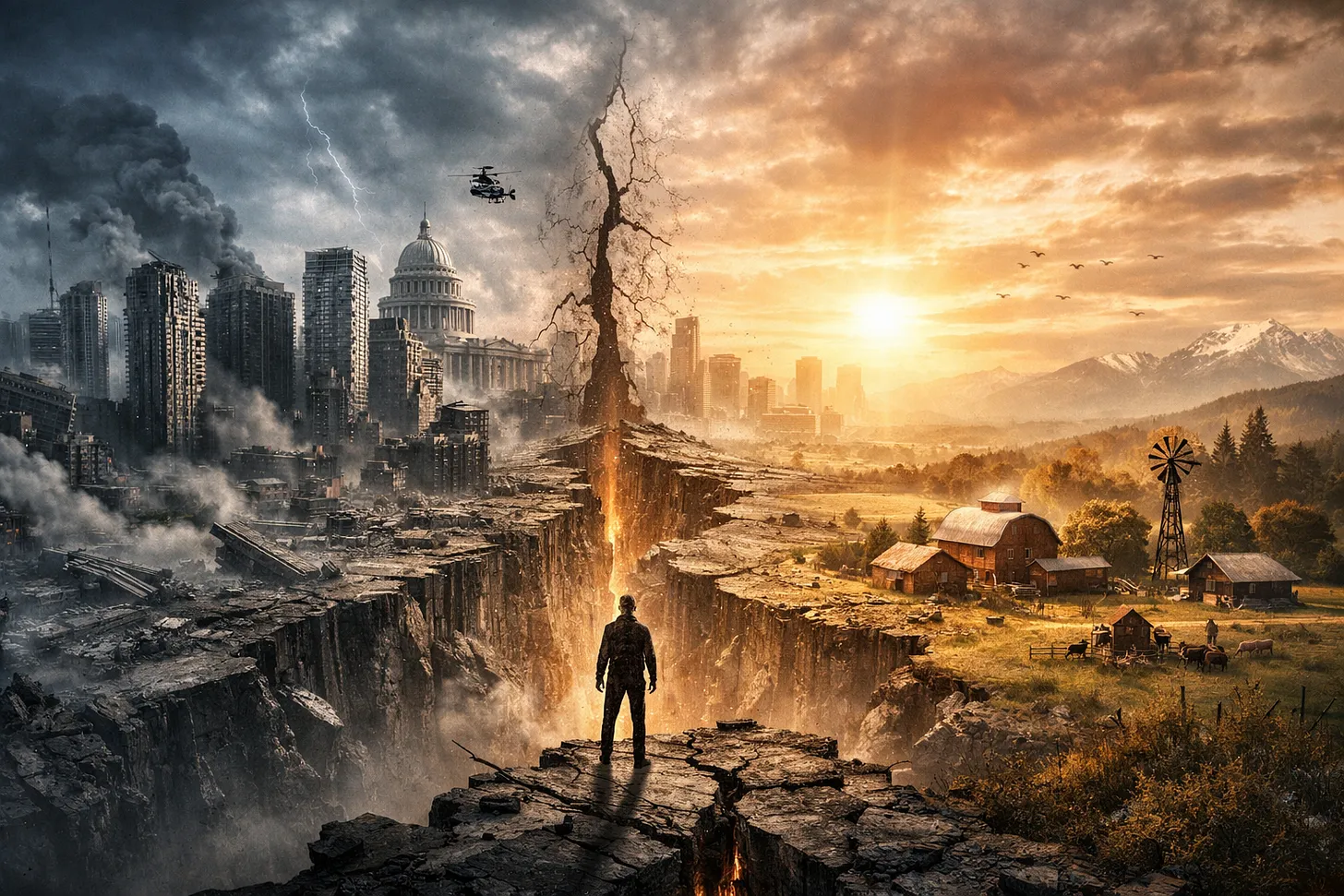
We tend to believe we’re moving forward, refining systems, improving outcomes. But every so often, stepping back reveals something else entirely — a pattern not of progress, but of repetition and intensification.
. . .
No matter how many times I’ve taken a run at this issue in my own writing, I keep arriving at the same place — different paths, same conclusion. It’s something that also aligns with what Hans-Hermann Hoppe puts forward, as echoed in Unbekoming’s essay Democracy: The God That Failed:
“The idea of democratic-republican rule must be rendered intellectually untenable — as laughable as the idea of monarchical rule is today. Not by replacing it with another form of government, but by recognising that government itself, in any form, is not the source of human civilisation. Private property is. The recognition and defence of private property rights, contractualism, and individual responsibility are what produce civilisation. Government, whether monarchical or democratic, parasitically draws on the wealth that private property creates. Democratic government draws on it faster, more aggressively, and with less resistance than any previous form.
“The strategic path is decentralisation. Secession. A systematic reversal of the political centralisation that has characterised the Western world for centuries. A territorially smaller government has more competitors, faces the constant threat of emigration, and must therefore restrain itself or lose its productive population to neighbours. At the limit — a world of tens of thousands of independent territories, regions, cantons, city-states, and free cities such as the present-day oddities of Monaco, Andorra, Liechtenstein, Hong Kong, and Singapore — competitive pressure would impose discipline that no single large government can replicate.”
Small communities and decentralized authority seem to be the only ways humanity has historically been able to operate organically in any meaningful sense. There’s been a renewed ruralist, homesteading, and planned communities movement in our generation, due in no small part to the tyrannical overreach of governments during 2020–2022. These models exist today and continue to proliferate, but only in a limited fashion — often planned from the ground up and, more often than not, still subject to the larger system of public law and corporatist statutes.
Anything beyond that inevitably demands increasing centralization, which, as the essay outlines, follows a predictable path. It metastasizes through its own incentive structures, gradually corrupting and corroding the very system that claims to “manage” humanity and its resources. The endemic issues of “democracy” are, in this sense, less mysterious than they appear. As ever, modern public discourse seems to suffer from a kind of historical amnesia, and in my view, that’s not by accident.
We’re handed highly uniform, curated ideas, ideologies, archetypes, and narratives throughout modern academia, and the sociocultural effect appears both total and self-sustaining. It’s probably safe to say that all of today’s alleged “superpowers” operate in a similar way, curating the grand narrative according to their own interests. Which one is true? None of them, of course. Even if every reason were tabulated, every eventuality logged, every life lost accounted for and justified, we would still be left with censorship, redaction, revisionism, and bias — politics and culture filtering everything to serve one angle or another, never quite revealing the whole picture.
We are living through — and attempting to reconcile with — the results of a century-long shift, one that appears to be accelerating toward systemic strain, if not outright civilizational collapse. While it is fair to say that all civilizations rise and fall, when we have the data, the historical record, and the means to educate ourselves — even to offer those in positions of power the opportunity to correct course — this state of orchestrated chaos and pervasive existential uncertainty is still where we find ourselves. The momentum favors the myopic, and increasingly, the desperate and malevolent.
What does seem evident is that more people across the world are becoming aware. Observant. Calling out deception. Attuned to the flaws, able to see the cracks forming everywhere. Even if we can’t quite name the problem, there’s a shared sense that the story itself is coming apart at the seams.
The “time preference” idea is a particularly useful lens here. You can see it reflected in everything from monetary policy to media culture — in how marketing, PR spin, welfare state narratives, and relentless consumerism are pushed across every channel. News and entertainment continue to serve the illusion of “normality,” even as it grows increasingly strained and hollow. Push division. Amplify grievance. Saturate the environment with problems, endlessly. Reactions are expected, predictable, and reliable. And then comes the same prescription: more laws, more control, more money printing. It has never worked, but somehow, this time it will be different. Just make sure you vote.
It becomes difficult to reconcile the steady rise in chronic disease, mental illness, inflation, and constant international “conflicts” with the notion that the underlying structure is sound — or that “world superpowers” represent anything human-centric, stable, or coherent. Presidents and prime ministers appear cast into a kind of faux-monarchical role, bordering at times on the dictatorial, yet without the long-term incentives or restraint such a role once carried. Whether they are selected, groomed, guided, and installed into these positions, or simply emerge this way, remains a persistent and contentious question.
More troubling is how readily governments — regardless of ideology or political identity — align in action, policy, and practice. The events of 2020 remain fresh, still rippling through the world’s population in ways both subtle and profound. At that level, it begins to look less like competition and more like coordination. Conflict appears manufactured, tension sustained. None of it points toward stability or coherence on any meaningful human level.
It even raises the uncomfortable possibility that what is often framed as a distant threat — a “one world government,” debated and dismissed in equal measure — may already be unfolding in practice, if not in name. The so-called “world wars” themselves have certainly played a role in accelerating this trajectory, stripping away the last remnants of monarchical structures, as Hoppe suggests, and clearing the path for something far more diffuse and entrenched.
In general, it feels as though the entire facade holds together on superstition and belief alone — along with the idea that our “freedoms” are being preserved by the very mechanisms that distort reality in the first place.
As the essay suggests, the numbers speak plainly enough. The pattern holds. The cycle not only repeats, but appears to intensify with each passing generation.
Even if we can’t fully articulate the mechanics, we can feel the direction things have been moving in for a long time now. It’s unsettling. At times, it feels existential. And it may not have a remedy at the systemic level. How could it?
Which brings things back, again, to the beginning: decentralization. Secession. A systematic reversal of political centralization as it has unfolded across the Western world.
Whether that turning point is imminent or generational isn’t entirely clear. But something is shifting. And if there’s anything within reach, it may simply be this: to become more deliberate and discerning in how we spend what little we truly control — our minutes, our means, our attention, and our living memory.
Temet nosce
Written by Trance Blackman. Originally published on tranceblackman.com on 13 April 2026.