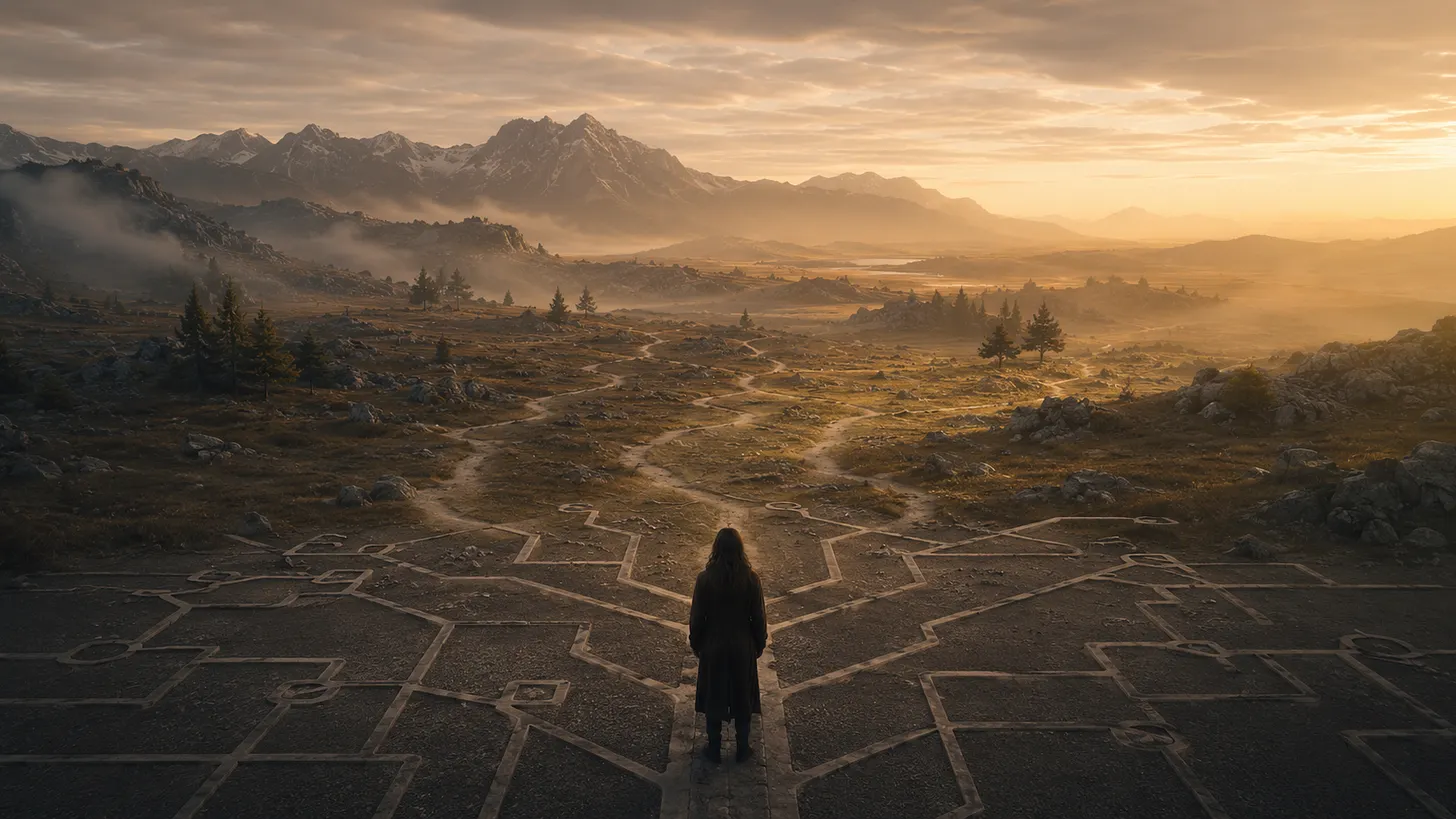
How much of what we believe must happen before we can move forward was ever truly ours to begin with? We inherit assumptions, expectations, fears, priorities, and definitions of success, then quietly build conditions around them. When this, then that. When I have enough. When I’m ready. When circumstances change. When someone approves. Eventually, these conditions cease to look like conditions at all. They begin to look like identity.
. . .
When this, then that.
Whose this? Why that?
Most of us live through a framework that is a patchwork of programs and conditions that, for the most part, are derived from the programs and conditions of somebody else, from somewhere else, based on the ideas of the environment in which we grew, the people, places, and circumstances we were exposed to.
Our this, our parameter that is most paramount, the requisite that must be met before we move forward and dare to entertain the idea of proceeding with whatever it is that calls us, that urges us, that tugs at our heartstrings, that interests us most deeply and profoundly, perhaps even at a critical juncture in our lives… Is it our this, or someone else’s?
And does that even really factor into the calculation? Does it even really matter? Will we still get to where we think we want to get to, regardless of the impetus, the instigation, the countless information packets that arrived into our consciousness, through which we defined value and priority, through which we derive action or inaction?
And then we layer in qualifiers. Are we deserving, or are they deserving? Is this what we truly want, or is it simply what they want for us?
We always think there’s time. We can readily come up with reasons to defer and delay, to make excuses and all manner of exit plans. Then we wonder why we need to eat, drink, or otherwise consume emotionally; distract ourselves aimlessly and obsessively; binge on fictitious fluff, mind fuckery, and cognitive filler so that our weary spirits can hide away, avoiding the hard questions and the uncomfortable reality of our fear-based consternation and endless contemplation.
When this, then that.
Whose this? Why that?
It works in coding and in programming language. It works in a linear, algorithmic environment. But it doesn’t work in lived, asymmetrical, unpredictable human reality.
And as much as we today are entrained to defer to calculators and machines, to the artifice of collected, collated, corroborated, cross-referenced, and cleverly encapsulated large language models and synthetic intelligence, our humanity keeps reaffirming itself at every turn. Our inborn intelligence has had enough of this perpetual extrinsic insult and seeks to remedy the imbalance. But we don’t comprehend its subtlety, its origin, its nature. We’ve been away from home for too long.
Our symptoms, reactivity, sensations, and sensitivities inform us of this contrast and conflict in every moment, with every breath, yet we ignore them, or at least pretend to. We cause ourselves unnecessary and excessive harm and injury in a thousand different ways, every single day. And then we project that pain onto the world, onto people we’ll never get to know. Onto our pets, who will always love us enough to take on or share a burden they know nothing about.
Nature and the world we inhabit are designed intricately and intimately to provide an infinite number of paths through which to pursue our best lives and, if we choose it, to thrive.
But we don’t trust it.
The answers, invitations, opportunities, and subtle course corrections that might move us toward what we say we want are presenting themselves all the time, from every direction. They arrive through people, circumstances, intuition, interruption, coincidence, discomfort, failure, beauty, curiosity, and desire.
But we don’t trust them.
So we seek, hoping that the next book, the next guru, the next expert, the next politician will have the answers. The next hit song that resonates deeply. The next poem, painting, or sculpture that touches something unspoken and unnamable.
There must be answers. There must be clues.
Why is this so difficult? Why does it always have to be so fucking hard?
Perhaps these are the wrong questions. Somewhere beneath all the noise, we know that they are. We know it as soon as we utter them. We know it as we repeat them day after day, week after week, year after year.
And yet we resist changing the frame.
It’s all we know. It’s who we think we are.
Eventually, the conditions we inherited, adopted, repeated, and defended become indistinguishable from identity itself. What began as somebody else’s this becomes ours. What began as a suggestion becomes a rule. What began as a rule becomes a requirement. What began as a requirement becomes an identity.
And then we spend our lives waiting for reality to satisfy conditions it never imposed upon us.
We wait for permission. We wait for certainty. We wait to feel ready, worthy, safe, healed, supported, understood, solvent, loved. We insist that one thing must happen before another can begin, and in doing so quietly surrender the only place from which anything ever does begin:
Here. Now.
When this, then that.
Whose this? Why that?
Solvitur ambulando

Written by Trance Blackman. Originally published on tranceblackman.com on 22 August 2026.