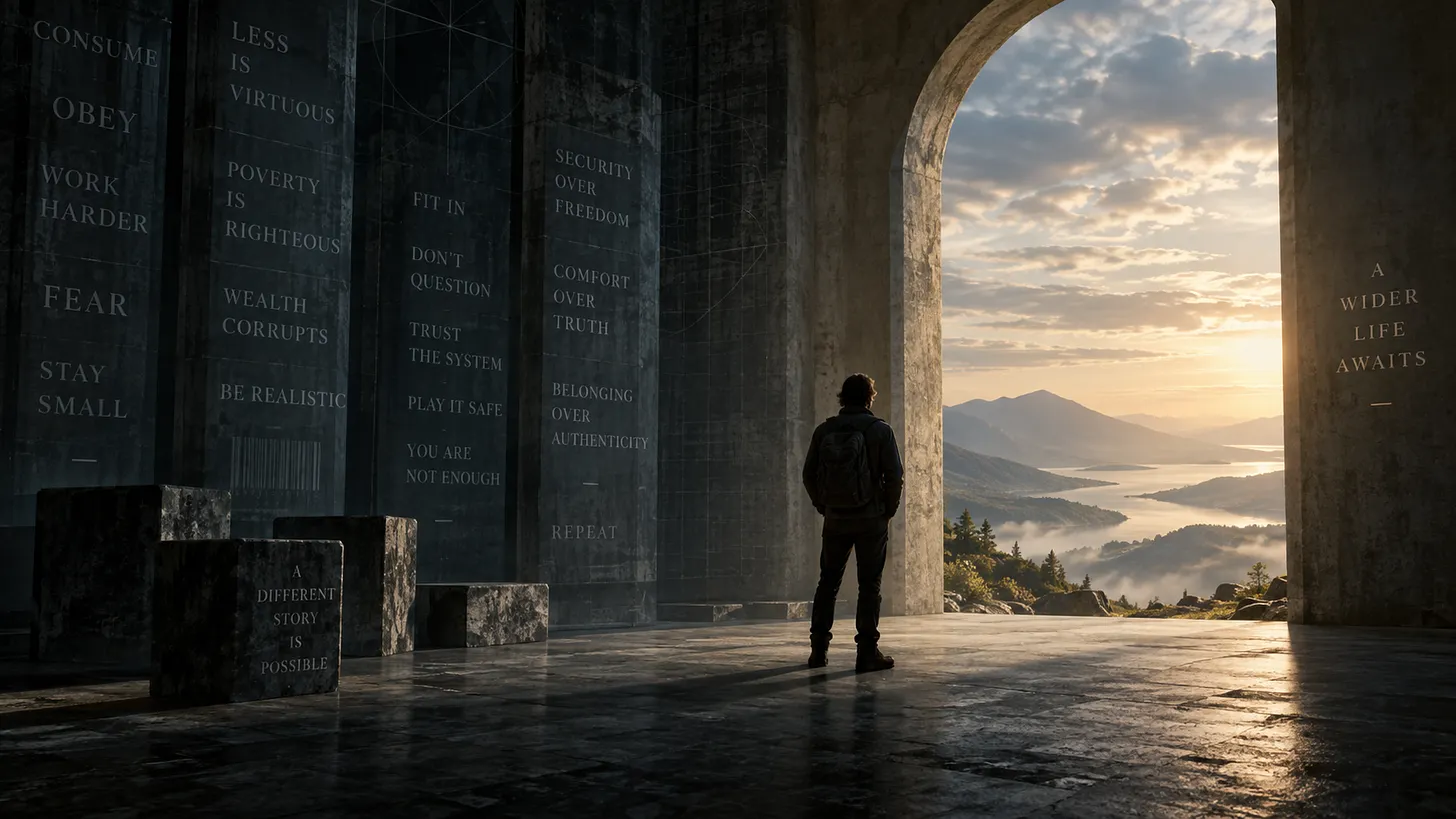
Perhaps the hardest programming to recognize is the programming that masquerades as virtue. It doesn’t arrive announcing itself as a limitation; it arrives as common sense, responsibility, humility, morality, even wisdom. We absorb it so completely that eventually we defend the very boundaries that keep us inside the smallest version of ourselves.
Tag: narratives

The deeper I get into these questions, the less interested I become in identifying a single person, institution, or hidden hand behind them. The more interesting thing, to me, is the machinery itself: the stories we inherit, the images we absorb, the things we are repeatedly shown, and the things that quietly disappear outside the frame. Somewhere in all of that is the question of how much of what we call our own perception has actually been shaped for us.

There are some ideas that seem almost too simple to notice until, once noticed, they begin to rearrange everything around them. Perhaps this is one of those ideas. Perhaps the body has been telling us the same thing all along, in a language older and more immediate than anything we have constructed to explain it.

This is one of those subjects where the more closely you look, the stranger the familiar story becomes. We are surrounded by products, ingredients, and assumptions that have become so ordinary that we rarely stop to ask why they are there in the first place, what purpose they actually serve, or whether our bodies are benefiting from them at all. Sometimes the simplest questions are the ones worth asking again.

Perhaps the first thing worth questioning is not what we have been told about the world, but why we have been taught to fear it in the first place. So much of what passes for certainty seems to depend upon our willingness to accept the premise before we ever examine it, and so much of what follows becomes inevitable only because we have agreed, consciously or otherwise, that it must be. Somewhere beneath all of it remains a simpler possibility: that we have far more agency than we’ve been led to believe, and that the story is not yet finished.