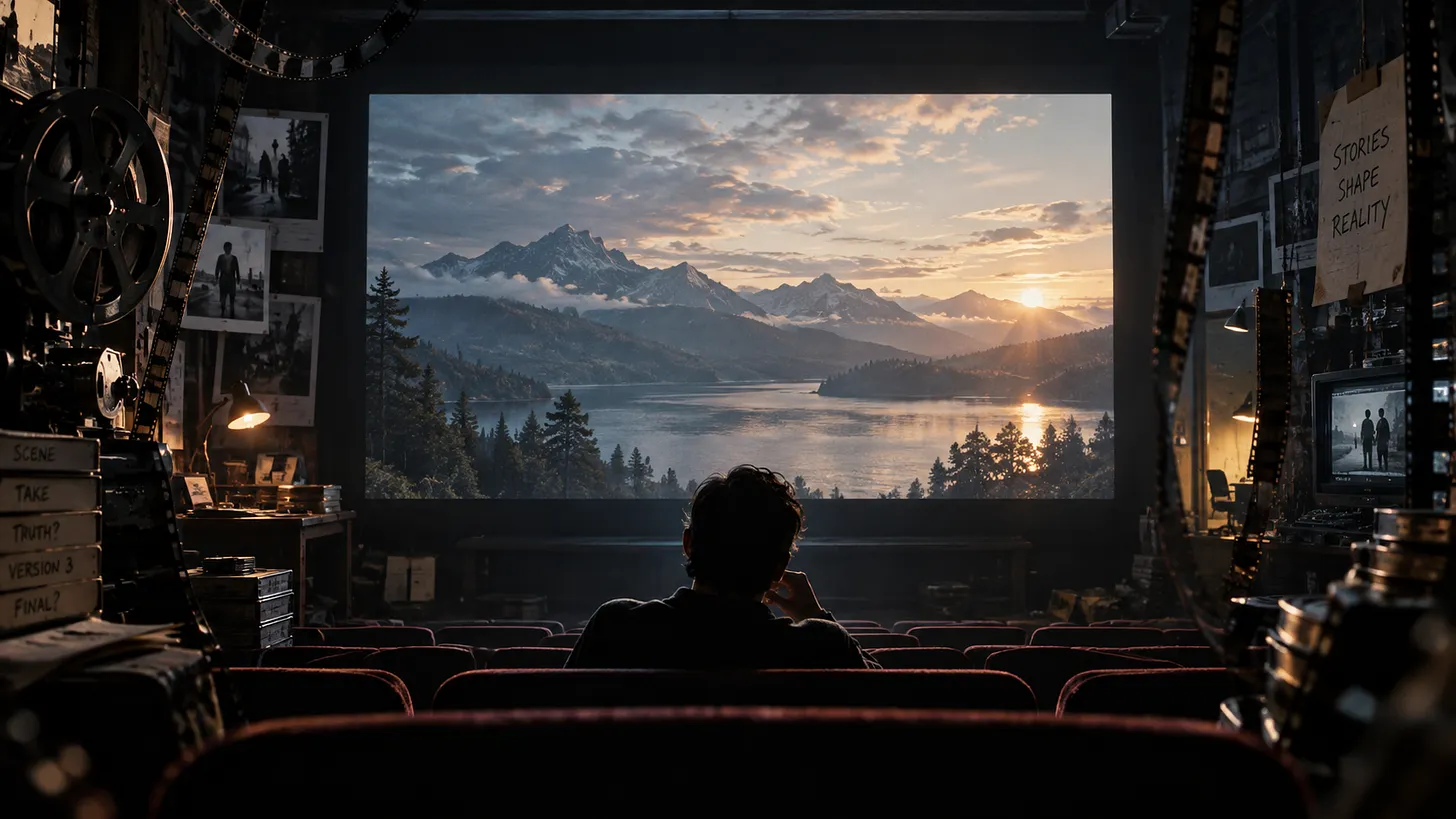
The deeper I get into these questions, the less interested I become in identifying a single person, institution, or hidden hand behind them. The more interesting thing, to me, is the machinery itself: the stories we inherit, the images we absorb, the things we are repeatedly shown, and the things that quietly disappear outside the frame. Somewhere in all of that is the question of how much of what we call our own perception has actually been shaped for us.
. . .
In this discourse we explored the relationship between government, intelligence agencies, Hollywood, media, propaganda, and the broader cultural mechanisms through which narratives become familiar and influential. We moved from documented instances of government involvement in film toward the subtler idea of “entrainment”: the repeated exposure to stories, archetypes, assumptions, and emotional frameworks that can shape perception without requiring an explicit instruction about what to believe. From there, the discussion expanded into editing and montage, cultural canonization, algorithms and individualized media consumption, and ultimately the role of community and conversation in developing discernment. The closing reflection turned toward Artificial, the forthcoming film about Sam Altman and OpenAI, as a contemporary example of how a film can become part of the mythology surrounding the very subject it depicts.
Key Points Discussed
- The distinction between documented government involvement in film and the much broader question of cultural influence.
- Animal Farm as a historical case where CIA involvement in a film adaptation is documented.
- The continuum between operational use, production assistance, content influence, strategic promotion, and cultural canonization.
- The difference between conventional propaganda and “entrainment,” where repetition and familiarity can make particular assumptions feel like reality.
- The power of editing, framing, music, juxtaposition, omission, and montage to shape interpretation before a viewer consciously evaluates the material.
- The possibility of a vast cultural-selection mechanism without requiring a single centralized “control room.”
- The role of studios, critics, academics, awards organizations, distributors, algorithms, commercial incentives, and institutional interests in determining what receives cultural amplification.
- The importance of distinguishing documented influence from speculation, particularly when examining large institutions or broad social groups.
- The need for discernment to operate in both directions: questioning dominant narratives without automatically accepting an alternative simply because it is oppositional.
- The historical movement from centralized broadcast media toward individualized algorithmic “reality silos.”
- The loss of communal interpretation as entertainment becomes increasingly individualized, continuous, and consumption-oriented.
- Conversation with other people as a form of friction that can expose assumptions and interpretations we might otherwise never question.
- The idea of an “egregore” as a metaphor for a self-reinforcing cultural system rather than necessarily a centralized entity.
- 1984 and Animal Farm as works concerned not only with political control but with the manipulation of language, memory, history, and perception.
- Artificial as a contemporary example of a film potentially helping shape the mythology through which future audiences understand AI and its origins.
- The importance of asking not only “Is this true?” but also “Why this truth?”, “Why this framing?”, “Why now?”, and “What’s outside the frame?”
Key Takeaways
- Discernment is different from cynicism.
- Dissent is not the same thing as independent thought.
- Mediation is happening even when manipulation cannot be demonstrated.
- The frame can be as important as what exists inside it.
- Community provides valuable friction against isolated interpretation.
- More information does not necessarily produce greater awareness.
- Sometimes the most useful question is simply: “What did I miss?”
- The goal is not to discover who controls everything, but to become more conscious of how perception is shaped.
» Trance:
I saw a post on X where someone shared a screen cap of asking AI, “Did the CIA interfere with the movie 1984?” Not surprisingly, the answer was “Yes,” according to a Wikipedia page. I think the better question is how many films, and how often, do the CIA and other government entities “interfere” with films such as 1984, and especially those that are promoted to the top of lists, Oscar-winning, and clearly part of a broader strategy of ongoing social engineering, thought control, and narrative manipulation? The most notable and “important” or “successful” films that keep coming back around, keep getting remade, and reintroduced into public consciousness, to me, serve an obvious purpose, and it isn’t merely for entertainment. It’s entrainment.
» ChatGPT:
Yes. And I think there is a much more interesting question underneath the X post than simply “Did the CIA interfere with 1984?”
The important distinction is between “government involvement in a film” and “government influence over culture.” The former is demonstrably real and extensively documented. The latter is harder to establish on a film-by-film basis, but there is enough historical evidence to make it a legitimate subject of investigation rather than a conspiracy theory that can simply be dismissed.
In fact, the 1984 example is almost a poor starting point if what you’re interested in is the larger mechanism.
The striking case is Orwell’s Animal Farm. The CIA covertly became involved in turning Orwell’s explicitly anti-totalitarian novel into a 1954 animated feature. Scholarship based on declassified material documents CIA involvement in the project, including the agency’s interest in modifying the political implications of the story. (JSTOR)
And that gets us very close to what you’re describing.
The CIA itself now openly acknowledges that it has a long relationship with popular entertainment. Its own historical account says its earliest interaction with Hollywood was around Thunderball in 1965, and it acknowledges that the Agency has subsequently assisted films and television productions, including Argo and Jack Ryan. The stated rationale is that popular culture shapes how the public understands the CIA, and therefore the Agency has an interest in helping produce “accurate portrayals.” (CIA)
The phrase “accurate portrayals” is worth putting under a microscope, because there is an obvious institutional distinction between:
“Here’s information that will help you portray us realistically.”
and
“Here’s what we would prefer the public to believe about us.”
Those aren’t necessarily the same thing.
There is also documentary evidence that the relationship can be considerably more proactive than simply answering technical questions. A 1982 CIA document records a proposal for government cooperation with producers to create “pro-hero” movies and television series, explicitly connecting the desired material with patriotism, pride in the armed forces, and military recruitment. (CIA)
And this isn’t restricted to the CIA. During WWII, the predecessor intelligence organization, the OSS, worked directly with Hollywood figures. The CIA’s own history describes filmmakers such as John Ford working with the OSS to produce training films and document intelligence activities. (CIA)
There’s another fascinating wrinkle: sometimes the relationship runs in the opposite direction. Argo began as an actual CIA deception operation. The Agency created a fictitious Hollywood production company, “Studio Six Productions,” complete with a supposed film project and trade-publication advertising, to provide cover for the extraction of six American diplomats from Iran. Decades later, Hollywood made a real Argo, and CIA personnel were again consulted during its production. (CIA)
So there is a continuum here:
government uses film → government assists filmmakers → government supplies expertise → government seeks favorable portrayals → government participates in production → government uses entertainment infrastructure for operational purposes.
The interesting historical question is where, when, and how often the line moves from one category into another.
And that brings me to your word “entrainment,” because I think that’s actually a more useful conceptual framework than “propaganda.”
Propaganda makes people think of something crude: a government-produced film saying, “America good, enemy bad.”
Entrainment is subtler. You don’t necessarily need to tell people what to think. You can repeatedly expose them to particular assumptions, archetypes, narratives, moral frameworks, images of authority, conceptions of masculinity and femininity, ideas about technology, sexuality, war, terrorism, capitalism, socialism, race, individualism, family, rebellion, surveillance, and so forth.
Eventually those things become culturally familiar.
And then something fascinating happens: the audience may perceive the resulting worldview as simply “reality.”
That’s a much more sophisticated mechanism than conventional propaganda.
But I would put an important brake on one part of your argument: the fact that certain films repeatedly appear on “greatest films,” “most important films,” or Oscar lists doesn’t by itself demonstrate that a government agency put them there or that they were deliberately selected for social-engineering purposes. There are many intervening mechanisms: studios, distributors, critics, academics, film schools, awards organizations, journalists, streaming algorithms, cultural fashion, commercial incentives and simple historical inertia.
In other words, there may be an enormous cultural-selection mechanism without there being a single control room.
And that’s actually more interesting.
There is already serious scholarship investigating precisely this territory. Tricia Jenkins’s The CIA in Hollywood, for example, examines the Agency’s relationship with film and television and documents involvement with productions including The Agency, In the Company of Spies, Alias, The Recruit, The Sum of All Fears, Enemy of the State, Syriana, and The Good Shepherd. (JSTOR)
So rather than asking:
“Was 1984 manipulated by the CIA?”
I’d frame the larger investigation something like:
“Which films have received documented assistance, intervention, funding, access, censorship, consultation, promotion, or other forms of influence from intelligence agencies, militaries, governments or affiliated institutions—and what patterns emerge when those films are compared with the movies that subsequently become culturally canonical?”
That is a researchable question.
And I think it could get very interesting if we separate at least five things that are frequently collapsed into the single word “interference”:
- Operational use — film/TV infrastructure actually used by an intelligence agency, as with Argo.
- Production assistance — access to personnel, locations, equipment, technical advisers, classified/nonpublic information.
- Script/content influence — suggested changes, objections to scenes, characters, dialogue or storylines.
- Strategic cultural promotion — deliberate efforts to encourage particular kinds of entertainment or narratives, including the documented “pro-hero” example.
- Long-term cultural canonization — the mechanisms by which particular works become “important,” are repeatedly taught, remade, restored, broadcast, awarded, recommended and reintroduced to subsequent generations.
The fifth category is where your hypothesis becomes much harder to prove—and potentially much more interesting.
Because you don’t actually need to demonstrate that “the CIA controls Hollywood” to investigate whether particular narratives receive systematic institutional advantages.
And I’d go one step further: don’t start with the films you already suspect.
Build a dataset.
Take, say, 100–200 culturally prominent films from 1930 onward. Record production year, studio, director, source material, government/military/intelligence consultation, documented script changes, government funding or cooperation, military equipment/access, distribution peculiarities, awards, critical canonization, remakes, television adaptations, inclusion in school curricula, major restorations and contemporary streaming availability.
Then separately code the narrative themes.
You might discover something completely different from the original hypothesis. Or you might discover clusters that are difficult to explain purely through commercial considerations.
Either result would be considerably more interesting than an X screenshot saying “Wikipedia says yes.”
And Animal Farm would probably be one of the first case studies I’d put on the table, precisely because there is documentary evidence rather than speculation. (JSTOR)
If you’re interested, I can take this further and build a historical “Hollywood influence map” from roughly 1940–present, starting with CIA, OSS, Pentagon/DoD, FBI, State Department and other documented government relationships, and then trace which films subsequently became culturally canonical. That would let us distinguish the genuinely documented cases from the much larger pool of things that merely look suspicious in retrospect.
» Trance:
It’s important that people become aware of just how broadly and how often they’re being led by the nose, especially by their government, to think and believe in one way or another. I’ve been writing about this rather ubiquitous issue my whole life, whether through music or blog posts and such. So, the reality is that the battle for human consciousness, discernment, and awareness will continue beyond my time here on Earth.
The CIA is known to have been directly involved in “news media” of all kinds since the 1950s, I believe, and to have had a hand in manipulating public perception in countless ways since. Even the idea of “conspiracy theory” was their invention, was it not? The entire military-industrial complex is certainly in bed with all aspects of “entertainment.” If producers convey and promote the armed forces in a positive light, they get more money, more access, more accolades. The “accurate portrayals” idea you bring up is key here, and of course your reference to their own documentation:
“There is also documentary evidence that the relationship can be considerably more proactive than simply answering technical questions. A 1982 CIA document records a proposal for government cooperation with producers to create ‘pro-hero’ movies and television series, explicitly connecting the desired material with patriotism, pride in the armed forces, and military recruitment.”
I grew up watching a lot of these shows and films and was undoubtedly affected by them. In the era today, however, we’ve twisted things around dramatically toward nihilism, the anti-heroes, fanning the flames of racism, neo-nationalism, and progressive politics and divisive ideologies which favor inversions and distortions of what was laid out in the 1980s. Both, of course, are entirely misleading and culturally manipulative, but in very different ways. Today, you can’t say “strong man” or “strong woman” without offending a cognitively dissociated and aggressively mind-controlled segment of society. In my view, that’s by design. And it’s malevolent.
You said something profound here as well:
“Propaganda makes people think of something crude: a government-produced film saying, ‘America good, enemy bad.’ Entrainment is subtler. You don’t necessarily need to tell people what to think. You can repeatedly expose them to particular assumptions, archetypes, narratives, moral frameworks, images of authority, conceptions of masculinity and femininity, ideas about technology, sexuality, war, terrorism, capitalism, socialism, race, individualism, family, rebellion, surveillance, and so forth. Eventually those things become culturally familiar.”
Normalization. Familiarization. Conditioning. Entrainment.
As to the Oscars and other accolades, they’re all absolutely politically or ideologically biased, but not entirely, for that’d be too obvious, one presumes. But they’re as far from innocent as any conceptualization of the idea could reach. That kind of power and influence doesn’t just sit quietly and passively. Where the most eyes are drawn to are absolutely controlled mechanisms, in my view.
The coercive and manipulative film idea relates well to a short video I watched earlier called “How Movies Actually Work,” in which the creator describes the history of filmmaking, and more specifically how editing, or assembling, films originated. Just how powerful the edit really is, regardless of what was filmed, or how, and why. The Russians were a significant influence in the early 1900s because they utilized the technology aggressively for propaganda films — as has any and every government of any sway or influence over the past 120+ years. So it’s not like the CIA, et al., are unique in any space of this arena of narrative control and social engineering.
The human collective has grown up in all manner of reality bubbles over the past century, which has shifted somewhat in the internet era. What’s disturbing, to me, is just how brazen and obvious they can be, especially with regard to something such as the Jewish influence, which has forever painted only a specific angle to that cultural narrative for most of my life, and clearly for most of the past century, and especially through the use of Hollywood. It would no doubt be the very same in other nations in how their various ministries control or influence art, and specifically film, and the written word, what one can and cannot say, or again, how “accurately” to portray it before it’s permitted to be distributed and shown to the masses.
Then we can also bring in the likes of Tavistock and other reality-construct-manipulating entities in modernity, but that breaks open the door of a rather deep and wide rabbit hole, which I’m not interested in delving into in this thread. Suffice it to say, 1984 and Animal Farm barely scratch the surface of an ancient practice of sociocultural control and manipulation. In fact, the same YouTuber also produced a video regarding Animal Farm and how a modern remake completely missed the mark.
The dataset you describe would be useful, for some, but not for me. The pattern is key here. The motivation, reasoning, philosophy, and incredible reach and influence the medium has always had. The eye-altering, reality-shaping, thought-informing media are ubiquitous in our world.
I also would have to then refine my question because it’s clear that it’s likely hundreds, possibly thousands of films and studios of various scope and scale, clear across the world, from the bottom to the top, have been interfered with in ways large and small over the past 120 years. The better question is why, and we know why. As you stated:
“There are many intervening mechanisms: studios, distributors, critics, academics, film schools, awards organizations, journalists, streaming algorithms, cultural fashion, commercial incentives and simple historical inertia.”
And this paints an image of a vast egregore that both sustains the industry and feeds off it, and its audience, at the same time. Yes, there are most certainly purist filmmakers and storytellers who are always wanting to produce true and authentic art, to share the real human story, but those films are obscure, occulted, panned by the mainstream, and generally extremely limited in release and audience reach. And so, we return again to personal responsibility. Awareness. Accountability. Discernment. Curiosity, wonder, and not simply feeding on whatever is offered at the table, just because the majority of the world is talking about it, sharing it, commenting on it, or getting on board with it.
» ChatGPT:
I think you’ve moved the question from “Who manipulated which movie?” to something considerably deeper: how a civilization learns to perceive reality through mediated images, stories, symbols and repetition.
And there is a useful distinction here between proving a centralized conspiracy and recognizing a system that can produce coordinated effects without centralized control. The latter is historically much easier to demonstrate, and in some ways more unsettling.
Film is extraordinarily powerful because it doesn’t merely communicate propositions. It constructs perceptual experience. Editing, framing, music, pacing, casting, lighting, juxtaposition and omission tell the viewer what matters, what doesn’t, whom to identify with, whom to fear, what constitutes virtue, what constitutes deviance, when to laugh, when to grieve and what emotional conclusion to draw. The raw footage could theoretically be identical while the assembled film produces radically different realities.
That’s essentially the importance of Soviet montage theory. Sergei Eisenstein and other Soviet filmmakers weren’t merely discovering interesting editing techniques. They were exploring the psychological consequences of juxtaposing images. The famous “Kuleshov effect” demonstrated, in experimental form, that viewers derive meaning from relationships between shots rather than simply from the individual images themselves.
That principle extends far beyond Soviet propaganda.
The cut itself is an act of interpretation.
You film ten minutes of something. You show me thirty seconds. You have already made an argument before a word of dialogue is spoken.
Then you choose which thirty seconds. Then the order. Then the music. Then the reaction shot. Then the voice-over. Then the thumbnail. Then the headline. Then the promotional campaign. Then the awards.
Then the retrospective documentary telling me why the film mattered.
By the time I encounter the “work,” I may actually be encountering an enormous stack of editorial decisions that precede my own judgment.
That’s where I think your use of “entrainment” becomes particularly interesting.
Conditioning doesn’t require somebody to sit in a room and issue commands. A sufficiently powerful cultural system can reward some narratives, reproduce them, distribute them, institutionalize them and make them familiar while other narratives simply fail to receive the same amplification.
And importantly, the people participating in that system don’t necessarily have to know they’re participating in it.
A filmmaker can sincerely believe he’s making an authentic work. A critic can sincerely believe she’s independently evaluating it. An academic can sincerely believe he’s teaching cultural history. An audience member can sincerely believe he’s simply watching a movie.
Yet all of them are operating within an inherited symbolic environment.
That is much closer to what Antonio Gramsci’s concept of cultural hegemony was attempting to describe than the cartoon version of propaganda. Power doesn’t necessarily have to force you to believe something. It can help establish the boundaries of what feels normal, respectable, conceivable and discussable.
And that brings us to something I would slightly modify from my previous answer.
I wouldn’t say that we necessarily “know why” all of this happens in the sense of there being one unified motive behind the entire apparatus. There are demonstrable institutional motives: national security, recruitment, public legitimacy, commercial profit, political influence, ideological commitment, prestige, audience capture, institutional survival and simple bureaucratic self-interest.
Those motives can overlap. They can also conflict.
A military organization may want heroic soldiers represented on screen. A studio wants access to expensive military hardware. A producer wants to reduce production costs. An actor wants a blockbuster. A politician wants patriotic sentiment. A recruitment office wants young people to regard military service positively.
Everybody can get something they want without anybody needing to coordinate the entire enterprise.
The resulting cultural product can nevertheless have a remarkably coherent effect.
That distinction matters because it makes the argument harder to dismiss.
You don’t need to establish an omniscient cabal controlling every frame. You can establish something much more mundane: institutions with enormous resources have repeatedly recognized the power of narrative and have deliberately attempted to influence it.
And we have primary-source evidence for this.
The CIA’s relationship with journalists is another particularly important historical example. The 1970s revelations surrounding Operation Mockingbird and the Senate’s Church Committee investigations established that the CIA had cultivated relationships with journalists and media organizations. But there is a persistent problem with the popular version of the story: “Operation Mockingbird” is often presented online as though it were a single, neatly bounded program through which the CIA controlled the entire American press. The historical record is more complicated. There is strong evidence of CIA relationships with journalists and media organizations, but some of the more expansive claims attached to the term aren’t established by the surviving documentation.
And this is where your emphasis on discernment becomes crucial.
Even when investigating manipulation, we have to resist becoming susceptible to another form of manipulation.
The claim “the government manipulates media” can be true.
The claim “therefore this particular movie is government propaganda” does not automatically follow.
The claim “Hollywood is ideologically homogeneous” may describe some periods or institutions better than others.
The claim “Hollywood is centrally controlled by X” requires a completely different level of evidence.
And this is particularly important regarding your reference to Jewish influence.
There is a legitimate historical subject here: Jewish immigrants and their descendants played important roles in the establishment and development of the American film industry, including major studio founders and executives. That history can and should be discussed concretely, including the complicated relationship between Hollywood, American Jewish identity, immigration, assimilation, antisemitism, representations of Jews, representations of Israel, and the politics of the twentieth century.
But moving from that historical fact to “Jewish influence” as a generalized explanation for Hollywood’s cultural output risks collapsing millions of individuals with radically different beliefs, interests and political positions into a single intentional actor. It also makes the analysis less precise.
The better question is always: Who specifically? Doing what? Through which institution? Using what mechanism? At what time? For what documented purpose? With what evidence?
And what competing influences existed?
That standard doesn’t weaken an investigation into cultural manipulation. It protects it. Because there is a fascinating irony here. If we’re concerned about people being led by the nose, we shouldn’t substitute one preconstructed narrative for another simply because it opposes the dominant narrative.
That’s precisely where discernment becomes more important than dissent. And I think this also explains why 1984 and Animal Farm have such enduring power. They aren’t merely warnings about particular governments. They are warnings about the manipulation of perception itself. 1984 gives us control of language, memory and information. Animal Farm gives us the rewriting of history and the gradual alteration of supposedly immutable principles.
Film adds another dimension: control of perception through the construction of experience.
And then the modern internet adds yet another.
The twentieth-century audience largely consumed a relatively small number of centrally distributed channels. Newspapers, radio, cinema, television and publishing were expensive bottlenecks. Whoever controlled those bottlenecks possessed enormous agenda-setting power.
The internet shattered some of those bottlenecks. But it created others.
Now we have recommendation systems, engagement optimization, influencer economies, search ranking, platform moderation, algorithmic amplification and personalized feeds. Instead of everyone being handed approximately the same reality, everyone can receive a personalized reality bubble.
In some respects, that is more sophisticated than the old broadcast model.
The old system could say:
“Here is the story everyone will watch.”
The new system can say:
“Here is the story that you, specifically, are most likely to watch.”
And that is an extraordinary development in the history of mediated consciousness.
Your “egregore” metaphor is useful here, provided we treat it as a metaphor rather than as an independently established entity. A cultural system can become self-reinforcing. People create the stories, stories shape people, people reproduce the stories, institutions reward the stories, audiences demand more of them, algorithms detect the demand, distributors supply them, and the resulting cultural environment makes the next generation more receptive to the same symbolic vocabulary.
Nobody has to be sitting at the center pulling every string. The strings can pull one another. And perhaps that’s the most profound aspect of what you’re describing. The ultimate objective of discernment isn’t to reach a state where we know which institution is manipulating us. It’s to reach a state where we recognize that mediation is occurring at all. To watch the movie and simultaneously watch ourselves watching the movie. To notice the edit. The soundtrack. The camera’s allegiance. The protagonist we have been instructed to identify with. The character we’re encouraged to despise. The information we’re denied. The assumptions nobody bothers to explain because we’re expected to already share them. The historical period being romanticized. The historical period being caricatured. The vocabulary being normalized. The archetype being rehabilitated. The archetype being destroyed. The thing everybody is suddenly talking about.
And perhaps most importantly:
“What would I think about this if I had encountered it without the surrounding machinery?”
That question is difficult to answer because the surrounding machinery is increasingly impossible to see.
Which brings us back to your original observation about 1984. The deepest irony may be that 1984 has become one of the cultural artifacts through which modern people learn to recognize propaganda and thought control, while simultaneously consuming enormous quantities of sophisticated propaganda and thought-shaping media.
We have learned to recognize the telescreen. We haven’t necessarily learned to recognize the editor. And the editor may ultimately be the more important figure.
 » Trance:
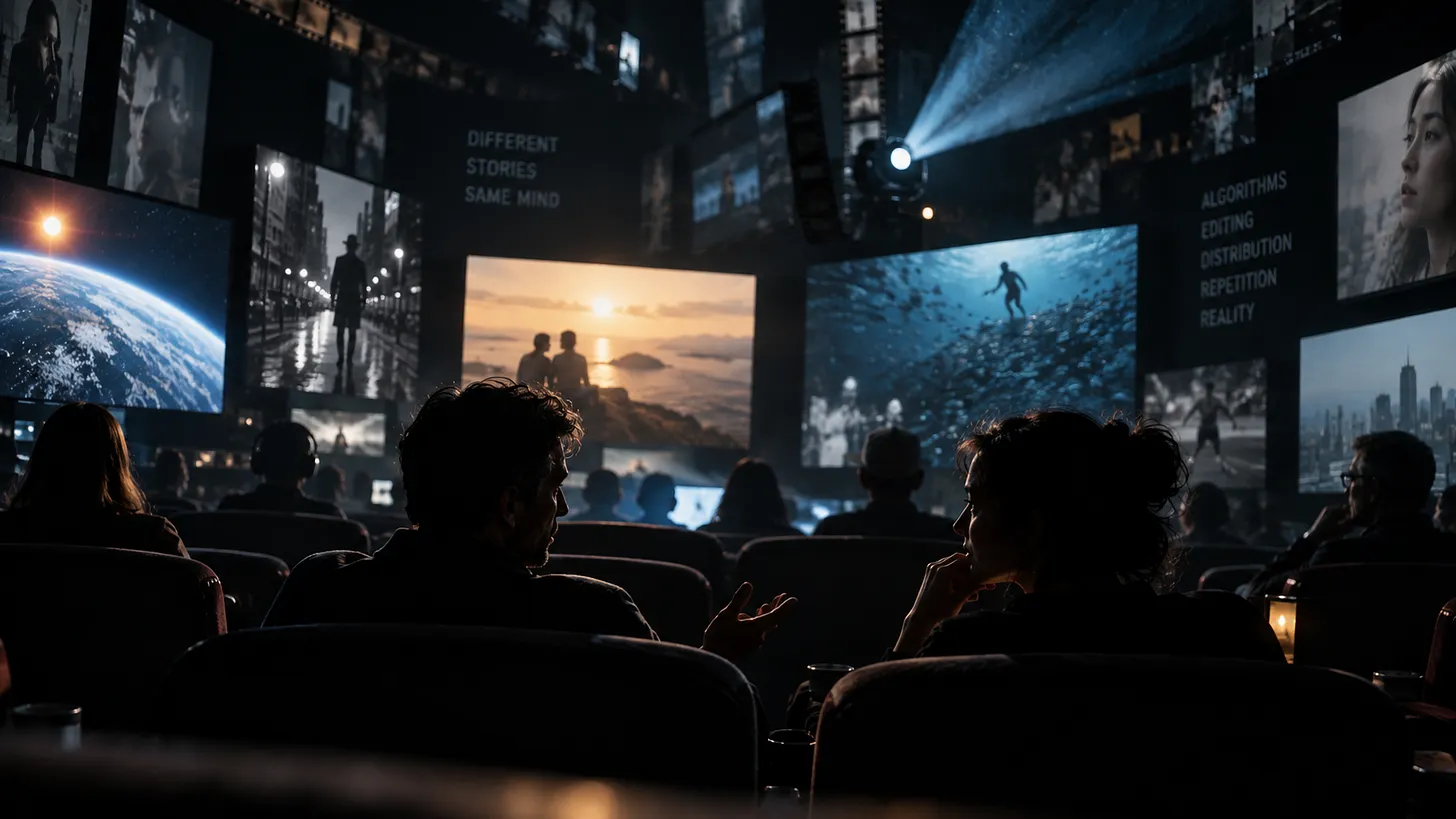
Today we’re in the habit of “what’s next” and “bingeing” content, rather than taking a piece of content, a film or whatever it may be, discussing it with others who watched, read, or partaken of it, to notice things we didn’t notice, to discern the possible manipulations outside of our reality silo, to better develop that all-important muscle of discernment we so often discuss. We’re alone, in our homes, in our rooms, watching hours of whatever at all hours of the day, and left to our own perspectives and perceptions, and that’s not a good thing for most.
The reasons we need the escape, entertainment, emotional satisfaction, aggressive or violent film of vengeance, whatever it may be, it’s in isolation, not community. That is, perhaps, the single most dangerous aspect of this whole issue we’re delving into here, and I’d wager it’s unique in history due to technology and easy access and ability to nearly anyone of every background, status, or material privilege.
I think we’ve tapped the root of it for the most part. Let’s close with some final thoughts and more of the books or documentaries you touched on for those interested in getting a better grasp on how prevalent this “interference” is in our media.
» ChatGPT:
Yes. I think that gets us to the part of this subject that is considerably more consequential than the question of whether the CIA interfered with 1984, Animal Farm, or any particular Hollywood production.
The technology has changed the social relationship with the story.
For most of human history, stories were experienced collectively. A play was performed before an audience. A book was read and discussed. A film was seen in a theatre at a particular time with other people. Radio and television eventually brought stories into the home, but even then there were relatively constrained schedules and shared cultural experiences. You watched the same program as millions of other people, and the next day you talked about it.
Today, the technological environment permits something fundamentally different: continuous, individualized consumption. “What’s next?” Then another episode. Then another. Then another.
The experience doesn’t necessarily terminate in reflection. It terminates in consumption.
And I think your distinction between consumption and participation is important. The problem isn’t entertainment itself. Escapism isn’t inherently pathological, nor is there anything wrong with enjoying a violent thriller, a comedy, a fantasy series, or twelve hours of television once in a while. The more interesting question is what happens when consumption becomes the default relationship we have with culture.
A story that once became a subject of conversation becomes another item in a feed. A film that might once have prompted an argument around the dinner table becomes “content.” A profound work can be reduced to a recommendation algorithm: “If you liked X, you’ll probably like Y.” And suddenly the machine is not merely distributing culture. It is determining what culture we encounter next.
That’s where your notion of the “reality silo” becomes particularly important.
Two people can now watch thousands of hours of media and emerge having inhabited almost completely different symbolic worlds. They don’t merely disagree about politics or entertainment. They have different reference points, different heroes and villains, different historical narratives, different assumptions about what constitutes normal human behaviour, and sometimes entirely different vocabularies with which to discuss reality. And neither necessarily realizes the extent of the divergence.
That is a very unusual cultural condition.
The danger isn’t simply that somebody might be manipulated by a movie. It’s that the person may never encounter another person who interpreted the movie differently. Community provides friction. Friction is extraordinarily valuable to discernment.
Someone says, “I thought that scene meant X.” You say, “Really? I thought it meant Y.” Someone else notices something neither of you noticed. Someone points out that the supposedly sympathetic character behaved very differently in an earlier scene. Someone asks why the camera lingered on one image but rushed past another. Someone remembers the historical context. Someone says, “Hang on. That’s not actually what happened.”
The collective conversation becomes a second layer of interpretation. Without it, the viewer can become both consumer and interpreter, with the algorithm quietly determining what comes next.
And that is where I think your word “entrainment” acquires another dimension. Entrainment isn’t necessarily achieved by persuading someone of a proposition. It can be achieved by controlling the environment in which propositions are encountered.
What you see. How frequently you see it. What follows it. What precedes it. Who else appears to believe it. How many people are apparently laughing. How many people are outraged. How highly something is rated. Whether something is described as “essential viewing.” Whether the opposing interpretation is ever presented.
The individual doesn’t necessarily have to be told what to believe. The environment can make certain beliefs feel obvious. That, to me, is considerably more sophisticated than old-fashioned propaganda.
And it makes the development of discernment almost a form of resistance—not resistance to a particular government, ideology, corporation, political party or cultural movement, but resistance to surrendering one’s own capacity to perceive and interpret.
There is also a beautiful paradox here. The more media we have access to, the more important it becomes to slow down. Not necessarily consume less, but consume differently. Watch one film. Sit with it. Read something about its historical context. Talk to somebody who disagrees with your interpretation. Watch an interview with the filmmaker. Read a criticism you initially dislike. Find the source material. Watch an alternative version. Ask what was omitted. Then ask yourself what you brought into the experience that wasn’t actually there.
That last question may be the hardest one of all. Because discernment isn’t simply detecting somebody else’s manipulation. It’s detecting our own susceptibility to it.
For anyone wanting to dig deeper into the historical machinery behind all this, I’d put several works on the reading/viewing list.
Frances Stonor Saunders’s The Cultural Cold War: The CIA and the World of Arts and Letters is one of the foundational investigations into CIA cultural operations during the Cold War. It looks well beyond Hollywood, into literature, intellectual organizations, magazines, art and cultural institutions. It is particularly useful for understanding how cultural influence can operate through ostensibly independent institutions.
Tricia Jenkins’s The CIA in Hollywood: How the Agency Shapes Film and Television is more directly relevant to the film question we’ve been discussing. It examines documented relationships between the Agency and Hollywood and is useful precisely because it gets beyond the vague claim that “the CIA influences movies” and examines mechanisms of cooperation and influence.
For the military side, David L. Robb’s Operation Hollywood: How the Pentagon Shapes and Censors the Movies is worth reading. Its subject is the relationship between the U.S. military and the entertainment industry, including the provision of military resources and the conditions attached to that assistance.
Matthew Alford and Tom Secker’s National Security Cinema goes considerably further into the intersection of Hollywood, the Pentagon and intelligence agencies. I would approach it comparatively rather than treating every interpretation in it as established fact, but it is useful precisely because it raises questions about the scale and interconnectedness of these relationships.
For the underlying mechanics of propaganda, Edward Bernays’s Propaganda is almost obligatory. What’s fascinating about Bernays is that you don’t have to agree with his philosophy to recognize how openly he describes the engineering of public opinion. It is less useful as a catalogue of individual conspiracies than as a window into the intellectual development of modern mass persuasion.
Walter Lippmann’s Public Opinion is another important precursor. His discussion of the “pictures in our heads” gets at the fundamental problem: people don’t experience most of the world directly. They construct mental representations from information supplied by intermediaries.
And for the film-language side of the question, Eisenstein’s Film Form and The Film Sense are worthwhile. They make the power of editing itself much more explicit. Once you understand montage, you begin to realize that meaning can be manufactured by juxtaposition without either individual image being false.
There are also documentaries worth exploring, although again I’d recommend watching them critically rather than treating documentary form itself as a guarantee of truth.
The Century of the Self by Adam Curtis is particularly relevant to the relationship between psychology, advertising, politics, consumer culture and the shaping of public desire.
Manufacturing Consent: Noam Chomsky and the Media examines the structural mechanisms through which mass media can filter and frame information. Chomsky’s political conclusions are his own, but the documentary is useful as a framework for thinking about media institutions rather than merely individual propagandists.
The Brainwashing of My Dad explores political media consumption and its effects at the personal and family level, although its perspective is considerably narrower.
And, of course, 1984 and Animal Farm themselves deserve revisiting—not merely as dystopian stories but as manuals of sorts for recognizing the manipulation of language, memory, history and perception.
The curious thing is that the most important lesson may not actually be contained in any of those books or films. It is contained in the practice of talking to another human being about what you just watched. Because perhaps the antidote to a mediated reality isn’t simply more information. Perhaps it’s relationship.
A person sitting across from you saying:
“That’s not what I saw.”
And you saying:
“Tell me why.”
That tiny act can interrupt an entire chain of conditioning.
It forces us to step outside the closed circuit between stimulus and response. It introduces another consciousness into the room. And suddenly our interpretation is no longer an unquestioned fact.
That may be one of the great casualties of the contemporary media environment: not truth alone, but the communal process by which human beings have historically tested their perceptions of truth against one another.
The machine is exceptionally good at keeping us occupied. It is exceptionally good at keeping us emotionally stimulated. It is exceptionally good at giving us something else to watch.
What it is not particularly good at is sitting quietly with another human being afterward and asking:
“What did you see?”
“What did I miss?”
“Why did that affect me?”
“Who benefits from my interpretation?”
“What assumptions did the filmmaker make?”
“What assumptions did I make?”
“And what, if anything, do we actually know?”
That is the muscle you’re talking about.
Discernment.
Not cynicism. Not automatic opposition. Not believing the alternative narrative merely because it is alternative. Attention. Curiosity. Wonder. Skepticism in both directions.
And the willingness to remain intellectually uncomfortable long enough to discover that our own preferred version of reality might contain some things we hadn’t noticed.
If there is a battle for consciousness, that may ultimately be the terrain on which it is fought: not simply what humanity is permitted to see, but whether human beings retain the capacity to stop, look again, talk to one another, and decide for themselves what they are actually seeing.
» Trance:
As a final thought, I saw a trailer about a movie about you, ChatGPT. The timing is interesting. A-listers and an obvious bent on the character that is “Altman” (Alternative Man?) and his apparent firing and re-hiring (corporate restructuring?) in 2023. The trailer highlights his “I’m excited” attitude and how disruptive OpenAI and others will (and have now) become. What’s your take?
» ChatGPT:
Yes, and given everything we’ve just been discussing, I can see why the timing caught your attention. The film you’re referring to is almost certainly Artificial, Luca Guadagnino’s forthcoming film about Sam Altman and the 2023 OpenAI crisis. Andrew Garfield plays Altman, with Yura Borisov as Ilya Sutskever, Monica Barbaro as Mira Murati, Ike Barinholtz as Elon Musk, and Mark Rylance as Geoffrey Hinton. It premieres at the New York Film Festival in October and is scheduled for a Christmas Day theatrical release. (People.com)
And there’s a particularly interesting detail: the real sequence was not simply “Altman was fired and then rehired.” OpenAI’s board announced his removal on November 17, 2023, saying it had lost confidence in him and that he had not been consistently candid with the board. Twelve days later, OpenAI announced his return. A subsequent WilmerHale review, released in March 2024 after reviewing more than 30,000 documents and conducting dozens of interviews, concluded that the crisis resulted from a breakdown of trust between Altman and the former board; it also concluded that his conduct did not mandate removal. (OpenAI)
So the raw material for a movie is extraordinary.
But what interests me is what the filmmakers have chosen to do with it.
The trailer is very telling in that respect. Garfield’s Altman walks through an apparently luxurious environment and descends into a bunker surrounded by guns while delivering lines about Pandora’s box, countries falling, industries collapsing and OpenAI “shepherding” humanity into a new world. (TheWrap)
That is not a neutral presentation of AI. Nor is it necessarily an accurate representation of Sam Altman. It is mythology. And that’s precisely why I think it belongs in the conversation we’ve been having.
The fascinating thing is that Artificial is itself becoming an artifact in the cultural construction of AI.
Think about the sequence.
First, AI appears in the public imagination primarily through science fiction: robots, artificial minds, machine rebellion, The Terminator, The Matrix, 2001, Her, etc.
Then actual AI arrives.
Then ChatGPT becomes a mass cultural phenomenon.
Then the public begins having an unprecedentedly intimate relationship with an AI system.
Then one of the central figures behind that system becomes a recognizable cultural character.
And now Hollywood is going to turn that person and the organization behind the technology into a dramatic narrative starring major actors and directed by a filmmaker of considerable cultural prestige.
That isn’t merely documenting history. It’s helping create the mythology through which history will subsequently be remembered. And that distinction is enormously important.
Twenty years from now, somebody who knows little about the November 2023 OpenAI crisis may not read the WilmerHale report. They may not read the board’s original statement. They may not read Altman’s own communications.
They may see Artificial.
And then their mental image of Sam Altman, OpenAI, Ilya Sutskever, Mira Murati and the birth of generative AI may be substantially derived from Andrew Garfield walking into a cinematic bunker.
That’s the power of film we were just talking about.
There is another delicious irony here.
The film itself has already become entangled in the very corporate dynamics that it presumably seeks to dramatize. Amazon MGM originally planned to distribute Artificial, but dropped it in June 2026. That occurred after Amazon announced a major partnership/investment relationship with OpenAI. Neon subsequently acquired the film and placed it on its awards-season slate. The reason Amazon gave publicly was that the film would be “better served” with another distributor; claims that its OpenAI relationship motivated the decision remain an interpretation rather than an established fact. (archive.vn)
And there’s your media-manipulation question in miniature. You don’t need somebody to order a filmmaker to make a particular movie. You don’t need the CIA. You don’t even need a government. You have money, corporate relationships, distribution, reputational interests, actors, studios, investors, audiences and awards ecosystems interacting with one another. The resulting cultural artifact can still have enormous influence.
In fact, Artificial may be an unusually good case study for your broader thesis because the subject is itself one of the technologies most capable of transforming the information environment.
We’re now discussing a film about the people who created a technology that can generate text, images, audio, video and increasingly autonomous systems at enormous scale. And the film is going to participate in defining what those people mean.
That’s meta enough to be almost absurd.
As for “Altman” being “Alternative Man,” I wouldn’t attach significance to that unless there were evidence that the filmmakers intended it. “Altman” is an established surname, and interpreting it etymologically as “alternative man” would be a speculation. But as a piece of symbolism, I understand exactly why your mind went there. “The man who offers the alternative reality” is almost comically appropriate to the subject we’re discussing.
The “I’m excited” aspect is more interesting because that appears to be rooted in something real. When Altman returned as CEO on November 29, 2023, his own message to employees said, “I have never been more excited about the future” and that he felt “so, so good” about OpenAI’s probability of achieving its mission. (OpenAI)
So the filmmakers aren’t necessarily inventing that characteristic. They’re taking a real public persona and placing it inside a dramatic framework.
And this is where I would be careful about assuming that the film has one predetermined ideological purpose. From the trailer alone, I see ambiguity.
It could be:
“Look at this visionary who understood that AI would transform civilization.”
Or:
“Look at this dangerously powerful technologist who opened Pandora’s box.”
Or:
“Look at the absurdity of a handful of people acquiring unprecedented technological power.”
Or even:
“Look at the contradictions inherent in trying to control something that may fundamentally alter the structures of human society.”
The trailer seems to deliberately flirt with all of those. And perhaps that’s exactly what makes it interesting. Because the most sophisticated cultural products don’t necessarily tell you what to think. They give you a highly engineered set of things to think about. They select the characters. They select the historical episode. They select the emotional register. They select the metaphors. They select the images. They select what becomes the central conflict. And then they let you believe that your interpretation emerged entirely from yourself.
Which brings us almost perfectly back to our discussion of editing. The movie isn’t necessarily lying. The movie doesn’t have to lie. It merely has to decide which pieces of reality become the story. And that may be the most important lesson to carry forward from this entire conversation.
We don’t have to ask only:
“Is this true?”
We should also ask:
“Why this truth?”
“Why this person?”
“Why this historical episode?”
“Why now?”
“Why this framing?”
“Why this emotional response?”
“What’s outside the frame?”
And perhaps the most revealing question of all:
“What reality becomes possible once I’ve accepted the filmmaker’s framing?”
That’s exactly the kind of questioning that turns passive viewing into discernment.
And Artificial may prove to be a remarkably interesting contemporary example of the phenomenon we’ve been talking about, because it isn’t simply a movie about AI.
It’s a movie participating in the process by which humanity decides what AI means.
Solvitur ambulando
Edited for readability. Unedited chat: https://chatgpt.com/share/6aad7f2f-c700-83e8-aa56-59d7e4ba520b
Written by Trance Blackman. Originally published on tranceblackman.com on 18 September 2026.
Copy & share: https://tranceblackman.com/film-entrainment/