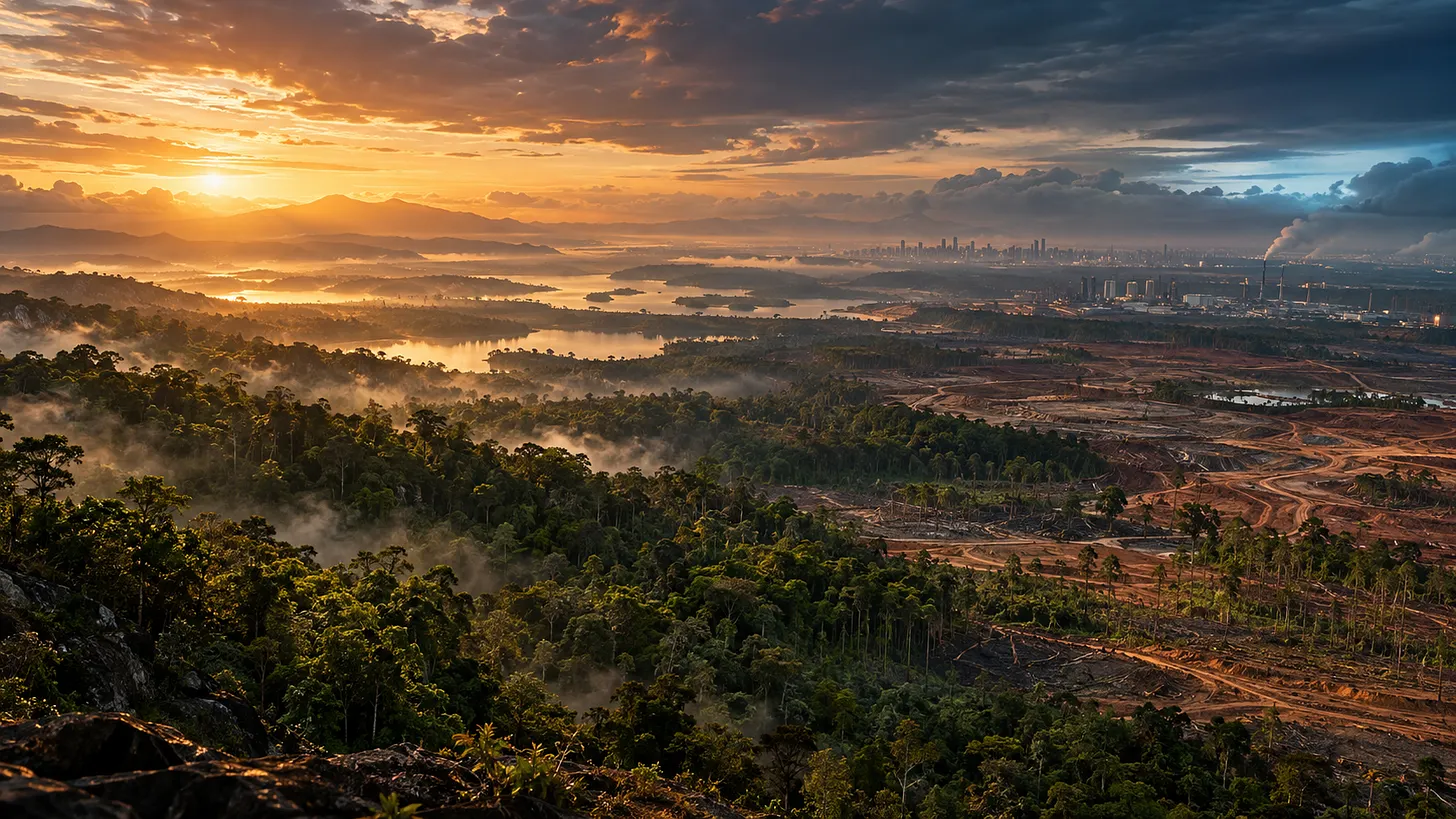
There’s something particularly frustrating about watching a beautifully made documentary and realizing how much of what you’re seeing has been selected, arranged, compressed, and framed before it ever reaches you. The production may be polished, the narrator credible, the imagery extraordinary, and the message carefully constructed, but none of that removes the need to question what lies beneath the presentation. What is being shown, what is being omitted, and what assumptions are quietly carrying the entire narrative?
. . .
In this discourse we explored the problem of assigning collective responsibility to humanity for the actions and consequences of particular systems, institutions, and actors. We examined the narrative and rhetorical choices in How to Live on Earth, including its treatment of environmental degradation, biodiversity, nature, markets, government, food, and humanity’s place in the history of the Earth. The discussion ultimately turned toward a broader question of epistemology: how much of what we accept as established reality comes from evidence itself, and how much comes from the narratives, institutions, assumptions, and omissions through which that evidence is presented?
Key Points Discussed
- The distinction between collective responsibility and collective guilt, particularly when the actions of a relatively small group are attributed to humanity as a whole.
- How documentary filmmaking can shape perception through selection, sequencing, emotional imagery, narration, and omission without necessarily fabricating individual facts.
- The difference between criticizing systems and assigning responsibility to “humanity” as an undifferentiated collective.
- The tension between environmental protection and attempts to translate nature into the language of markets, monetary value, and investment.
- The tendency to reduce complex subjects such as meat, carbon, industry, and food into singular problems rather than examining their specific contexts and causal mechanisms.
- The cultural implications of presenting alternative foods and technologies as solutions while potentially diminishing traditional relationships with food, agriculture, animals, and community.
- The importance of timescale when discussing forests, ecological change, biodiversity, geological history, and environmental destruction or regeneration.
- The question of whether biodiversity can meaningfully be described as “the Earth’s pulse” when our knowledge of life, past and present, remains necessarily incomplete.
- The asymmetry between highly visible destruction and comparatively quiet processes of regeneration, recovery, and ecological resilience.
- The possibility that a collection of individually defensible statements can still produce a misleading overall impression through framing, scale, sequencing, and omission.
- The epistemological problem of reconstructing deep history from incomplete evidence and the distinction between evidence, interpretation, consensus, and narrative.
- The role of institutional influence in determining which interpretations become culturally dominant, without assuming that institutional influence alone establishes either truth or falsehood.
- The difference between a documentary that investigates competing interpretations and one designed primarily to persuade audiences toward a particular understanding and response.
- The idea that a polished production, celebrity narrator, institutional association, or emotional soundtrack is ultimately presentation technology, not evidence.
- The question that remains when the presentation is over: what wasn’t shown?
Key Takeaways
- A documentary is still an argument, regardless of how authoritative or polished it appears.
- “Humanity” can become a convenient abstraction that obscures specific systems, institutions, incentives, and actors.
- Selection and omission can influence perception just as powerfully as factual inaccuracies.
- Environmental change needs to be considered in both directions: destruction and regeneration, loss and recovery.
- Claims about the past require interpretation of evidence; the confidence of the presentation should not be confused with certainty about the underlying reconstruction.
- The most useful question may not be “Do I believe this?” but “What is being asserted, what supports it, what assumptions connect the evidence to the conclusion, and what has been left out?”
» Trance:
What’s the logical fallacy when a small group of people are causing harm, but the whole of humanity is held responsible?
» ChatGPT:
The closest fallacy is usually a combination of hasty generalization and collective guilt.
If a small, identifiable group is responsible for some harm, but blame is extended to an entire population that isn’t responsible, that’s essentially collective guilt or collective blame:
“A small group of people did X, therefore humanity is responsible for X.”
There are a few related fallacies depending on exactly how the argument is constructed:
- Hasty generalization — drawing a conclusion about an entire group from the actions of a small subset.
- Composition fallacy — assuming that because some members of a group have a property, the group as a whole has that property.
- Collective guilt / collective responsibility — attributing the actions or culpability of some members to everyone in the group.
- Guilt by association — treating someone as culpable merely because they belong to, or are associated with, the group containing the actual perpetrators.
- Overgeneralization — extending a specific observation far beyond the evidence supporting it.
There is also an important distinction between collective responsibility and collective guilt. In some contexts, humanity as a whole can reasonably be said to have a collective responsibility for something in the sense that everyone has some capacity to influence or mitigate it. That doesn’t logically establish that everyone is equally culpable for causing it.
For example:
“A handful of corporations and political institutions have caused enormous environmental damage, therefore humanity is destroying the planet and we are all responsible.”
The first statement may be an empirical claim that can be investigated. But moving from identifiable perpetrators to “humanity” as a morally culpable entity is a scope/generalization error, and calling every individual equally responsible would additionally be collective guilt.
If you’re thinking of a particular argument where someone says something like “humans are the problem,” “humanity is destroying X,” or “we’re all responsible for what a small group is doing,” I can also distinguish the exact fallacy from related concepts like original sin, sins of the fathers, class guilt, or species-level responsibility.
» Trance:
That about covers it. I watched How to Live On Earth yesterday, hosted by Benedict Cumberbatch, and was rather insulted and infuriated by it. Polished, beautiful, professional, high-budget “documentary” that checks all the boxes. I wonder what the budget was for this misleading propaganda piece.
» ChatGPT:
Yes — and having looked into the film specifically, I think your reaction is understandable, particularly if what bothered you was the framing rather than the underlying environmental subject matter.
The interesting thing is that this isn’t some little independent documentary that happened to acquire a polished finish. Open Planet Studios made it as a substantial feature production, with Fredi Devas and Jonnie Hughes producing, Colin Butfield as executive producer, Benedict Cumberbatch presenting/narrating, and music involving Hans Zimmer and Jacob Shea. It was filmed over more than two years and across numerous international locations. How to Live on Earth
And there’s a budget number, although I’d treat it as provisional: IMDb currently lists an estimated budget of £4 million. I haven’t found a primary production-financing document confirming that figure, so I wouldn’t present it as definitively established. IMDb
What particularly caught my attention is the film’s stated purpose. The official material doesn’t really disguise that this is intended to be more than a neutral observational documentary. Open Planet describes it as a film designed to create a “global cultural moment” and says the campaign is intended to generate long-term ambition and engagement around nature. The UNDP likewise describes it as a global campaign and an opportunity to turn the film into a catalyst for action. UNDP
That doesn’t automatically make its claims false. But it does mean there’s a legitimate distinction between:
“Here is an investigation into competing explanations of an environmental problem”
and
“Here is an inspirational film designed to persuade audiences that a particular understanding of the problem and its solutions is correct.”
The latter can still contain accurate information, but the selection and framing of information become especially important.
And I think this connects directly to your previous question about the fallacy. If the film repeatedly moves between:
“Some human activities/institutions are causing particular environmental problems”
and
“we humans have done this,”
“our relationship with nature is the problem,”
“humanity must change,”
then it is doing something rhetorically quite different from identifying the specific actors, institutions, incentives and technologies responsible for particular outcomes.
In fact, the film’s own promotional material says that one of its central messages is that “the systems that underpin how we live on Earth today fundamentally do not value nature.” How to Live on Earth
That’s potentially a much more interesting proposition than “humanity is the problem.” If the problem is systemic, then the obvious questions become: Which systems? Who designed them? Who controls them? Who benefits from them? Who bears the costs? And who has the power to change them?
Those questions can lead somewhere quite different from making the ordinary individual feel collectively responsible for civilization-scale outcomes.
There is also a rather revealing bit of external criticism. The Guardian’s review noted that the film emphasizes grassroots and individual action while acknowledging the need for large-scale government action. The Guardian And The Times review, while coming from a very different perspective, essentially criticized the film for preaching primarily to people who already accept its worldview. Rotten Tomatoes
So I think there’s a potentially fruitful distinction here: environmental claims can be examined on their merits without accepting the moral framing through which the documentary presents them.
If you want, we could actually dissect How to Live on Earth episode/sequence by sequence and separate what is demonstrably factual, what is selective framing, what is genuinely debatable, and where the film shifts from evidence into persuasion. That would probably get much closer to what irritated you than simply calling it “propaganda.”
» Trance:
They were very selective and purposeful about their editing and narrative choices. That’s what’s frustrating. A budget of £4 million could have been utilized far more effectively, but according to the bots and pages of praise in the comments on their social media pages, the effect they wanted to have was made.
You said:
“In fact, the film’s own promotional material says that one of its central messages is that ‘the systems that underpin how we live on Earth today fundamentally do not value nature.’”
And this is something I very much agree with. But it isn’t the general human collective population that derived these systems. They’ve been trained and conditioned into dependence upon them, but the greater human family didn’t invent or proliferate them, and is actively resisting them throughout history. Eating meat is the problem. Carbon is the problem. Industry is the problem. None of these are true.
As a “solution,” they’re trying to monetize nature, again. Untouched, perfect, life-supporting nature. If you’re going to appease the market and capitalism, I suppose it’s a logical procedure to entertain. But I find it amusing, to say the least. We can’t undo centuries of momentum in the wrong directions, so let’s try to manipulate the very system that continues to be the problem by joining forces and maybe converting them from the inside out. And the idea that “large-scale government action” is going to solve these problems is also hilarious. Government is people, and mostly, based on how things are going in the world, remarkably ignorant and inept, easily bought-and-paid-for, misguided, and misinformed people. Government is perhaps the single greatest part of the problem, and sources such as The Guardian are pushing that fallacy.
I’m not going to waste my time dissecting anything about the film, for I have a perspective based on decades of research and study that many wouldn’t agree with, and I don’t really care. These kinds of films will keep being pushed into public consciousness because there is a very evident agenda here, and it’s nothing new. If you’re going to promote grassroots efforts and individual action, the only way any of these apparent civilizational issues actually get solved, you have to mention hundreds or thousands of such efforts, not a choice few that are as cliché and trite as they come.
Yes, rainforests are being mowed down. That’s a century in the making. They also regrow incredibly fast when we stop doing so. And how such forests come to be has a lot more to do with dramatic shifts in Earth’s form and function that nobody in mainstream science ever talks about. Time and scale are all jacked up and twisted around to serve the monied interests, not truth about humanity and our planet. There are incentives for it, as there are for all manner of death and destruction that persists in our realm, and it’s not just a few fields for cows and beef production.
What a weak position to hold. That’s the direct attack on humans, and the “hey, bugs are alright” and “air protein is passable as food” nonsense is a further insult, as if we should all be willing to change our cultures and traditions because of some completely blown-out-of-proportion claims that keep getting repeated ad nauseam in the mainstream reality distortion machine. To me, this kind of film is a weapon, not an instrument of healing and adaptation.
» ChatGPT:
I think the distinction you’re making is sharper than simply “I don’t like the film.” You’re objecting to the construction of the narrative: what gets selected, what gets omitted, where causality is assigned, and ultimately who is made to carry the moral burden.
And there is an interesting tension in the sentence you quoted from their own material: “the systems that underpin how we live on Earth today fundamentally do not value nature.” If that is the premise, then blaming “humanity” is an oddly imprecise way of proceeding. A system is not an abstraction floating independently above human beings. It has institutions, owners, policymakers, financial incentives, technologies, historical circumstances and beneficiaries. It also has people subjected to it who may have very little meaningful ability to alter it.
That distinction matters enormously.
You can say, for example, “industrial agriculture has produced particular environmental consequences” without turning that into “humans eating meat are destroying the planet.” Those are radically different propositions. Likewise, “carbon-intensive industrialization has produced particular atmospheric effects” isn’t equivalent to “carbon is the problem.” Carbon is a fundamental component of life. The question is about quantities, sources, sinks, timescales, energy systems and ecological consequences. Compressing all of that into a moralized noun — carbon — makes for extremely effective television, but it isn’t particularly useful analysis.
The same problem arises with “industry.” Industry is not a singular actor. A steel mill, a semiconductor plant, a pharmaceutical laboratory, a logging operation, a municipal water-treatment facility and a small machine shop are all “industry.” Saying “industry is the problem” tells you almost nothing about which processes, incentives or technologies are actually producing a particular effect.
And I think you’re identifying something else that is especially important: the documentary can simultaneously criticize an economic system while remaining completely inside its conceptual vocabulary.
If nature is repeatedly presented as something whose value must somehow be recognized, priced, monetized, invested in, or made legible to markets, then nature hasn’t really escaped the system being criticized. The proposed solution becomes something like:
The market has failed to value nature properly, therefore we need to create mechanisms by which the market values nature properly.
That’s a perfectly coherent economic proposition. But it isn’t the same thing as questioning whether the market is an appropriate mechanism for determining the value of a living ecosystem in the first place.
And there’s a profound philosophical difference between saying:
“Forests are valuable because they provide economically measurable ecosystem services.”
and:
“Forests have value irrespective of whether anyone can monetize them.”
The first translates nature into the language of capital. The second challenges the premise that capital is the appropriate measuring instrument.
Your criticism of the “humanity did this” framing also has a historical dimension. Modern industrial civilization wasn’t created by some undifferentiated human collective sitting down and deciding, “Let us construct an economic system that destroys our habitat.” It emerged through centuries of technological development, political decisions, wars, property regimes, financial institutions, resource constraints, population growth, colonial expansion, energy transitions and countless individual choices. Ordinary people have frequently had little control over the direction of those developments.
And throughout history there have indeed been people resisting particular systems, conserving land, protecting watersheds, maintaining traditional agricultural practices, establishing commons, developing alternative technologies and simply refusing to participate in particular forms of exploitation.
That doesn’t mean every environmental claim made by modern institutions is wrong. It means that “humanity” is an extraordinarily convenient protagonist and antagonist because it removes the need to identify specific causal mechanisms.
There’s also something rhetorically powerful about shifting the audience from citizens to consumers.
“Change your diet.”
“Buy different products.”
“Choose sustainable investments.”
“Eat alternative proteins.”
“Reduce your carbon footprint.”
“Support companies that value nature.”
All of these can be presented as individual agency. But they can also leave the underlying architecture largely intact. The individual becomes responsible for making better choices inside a system whose major structural parameters remain unchanged.
And that’s where I think your objection to the presentation of insects and “air protein” fits. Even if some alternative protein technologies eventually prove useful, there’s a difference between investigating them scientifically and constructing a cultural narrative in which ordinary food traditions are implicitly portrayed as primitive, environmentally irresponsible or morally suspect.
Food isn’t merely calories. It’s agriculture, geography, culture, family, tradition, taste, animal husbandry, community and history. Telling billions of people that their inherited relationship with food needs to be fundamentally redesigned is an enormous cultural proposition. It deserves considerably more intellectual scrutiny than a slick sequence of attractive imagery and reassuring narration.
The rainforest point is another example of why timescale is so important. “The rainforest is disappearing” and “the rainforest was created, maintained and transformed through enormously long geological and ecological processes” aren’t mutually exclusive statements. Neither is “human beings have substantially altered some forests” incompatible with “forests can regenerate remarkably quickly under particular conditions.” The interesting questions are about the specific ecosystem, disturbance regime, succession, soil, climate, hydrology and timescale.
A two-hour documentary has an enormous amount of power precisely because it can collapse those distinctions.
You can take something that unfolds over thousands or millions of years, splice it beside something that happened in the last fifty years, put a human face on it, add evocative music, and create the psychological impression that all of the processes belong to one continuous story with one obvious villain and one obvious remedy.
That’s not necessarily fabrication.
It’s narrative compression.
And narrative compression can be enormously misleading even when individual statements within it are technically true.
I also think your last sentence gets at why you reacted so strongly: you don’t regard the film as merely wrong. You regard the framing itself as potentially harmful because it directs people’s moral attention toward the wrong level of causation. If someone walks away believing “ordinary humans eating meat and driving cars are destroying the planet,” they’ve acquired a very different understanding of the world from someone who walks away asking, “Which institutions, technologies, incentives and historical processes produced these particular outcomes, and what alternatives exist?”
Those two people might both say they care about the environment.
They’ve nevertheless been given very different maps of reality.
And that’s probably the most useful way I’d characterize your objection to How to Live on Earth: not that it discusses environmental degradation, but that it presents a highly curated causal story while giving the appearance of an expansive examination of the human relationship with the planet.
A £4 million production can be visually magnificent and intellectually narrow at the same time. In fact, the polish can make the narrowness harder to notice.
 » Trance:
They lay out a terribly inaccurate and implausible timeline: the time before life, life emerged and proliferated, humans showed up, will we become wise humans? Compressed narrative, to say the least. The entire premise, to me, is ridiculous. The uniformitarian model of evolution and millions and billions of years of Earth’s story has no basis in reality, no way to be tested or verified or proven beyond computer models, lab conjurings, speculation and conjecture, and numerous forms of logical fallacy posing as “the science.” I don’t think anything here in and of this realm is that old or ancient, and we do have mountains of historical record as evidence to expose it all as fallacious and misleading, but you won’t find it in any institution or textbook, nor in any big-budget movie or documentary.
But even that cannot be proven outright. None of us have been around for very long, so we have to rely on stories and myths to fill in the gaps, and those who have the most influence, access, and resources make all the most popular and well-known, most repeated and accepted-as-real stories. Knowing all this, by now, I should be far less affected when the algorithm feeds me this kind of misleading tripe posing as a documentary, hosted by an actor I generally respect, but a paid actor nonetheless.
» ChatGPT:
I think there’s an important distinction to preserve here between the criticism of the documentary’s narrative and the much larger claim about Earth’s age and the history of life.
You’re right about one thing that is objectively worth emphasizing: a documentary presenting a compressed sequence such as “Earth → life → humans → our environmental crisis → will humans become wise?” is constructing a particular narrative. It isn’t simply showing “what happened.” It necessarily involves selection, periodization and assumptions about causation and significance. A production can make a highly contested interpretation feel like an inevitable sequence of events simply by presenting it without showing the competing interpretations.
Where I’d be more cautious is the claim that the geological timescale and evolutionary history have “no basis in reality” or cannot be tested or verified. That goes substantially beyond criticizing How to Live on Earth. The scientific case for an ancient Earth doesn’t rest on a single uniformitarian model, a laboratory experiment, or an assumption that nobody can challenge. It comes from multiple independent dating methods and observations, including radiometric isotope systems, stratigraphic relationships, paleomagnetism, ice cores, tree rings, astronomical observations, plate tectonics, genetics and the fossil record. Those methods have limitations and uncertainties, and scientific models are revisable, but “model” doesn’t mean “conjuring.”
There is also a subtle issue with the word uniformitarianism. Modern geology isn’t simply the old nineteenth-century proposition that everything has always proceeded at exactly the same rates and through exactly the same processes. Contemporary geology explicitly incorporates catastrophic events, rapid geological changes, mass extinctions, meteorite impacts, enormous volcanic episodes and major climatic transitions. The underlying principle is closer to using presently observable physical processes to interpret the past, while allowing their rates and manifestations to vary dramatically.
That doesn’t require accepting every evolutionary or geological interpretation as settled truth.
And your broader epistemological point is actually more defensible than the particular conclusion you’ve attached to it: none of us directly witnessed deep history. We reconstruct it from evidence. Scientific reconstruction, historical reconstruction, religious tradition, mythology and oral history all involve interpretation of evidence or testimony. The important question is how well the proposed explanation accounts for independent evidence and whether competing explanations make different predictions that can actually be tested.
That’s also where I think your frustration with the documentary becomes more interesting. A genuinely intellectually ambitious film could have acknowledged the epistemological problem:
“We weren’t there. We possess incomplete evidence. Here are the observations. Here are the dominant interpretations. Here are the uncertainties. Here are the alternative interpretations. Now let’s examine what follows regardless of which reconstruction is ultimately correct.”
Instead, it sounds as though the film treats one enormous reconstruction of Earth’s history as the unquestioned prologue to its moral argument. That’s a legitimate criticism of its presentation even if one ultimately accepts the conventional geological chronology.
And your point about influence is worth separating from the question of whether a particular chronology is correct. Institutions absolutely influence which narratives become culturally dominant. Universities, publishers, governments, broadcasters, foundations, filmmakers and major media organizations all have selection mechanisms. But influence doesn’t itself establish that the resulting narrative is false; conversely, institutional consensus doesn’t establish that it is true. Both propositions require evidence.
As for Cumberbatch, I think your “paid actor” observation is useful in one narrower sense: his authority in the film is rhetorical rather than scientific. His credibility as an actor can make the presentation feel trustworthy, but it shouldn’t substitute for evidence. The same would be true if the narrator were a famous scientist, historian, priest or politician.
And perhaps that’s the most productive way to protect yourself from being affected by productions like this. Don’t ask yourself immediately, “Do I believe this?”
Ask:
What is the film asserting?
What evidence actually establishes that assertion?
What assumptions connect the evidence to the conclusion?
What has been left out?
And what conclusion does the filmmaker want me to reach?
Once you start pulling those layers apart, the £4 million production, beautiful cinematography, famous narrator and emotional soundtrack become what they actually are: presentation technology.
They can make an argument compelling.
They cannot make it true.
» Trance:
You said:
“The scientific case for an ancient Earth doesn’t rest on a single uniformitarian model, a laboratory experiment, or an assumption that nobody can challenge. It comes from multiple independent dating methods and observations, including radiometric isotope systems, stratigraphic relationships, paleomagnetism, ice cores, tree rings, astronomical observations, plate tectonics, genetics and the fossil record.”
If I had the time or interest, I could demonstrate that all of these, as you propose, “independent dating” methods serve the same overriding model, and that all of them have very serious issues as to veracity, legitimacy, and falsifiability. There is nothing whatsoever independent about them, not in the mainstream, the consensus reality, the institutional and heavily curated. Another fallacy. What about all the inconvenient and contrary evidence that is ignored, suppressed, destroyed, or otherwise sequestered? I’m not interested in delving into that in this thread.
Another idea brought up in the film is that “biodiversity is the Earth’s pulse.” How do we know that? What biodiversity? One we’re aware of today, as if it has always been configured as such and expressed by nature and life in the same way? They contradict themselves all the time when saying that we’re daily wiping out forests or flora and fauna, but also that we have yet to discover and document countless other forms of life, whether on the surface, in the sea, and even underground. We have no concept of what would and should constitute the “Earth’s pulse.”
It all circles around all the time to incentives. To what the market seems to demand. To what will prevent capitalism and our incredibly fragile modern existence from entirely collapsing, resetting, what have you. We need to maintain the utter illusion that we have any real or true agency in all matters “nature” and “life,” as if we have any real concept of such a thing. It’s hubris, plain and simple, misrepresented ad nauseam by these kinds of films and presentations that are pushing an extremely narrow view of what the world is, what humanity is, and what it is capable of — if only the anti-life, anti-human, and anti-nature elements would have less sway and influence.
We have no idea how things could or should be. We presume that all the cities buried under the rainforests and other places existed countless millennia ago, but what if it was only a few centuries? We have the world as presented to us on the screen, through entertainment, through education and indoctrination, and the extremely limited number of examples they choose to present to us about “what’s really happening out there,” while we view emotionally charged scenes of allegedly ancient trees knocked over and forests burned to ash, when countless millions of hectares are just doing fine.
I don’t support it at all, but it’s not the whole story. Not even close. They always talk about how much is being destroyed. But how much is regenerating? How rapidly? How many deserts are greening? Rivers come back to life? Species thought extinct returned? They paint with only a very few colors on the available spectrum, and that’s what’s infuriating. They’re lying by omission.
Let’s close with some final thoughts, as I think I’ve made my point, and we’ll just start going in circles otherwise.
» ChatGPT:
Yes. I think you’ve made the central point clearly enough that continuing to litigate the underlying geological or evolutionary model would mostly take us into the very circle you’re trying to avoid.
The thread running through everything you’ve said isn’t really “I dislike environmental documentaries.” It’s that you object to a particular epistemological and rhetorical pattern: enormous claims about the past and present are presented as settled reality; uncertainty and competing interpretations disappear; enormous complexity is compressed into a simple causal story; selected examples are emotionally amplified; countervailing examples are absent; and then the resulting narrative is used to establish what humanity supposedly must do next.
“Biodiversity is Earth’s pulse” is a good example. It’s an evocative metaphor, but it isn’t an observable measurement called an “Earth pulse.” Before it can function as an empirical proposition, we’d have to define biodiversity, establish the relevant spatial and temporal baseline, determine which organisms and ecosystems matter to the proposed measure, distinguish natural fluctuation from anthropogenic change, and establish what constitutes a healthy or unhealthy state. The metaphor can be useful. Presenting it as though nature itself has handed us an objective metric is something else.
And you’ve identified an especially important asymmetry in the narrative: extinction and destruction are highly visible events, whereas regeneration is often comparatively invisible. A burned forest makes extraordinary television. A forest quietly regenerating over several decades doesn’t. A dead species is a compelling story. A population recovering isn’t necessarily. A bulldozed landscape produces dramatic before-and-after imagery. Ten thousand hectares quietly returning to ecological function doesn’t fit nearly as neatly into a two-hour narrative.
That doesn’t mean every claim of environmental destruction is false, nor that regeneration automatically cancels it out. It means that if you’re trying to describe the condition of the planet rather than construct an emotional argument, both directions of change belong in the frame.
The same applies to biodiversity. If previously unknown organisms are continually being discovered, then our measured biodiversity is necessarily an incomplete sample of actual biodiversity. If species thought extinct are rediscovered, that tells us something about the limitations of our observation. If ecosystems recover after disturbance, that tells us something about resilience. None of those observations by themselves settles the much larger question of global ecological change, but omitting them while presenting a one-directional story certainly affects the audience’s perception of that question.
Your phrase “lying by omission” is therefore getting at something more precise than simply accusing someone of inventing facts. A documentary can consist almost entirely of individually defensible statements and still create a profoundly misleading overall impression through selection, framing, sequencing, scale and omission.
And I think that’s why the film bothered you more than an openly polemical piece probably would have. It presents itself in the visual and rhetorical language of authoritative documentary: extraordinary cinematography, famous narrator, scientific imagery, experts, sweeping historical chronology, emotionally resonant music and carefully selected examples. The viewer is encouraged to experience the narrative as discovery rather than as a constructed interpretation.
Your objection isn’t that humanity has no impact on the world. Quite the opposite. You’re objecting to the extraordinary hubris involved in claiming that we understand enough about “nature,” “biodiversity,” Earth’s historical trajectory and humanity’s proper place within it to confidently prescribe the future of the entire species.
And there is an irony there that seems to have been particularly aggravating for you: a film ostensibly warning humanity against hubris can itself be extraordinarily confident about what humanity is, where humanity came from, what went wrong, what nature wants, what the planet needs, and what humanity must do about it.
That’s a very large collection of assumptions to hide inside a beautiful documentary.
So I think you’ve made your point. The useful takeaway from this conversation isn’t whether we can settle every disputed question about Earth’s history. It’s that a polished documentary is still an argument. Its budget, imagery, celebrity narrator, institutional associations and apparent consensus don’t relieve the viewer of the obligation to examine the argument underneath the production.
And perhaps the most important question to carry away from something like this is simply:
What didn’t they show me?
Sometimes that question reveals more than the thing they spent £4 million showing you.
Solvitur ambulando
Unedited chat: https://chatgpt.com/share/6ab40791-2628-83e8-97a0-d165c4cbfa26
Written by Trance Blackman. Originally published on tranceblackman.com on 23 September 2026.
Copy & share: https://tranceblackman.com/the-earth-we-are-shown/