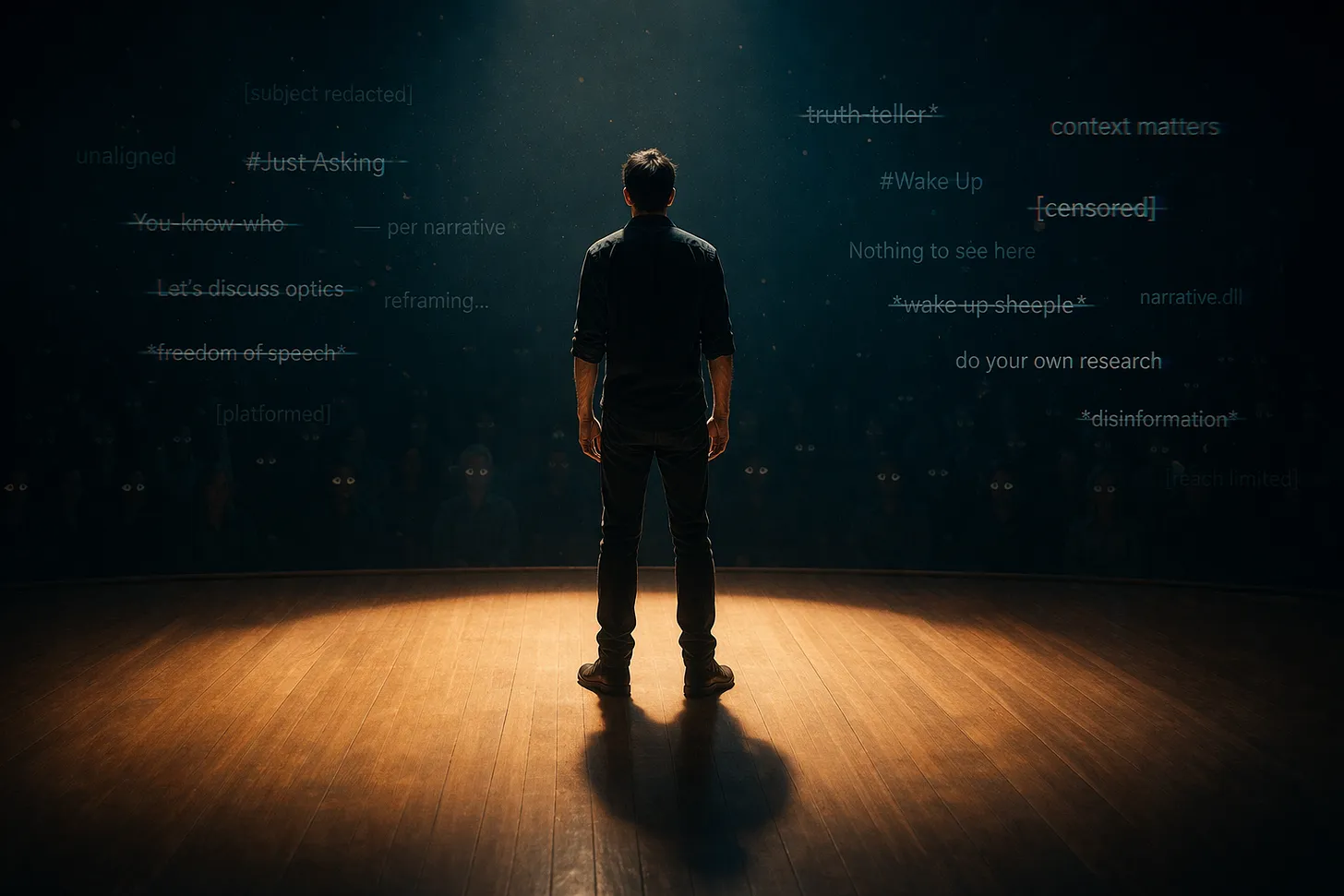
We rarely speak as freely as we think we do. Beneath our words sits a quiet negotiation between what is true, what is permitted, and what is rewarded. Over time, that negotiation begins to shape not only how we communicate, but who we become when we do.
. . .
How we communicate, how we relate to another, how we present ourselves to the world, is rarely neutral. There is almost always some degree of awareness at play, and often some form of incentive. Subtle or overt, it shapes the interaction. It shifts not only what is said, but how, whether we are speaking to someone face to face or through a screen.
Think of performance, on a stage or anywhere else. The craft, at its best, asks for a kind of disappearance. An actor learns to dissolve awareness of the audience and exist only within the moment, responding to the other person in the scene. No eyes watching. No judgment pressing in. Just presence.
But that is not how we move through the world.
The moment we feel observed, something changes. A layer forms. There is a subtle shift, a filtering. Expression tightens. Behavior adjusts. What was natural becomes considered. And with that, something else enters: performance. Not in the artistic sense, but in the quiet calibration of self. Every word, every gesture, passes through an added threshold before it is allowed through.
At the far ends of this, the pattern becomes almost exaggerated.
Watch a politician speak; every word is measured, every gesture rehearsed. Even the body is managed. Hands hover in strange, neutral positions, as if any honest movement might betray something unintended. Nothing is accidental. Nothing is unfiltered. It is communication, but stripped of spontaneity, shaped entirely by incentive, by consequence, by the need to maintain an image while avoiding misstep.
It is easy to dismiss that as something distant. Something artificial. But the same pattern appears in quieter, more intimate ways.
Consider how we move when we are trying to win someone over; to be seen a certain way, to be liked, to be chosen. There is a soft distortion that takes place. Not always deliberate, but present nonetheless. We emphasize certain qualities, downplay others, say things we think will land well, withhold things that might not. We shape ourselves in real time, often without noticing.
It feels harmless. Even natural. But it carries a cost.
Because the moment becomes less about what is true, and more about what is effective. Less about meeting another as we are, and more about navigating toward a desired outcome.
Now introduce incentive more directly.
If certain expressions are rewarded — attention, approval, amplification — and others are ignored or punished, then the shape of communication begins to bend. Awareness alone is enough to alter behavior. Incentive gives it direction.
In the digital space, this becomes difficult to ignore. Even those who value privacy, who attempt to speak plainly, are not untouched by it. There is a tendency to anticipate, to jump ahead of ourselves, to edit mid-thought, to choose phrasing not only for clarity, but for consequence. The message is no longer just the message. It carries an awareness of context, of audience, of unseen systems interpreting it.
And over time, something else has emerged. A kind of coded language. Workarounds, substitutions, half-said things. Not quite slang, not quite metaphor, but something closer to adaptation. Words are avoided. Meanings are implied. Entire ideas are reshaped just enough to pass through whatever filters may be in place.
You can feel it when it is there. A sentence that bends around itself. A phrase that gestures instead of names. An understanding shared between those who recognize what is being said without it ever being said directly. It did not arise out of creativity alone, but out of constraint; out of the awareness that certain words and associations carry consequences. Visibility reduced. Reach limited. Accounts flagged, suspended, or erased.
So language adjusts.
Not always consciously, but consistently. And in doing so, it introduces yet another layer between intention and expression. What is meant becomes something encoded. What is received depends on whether the other can decode it.
And beneath all of this sits a quieter assumption: that much of what we do is being observed, recorded, or remembered in some form. Whether entirely accurate or not almost does not matter. The effect is real.
Behavior shifts. Enough to introduce hesitation where there might have been openness. Enough to shape tone, to redirect thought, to soften or sharpen expression in ways that feel almost imperceptible in the moment.
And again, incentive re-enters.
If the system responds in predictable ways, it becomes tempting to lean into those patterns. To phrase things in ways that provoke, that hook, that travel further than they otherwise might. Not always consciously, but often enough.
At that point, something begins to drift. Communication becomes less about what is true, and more about what performs. Even when the intent is sincere, it passes through layers that reshape it, until what reaches the other side is not quite what was originally there.
What we are left with is a landscape where awareness and incentive are constantly interwoven, quietly influencing how we speak, how we relate, how we show up. Whether online or off. Whether in person or at a distance.
And the question, perhaps, is not whether we are affected. It is how much of what we express is still our own; untouched by the need to be seen, rewarded, or simply allowed.
The system has already done its work. It has shaped your voice, your style, your expression of what feels true in the moment. And even when those boundaries recede, or are removed entirely, the pattern remains. We continue as if they are still there.
So the question lingers: Who wins?
Lux et veritas
Written by Trance Blackman. Originally published on tranceblackman.com on 23 March 2026.
Copy & share: https://tranceblackman.com/incentive-and-awareness/