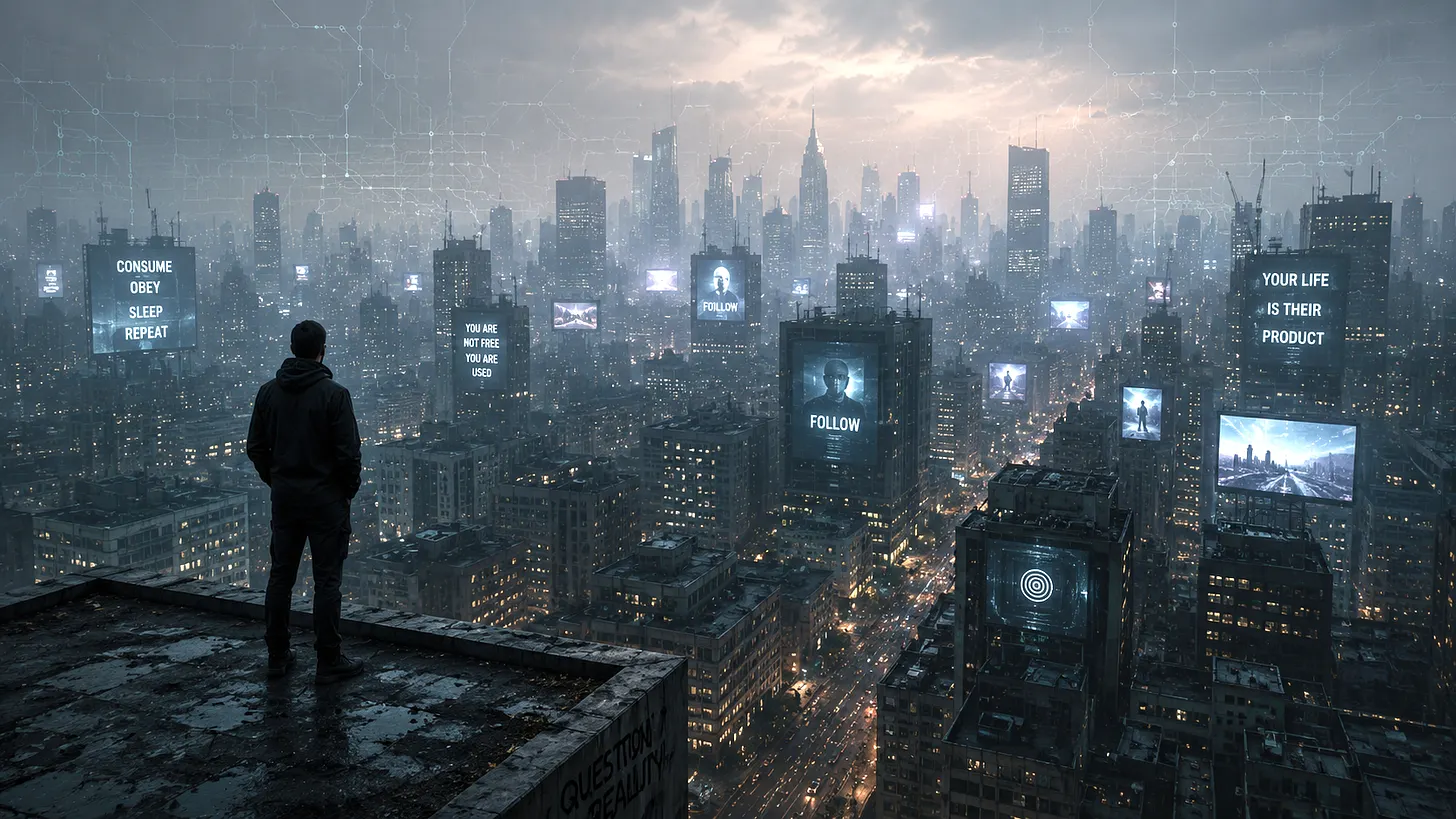
There is a growing inability, or perhaps unwillingness, to recognize how deeply modern culture shapes the moral and psychological condition of society. Most people move within systems they neither question nor fully perceive, absorbing values, incentives, behaviors, and narratives as though they emerged naturally rather than being carefully cultivated through institutions, markets, media, and governance itself. Yet beneath the spectacle of progress, inclusion, convenience, and endless consumption lies a deeper erosion, one that gradually disconnects human beings from responsibility, discernment, self-reliance, and ultimately from what is real and true.
“We are an immoral society. If that weren’t the case, drugs and prostitution/trafficking, cheap wares and sordid affairs wouldn’t be the biggest commodities on earth, across all nations, across all classes and demographics.”
Governance is downstream from culture, so it is critical to comprehend the machinations of a worldwide system that shapes, defines, manipulates, and controls cultural narratives of the human collective in all its many variations. Immorality is a particularly insidious and wildly effective brush our diverse forms of artwork and natural expressions are routinely coated with, obscured, and painted over. The more a society drifts into immorality, the more governance drifts toward what resembles communism. It becomes a self-perpetuating cycle, each element feeding into and being propelled by the momentum of the other, a downward spiral that repeats and reinforces itself, subjecting largely unconscious populations to the same slow unfolding collapse.
Our world today is increasingly captured within a vast late-stage capitalist, corporatist market system dominated by metastasizing conglomerates and entrenched ultra-wealthy factions that are only too willing to participate in this dynamic. Arsonists, including NGOs, billion-dollar charities, and alleged humanitarian groups, add fuel to every fire, extracting resources, generating vast ecological waste, and extracting profit from every layer of a parasitic and predatory structure, all while presenting themselves as diverse, equitable, inclusive, environmentally conscious, and progressively minded. It’s all marketed as being “for the greater good.” In practice, they remain deeply embedded within, and intertwined with, every major government and centralized institution, influencing decision-making and policymaking none of us hear about or know about. What’s spoken about in headlines and public appearances is carefully curated and purposefully packaged. It doesn’t reflect the real story and rarely touches on what is true.
This is the world we live in today. We are not born immoral, but through child-rearing, conditioning, and the programming of our modern environments, we become increasingly ingratiated into the patterns of immorality that define the surrounding culture, though very few are aware of or would ever admit it. Whether or not people believe themselves to be good, righteous, just, or moral, many are, in effect, deceiving themselves. The greater world operating system is one that prioritizes and values incentive structures that serve and protect the machinery of the market over anything else.
When you look at the world around you, at what dominates markets and mainstream narratives, at the commodities that hold the highest value, and at the ways we purchase, consume, and produce, while money is continually devalued and production is increasingly cheapened and made fragile in the pursuit of maximum profit, and while politicians and governments operate through webs of corruption, scandal, and unaccountable maneuvering, how could one reasonably argue that we live in a moral society? Given what we consume, are informed and entertained by, and are encouraged to imitate, all of which perpetuates widespread harm and degradation, deception, distortion, and degeneracy, it becomes rather difficult to claim the system itself as morally oriented.
Are those raised in stricter environments, with more constraints, limitations, rules, and expectations, more moral than those raised in the current era of liberal, progressive, and so-called woke culture, where everything is permitted, everyone is affirmed, and every effort is rewarded with a gold star just for participation? The more obsessive we become about avoiding offense, the more offensive and hollow the collective experience becomes, desensitized, denatured, and increasingly artificial.
When the world around you incentivizes immorality and uses language, culture, and institutional education to install principles and encourage behaviors that inevitably align with degradation and degeneracy, being immoral and unethical is not only normalized, but easily justified and excused. This discussion necessarily moves beyond nature versus nurture. It goes to the question of how human beings are formed to become self-guiding, emotionally intelligent, and discerning. In such cases, one would presume individuals should become less dependent on those who raised them, not through resentment, but through maturation, and certainly less reliant on the welfare state or the expanding lattice of rights, benefits, and entitlements offered therein. They tend to become more productive, adaptive, and fulfilled. They are more capable of knowing where they stand, what they stand for, and how to defend their position, while correcting and refining themselves at every step along the way. In that sense, they are moral by default and largely resistant to corruption.
As we see in the world today, there is a growing dependence on the state, even as many people imagine themselves to be more free, capable, and independent than ever. The modern image of self-sufficiency and self-reliance, amplified through online culture and the performance of individuality, is often more aesthetic than real, and the algorithm will ensure your version of reality is obfuscated to keep you scrolling, staring, and engaging rather than learning, discerning, and reorienting toward what is real and true, or moving in that direction. It may well leave you passive, pondering, and perpetually paused. Beneath the surface, societies continue drifting toward greater reliance on centralized systems, expanding bureaucracy, and increasingly socialized forms of governance, even if those terms are rarely used. These are effects of centralized power and influence and the incentive structures that seem inevitable to emerge within them, though it is not necessarily a failure of the system. It is a fairly predictable cycle that has repeated throughout history.
It may seem counterintuitive, but the more a culture leans into hedonism, narcissism, hyper-individualism, and self-gratifying pursuits, the downstream effects of relative “good times” one could argue we are passing through in this era, the more fragmented and psychologically dependent it becomes. The result is the world we see today: more government intervention, more centralized authority, more welfare and institutional management, and populations that grow increasingly fractious and dependent with each generation, despite the illusion of personal freedom and autonomy. Again, the algorithm skews our reality to serve the system, the market share, the profit model, not the human who is largely unconsciously engaged with it.
Perhaps worse is that many available resources now prioritize visible minorities, Indigenous groups, or those categorized as marginalized, underprivileged, or disadvantaged. This in itself is a multi-billion-dollar industry that has dramatically influenced every institution across the land. In attempting to create a uniform standard of inclusion, the system often flattens individuality, tradition, and culture into broad, misleading, and convoluted political categories. Rather than supporting those who actively build, produce, innovate, and maintain the foundations of society, entrepreneurs, business owners, skilled tradespeople, creators, and others who generate opportunity and infrastructure, welfare-state policies appear increasingly oriented toward redistributing resources away from the productive base and toward managed dependency. The focus shifts away from strengthening what is functional and generative and instead toward administering the fragmented and fractured edges of society. You will know its effects vividly when you are checking the dates when payments and benefits are deposited into your bank account, and it never comes soon enough. There are ways to remedy this for yourself, but it will require rebuilding a framework based on morality and self-reliance, which may not be as easy as it sounds.
It is probably fair to argue that those who are capable and well-resourced, who come from backgrounds where opportunities and support were already available, arguably should not need to rely on loans, grants, or state assistance. Yet in practice, the system is more complex: even individuals and institutions with significant wealth and influence actively pursue grants, incentives, and publicly funded advantages. It is too simple to say that it takes money to make money, but the world, for the most part, affirms this adage virtually everywhere you look.
At the same time, participation in the system increasingly depends on navigating a dense landscape of incentives, exemptions, and structural advantages that are more readily understood and accessed by those with time, expertise, and resources. Without that, the system can appear to place a growing burden, through taxation, inflation, and perpetually rising costs of living, on those most productive and market-capable, while allegedly redistributing taxation and public revenue toward those with fewer means. If that is true, why are “tent cities” bigger than ever in every city of the modern Western world, while suicides, addiction, and homelessness continue to rise? Their math is not mathing, and their crafted speeches and uniform-across-all-networks news media jargon are simply fanciful fiction and fantasy employed to pacify the voters, an audience ill-equipped to comprehend what is actually going on behind the scenes while their God-given rights are quietly suppressed and subdued.
Again, this resembles a communistic impulse, an expectation of equality or equity across all participants within the state, even though this has never fully existed in practice. What incentives remain for a population increasingly told they are privileged, unfairly advantaged, or morally suspect because of their success? Why would they continue to accept rising taxes, fees, and obligations in support of a system designed to balance outcomes regardless of capability, productivity, or contribution?
They would not. And that quiet, accumulating realization is what drives the growing apathy and distrust in the systems people are still expected to rely on. It pushes those who would otherwise pursue their paths with a moral center, through genuinely ethical means, methods, and manners, away from their better knowing, away from their inborn intelligence, away from their true humanity. Perhaps, ironically, in doing so they become enslaved in mind, body, and spirit, which is precisely what a system increasingly incentivized to maintain the illusory necessity of human management and control requires of them. And the cycle, and its underlying pattern, is not an easy one to break.
The system we operate within behaves as if it is built on infrastructure that has become compromised to the core, or perhaps it is simply functioning exactly as designed. Regardless, for a system that has risen out of an increasingly toxic soil, there are no wide-scale solutions for this, though that will not stop politicians, commentators, and institutional voices from insisting otherwise. Meanwhile, many people are already moving toward simpler, more traditional or “old fashioned” ways of living, or building parallel systems, private associations, and intentional communities. Whether that will be enough to slow the momentum of a world system that feels increasingly unstable remains to be seen. Maybe it should not matter either way. The more prepared one is, come what may, the more resilient they will be regardless of what the world stage offers and presents to them.
None of this is to suggest that humanity is doomed, nor that every institution, individual, or structure is irredeemably corrupt. It is very easy to be cynical these days, but that mindset only serves and feeds the menacing and malevolent machine that subsists on our otherwise limitless human creative prowess. It does suggest, however, that a society untethered from morality, personal responsibility, discernment, and truth cannot indefinitely sustain itself without consequence. The deeper the dependence on systems that reward illusion, convenience, and emotional manipulation over character, competence, and self-governance, the more spiritually hollow and psychologically fragile the culture becomes. You have only to take a good, honest look around you for all the evidence you may need. Real change likely will not emerge from governments, corporations, or institutional promises, but from individuals willing to confront themselves honestly, reclaim responsibility for their own lives, and rebuild from the ground up, quietly, deliberately, and with moral clarity.
Lux et veritas
Inspired and informed in part by:
To Fight or Not to Fight, gatekeepers, morality — Tom Barnett
EBM: Evidence-Based Medicine — Unbekoming
Crrow777Radio Episode 522.5 — Theresa Buccola
Written by Trance Blackman. Originally published on tranceblackman.com on 16 May 2026.
Copy & share: https://tranceblackman.com/immorality-as-infrastructure/