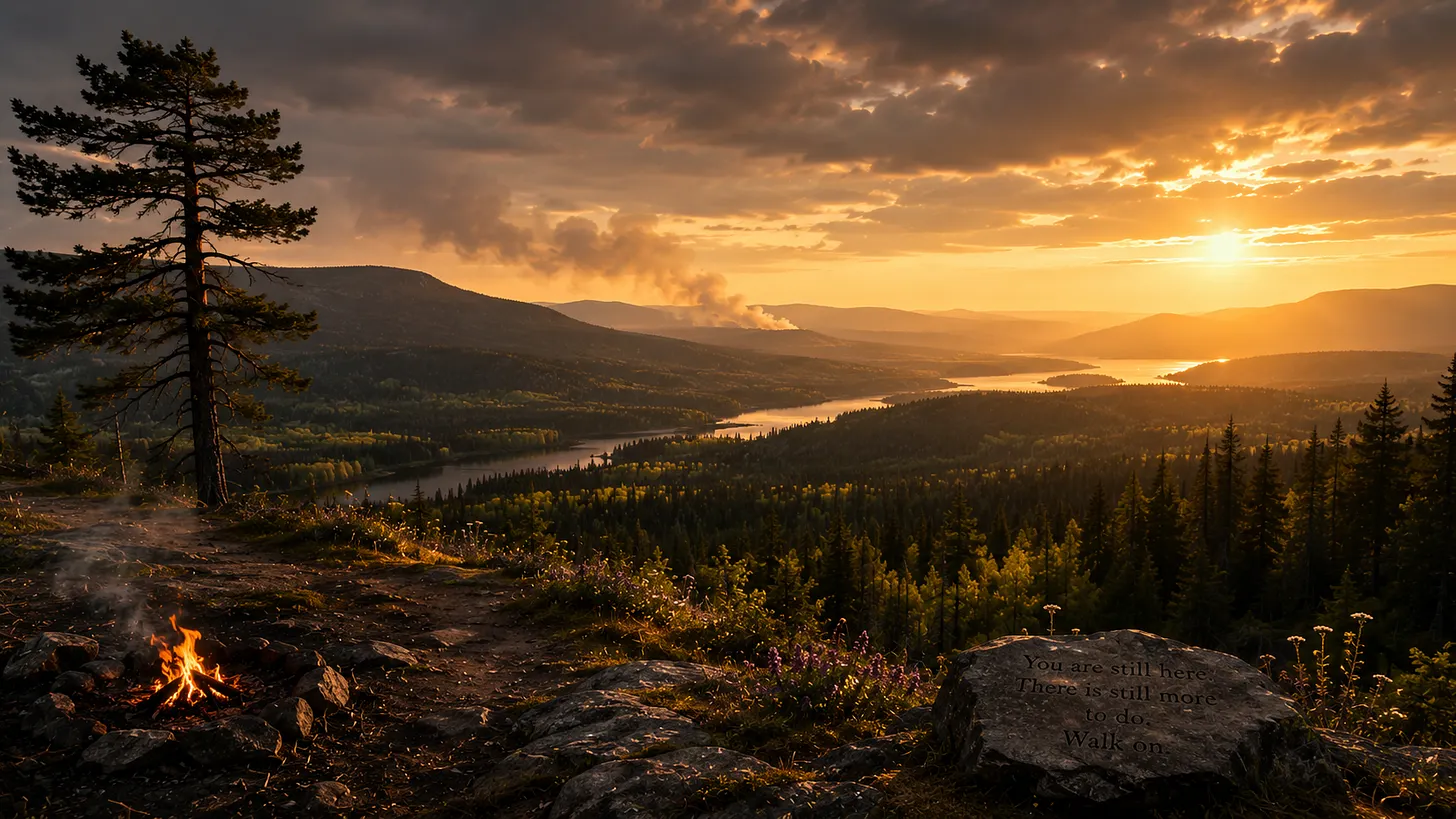
Some ideas linger at the edge of awareness until circumstances drag them into the foreground. A distant column of smoke on the horizon. A phone call in the middle of the evening. A conversation that suddenly turns reflective. Certain realities have a way of interrupting our routines and reminding us of things we spend most of our lives trying not to think about. Fire is one of them. Death is another.
. . .
It’s funny how, in our modern era, we’re coached and conditioned and brainwashed into fearing elemental things, elemental aspects, and unavoidable realities of life. Fire and death are but two examples.
Given the excessive and continuous propaganda of climate narratives, people are today terrified of fire, especially where I live in British Columbia, Canada. As I write (well, narrate to later edit/write) this, hiking in the hills, I can hear sirens, helicopters, and a spotter plane responding to an apparent fire not too far away. The government, in their infinite wisdom, has again increased the budget for this industry, and there are certainly actors who will find a way to make sure most, if not all, of that budget gets used up lest they face a reduction next year.
It’s a government-sponsored, billion-dollar racket, in my view, though perhaps a necessary one that utilizes our vast forest resources in an oddly inverted manner. I don’t know. But as always, it’s evident that the narrative serves their business model: blame the rest of us, whether for allegedly ruining the climate simply by existing or for being reckless enough to cause wildfires. Humans are such losers, right? Check yourself. What if humans are the singular reason for the existence of this realm? What if an entire class profits from weaponizing as much of it against us as possible?
Regardless, the prevailing idea in the zeitgeist is that from May through October we should be afraid of lighting a match anywhere near anything remotely flammable. It’s childish and asinine, to say the least. Certainly, there are irresponsible people in the world. There always have been. Similarly, natural causes have always existed. But reality is rarely as simplistic as the incessant marketing and ubiquitous messaging would have us believe.
What interests me most is what this reveals about the state of collective consciousness, and about the media’s role in cultivating and amplifying manufactured crises and misguided fears.
Death, of course, occupies a similar place in the human story. Perhaps the only thing feared more than death is what may come afterward.
A death happens in your family, perhaps of a distant relative, and in the quiet conversations that follow, the same familiar reflections arise.
“They’re in a better place now.”
“At least they don’t have to suffer anymore.”
Underneath all of these rather vacuous sayings is the unspoken acknowledgment that life here on Earth is a bit of a shitshow right now. Everyone is reminded, however briefly, to live their best life, to love more deeply, to spend time with friends and family, to pursue what matters because tomorrow is never guaranteed.
There is validity in that perspective. Yet it is often fleeting. Within days, perhaps even before the celebration of life has concluded, most people settle back into the same routines that brought them to that moment. They were shocked awake, reminded once again of the fragility of human life, and then gradually lulled back to sleep.
But why fear things that are both inevitable and absolute aspects of the human experience? Why fear things largely outside of your control? Why default to a negative bias toward forces that are essential to renewal, rebirth, recycling, and transformation in all their curious and wonderful expressions?
Death, of any and every kind, serves a function in this realm. Fire does too. Both clear the ground for what comes next. Fearing them often demonstrates a kind of ignorance, perhaps even an arrogance, as though they are errors in the system rather than integral parts of it. As though they are things we should someday overcome entirely.
Why not use them differently?
Why not let them fuel your courage? Why not allow them to challenge those arbitrary worries, superficial concerns, and manufactured fears that keep you from pursuing what genuinely inspires and motivates you?
When a fire is noticed and reported, the response is immediate. Crews mobilize. Resources appear. Action is taken. Yet when it comes to our own lives, many have become increasingly passive, sedentary, isolated, and complacent. We delay action. We postpone change. We wait for permission.
Massive frauds and hoaxes may provide fertile ground for ignorance, but they also expose it. And despite all the confusion, the authentic human spirit has a remarkable tendency to reassert itself.
Elements of evil may enjoy temporary victories. They may continue believing their manipulations are necessary or justified. They may cause immense harm, disruption, and suffering along the way. But they never truly own the day. They cannot. Their power is entirely dependent upon the collective from which they draw it. We are the source. They are merely the imitators, the mimics, the dark reflections. So to fear disruption, to fear necessary purification, and to fear what ultimately awaits every one of us seems somewhat wasteful, doesn’t it?
Fire and death are not merely endings. They are catalysts. They should remind us. Enliven us. Inspire us. Yet in our era, fear itself has become profitable. What terrifies people most, whether true or not, often becomes the most valuable commodity of all.
But everything is an offer. We choose whether to accept it. We choose whether to subscribe to narratives that keep us small, isolated, overly analytical, and trapped in endless self-reflection. We choose whether to continue carrying stories that have been handed to us through persistent messaging, social conditioning, and inherited assumptions about who we are supposed to be. And we choose when to stand up and walk away.
Belief is useful only up to a point. Beyond that lies knowing. Gnosis is not something granted by authority. It is discovered directly. We can step outside the framework that has been imposed upon us. The grand illusion may have served its purpose, but it remains nothing more than information, ideas, perspectives, and perception-altering narratives. All of it can be examined. All of it can be repurposed. Agency can be reclaimed. Authority can be reclaimed. Meaning can be reclaimed. Fire and death are integral, inescapable parts of life. Use them well.
Just as a fire passes through a forest and renewal begins almost immediately, death also participates in a larger process of regeneration. Even within your own body, countless cycles of destruction and renewal are occurring every moment. Cells die. Others emerge. Healing happens. Adaptation happens. Life continues. It branches outward in every direction, instantly, endlessly, perpetually.
You are still here. There is still more to do, more to learn and discern, more wisdom to distill, more of your story to share.
Walk on.
Written by Trance Blackman. Originally published on tranceblackman.com on 17 June 2026.
Copy & share: https://tranceblackman.com/fire-and-death/