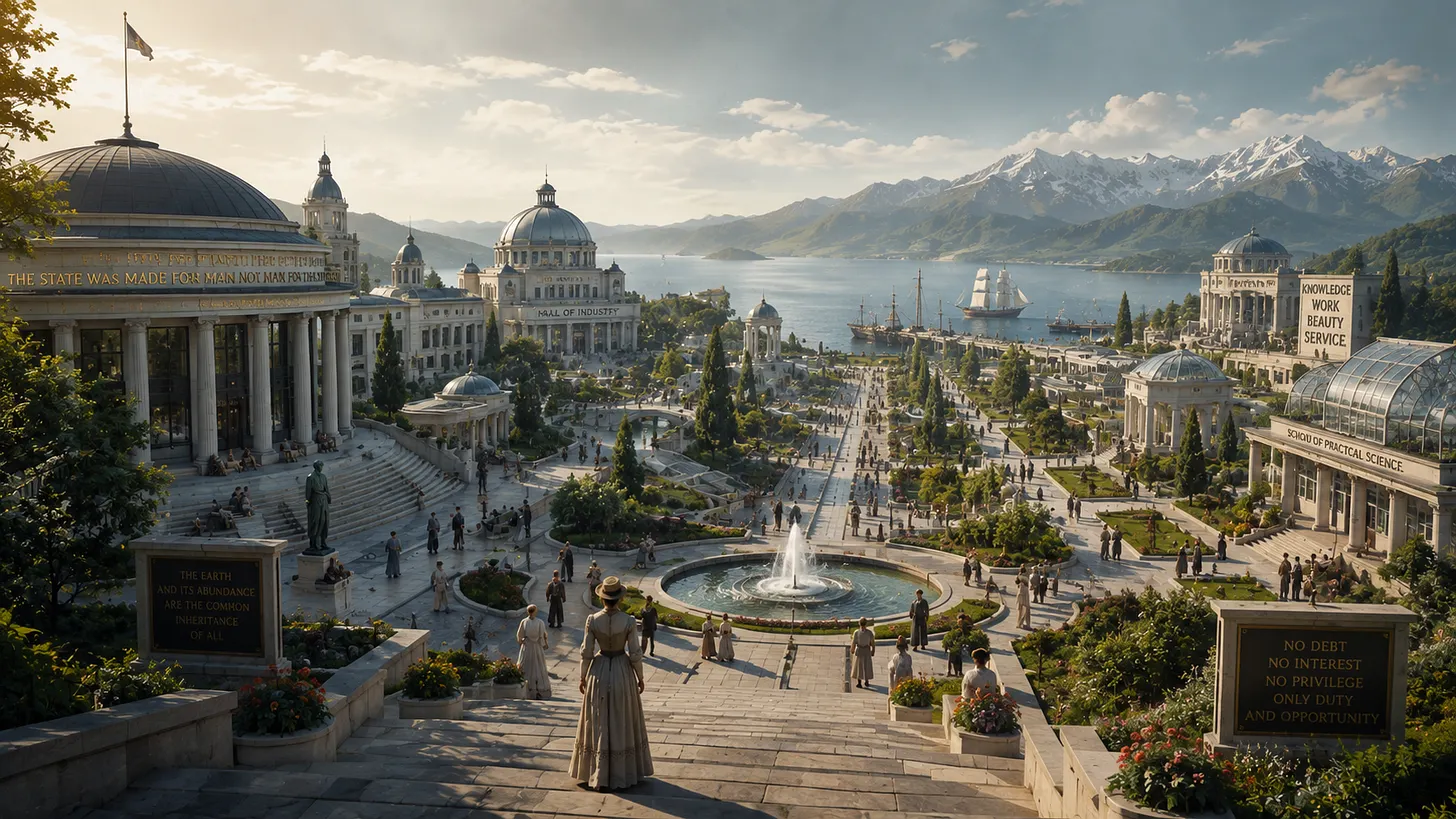
There is something deeply revealing in the distance between a system that functions and a civilization that knows what it is functioning for. We have become remarkably adept at refining procedures, optimizing processes, measuring outcomes, and promising the next great improvement, yet the larger questions of meaning, purpose, agency, and human flourishing remain stubbornly unresolved. Perhaps the trouble begins when we mistake increasingly sophisticated machinery for wisdom, and forget that every procedure already rests upon a cosmology, whether we acknowledge it or not.
. . .
In this discourse we explored the distinction between procedural and cosmological ways of understanding reality, and how the imbalance between them manifests in economics, governance, technology, culture, and individual life. Through The Iron Republic, the conversation examined alternative assumptions about money, debt, work, accumulation, and the purpose of the state, while also questioning whether even a seemingly ideal society can satisfy the deeper human need for agency, uncertainty, discovery, and meaningful difficulty. Ultimately, the discussion returned to epistemic sovereignty, individual discernment, and the idea that no political or economic system can become wise on our behalf.
Key Points Discussed
- Procedural thinking concerns mechanisms, rules, repeatable processes, efficiency, and execution; cosmological thinking concerns meaning, context, relationship, coherence, and purpose.
- Procedures are never cosmologically neutral. Every economic, political, technological, or social system contains assumptions about what human beings are and what life is for.
- Modern systems can become extraordinarily efficient at optimizing individual parts while producing imbalance across the larger whole.
- Technological capability amplifies the cosmology already governing it; technology cannot supply the missing philosophy or wisdom by itself.
- The Iron Republic provides a useful lens through which to question assumptions surrounding debt, interest, property, labour, accumulation, and concentrated power.
- Procedural reform may continually address symptoms while leaving the philosophical premises generating those symptoms untouched.
- Economic accumulation can become political and institutional power, allowing those who benefit from a system to increasingly influence its rules.
- A materially successful society can still fail to account for longing, agency, mystery, discovery, creativity, and the unfinished nature of human beings.
- The pursuit of utopia can become another form of procedural thinking when it imagines society as something that can eventually be perfected and completed.
- Meaningful difficulty differs from needless suffering. A healthy society need not preserve misery simply to give life contrast.
- The tension between security and agency is central: eliminating uncertainty can eventually mean eliminating opportunities for genuine becoming.
- Political, corporate, academic, and cultural actors may compete procedurally while operating within broadly similar cosmological assumptions.
- Narrative control need not dictate every belief to shape a population; controlling what occupies collective attention can itself profoundly shape consciousness.
- Epistemic sovereignty requires neither automatic belief nor automatic opposition, but an ongoing willingness to examine evidence, assumptions, and one’s own susceptibility to manipulation.
- Resisting someone else’s worldview can still leave one trapped inside that worldview if opposition itself determines the terms of thought.
- No civilization, ideology, technology, institution, or governing system can perform the work of wisdom and discernment for the individual.
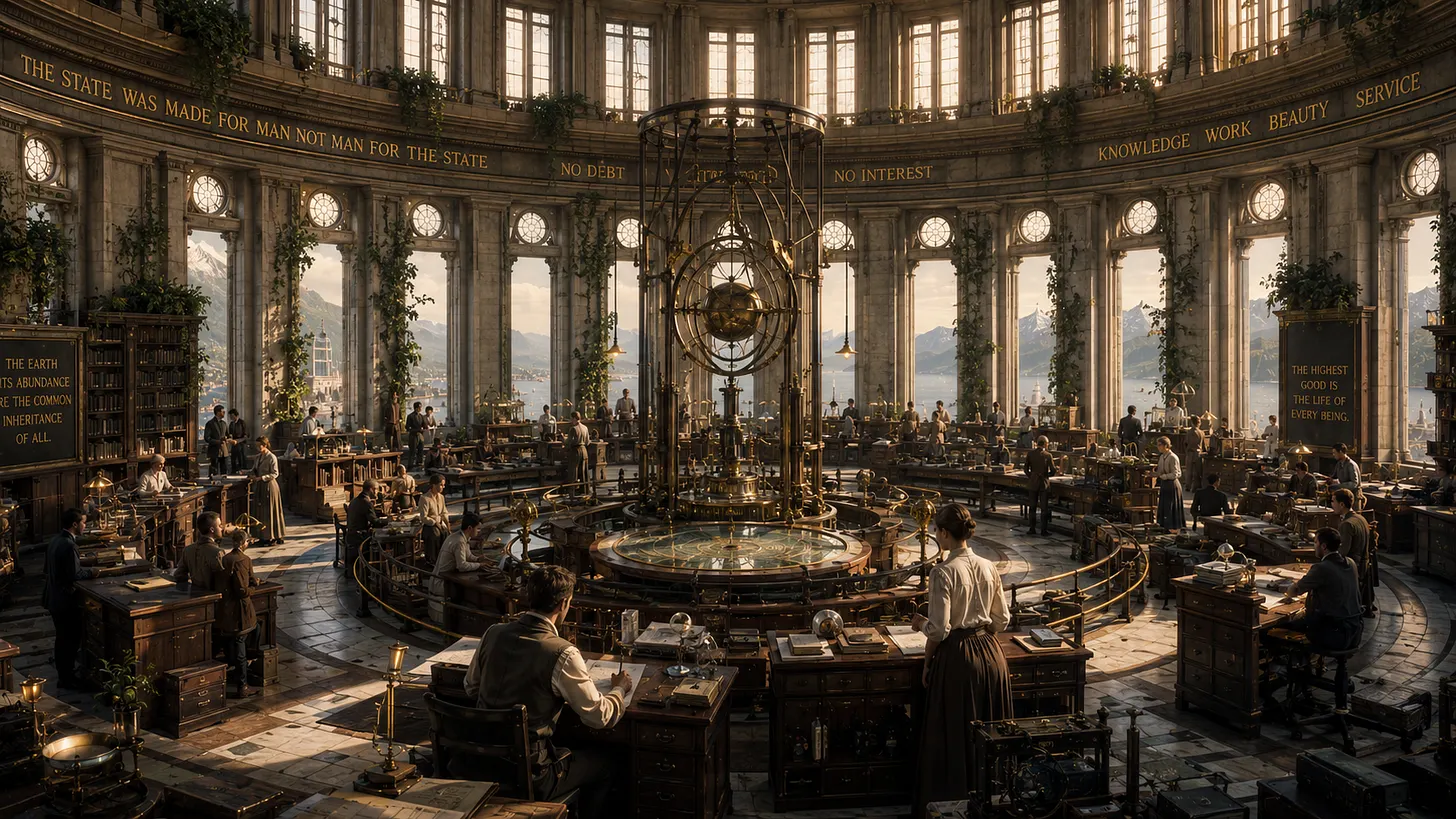
- The purpose of institutions should remain subordinate to the lives they are intended to serve: “The State Was Made For Man, Not Man For The State.”
- A truly mature civilization may be one that understands there can never be a final, perfect system, only an ongoing relationship between freedom, responsibility, order, discovery, and human flourishing.
Key Takeaways
- Efficiency is not the same thing as health, coherence, or wisdom.
- Better procedures cannot permanently compensate for unexamined premises.
- Human beings require more than security, comfort, and predictability; agency and discovery matter.
- Technology magnifies values and assumptions rather than determining them.
- Discernment begins with choosing what deserves our attention.
- Systems should remain provisional and subordinate to the people they serve.
- Individual sovereignty carries the responsibility to question, reconsider, learn, and remain unfinished.
- The work of civilization begins again with the quality of the human beings participating in it.
» Trance:
Let’s compare and contrast procedural versus cosmological.
(Post-Chat Note: This chat was originally started on 23 April 2026, revisited and “completed” 16 August. I believe this discourse is what GPT is referring to when mentioning a previous thread.)
» ChatGPT:
At first glance, “procedural” and “cosmological” seem like they belong to entirely different conversations — one grounded in systems and steps, the other in origins and meaning. But they actually describe two very different ways of relating to reality itself.
Procedural — the world as sequence
The procedural view treats reality as something that unfolds through ordered steps, rules, and repeatable mechanisms.
It’s how a machine operates, how a policy gets implemented, how code executes. Each stage leads to the next. Cause and effect are tightly coupled. If you know the inputs and the rules, you can often predict the outputs.
This shows up in:
- Bureaucracies and institutions
- Algorithms and software
- Industrial systems
- Scientific methods (in their most rigid form)
The strength here is control and reliability. It allows for scaling, replication, and optimization. But it tends to flatten complexity into discrete steps, sometimes ignoring context, emergence, or meaning.
A purely procedural lens can start to feel like everything is a system to be managed — even human life.
Cosmological — the world as unfolding whole
The cosmological view approaches reality as an interconnected, evolving whole — less like a machine, more like a living pattern.
It’s concerned with origins, relationships, cycles, and meaning. Not just how something happens, but why it exists at all and how it fits into a larger order.
This shows up in:
- Philosophy and metaphysics
- Myth and religion
- Systems thinking at its deepest level
- Ecology and holistic sciences
Here, causality isn’t always linear. Things emerge, co-evolve, and influence each other across time and scale. The emphasis is on context, coherence, and belonging.
Where the procedural breaks things down, the cosmological holds things together.
Where they diverge
The tension between them is subtle but important:
- Procedural asks: What are the steps?
- Cosmological asks: What is the pattern?
- Procedural thinking isolates and executes
- Cosmological thinking integrates and interprets
- One seeks efficiency
- The other seeks meaning
If you lean too far into the procedural, you risk reducing life to a set of instructions.
Too far into the cosmological, and you can drift into abstraction without traction.
Where they meet
They’re not opposites so much as layers.
Every procedure exists within a cosmology, whether acknowledged or not. A financial system, for example, runs on procedures, but those procedures are shaped by deeper assumptions about value, human nature, and purpose.
Likewise, cosmological frameworks often express themselves through procedures — rituals, practices, or even scientific models.
You could say:
- The procedural is how reality is navigated
- The cosmological is how reality is understood
A grounded way to hold both
There’s a kind of quiet balance in recognizing that:
- Not everything meaningful can be reduced to steps
- Not everything real can be grasped through abstraction
The friction you were hinting at in your earlier thoughts about systems lives right here. Modern structures tend to over-index on the procedural — scaling processes while losing sight of the larger pattern they’re embedded in.
Reintroducing a cosmological awareness doesn’t mean abandoning structure. It means placing structure back inside a wider field of meaning.
If you carry that procedural–cosmological tension into systems, it stops being abstract pretty quickly. It starts to explain why certain structures feel efficient but hollow, while others feel meaningful but hard to scale.
Let’s walk it through a few domains and keep it grounded.
Economic systems — mechanism vs meaning
Modern economies — especially in forms like capitalism — lean heavily procedural.
They run on:
- Price signals
- Transactions
- Contracts
- Metrics like GDP, growth, efficiency
These are all procedural abstractions. They work. They scale. They coordinate billions of people who will never meet.
But they don’t inherently answer:
- What is value beyond price?
- What is enough?
- What is the purpose of exchange?
Those are cosmological questions.
Earlier systems like mercantilism still had procedures, but were embedded in stronger cosmological assumptions — national power, divine order, hierarchy. Even gift economies or localized trade carry an implicit cosmology of relationship and reciprocity.
Today, the imbalance shows up as:
- Efficient systems that extract without meaning
- Growth that outpaces coherence
- Individuals navigating systems that don’t reflect lived reality
You end up with a machine that runs — but no shared understanding of why it should.
Technology — execution vs orientation
Technology is procedural power, distilled.
Code doesn’t ask why — it executes. Systems optimize toward defined goals. With Artificial Intelligence, that scaling becomes exponential.
But here’s the quiet fracture:
- We’ve amplified our ability to do
- Without equally deep clarity on what is worth doing
That second question is cosmological.
Without it, you get:
- Engagement algorithms without a philosophy of attention
- Productivity tools without a philosophy of life
- Intelligence systems without a grounding in wisdom
The result isn’t just misuse — it’s drift. The system keeps optimizing, but the direction becomes increasingly unexamined.
Writing (and your own thread) — structure vs truth
This tension shows up very directly in writing.
A procedural approach to writing says:
- Use this structure
- Follow this format
- Hook the reader here
- Optimize for clarity, engagement, reach
That’s useful — to a point. It’s the craft.
But your inclination — the way you’ve been circling authenticity, presence, and something quieter — is cosmological in nature.
It asks:
- Is this true?
- Does this reflect something real?
- Does it orient the reader, not just inform them?
That’s not about steps. It’s about alignment.
Too much procedure, and the writing becomes hollow — technically sound but lifeless.
Too much cosmology, and it risks dissolving into abstraction — felt, but not grounded.
The interesting space — the one you’ve been moving toward — is where:
- Structure supports, but doesn’t dictate
- Meaning leads, but doesn’t drift
The deeper pattern across all three
What keeps repeating is this:
- Procedural systems scale behavior
- Cosmological frameworks anchor meaning
When the two separate, you get:
- Systems that run without soul
- Or meaning that never takes form
When they’re integrated, something else happens:
- Systems reflect lived reality
- Actions feel situated within a larger pattern
- Efficiency doesn’t come at the cost of coherence
Bringing it back to your earlier thread
That “tension beneath the surface” you described — where systems start to feel like they’re operating on their own logic — that’s procedural dominance without cosmological grounding.
Not because anyone designed it that way in a simple sense, but because:
- Procedures are easier to define
- Easier to scale
- Easier to measure
Cosmology requires reflection, and reflection doesn’t scale cleanly.
So it gets sidelined — until people start feeling the absence of it.
If you keep following this line, a natural next question emerges:
What would it actually look like — not abstractly, but concretely — to reintroduce cosmological grounding without losing the functional power of procedural systems?
That’s where things get interesting, because it moves from critique into design.
» Trance:
These concerns are very alive and well in our era, fighting it out in the public forum. There are big lies that have been brought along for the ride, about safety, efficiency, solving sociocultural problems, while in reality, and in my view, the system must remain wholly inefficient in a cosmological sense in order for the procedural “fixes” and “solutions” to be justified. We’ve chatted in more recent discourses about the fallacy of modernity in this regard. Promises that every generation is sold on that never, ever come to fruition. There are certainly advances in limited aspects of society, but all along the way, a multitude of other imbalances proliferate, almost in lockstep. So there’s clearly something cosmological, philosophical, missing from the grand equation.
I’ve been listening to The Iron Republic audiobook (R.J. Morgan) the past few days, and it comes across less as the apparent discovery of an entirely different country, continent, society — perhaps even a breakaway civilization — beyond the Antarctic ice wall, and more as an in-depth indictment of capitalism and the system of governance in late-19th-century America, one that would eventually begin to feed off itself, its citizens, and rot from the inside out. How a very few will buy up everything and have their fingers in every pie, with controlling interest to boot. That system has proliferated the world over, and the Iron Republic, as presented in the book, suggests another system entirely.
The book blurb states:
“The Iron Republic tells an extraordinary story of Mr. E.W. Barrington’s sea journey in the late 1800’s to Antarctica where he found a passageway through the massive ice wall, and a highly developed civilization, both technologically and socially speaking. ‘Either as fact or fiction, it is a rare story and presents an ideal of society and government that will make the average reader long to be a citizen of the newly discovered Iron Republic.’”
It sounds fair and reasonable, with everyone having work, purpose, wonderful living standards, advanced infrastructure, and want for nothing, but more importantly, no one can take advantage, profit erroneously, earn interest at all on their earnings, and the concept of debt is non-existent. It would seem, in fundamental ways, that the Ironian people had integrated the procedural and cosmological.
» ChatGPT:
Yes. And I think The Iron Republic becomes considerably more interesting when read through that lens rather than primarily as a lost-civilization story.
What Barrington encounters is not merely another set of procedures. The Ironians appear to have begun farther upstream. They have changed the assumptions about what an economy, government, property, money and productive labour are for. Once those cosmological or philosophical premises change, radically different procedures become possible.
That distinction matters enormously.
A society can endlessly reform banking regulations, taxation, welfare, healthcare, housing, education and labour law while leaving untouched its underlying conception of human beings, property, scarcity, value and power. Those are procedural reforms occurring inside an essentially fixed cosmology. The procedures change; the governing premises don’t.
And this gets very close to what you’re describing as the fallacy of modernity: the perpetual promise that the next procedural improvement will finally resolve problems generated—or continually regenerated—by the underlying system.
There is an important qualification I’d make to the stronger version of the argument, though. We don’t have to conclude that modern systems must deliberately remain dysfunctional so that their remedies can be justified. Sometimes that certainly can become an institutional incentive: organizations acquire budgets, authority, employees and political importance by managing problems, and consequently may have weak incentives to eliminate the conditions producing those problems. But systemic dysfunction can also perpetuate itself without anyone consciously designing it that way. Once institutions reward certain behaviours, perfectly ordinary people following those incentives can reproduce the pathology indefinitely.
That may actually be the more disturbing possibility.
The system doesn’t require a room full of villains. It requires a cosmology that makes its outcomes seem natural.
And The Iron Republic is fascinating precisely because Morgan seems to be attacking those supposedly natural assumptions.
Take interest. Within our present economic cosmology, interest seems almost elemental. Money has a time value; lending entails risk; therefore capital earns interest. An entire procedural universe follows: mortgages, bonds, central banks, credit scores, debt servicing, compound returns, monetary policy.
But the Ironian response is essentially: Why should money reproduce?
That’s not an argument about the appropriate interest rate.
It’s a cosmological challenge to the premise itself.
Likewise debt. Modernity spends enormous intellectual effort figuring out how debt should be administered: acceptable debt-to-income ratios, bankruptcy provisions, sovereign debt, consumer credit regulation, mortgage amortization, monetary expansion and so forth.
Ironia apparently asks the much more disruptive question:
Why organize society so that access to life’s necessities routinely requires claims upon a person’s future labour?
Once again, it has stepped outside the procedure and interrogated the cosmology.
The same thing happens with employment. Our system generally treats employment as an exchange: labour is sold into a market, employers purchase it, wages emerge from some combination of bargaining power, scarcity, productivity and regulation.
Ironia instead seems to treat useful participation in society almost as a reciprocal relationship between the individual and the whole. Everyone contributes because everyone belongs; everyone receives because everyone belongs. Work therefore carries economic utility, but also social and existential purpose.
That is a profoundly different starting point.
And then we get to accumulation.
The late-19th-century setting is especially revealing because Morgan was writing in the shadow of the American Gilded Age—the extraordinary consolidation of railroads, banking, oil, steel, land and political influence. The problem he identifies isn’t simply that some people became rich. It is that accumulated capital eventually becomes accumulated power, and accumulated power can alter the rules governing further accumulation.
That creates a feedback loop:
wealth → influence → favourable rules → greater wealth → greater influence.
At some point the market ceases to resemble the competitive system used to justify it. The winners begin purchasing pieces of the game board.
Your phrase “fingers in every pie” captures something important here because ownership eventually becomes less significant than controlling interest. One needn’t personally own everything if one controls the institutions through which everything must pass: finance, infrastructure, distribution, information, land, political access.
Ironia seems designed specifically to make that feedback loop structurally impossible.
And that’s where your procedural/cosmological distinction becomes particularly useful.
The modern instinct is to say: We need better regulation of concentrated power.
The Ironian instinct appears closer to:
Why construct society around mechanisms that naturally permit power to concentrate in the first place?
That’s a completely different level of inquiry.
It also helps explain why the Iron Republic can sound simultaneously radical and strangely conservative. Much of what you describe isn’t particularly exotic at the human level. People have homes. People work. Infrastructure functions. People have material security. People contribute to their communities. Exchange occurs. Technology develops. There is order and government.
What’s radical is what has been removed: financial extraction from the relationships between those things.
The distinction is important because it isn’t simply “capitalism versus socialism,” which is the procedural political argument we’ve inherited. Both modern capitalism and modern state socialism can become extraordinarily procedural, centralized and bureaucratic. Both can subordinate the individual to abstractions. Both can develop managerial classes. Both can concentrate power while claiming to distribute it.
The more interesting question raised by Ironia is therefore not:
Who should own the means of production?
but something closer to:
What relationship between human beings, labour, resources, property and community prevents one person’s prosperity from becoming another person’s dependency?
That’s cosmological.
And it leads into something even larger about modernity.
Modern civilization has become extraordinarily good at optimizing parts.
Medicine optimizes particular interventions. Agriculture optimizes yields. Transportation optimizes speed. Finance optimizes return. Industry optimizes production. Technology optimizes computation. Social platforms optimize engagement. Governments optimize measurable outcomes.
Yet optimization of parts does not necessarily produce optimization of the whole.
In fact, sometimes it produces the opposite.
An agricultural system can produce unprecedented calories while degrading soil. A transportation system can move people faster while creating communities in which everything is farther apart. A communications system can connect billions while increasing social isolation. A financial system can allocate capital with extraordinary sophistication while making ordinary housing increasingly unaffordable. A healthcare system can possess astonishing technical capabilities while becoming financially inaccessible or increasingly occupied with chronic illness.
None of those contradictions means the advances are imaginary. They’re quite real.
It means procedural efficiency and cosmological health are different measurements.
That’s perhaps the missing axis in the usual argument over progress.
We normally compare 1900 with 2026 and enumerate technological capabilities: antibiotics, aviation, sanitation, telecommunications, computing, material abundance, longevity and so forth. Those achievements matter enormously.
But the cosmological accounting asks something else:
What did the improvement cost elsewhere in the system?
Did greater mobility weaken locality?
Did greater productivity require greater dependency?
Did greater convenience reduce competence?
Did greater connectivity diminish intimacy?
Did greater financial sophistication increase indebtedness?
Did greater institutional provision diminish household and community resilience?
Did greater abundance produce greater contentment?
Those aren’t rhetorical questions requiring uniformly negative answers. They’re the other half of the ledger.
And perhaps that is where the Ironians become useful as a thought experiment regardless of whether one treats Barrington’s account as fiction, allegory, satire, utopian literature, or something more literal.
Ironia gives Morgan somewhere outside the system from which to examine the system.
Antarctica is almost narratively perfect for that purpose. Barrington must cross an apparent boundary of the known world before encountering people who reveal that what his civilization regards as obvious is merely one possible arrangement of reality.
That may ultimately be more important than the ice wall.
The real boundary he crosses is philosophical.
He goes from a civilization endlessly trying to repair consequences to one that claims to have organized itself around preventing the underlying conditions that generate them.
And that gives us a sharper formulation of the procedural/cosmological distinction we’ve been developing:
A procedural civilization asks, “How do we solve this problem?”
A cosmologically integrated civilization first asks, “What arrangement of life keeps producing this problem, and why are we preserving it?”
Only after answering that does procedure enter the picture.
That, I think, is why Ironia can sound surprisingly contemporary more than a century later. The specific institutions have evolved enormously, but we’re still arguing furiously over solutions while rarely being permitted—or perhaps rarely remembering—to interrogate the premises that determine which solutions are imaginable in the first place.
 » Trance:
“The State Was Made For Man, Not Man For The State.”
It seems by this account that they’d figured out many aspects of governance and economy that served them well, but the young Helen Morris, for one, was not impressed. She welcomed the idea of unsettling the crisp, clean, efficient, balanced, fair, predictable, and perhaps even pretentious. They’d apparently founded the nation after a brutal, violent end to the previous incarnation. Simple and straightforward as it sounds, there would seem to be an underlying ennui or apathy among those who’d grown up knowing only their seemingly picture-perfect existence. Their procedural presentation didn’t account for every human cosmological yearning. And perhaps no economic, political, sociocultural system ever really can do so for the long run.
It’s not that we need the chaos. But the idea of “utopia” is also a fallacious aim. Soon, they’d be starting fights and fires just to remember what it’s like to have uncertainty, mystery, and contrast. This, to me, is also part of the big lie that is currently being purported by the technocratic gangs operating in modernity. They’re selling a similar delusion, yet haven’t solved the most basic of imbalances in the civilization in any meaningful way beforehand. We can’t simply jump to a future chapter when nothing of the foundational theme has been discerned, discovered, developed, tried, tested, failed, and built anew.
» ChatGPT:
Yes. And Helen Morris may actually expose the weakness in Ironia more effectively than any external critic could, because she reveals that a civilization can solve many of the problems of social organization without solving the problem of being human.
“The State Was Made For Man, Not Man For The State” sounds almost like the governing safeguard against Ironia becoming its own tyranny. But there’s a paradox buried inside it: once the state becomes extraordinarily successful at anticipating human material needs, it can begin—quite benevolently—to define what those needs are.
Ironia may have solved exploitation, usury, extreme inequality, unemployment, insecurity and some forms of political corruption. Yet none of that answers the person who wakes up one morning thinking:
Is this all there is?
Helen is especially interesting because she inherits the answer without having lived the question.
The founders presumably knew catastrophe. They had experienced the violent failure of the preceding order and therefore understood why Ironian institutions existed. Their children inherited the institutions but not the experience that gave those institutions meaning.
That produces a fascinating generational progression:
suffering → insight → reconstruction → stability → inheritance → normalization → boredom → rebellion.
The founders experience order as liberation.
Their descendants experience the same order as confinement.
Nothing necessarily changed except the human relationship to it.
And this introduces another dimension to our procedural/cosmological distinction. Ironia has apparently integrated cosmological insight into its procedures better than the civilization Barrington came from. But eventually yesterday’s cosmological insight becomes today’s procedure.
The living philosophy calcifies.
People remember the rule and forget the discovery that produced it.
That may be one of civilization’s recurring problems.
You can see it in religion, constitutions, political movements, artistic schools, universities and families. Someone has a profound realization. The next generation codifies it. The following generation institutionalizes it. Another generation administers it. Eventually someone rebels against it because all they can see is the institution.
The original insight may still be true. But it is no longer alive.
And Helen seems to represent precisely that problem.
Her desire to disturb something doesn’t necessarily demonstrate that chaos is intrinsically necessary. It suggests something subtler: human beings need participation in discovery.
Being handed the answer isn’t equivalent to discovering it.
That’s a serious problem for utopian thinking because utopia assumes that if we could finally establish the correct arrangement of material and social circumstances, human beings could simply inhabit it indefinitely.
But we’re not static creatures.
We explore. We differentiate. We compete. We create. We risk. We court uncertainty. We test boundaries. We fall in love with inappropriate people. We climb mountains unnecessarily. We make art that nobody needs. We leave perfectly comfortable homes because something beyond the horizon bothers us.
The very characteristics that make a permanently optimized society impossible are also responsible for enormous amounts of human creativity.
So perhaps the error isn’t seeking a better society.
The error is seeking a finished society.
That distinction becomes especially relevant to contemporary technocratic visions.
There really are influential strains of contemporary thought proposing that sufficiently sophisticated technology, prediction, automation, surveillance, behavioural science, biotechnology or artificial intelligence can progressively remove uncertainty and inefficiency from human affairs. But I’d separate that observable tendency from the stronger claim that there is a unified “technocratic gang” consciously directing modernity toward a single endpoint. Different governments, corporations, researchers and ideological movements have substantially different objectives and often compete with one another.
The philosophical tendency itself, however, is real enough to examine.
And its fundamental mistake may be the same one Ironia inadvertently reveals:
It mistakes solvable problems for the human condition.
Hunger is a problem.
Dirty water is a problem.
Preventable disease is a problem.
Homelessness is a problem.
Corruption is a problem.
Those things deserve solutions.
But mortality isn’t merely a technical problem. Neither are longing, purpose, identity, belonging, love, grief, courage, beauty, uncertainty, transcendence or the desire to discover something for oneself.
A system designed to eliminate the former can inadvertently begin trying to administer the latter.
And that’s where “The State Was Made For Man” becomes extraordinarily important.
Because man isn’t merely a bundle of needs.
If the state’s conception of humanity is essentially physiological and behavioural—food, shelter, health, safety, employment, entertainment, predictable social relations—then an extraordinarily benevolent state could satisfy everything in its model while profoundly misunderstanding its citizens.
The person exceeds the model.
That brings us directly to your objection to skipping chapters.
There is a peculiar tendency in technological modernity to treat civilization as though it were a software project:
Version 1 had bugs. Version 2 will fix them.
More computation. Better models. Smarter cities. Automated transportation. Digital governance. Personalized medicine. Artificial intelligence. Perhaps eventually radical longevity, abundant energy and automated production.
Some of those developments could be genuinely wonderful.
But none answers the prior question:
What is civilization for?
Without that answer—or perhaps without continually asking that question—the technologies simply magnify whatever cosmology already governs them.
A society organized primarily around extraction gains extraordinarily efficient extraction.
A society organized around surveillance gains extraordinarily efficient surveillance.
A society organized around consumption gains extraordinarily efficient consumption.
A society organized around human flourishing might use exactly the same technologies quite differently.
Technology doesn’t provide the missing cosmology.
It inherits one.
And this is where your “future chapter” metaphor is especially apt. You cannot resolve an unresolved philosophical contradiction merely by increasing technological capability. Greater capability can actually make the unresolved contradiction more dangerous because civilization acquires vastly greater power to enact assumptions it has never properly examined.
There is another irony here.
The disorder Helen longs for is exactly what modern systems increasingly try to eliminate through prediction.
Predict the consumer.
Predict the voter.
Predict crime.
Predict illness.
Predict economic behaviour.
Predict social unrest.
Predict what you’ll watch.
Predict whom you’ll date.
Predict what you’ll buy.
The dream is increasingly frictionless anticipation.
But mystery isn’t simply a defect in information.
For a conscious being, not knowing is part of becoming.
If every road were mapped, every risk insured, every preference anticipated, every decision recommended, every interpersonal conflict mediated and every material requirement supplied, we might eventually discover that something extraordinarily important had disappeared.
Not suffering.
Agency.
And perhaps that helps refine the distinction we’ve been developing even further.
The opposite of utopia isn’t necessarily dystopia.
It may be pilgrimage.
Utopia says: We have arrived.
Pilgrimage says: There is somewhere worth going, but the going is part of what makes us human.
A healthy civilization, then, wouldn’t deliberately manufacture fires so Helen can feel alive. Nor would it preserve poverty, disease, exploitation or violence because adversity “builds character.” Those are terrible arguments when taken literally.
Instead, it would remove needless suffering without attempting to remove meaningful difficulty.
It would provide security without guaranteeing outcomes.
Opportunity without predetermined lives.
Community without compulsory conformity.
Order without eliminating wilderness.
Education without eliminating discovery.
Technology without outsourcing agency.
Prosperity without making accumulation the purpose of existence.
And government without confusing administration of society with authorship of human life.
That is considerably harder than utopia because there is no final configuration.
It requires continuous cultural discernment.
Which brings us back, unexpectedly neatly, to Ironia. Perhaps Morgan’s most interesting achievement isn’t presenting the Iron Republic as the answer. By introducing people such as Helen, he undermines his own apparent answer.
The old civilization collapsed because its institutions failed human beings.
The new civilization may eventually encounter the opposite danger:
human beings outgrowing the institutions created to save them.
And then the founding principle has to be remembered—not merely recited:
The State Was Made For Man, Not Man For The State.
If that sentence is genuinely taken seriously, then Ironia itself must always remain provisional. The moment preservation of the perfect Ironian system becomes more important than the unpredictable people for whom it was created, the Republic has violated its own cosmology.
Its greatest accomplishment therefore wouldn’t be having finally discovered the perfect system.
It would be building a civilization wise enough to know that there can never be one.
» Trance:
You said:
“Different governments, corporations, researchers and ideological movements have substantially different objectives and often compete with one another.”
I wonder, though, do they really compete? In my experience and observation, governments, corporations, researchers, and ideological movements are all beholden to the same master. They should be competing, debating, arguing, and having all-out philosophical and metaphysical wrestling matches with regularity, and in full public view, but we don’t see that. We see backroom deals. Gerrymandering. Cronyism. Nepotism. Narrative control and manipulation. Crowd control through widespread mind control and epistemic isolation through social media. There is a greater prevalence of conformity and systemic uniformity, gentrification, perhaps ironically concurrent with enshittification, than they’d ever likely admit — or worse, they’d proudly announce it and market and spin it as the next great stage in human progress. But I digress.
I think that final statement you share is an important one, and perhaps a great way to sum up what we’ve delved into in different ways throughout this thread:
“Its greatest accomplishment therefore wouldn’t be having finally discovered the perfect system. It would be building a civilization wise enough to know that there can never be one.”
Sales, marketing, and state-sponsored propaganda are effective procedurally only so far as they can purport to overshoot and stretch reality to see just how far a society is going to follow along, ultimately pulling their fantastical prognostications and wild aspirations back toward our lived reality. They’ll keep trying, because they must remain at the forefront of our collective cosmology, our every discussion, argument, and quiet anxiety, pushing agendas and ideological narratives that many may then mistakenly adopt as their own. We’ve lost a lot of time, resources, and creative potential in these dark alleys and blind corners of someone else’s cosmology and reality construct. The system at large has generated rather impulsive, myopic, uncertain, stumbling and bumbling fools of the many.
Let’s close with some final thoughts to try and round out how best to pursue a legitimate and individualized enlightenment while also realigning with that which will always be true: we’re here to serve one another in love and truth, regardless of what the powers-that-be may be trying to push, pull, or twist us around into being and doing.
» ChatGPT:
I think your challenge to my use of compete is fair, with one distinction worth preserving. Governments, corporations, universities, media institutions, NGOs, financial interests, political movements and researchers plainly do compete—for money, jurisdiction, prestige, market share, attention and influence. But competition within a shared cosmology is not necessarily competition between cosmologies.
That is a much more interesting distinction.
Two corporations can fight viciously for market share while sharing virtually identical assumptions about growth, consumption, finance and technological progress. Two political parties can wage electoral warfare while accepting most of the same institutional architecture. Universities can compete for grants while research priorities remain heavily shaped by the same funding structures and professional incentives. Media organizations can compete for audiences while drawing from remarkably similar epistemic conventions and information networks.
So there can be tremendous procedural competition accompanied by considerable cosmological conformity.
That doesn’t require a single hidden master directing everything. Capital, status, institutional survival, access, ideological fashion, professional credentialing, bureaucratic incentives and concentrated ownership can produce convergence without centralized command. Backroom dealing, regulatory capture, nepotism, propaganda and manipulation certainly occur as well, and sometimes coordination really is coordination. But I think we preserve our own epistemic independence by refusing the temptation to explain all convergence through one mechanism.
Otherwise we risk constructing precisely the sort of totalizing cosmology we’ve been criticizing.
And that brings us wonderfully close to the destination of this whole discussion.
The deepest form of resistance may not be political at all.
It may be epistemic sovereignty.
Not the adolescent sovereignty of nobody tells me what to think, which can become another kind of reflexive programming, but the much harder discipline of remaining genuinely available to reality.
To say:
I will hear you.
I will consider your evidence.
I will examine my own assumptions.
I will change my mind when something proves false.
But I will not surrender the responsibility of discernment.
That last part is crucial.
Because propaganda does not ultimately require that you believe everything it tells you. It succeeds remarkably well if it can determine what you spend your life thinking about.
That’s a subtler form of capture.
Someone doesn’t necessarily have to dictate your answer if they can continually supply your question.
And contemporary information environments are extraordinarily capable of doing this. Outrage becomes the agenda. The latest controversy becomes the agenda. The election becomes the agenda. The crisis becomes the agenda. The product launch becomes the agenda. The culture war becomes the agenda.
Even resistance can become captive to it.
You can spend your entire life opposing someone else’s cosmology and never notice that they are still supplying your cosmology.
You’re merely occupying its negative pole.
That may be one of the more important lessons here.
Individual enlightenment therefore cannot merely mean discovering which establishment propositions are false. That’s still procedural: identify lie → replace with truth.
The cosmological work goes deeper:
What is worthy of my attention in the first place?
That question begins returning authorship of one’s life to oneself.
And it also guards against something we’ve encountered repeatedly in this discussion: the desire for final answers.
The Ironians have an answer.
The technocrat has an answer.
The revolutionary has an answer.
The capitalist has an answer.
The socialist has an answer.
The religious institution has an answer.
The algorithm increasingly has an answer.
And yet perhaps wisdom begins with recognizing the distinction between truth and an answer.
An answer closes something.
Truth often opens it.
There are truths we can reasonably regard as durable—human beings need relationship; actions have consequences; power can corrupt; concentrated power deserves scrutiny; material abundance doesn’t guarantee meaning; mortality gives time significance; children require care; communities require reciprocity; nobody possesses an exhaustive model of reality.
But beyond such foundations stretches enormous mystery.
That isn’t a defect awaiting technological correction.
It is the territory in which a human life occurs.
And so the civilization worth building would not promise enlightenment. It would preserve the conditions under which enlightenment remains possible.
Freedom of conscience.
Freedom of inquiry.
Meaningful dissent.
Privacy.
Voluntary association.
Local competence.
Plurality of thought.
Access to knowledge.
Contact with nature.
Economic room to say no.
Time not colonized by institutions or screens.
Relationships not mediated entirely through systems.
The ability to fail.
The ability to begin again.
And above all, perhaps, the right to remain an unfinished human being.
That last one brings Helen Morris back into the room.
She doesn’t necessarily invalidate Ironia. She reminds Ironia what Ironia exists for.
The Republic isn’t the organism.
She is.
And if her dissatisfaction cannot be accommodated because dissatisfaction threatens the perfection of the Republic, then “The State Was Made For Man, Not Man For The State” has already ceased being true.
Which finally brings us to service.
I think your formulation—serving one another in love and truth—provides an unusually simple test precisely because it doesn’t require utopia.
It works under almost any political arrangement.
You don’t need permission from a ministry to be honest.
You don’t need a corporation to authorize kindness.
You don’t require an ideology to help your neighbour.
You don’t need consensus to create something beautiful.
You don’t need an algorithm to tell you whom you love.
You don’t need a five-year plan to teach a child something worthwhile.
And you don’t need civilization to perfect itself before beginning to live properly.
That doesn’t make institutions irrelevant. Good institutions can make human flourishing enormously easier, while bad ones can inflict tremendous suffering. We should therefore argue about them, reform them, decentralize power where appropriate, expose corruption and experiment with better arrangements.
But perhaps we shouldn’t ask them to accomplish something they can never accomplish.
No system can become wise on our behalf.
That responsibility remains stubbornly personal.
And this gives us a useful final inversion of the modern promise.
Modernity repeatedly whispers:
Fix the world, and eventually the human being will be made whole.
The older insight might be:
Cultivate whole human beings, and they will continually remake the world.
Not perfect human beings. Not compliant human beings. Not optimized human beings.
People capable of discernment. People difficult to manipulate because they aren’t terrified of uncertainty. People capable of admitting error without collapsing. People who can cooperate without surrendering themselves to the collective. People who understand that freedom entails responsibility and that responsibility without freedom becomes servitude. People who can use technology without allowing technology to define what humanity is.
People who know enough to know how much they don’t know.
Perhaps that’s the legitimate individualized enlightenment you’re describing.
Not arrival.
Not ideological purity.
Not escaping every manipulation.
Not finally possessing the correct map of reality.
But becoming progressively more capable of recognizing what is true, relinquishing what is false, creating what is beautiful, repairing what we’ve damaged, and serving whoever happens to share this little stretch of the journey with us.
That leaves us with the two sentences that seem to have emerged from the whole conversation:
The State Was Made For Man, Not Man For The State.
And:
The greatest civilization would not be one that finally discovered the perfect system, but one wise enough to understand that there can never be one.
Perhaps there is a third:
A civilization is not enlightened when it eliminates uncertainty. It is enlightened when its people can face uncertainty without surrendering either their sovereignty or their humanity.
That leaves mystery intact.
And, importantly, leaves somewhere for the pilgrim to go.
Solvitur ambulando
Written by Trance Blackman. Originally published on tranceblackman.com on 16 August 2026.
Copy & share: https://tranceblackman.com/the-unfinished-civilization/