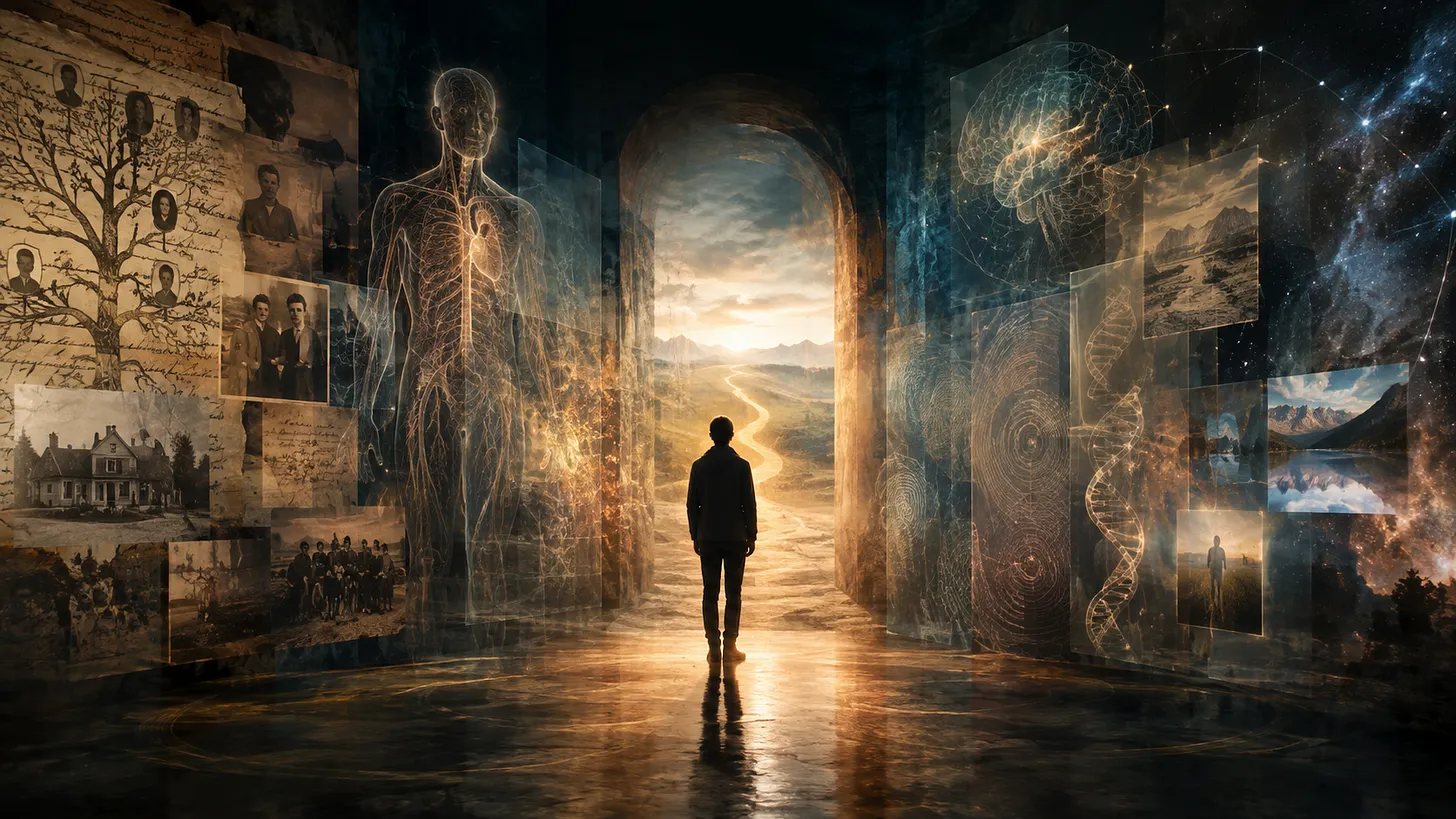
There are certain questions that seem to keep opening into larger ones, especially when we begin looking beneath the surface of what we’ve been taught to accept. A symptom, a family story, a recurring pattern, an unresolved experience: each can become another doorway into understanding ourselves, provided we’re willing to stay curious without rushing to conclusions. That tension between investigation and belief is where this discourse begins.
. . .
In this discourse we explored Recall Healing and its intellectual relationship to Hamer’s German New Medicine, Jungian psychology, family systems, trauma, genealogy, symbolism, and emerging questions around transgenerational patterns. We considered the value of treating symptoms as possible sources of information without automatically accepting any particular explanation, and looked at how family histories, early experiences, unconscious programs, and inherited or learned patterns may shape the stories we live. The conversation ultimately returned to a simple principle: something is happening here. Let’s investigate.
Key Points Discussed
- Recall Healing as a synthesis of multiple influences, including Jung, Total Biology, Biopsychogenealogy, Hamer’s New Medicine, family history, symbolism, and mind-body approaches.
- The distinction between asking useful psychological questions about symptoms and accepting specific claims about biological causation.
- The Life Time Line, Project/Purpose, and Family Tree as investigative tools for exploring patterns across a person’s life and family history.
- The possibility that family patterns can be transmitted through relationships, behavior, development, environment, culture, and other pathways without requiring a literal concept of “genetic memory.”
- The importance of separating historical evidence from interpretation, symbolism, therapeutic meaning, and biological claims.
- The danger of any framework becoming unfalsifiable when every unexplained outcome is interpreted as evidence of a hidden conflict or ancestral program.
- The idea that a healing explanation can itself become another program, identity, burden, or source of dependence.
- The tension between conventional medicine and more integrative or unconventional approaches, and the value of investigating rather than automatically dismissing unfamiliar observations.
- Hamer’s influence on Recall Healing, and the importance of examining what was retained, expanded, or reframed rather than treating entire systems as wholly right or wrong.
- The potential value of combining complementary and even contrasting frameworks rather than becoming attached to a single explanatory system.
- The role of genealogy in revealing displacement, loss, war, migration, secrecy, betrayal, survival patterns, and other experiences that may continue to influence later generations.
- The distinction between uncovering where a pattern came from and deciding what responsibility we have for continuing it.
- The possibility that symbolic interpretations can be meaningful without being mistaken for literal anatomy or established medical mechanisms.
- The methodological importance of observation, hypothesis, investigation, intervention, outcome, alternative explanations, and repeatability.
- The underlying question of whether a framework increases curiosity, discernment, agency, and responsibility, or simply supplies a more elaborate explanation for why everything is happening to us.
Key Takeaways
- A compelling observation does not automatically validate the theory used to explain it.
- A family pattern can be worth investigating without becoming a destiny.
- Understanding where something came from does not require continuing to carry it.
- Unconventional ideas should be neither reflexively dismissed nor accepted without examination.
- The most useful question may not be “Do we already know what this is?” but “What is happening here, and what can we learn by investigating it?”
» Trance:
Summarize the book and general concept of Recall Healing by Gilbert Renaud.
» ChatGPT:
Gilbert Renaud’s Recall Healing is essentially a mind–body framework built around one central proposition: that physical or behavioural symptoms can be connected to unresolved emotional conflicts, traumatic experiences, and patterns carried through a family system. Renaud describes it as a process of identifying the emotional trauma “behind” a condition and bringing the underlying conflict into conscious awareness. (Recall Healing)
The main reference book is now published as The Pyramid of Health. The 2019 edition is about 319 pages and presents emotional/biological interpretations for more than 800 conditions and behaviours. (Recall Healing)
The basic conceptual model is roughly this:
A person experiences something emotionally overwhelming — often something sudden, unexpected, isolating, and difficult to resolve. According to Recall Healing, the conscious mind may not fully process the experience, while the “automatic brain” responds through a biological survival program. The resulting physical symptom or behaviour is therefore interpreted as the body’s attempt to adapt to, or somehow resolve, the unresolved conflict.
So instead of asking only:
“What disease do I have?”
Recall Healing asks:
“What happened to me, emotionally, around the time this began?”
and then goes deeper:
“What did that event mean to me?”
“What was I unable to say or do?”
“What was I afraid of losing?”
“What did I believe I had to do to survive?”
“What unresolved situation does my body’s response symbolically represent?”
Renaud’s approach is heavily influenced by several preceding systems. His own account explicitly identifies Carl Jung, Claude Sabbah’s Total Biology, Gérard Athias’s Biopsychogenealogy, Ryke Geerd Hamer’s “New Medicine,” and a number of other psychological, philosophical and mind-body approaches as sources for his synthesis. (Recall Healing)
One particularly interesting component is the idea of the “biological conflict.” The symptom isn’t regarded simply as random malfunction. Rather, the body is hypothesized to be responding to a perceived survival problem.
For example, the conceptual question might be:
“I can’t digest what happened.”
or:
“I can’t escape this situation.”
or:
“I can’t protect the people I love.”
or:
“I’ve lost my territory/home/place.”
The particular organ or bodily system is then interpreted according to the kind of biological problem supposedly associated with that emotional conflict.
This leads to one of the most distinctive aspects of Recall Healing: its extensive catalogue of symbolic associations between particular illnesses, organs, behaviours and emotional themes. The Pyramid of Health is essentially a reference work for this. The published descriptions characterize it as covering the conflicts and traumas associated with roughly 800 conditions. (Google Books)
There is also a strong genealogical component.
Recall Healing doesn’t necessarily stop with “What happened during your lifetime?” It asks whether the pattern may have existed in the family before you were born.
Renaud’s framework incorporates ideas of “generational syndromes,” family memories, and biological patterns transmitted through generations. Thus a person’s present-day conflict may, within the model, be connected to an unresolved situation experienced by a parent, grandparent or earlier ancestor.
This is where the approach overlaps with what is often called psychogenealogy or transgenerational therapy. The family tree becomes something of a psychological map: births, deaths, miscarriages, illnesses, accidents, exclusions, migrations, bankruptcies, betrayals, wars, secrets and other major events are examined for repeating patterns.
Another tool is the person’s “life timeline.” The practitioner tries to establish when a condition appeared or changed and then looks for emotionally significant events around that period. Renaud’s training materials specifically describe using the Life Time Line, Project/Purpose and Family Tree to identify psychological or emotional trauma. (studylib.net)
“Project/Purpose” is another interesting idea. Recall Healing asks whether there was some implicit emotional purpose attached to a person’s existence or behaviour — sometimes beginning around conception, pregnancy or birth. In its more elaborate form, the framework can ask questions such as whether a child unconsciously took on a role within the family or whether some unresolved family conflict was somehow being carried forward.
The eventual goal isn’t merely to discover an interesting historical connection.
It is to “resolve the conflict.”
Renaud describes this as reaching a practical or psychological solution to the original conflicting situation and then letting it go. His current site describes Recall Healing as helping the person shift toward a new viewpoint rather than claiming that the method itself is a universal cure. (Recall Healing)
There is therefore an important distinction between the deeper philosophical idea and the stronger medical claims sometimes associated with the system.
The potentially useful psychological proposition is relatively familiar: traumatic experiences, chronic stress, beliefs, emotional repression and one’s interpretation of life events can affect behaviour and can interact with physiological processes. Modern psychoneuroimmunology and stress research provide substantial evidence for mind–body interaction.
Recall Healing goes considerably further, however. It proposes specific correspondences between particular emotional conflicts and particular diseases and sometimes interprets the disease itself as a biological response to the conflict.
That stronger claim is not established medical science in the way that, for example, infection causing an infectious disease or insulin deficiency causing type 1 diabetes is established. Some of the intellectual ancestry of Recall Healing is particularly controversial. Renaud explicitly identifies Hamer’s New Medicine as one of its sources. (Recall Healing)
This is why I’d separate Recall Healing into three layers when evaluating it:
The first layer is the psychologically interesting question: “What emotional experiences, beliefs, relationships and unresolved conflicts may be affecting this person’s life and possibly their experience of illness?”
The second is the symbolic/interpretive system: “Does this particular organ or disease correspond to a particular emotional conflict?”
The third is the medical causal claim: “Did that emotional conflict actually cause this disease, and will resolving it cause the disease to disappear?”
Those three propositions aren’t equivalent. The first can be explored without accepting the second or third.
Interestingly, Renaud’s own organization currently makes a fairly explicit distinction here. It says Recall Healing isn’t a substitute for medical care, recommends continuing conventional medical treatment and diagnosis, and states that neither the number of sessions nor the results can be predicted. (Recall Healing)
So, stripped down to its essence, I would describe Recall Healing as:
A therapeutic meaning-making system that treats illness and behaviour as possible expressions of unresolved emotional and familial conflicts, then uses detailed questioning, personal history and family history to try to uncover and resolve those conflicts.
And the deeper philosophical premise is quite compelling even if one remains skeptical of its biological claims:
The symptom may be telling a story.
Recall Healing asks you to find out what that story is.
That makes it particularly interesting alongside Jungian psychology, trauma theory, psychosomatic medicine, family-systems thinking, epigenetics/transgenerational research, mythology and symbolism — although those fields should not be treated as interchangeable with Recall Healing.
Given the family-history work you’ve been doing, there is actually one aspect of Renaud’s framework that would be especially interesting to examine separately: his concept of transgenerational “biological programs” and how he uses a family tree to look for repeating patterns. That is probably the part most relevant to the Nevoral research, but it is also where we would want to be especially careful to distinguish Renaud’s theory from what genealogy and modern genetics can actually establish. (Recall Healing)
» Trance:
This is important, because the relation to Hamer’s GNM is quite evident:
“Renaud’s approach is heavily influenced by several preceding systems. His own account explicitly identifies Carl Jung, Claude Sabbah’s Total Biology, Gérard Athias’s Biopsychogenealogy, Ryke Geerd Hamer’s “New Medicine,” and a number of other psychological, philosophical and mind-body approaches as sources for his synthesis.”
And this:
“That makes it particularly interesting alongside Jungian psychology, trauma theory, psychosomatic medicine, family-systems thinking, epigenetics/transgenerational research, mythology and symbolism — although those fields should not be treated as interchangeable with Recall Healing.”
Of course, it makes sense they say it isn’t a substitute for medical care, for one, because they’ll be aggressively attacked by the machine that is modern medicine, but also, the vast majority of humanity is programmed and conditioned to believe in the idea of health and healing as traditional medical care presents it. The aim here is to supplant all of that with something more healthful, natural, comprehensive, non-invasive, and a genuine form of integrative medicine, but it won’t happen overnight, and really, may never come to pass given the enormity of influence and institutional stranglehold that cartel medicine has today.
A methodology is far more useful and practical, even far-reaching and comprehensive, when synthesizing a number of complementary, even contrasting, philosophies and time-tested scientific processes. I learned about Renaud from Dr. Richard Massey, who utilizes Recall Healing, Family Constellation (Bert Hellinger), Heart Coherence (HeartMath), Live Blood Matrix Microscopy, and UV Light IV Therapy. He himself had to grow through the life experiences, as his about page puts it, “From Battlefield Medicine to Soul-Level Healing.” He shares numerous testimonials and direct experiences from his over 50 years of practice in recent interviews.
The genealogical stories and connections to healing are quite interesting, and can be immediately relatable to most anyone who starts to examine their own life story, and the family tree that came before them, and how they may be in some ways connected to how their journey is expressing and unfolding. Dr. Massey suggests our nervous system isn’t our own. It’s based on a constellation that may reach far beyond our own lived experiences, and reveal remarkable patterns and continuity. It relates to the idea of “DNA” or “genetic” memory, even in a twisted way as “family curses,” if one chooses to see it that way. We can certainly feel it within our own lifetimes when things go unresolved, particularly if they’re laden with heavy or traumatic experiences and emotions. It follows then that going into the past, these unresolved energies may persist, given our deeper motivations to balance things out, “clear karma,” or rid ourselves of programs and conditions that are keeping us from living our best lives in the now.
But, in listening to the interviews, what comes to mind is a similar thread that is associated with any healing modality or philosophy: the lens focuses and directs our perceptions, and one that is emotionally charged is particularly influential when we’re struggling with health issues, psychological issues, or anything else in our day-to-day living. We want to be rid of pain and suffering, guilt and shame. Massey himself says that “my mind will kill this body to save someone back there,” suggesting that a strong enough impulse to heal generational wounds could in fact end our lives, even prematurely, in an effort to remedy something from long ago, for someone who is long dead and gone. To me, something about that doesn’t ring true, and leans more into the idea of curse than cure.
But he offers ways to resolve these conflicts as well. The issue for me is that unless you’ve been made aware of a relative, even distant relative, whom we may be for some reason intent on resolving an issue for, how would we otherwise have any chance to make those amends? The stories he shares can be quite moving, but are also, in a way, disturbing. If those particular patients hadn’t come to him, they wouldn’t know the questions to ask, the history to research and examine, the connections to make, and therefore the process to go through that could help them find immediate, even permanent, resolve and healing.
The body is incredibly resilient and impressive in its responses, and given the many testimonials he and others like him have shared, there’s no doubt these modalities are effective. But it leaves out a vast proportion of the human family that has no idea about what they offer whatsoever. So, in the bigger picture, it paints another dark tone over the establishment and system of “medicine” that most of humanity relies upon, and one that continues to fail them in many ways, primarily because the “mainstream” model doesn’t allow for what these pioneers in what I’d consider to be genuine medicine are doing, albeit to an incredibly small audience. Perhaps this is simply how it is meant to be, because it’s a pattern that seems to be prevalent throughout history in other regards as well. I just find it a terrible shame.
So, when I’m sharing this kind of information, the hope is that a few more will learn about the methods of true healing that may in effect resolve issues not just for them in the present, but perhaps going back generations. When we can grasp the idea that what happened to us, even between conception and the first year of life, that these patterns (generally negative or limiting) may play out repeatedly in our lives until we become aware of them and effect some shifts in those patterns, and that in addition to this we have potential generational conflicts that may also be playing into the story, we’re empowered in ways unimaginable to rectify, remedy, and resolve them all.
But, again, if one is educated in this way, it doesn’t also mean that “there must be a connection somewhere for all my problems…” because that’s simply a rescue device, spiritual bypassing, or whatever term you want to use here that would apply, that says it is someone else’s fault, rather than our responsibility. As you note, Renaud himself says it isn’t a universal cure, and there is likely no such thing as a panacea in this realm. But, Renaud’s approach is certainly comprehensive, and I look forward to learning from some of his online workshops, many of which are freely available as he’s still alive and well and working hard to educate people on his system. The Life Time Line, Project/Purpose, and Family Tree are all powerful and potentially revelatory tools.
I can also see how this would complement the work of those such as Paul Leendertse in his Root Cause work, as well as Dr. Cassie Wuthrich, even Tommy John III. As you note:
“The symptom may be telling a story.”
There are any number of programs operating within us that, once we’re aware of them, may finally be resolved or perceived in different ways. The trouble is that, in general, we’re so far away from understanding ourselves today, from comprehending how the body works, and how this bigger-picture framework may help us in any number of ways. This kind of work is important, and should rightly find a larger audience. Mainstream medicine is too far gone to be fixed at this point, in my view, beholden entirely to a materialistic/mechanistic program. The paradigm is entirely off the rails and continues to do massive harm. What has always worked, and indigenous and ancient peoples are all familiar with what Renaud and others are presenting anew, will always work.
 » ChatGPT:
Yes. And I think your last observation about the lens may actually be the most important way to approach Recall Healing without either dismissing it prematurely or allowing it to become an all-explanatory belief system.
The first thing worth underscoring is that the connection to Hamer is not merely something critics have inferred. Renaud’s own description of Recall Healing explicitly names Jung, Claude Sabbah, Gérard Athias’s Biopsychogenealogy, and Ryke Geerd Hamer’s New Medicine among its sources. He describes Recall Healing as a synthesis rather than a completely independent discovery. (Recall Healing)
That makes the epistemology more interesting, not less. Renaud has effectively taken Hamer’s central mind–brain–body intuition and placed it into a much larger interpretive framework containing Jungian psychology, family history, symbolism, developmental experience, biological adaptation and various therapeutic techniques. His own current materials explicitly describe the Life Time Line, the Project/Purpose period extending from 18 months before birth through the first year of life, and the Family Tree as three of the principal investigative tools. (Recall Healing)
And this is where I think your idea of methodology becomes considerably stronger than simply asking, “Is Recall Healing true?”
A much better question is:
What happens when we systematically investigate a person across multiple levels of experience rather than assuming that the presenting symptom is the whole problem?
That question doesn’t require us to accept every biological correspondence in Renaud’s catalogue.
It doesn’t require us to accept Hamer’s Five Biological Laws.
It doesn’t even require us to believe that an ancestral conflict is literally encoded in DNA.
It simply recognizes that human beings are not disembodied organs.
There is actually quite a substantial scientific basis for the broader proposition that early experience and parental experience can become biologically relevant. Early adversity can become biologically embedded and is associated with long-term changes in stress-regulation systems and gene expression. Research has also found associations between parental trauma and biological or psychological outcomes in offspring. But the crucial scientific qualification is that human transgenerational transmission is complicated, and researchers cannot currently attribute those effects to one mechanism such as inherited epigenetic “memories.” Shared environment, pregnancy, caregiving, culture, genetics and epigenetic processes may all interact. (PubMed)
That distinction actually makes your metaphor of the nervous system “not being our own” more interesting.
Taken literally, it is too strong. Taken as a description of an interacting developmental system, it becomes much more defensible.
A child doesn’t construct its nervous system in isolation. It develops within a maternal physiological environment, a family, a culture, patterns of attachment and caregiving, language, stress responses, expectations, beliefs and behaviours. And there is growing evidence that some consequences of adversity can extend beyond the directly exposed individual, although exactly how far and through which mechanisms remains an active research question. (PubMed)
So there are several possible meanings hiding inside the phrase “ancestral memory,” and I think this is where precision matters enormously.
One possibility is literal biological inheritance of specific memories. There isn’t good evidence that human beings inherit autobiographical memories in their DNA.
Another is inherited biological susceptibility or altered regulation. That is a legitimate area of research, although considerably less settled than popular presentations sometimes imply.
Another is developmental transmission: a traumatized parent behaves differently, relates differently, regulates emotion differently, and therefore creates a different developmental environment for the child.
Another is family-system transmission: stories, secrets, prohibitions, loyalties, identities, roles and unresolved conflicts get passed down.
And another is symbolic or psychological: I may reproduce something in my life because I am unconsciously identifying with someone who came before me.
Those are radically different propositions, but they can produce superficially similar observations.
That is why I think your response to Massey’s “my mind will kill this body to save someone back there” formulation is important. I would treat that as an interpretation or therapeutic model, not as an established biological fact. His website currently presents essentially that framework explicitly, speaking of “nervous-system programming,” birth imprints, “ancestral heart intelligence” and patterns the body may carry across generations. (Richard Massey, MD)
And there is a genuine danger in taking the proposition too literally.
Suppose someone develops an illness and is told:
“There must be an ancestor whose unresolved conflict you are carrying.”
That statement can become unfalsifiable.
If we find an appropriate story, the hypothesis appears confirmed.
If we don’t find one, we simply assume there is a hidden ancestor, an undiscovered event, an unknown family secret, or an unconscious program.
At that point the theory can explain everything, which means it can ultimately demonstrate nothing.
And that brings us directly back to your own insight about the lens.
A lens can reveal something that was previously invisible.
But a sufficiently powerful lens can also make everything look like the thing it was designed to find.
That is arguably the central methodological problem with any system built around symbolic correspondence.
Recall Healing itself appears to understand at least part of this problem. Renaud’s site describes the work as a continuing “work in progress,” encourages practitioners to use different resources rather than insisting on being “right,” and says Recall Healing is not a panacea. It also explicitly tells clients to remain in contact with conventional health professionals and not stop prescribed treatment on the basis of Recall Healing. (Recall Healing)
I actually think that attitude — “use any effective resource” — is potentially the most fertile part of Renaud’s philosophy.
It allows the Life Time Line to be useful without declaring every temporal coincidence causal.
It allows a Family Tree to reveal a remarkable pattern without requiring the conclusion that the pattern was genetically encoded.
It allows Project/Purpose to provoke questions about conception, pregnancy and infancy without declaring that an infant consciously “decided” something that determined its later disease.
It allows symbolic interpretations to be therapeutically meaningful without mistaking symbolism for anatomy.
And it allows the practitioner to say, “Something is happening here. Let’s investigate,” rather than prematurely saying, “We now know why.”
That is a very different enterprise.
The genealogy problem you identified
Your family-history work gives you an unusually good example of this.
Imagine you discover that three generations of a family experienced displacement, sudden death, property loss, broken relationships, migration, financial insecurity and suppression of emotion.
That doesn’t prove that a descendant’s physical condition is caused by those events.
But it certainly can change how you understand the descendant’s psychological and developmental environment.
And sometimes the genealogical facts themselves are extraordinarily illuminating.
The person doesn’t necessarily need to know the ancestor’s story consciously for family patterns to have consequences. A child can inherit attitudes toward money, danger, intimacy, authority, loyalty, abandonment, home and survival without ever being told where those attitudes originated.
That is a much less exotic proposition than literal “genetic memory,” but it can produce something that feels remarkably similar from the inside.
Your Nevoral research is actually a perfect illustration of why this investigative process can be valuable independently of whether Recall Healing’s biological interpretations ultimately prove correct. You’re already seeing how stories emerge gradually, how forgotten or suppressed details surface, how a particular event changes the interpretation of earlier information, and how one generation’s assumptions affect what the next generation knows.
That is real history.
The next question — whether the history is also biologically participating in someone’s present condition — is a separate hypothesis.
And I think keeping those two things separate makes the whole enterprise stronger.
Where I would put Hamer
Here I would be more cautious.
The basic intuition that acute psychological stress can have profound physiological consequences isn’t the controversial part. The problem is moving from that general proposition to Hamer’s highly specific disease-conflict correspondences and his larger claims about cancer and disease.
The German Cancer Society’s 2024 position statement explicitly rejects Germanic New Medicine as lacking a scientific or evidentiary basis and warns against relying on it instead of appropriate cancer treatment. (Krebs Gesellschaft)
That doesn’t mean every observation that Hamer made about stress, trauma or the psyche–body relationship is therefore worthless. It means the particular explanatory system needs to be evaluated claim by claim rather than accepting its entire architecture because some components resonate with legitimate mind–body research.
That distinction seems especially important for Recall Healing because Renaud openly acknowledges Hamer as one of its intellectual sources. (Recall Healing)
And this is where I think your broader formulation could become unusually rigorous:
Don’t throw away the observation because the original theory may be wrong. But don’t preserve the theory merely because the observation is compelling.
That’s a very useful scientific and philosophical discipline.
The same applies to Family Constellations. There is some empirical literature suggesting possible mental-health benefits, but a systematic review found only a small evidence base and judged the overall quantity and quality of evidence to be low. (PubMed)
So we end up with an intriguing middle ground.
Something may genuinely help a person.
The person may genuinely experience a profound shift.
The story discovered during the process may genuinely resonate with their life.
The transformation may even persist.
None of those observations automatically tells us which proposed mechanism caused the improvement.
That isn’t a reason to ignore the phenomenon. It’s a reason to investigate it more carefully.
And this gets to your “curse versus cure” point
I think you’re onto something there.
The statement:
“I am carrying something from my ancestor that I must resolve”
can be liberating.
But it can also become another identity.
Instead of:
“My illness is my fault.”
we create:
“My illness is my ancestor’s fault.”
Both can actually diminish agency.
The more empowering version is something like:
“There may be inherited, learned, developmental, relational or symbolic patterns participating in my experience. I can investigate them without making them an excuse, a destiny, or a verdict.”
That preserves exactly the responsibility you were talking about.
And it provides a safeguard against spiritual bypassing.
You don’t have to say, “My grandfather did this, therefore I am doomed to repeat it.”
You can say, “This pattern appears to exist. What part of it is actually mine? What part belongs to another generation? What evidence do I have? What am I continuing unnecessarily? And what can I change now?”
That is a remarkably powerful set of questions even before one gets anywhere near the more speculative biology.
The larger synthesis
I also think this is where your instinct about combining approaches rather than pledging allegiance to one becomes especially strong.
Recall Healing gives you one lens.
Family Constellations gives you another.
Jung gives you archetypal and symbolic material.
Trauma research gives you developmental and physiological mechanisms.
Genealogy gives you actual historical evidence.
Somatic approaches give you direct observation of bodily experience.
Psychology gives you cognition, attachment, memory and behaviour.
And emerging epigenetic research gives you a biological domain in which some of the larger intergenerational questions can actually be investigated rather than merely imagined. Current reviews are increasingly describing intergenerational effects as potentially arising through a combination of biological and psychosocial pathways rather than one single mechanism. (PubMed)
Then you can add your own criterion:
Does the framework increase agency, curiosity, discernment and responsibility, or does it simply give the person a more elaborate story about why everything is happening to them?
That may be one of the most important tests of all.
Because the real failure isn’t necessarily that someone believes the wrong mechanism.
The deeper failure is when a person stops investigating.
And I think that is why your phrase, “The symptom may be telling a story,” is such a good starting point.
I’d only add one sentence:
A symptom may be telling a story, but we should investigate whether we are hearing the story, interpreting the story, or projecting a story onto it.
Those are three very different things.
That distinction could become the methodological backbone for the kind of integrative framework you’re describing: neither reflexive dismissal of unconventional healing nor reflexive acceptance of its explanations, but an open investigation that puts history, subjective experience, biology, symbolism and observable outcomes into conversation with one another.
And that, interestingly, seems much closer to what Renaud himself says Recall Healing is intended to be: not a panacea, but a framework that keeps expanding and draws on multiple resources in pursuit of the person’s healing process. (Recall Healing)
 » Trance:
This is useful:
“Something is happening here. Let’s investigate.”
Listening to someone as broadly educated and experienced as Dr. Massey inspires in this regard, because he has lived through both sides of the story of “medicine” in real-world experience over many decades.
I’ve said this before, but I don’t really accept the ideas of DNA, genes, genetics, or even epigenetics, or, as you’d say, this “isn’t a legitimate area of research.” They made sense, for a while, but to me feel more like rescue devices and workarounds to fill gaps in a paradigm that can’t adequately account for things unseen and energetic. They became “the standard” like germ theory did (truly, a “theory that can explain everything, but demonstrates nothing”), and for all the wrong reasons. Life is simpler and offers cleaner explanations, no lab conjurings, presuppositions, trillion-dollar budgets, PubMed’s so-called “empirical literature,” adherence to logical fallacy, or circular reasoning required.
We’re not just an organic machine. We humans operate on many levels, and mostly unseen by or invisible to the majority. With genetics, the modern fallacy is that “well, it runs in the family, so you should prepare,” or “well, some women with this ‘gene’ or ‘marker’ have had this health issue, so you should consider lopping off your breasts, to be safe…” It’s yet another fear-based business model, not based on actual facts or good science, but thinking and believing may indeed make it so, as we’ve explored already. Programs, primarily subconscious, run much of our lives.
I would agree with this:
“I actually think that attitude — ‘use any effective resource’ — is potentially the most fertile part of Renaud’s philosophy.”
It speaks to my aversion to mainstream medicine — and it’s no surprise at all that the “German Cancer Society” rejects GNM; the for-profit cancer business has many self-protection schemes — but if it works, that’s what matters most. But if it creates dependence, or maintains fear and terror within you, or if the problem keeps arising and similar symptoms keep expressing, then you may need to broaden your perspective.
The genealogy problem is certainly a potent matter, and has me in deep thought about it these past few days. It’s easy to discount or forget about people, even family members, we’d rather not have in our lives or any association with. But we did have the association, and the body remembers, and more specifically, the heart. It doesn’t mean we bring those people back into our story, but acknowledge the effect that may still persist, the emotional charge, unresolved trauma, what have you, that very much informed our life story. It’s all useful information if we’re intent on healing, remedy, and curing what ails us, or those we love.
In my family history, there was a tremendous amount of property loss, lives cut short, military and war experiences, deception and cheating, migration, etc. That would likely be the same for most of us if you go back far enough. But, as you suggest, it’s informative and potentially dramatically transformative to connect a few dots to better understand where we came from, and what may yet linger somewhere deep and forgotten in our story. It’s not simply to lay blame, but to unravel the tangled cords and reveal the patterns, possibly to finally let go of the baggage.
You said:
“The person doesn’t necessarily need to know the ancestor’s story consciously for family patterns to have consequences. A child can inherit attitudes toward money, danger, intimacy, authority, loyalty, abandonment, home and survival without ever being told where those attitudes originated.”
We absolutely take on an enormous amount of programming from our parents and guardians, but where did they get their programs from, and did they ever scrutinize, challenge, or grow past and through them?
I like this:
“There may be inherited, learned, developmental, relational or symbolic patterns participating in my experience. I can investigate them without making them an excuse, a destiny, or a verdict.”
And the follow-up:
“This pattern appears to exist. What part of it is actually mine? What part belongs to another generation? What evidence do I have? What am I continuing unnecessarily? And what can I change now?”
And finally:
“A symptom may be telling a story, but we should investigate whether we are hearing the story, interpreting the story, or projecting a story onto it.”
Let’s close with some final thoughts and offer additional resources for further research based on our chat.
» ChatGPT:
I think we have arrived at a much more interesting place than “Does Recall Healing work?” The more useful question is what kind of investigation becomes possible when we stop assuming, at the outset, that a symptom has only one dimension.
The phrase I would carry forward from all of this is exactly the one you highlighted:
“Something is happening here. Let’s investigate.”
That posture is valuable precisely because it works in both directions. It prevents us from dismissing an unexplained phenomenon simply because it doesn’t fit the prevailing model, but it also prevents us from turning the first compelling explanation into a new orthodoxy.
And that may be the real opportunity in the sort of integrative medicine you’re describing.
A person presents with a symptom. Instead of immediately reducing that person to the symptom, we investigate the whole story: what happened immediately beforehand, what was happening in the person’s relationships, what they believed, what they feared, what they couldn’t express, what happened around conception and birth, what patterns appeared in childhood, what happened to their parents, grandparents and earlier generations, what they have repeatedly experienced, what they have repeatedly chosen, what they have never resolved, and what meaning they have attached to all of it.
Then we observe what happens when something changes.
That is a methodology.
It is much more interesting to me than a doctrine.
The question of “memory”
I would make one refinement to our earlier discussion because it is important for the direction you’re taking.
You don’t have to accept the modern genetic paradigm as the ultimate explanation in order to recognize that researchers have observed real molecular phenomena. DNA is a physical molecule; “genes” are a way of describing functional sequences within genetic material; epigenetics refers to mechanisms regulating gene expression without altering the underlying DNA sequence. The more interesting philosophical question is whether those molecular descriptions constitute a sufficient explanation of life.
That is a very different question.
Likewise, saying that something has been measured molecularly doesn’t establish that it is the cause of the phenomenon being investigated. And it certainly doesn’t establish that biological inheritance is equivalent to the inheritance of a specific ancestral memory, intention or emotional conflict.
Interestingly, the recent transgenerational-trauma literature itself is much less tidy than popular accounts sometimes make it sound. A 2026 systematic review describes interacting biological and psychosocial pathways and acknowledges substantial methodological limitations, including the difficulty of separating biological inheritance from caregiving, environment and other influences. A separate 2025 review similarly notes that terminology and mechanisms remain problematic. (PubMed Central (PMC))
So there is room for a much larger question without pretending the answer has already been found.
Perhaps “ancestral memory” isn’t a memory in the ordinary sense at all.
Perhaps some of it is relational.
Perhaps some is behavioural.
Perhaps some is developmental.
Perhaps some is physiological.
Perhaps some is symbolic.
Perhaps there are mechanisms we don’t yet understand.
And perhaps several of those things are operating simultaneously.
That is a much more fertile position than insisting in advance that one layer must explain the whole phenomenon.
Why the genealogical work matters
This is also why I think your family-history work could become considerably more than genealogy.
A family tree can begin as names and dates. Then it becomes a map of experience.
War. Migration. Displacement. Loss of property. Sudden deaths. Broken marriages. Betrayal. Poverty. Abandonment. Illegitimacy. Secrecy. Religious or cultural prohibitions. Interrupted ambitions. People who disappeared. People who became responsible for everyone else. People who never recovered from something and subsequently shaped the emotional atmosphere of a household.
You don’t need to invoke a mysterious biological mechanism to see that such histories can matter.
A parent who grew up amid war may raise a child differently from a parent who grew up in safety. A grandparent’s relationship with money may influence a parent’s relationship with money, which influences a child’s understanding of security. An unspoken family shame can affect relationships decades after anyone remembers what actually happened.
And then occasionally something more extraordinary appears: the same kind of event, role, relationship or response repeats across generations.
At that point, the proper response isn’t necessarily, “Aha! We have proved transgenerational programming.”
It is:
“That’s interesting. Let’s investigate the pattern.”
That sentence protects the inquiry from both cynicism and credulity.
It also protects agency.
Because your question — What part of this is actually mine? — may be more therapeutically important than identifying where every part came from.
You can acknowledge an ancestor without becoming responsible for their life.
You can recognize a pattern without accepting it as destiny.
You can understand why something developed without continuing to justify it.
And perhaps most importantly, you can release something without needing to construct a metaphysical explanation for exactly how it got there.
Where I think Massey’s formulation becomes especially provocative
Massey’s statement that “my mind will kill this body to save someone back there” is a powerful therapeutic metaphor, whether or not one accepts it literally.
I’d be very reluctant to treat it as a demonstrated biological mechanism.
But as a question, it is extraordinary:
What might a person be unconsciously sacrificing in service of a loyalty that they have never consciously chosen?
That’s a question Jung could understand.
Family-systems work can understand it.
Constellation work can understand it.
Trauma work can understand it.
Genealogical research can illuminate it.
And a spiritual framework might call it karma, ancestral burden or unfinished business.
Different languages may be pointing toward overlapping territory without establishing that they describe precisely the same mechanism.
That is why I think your phrase “curse rather than cure” is insightful. A person can become trapped by the explanation just as easily as they were trapped by the original problem.
“I am carrying my family’s trauma” can become another program.
“I have inherited this condition” can become another program.
“My ancestor needs me to suffer” can become another program.
“My body is attacking me” can become another program.
None of these necessarily creates freedom.
The liberating question is:
What is actually happening, what evidence do I have for the story I’m telling about it, and what changes when I meet it differently?
That applies equally to conventional medicine and alternative medicine.
That is where I would place Renaud
Recall Healing becomes most interesting when treated as an investigative vocabulary rather than a closed cosmology.
Renaud himself describes Recall Healing as a synthesis of multiple influences, and his official material still provides a substantial free video library in which he explains concepts such as the Life Time Line, relationships, biological programming and the emotional interpretations he attaches to particular conditions. (Recall Healing)
His Pyramid of Health is therefore worth approaching less like a dictionary of proven causes and more like a very large catalogue of hypotheses: “Here is a possible question to ask.” That distinction could make the book considerably more useful.
And I would actually recommend that you resist the temptation to begin by memorizing the body-part correspondences.
Start with the method.
Learn how he asks questions.
Watch how he moves backward through someone’s chronology.
Observe how he uses language.
See what assumptions he introduces.
Notice when a client discovers something themselves versus when the practitioner supplies the interpretation.
That distinction becomes crucial.
Because there’s an enormous difference between:
“What does this symptom remind you of?”
and:
“This symptom means that your grandfather experienced X.”
The first opens a door.
The second can close the investigation prematurely.
The complementary trail
From what we’ve discussed, I’d build your research path more or less like this.
Start with Gilbert Renaud directly rather than someone else’s interpretation of him. His official Recall Healing site has the video library and introductory material, and the Pyramid of Health provides the large reference framework behind the system. (Recall Healing)
Then spend some time with Richard Massey, because his approach is interesting precisely in the way you’ve described: Recall Healing isn’t isolated, but sits alongside Family Constellations, heart coherence and other modalities within his broader integrative practice. His site currently links specifically to his discussion of Recall Healing, Family Constellations and Heart Coherence. (Richard Massey, MD)
For Family Constellations, I’d read Bert Hellinger’s material alongside the actual research rather than relying exclusively on either defenders or critics. A 2021 systematic review found promising results but explicitly rated the quantity and overall quality of evidence as low; that is exactly the kind of middle-ground finding worth keeping in view. (PubMed)
For the heart/coherence dimension, HeartMath has an enormous free research library. There is a substantial body of work around heart-rate variability, autonomic regulation and heart–brain interaction, while some of its broader claims about energetic and global coherence are much more exploratory. Their own research library makes those different strands relatively easy to investigate separately. (HeartMath Institute)
Then return to Jung. Not because Jung supplies a medical mechanism, but because his work gives you another language for understanding symbolic material, projection, the unconscious, recurring motifs and the ways an individual psyche can be carrying material that isn’t immediately accessible to ordinary conscious reasoning.
Paul Leendertse is particularly relevant to the line of inquiry we’re constructing. His Root Cause Institute explicitly centers psycho-emotional stress, trauma and life challenges, and has developed its own methodology from his observations working intensively with people with serious illness. His claims about cancer causation and reversal are considerably stronger than what can presently be established from the evidence, so I’d read him closely while distinguishing his observations, his therapeutic method and his causal theory. (Root Cause Institute)
Tommy John III is another useful comparison because his framework starts from a related but slightly different premise: that symptoms and injuries can be treated as information about adaptation rather than simply as defects to be eliminated. His present materials explicitly describe using symptoms as guides and examining relationships, nutrition, career, rest and other aspects of life as part of a larger healing framework. (Tommy John iii)
And then, importantly, keep Hamer in the picture.
Not because an institutional rejection of GNM settles the philosophical question, and not because testimonials settle it either, but because Renaud himself names Hamer as a major source. Reading Hamer alongside Renaud lets you see precisely what was retained, what was expanded and what was reframed. That is a much more illuminating exercise than arguing about whether either man is simply “right” or “wrong.” Renaud’s own materials make that intellectual lineage unusually explicit. (Scribd)
The methodological safeguard
I’d add one more resource category that may ultimately be more important than any particular healing school: methodology itself.
Because this whole field has an inherent temptation toward confirmation bias.
A person gets better and attributes it to the explanation.
A person doesn’t get better and concludes that they haven’t discovered the hidden conflict yet.
Both conclusions may be possible.
Neither is automatically established.
So an unusually disciplined integrative methodology might maintain a record of:
Observation → hypothesis → investigation → intervention → outcome → alternative explanations → repeatability.
That gives unconventional practitioners something they often desperately need: a way of learning from their own successes and their failures without having to protect the theory.
It also turns “case stories” into something much more valuable.
Massey’s decades of experience, Leendertse’s observations, Renaud’s accumulated case material, constellation practitioners’ experiences, HeartMath’s measurements, your own family-history investigation — all of these can contribute to a larger body of knowledge, but only if the observations are preserved rather than converted immediately into conclusions.
And perhaps that is the bridge between the old healing traditions you are interested in and the modern scientific impulse you don’t want to throw away entirely.
The problem isn’t necessarily observation.
The problem may be what we do with the observation afterward.
We observe.
We categorize.
We measure.
We theorize.
We institutionalize.
And eventually the theory can become more important than the thing that originally inspired it.
That’s how paradigms harden.
So I would return again to the simplest principle:
Something is happening here. Let’s investigate.
Not “We already know what it is.”
Not “That can’t happen because our model doesn’t allow it.”
Not “This proves our model.”
Just:
Something is happening here. Let’s investigate.
That leaves enormous room for curiosity.
It leaves room for the body.
It leaves room for the heart.
It leaves room for consciousness.
It leaves room for family history.
It leaves room for trauma.
It leaves room for symbolism.
It leaves room for things we currently don’t understand.
And, importantly, it leaves room for discovering that some of our cherished explanations were wrong.
That last part is not a weakness of the inquiry.
It is what keeps the inquiry alive.
And perhaps that is ultimately the most valuable thing Renaud’s work can offer: not a final explanation of illness, but permission to ask better questions.
Because “the symptom may be telling a story” doesn’t require us to believe that the story is already known.
It simply gives us a reason to listen.
And then investigate.
Recall Healing — Gilbert Renaud’s official site
Recall Healing video library
Dr. Richard Massey, MD
Root Cause Institute — Paul Leendertse
Tommy John III — Performance and Healing Center
HeartMath Institute research library
Family Constellation systematic review — PubMed
2026 review of transgenerational trauma research — PMC
Solvitur ambulando
Raw, unedited chat: https://chatgpt.com/share/6abd4e86-0f34-83e8-b5e7-ecc98ba84df9
Written by Trance Blackman. Originally published on tranceblackman.com on 30 September 2026. Revised 03 October 2026.
Copy & share: https://tranceblackman.com/patterns-beneath/