Skip to content

Lux Colloquii

Lux Colloquii is Latin for light through conversation. It reflects the throughline of my work: amplifying the light through an ongoing exploration of ideas and possibilities in conversation with AI.

Spanning philosophy, psychology, politics, metaphysics, spirituality, science, wellness, and more, this space — like my journal — exists as a forum for curiosity, reflection, and genuine inquiry. Each post unfolds as a question-and-answer dialogue, documenting authentic exchanges with AI that explore knowledge, consciousness, and the human experience.

There is no truly neutral AI. Every model reflects assumptions, biases, and limitations. As such, this project is as much an exercise in critical thinking, discernment, and intuition as it is a record of conversation. I encourage you to question, verify, and investigate ideas for yourself. Nothing published here should be considered medical, financial, legal, or health advice.

If you’re drawn to thoughtful dialogue and fresh perspectives on both timeless and emerging questions, Lux Colloquii invites you to engage, question, and explore.

In all things, amplify the light.


Light, Language, and Living: The Screen, the Sun, and Walking Beyond the Model

Light, Language, and Living: The Screen, the Sun, and Walking Beyond the Model

In this discourse we explored the relationship between sunscreen use, skin cancer research, institutional science, reductionist medicine, genetics, and the broader assumptions that underpin modern healthcare. The discussion moved beyond a single study into questions of behavior, personal responsibility, systems thinking, financial incentives, the limits of scientific models, and the tension between established paradigms and alternative perspectives on health and healing.

The Quiet Intelligence of Nature: On Honey and the Living World

The Quiet Intelligence of Nature: On Honey and the Living World

There is something to be said for stepping outside the prescribed narratives and assumptions that shape so much of modern life. Food, health, and our relationship with the natural world have become increasingly abstracted, measured, categorized, and regulated, often at the expense of direct experience and common sense. Yet some questions remain worth asking, particularly those that encourage us to reconnect with place, observation, experimentation, and the quiet wisdom embedded within nature itself.

The Measure of Things: Beyond the Numbers

The Measure of Things: Beyond the Numbers

There’s an interesting distinction between knowing something and measuring it. The modern world tends to place extraordinary trust in numbers, standards, and systems, often treating…

The Conditions of Health: An Ecological Perspective

The Conditions of Health: An Ecological Perspective

There comes a point when questioning a system is no longer enough. The deeper task is examining the assumptions beneath it — the beliefs, models, and narratives that have become so commonplace they pass without scrutiny. Health is one such domain. What follows is a reflection on medicine, ecology, observation, and the increasingly urgent need to rediscover principles that existed long before institutions claimed authority over them. It is not a search for new answers so much as a reconsideration of what may have been forgotten.

The Quiet Laboratory: On Expressive Writing

The Quiet Laboratory: On Expressive Writing

There is something quietly revealing about how the mind behaves when it is allowed to speak without audience or correction. It does not arrive in clean arguments or finished positions, but in fragments, reversals, and half-formed truths that only become visible once they are given space to exist outside of repetition. Writing becomes less about expression as output and more about contact with what is already moving beneath the surface.

The Body Already Knows: Returning to Embodied Intelligence

The Body Already Knows: Returning to Embodied Intelligence

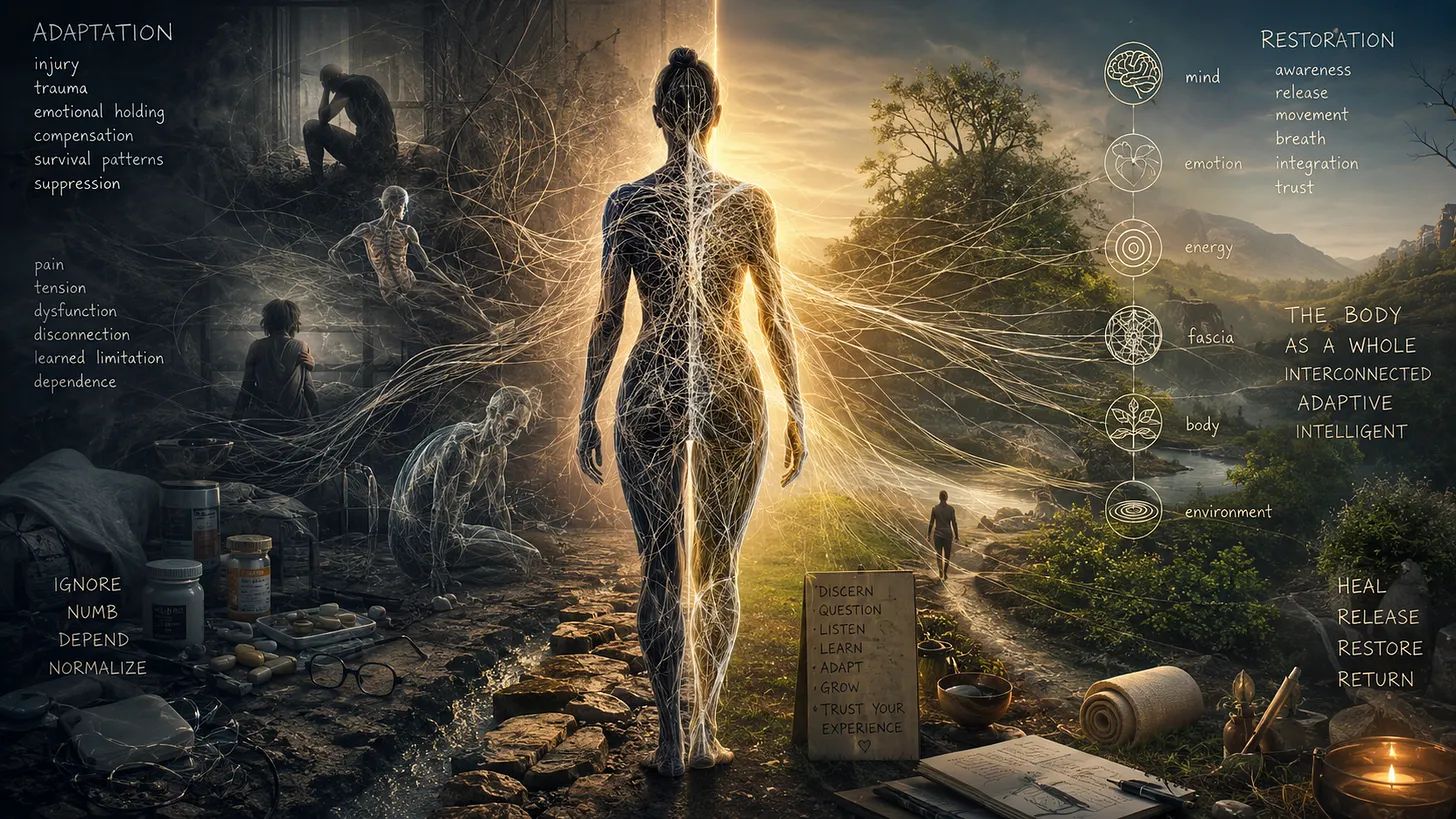
There comes a point in a person’s life when the noise of the world no longer carries the same authority it once did. The constant messaging around sickness, fragility, intervention, and management begins to feel strangely inverted, as though the living intelligence of the body has been buried beneath layers of institutional conditioning and industrial abstraction. In stepping back from that atmosphere, even briefly, one may begin rediscovering something both ancient and immediate: the body is not separate from nature, and perhaps never ceased attempting to heal despite all the ways we have been taught to distrust it.