Somewhere along the way, movement became exercise, exercise became industry, and ordinary human function became something we apparently need experts, equipment, programs, and branded methodologies to recover. Slow jogging is interesting precisely because there’s almost nothing to it. Move gently. Stay relaxed. Let the feet, legs, hips, arms, breath, and nervous system remember what they already know how to do. The more interesting question isn’t whether we can optimize it, but how much of our natural movement we’ve gradually trained out of ourselves in the first place.
Tag: fascia
The Body Remembers: Fascia, Healing, and the Shape of Experience
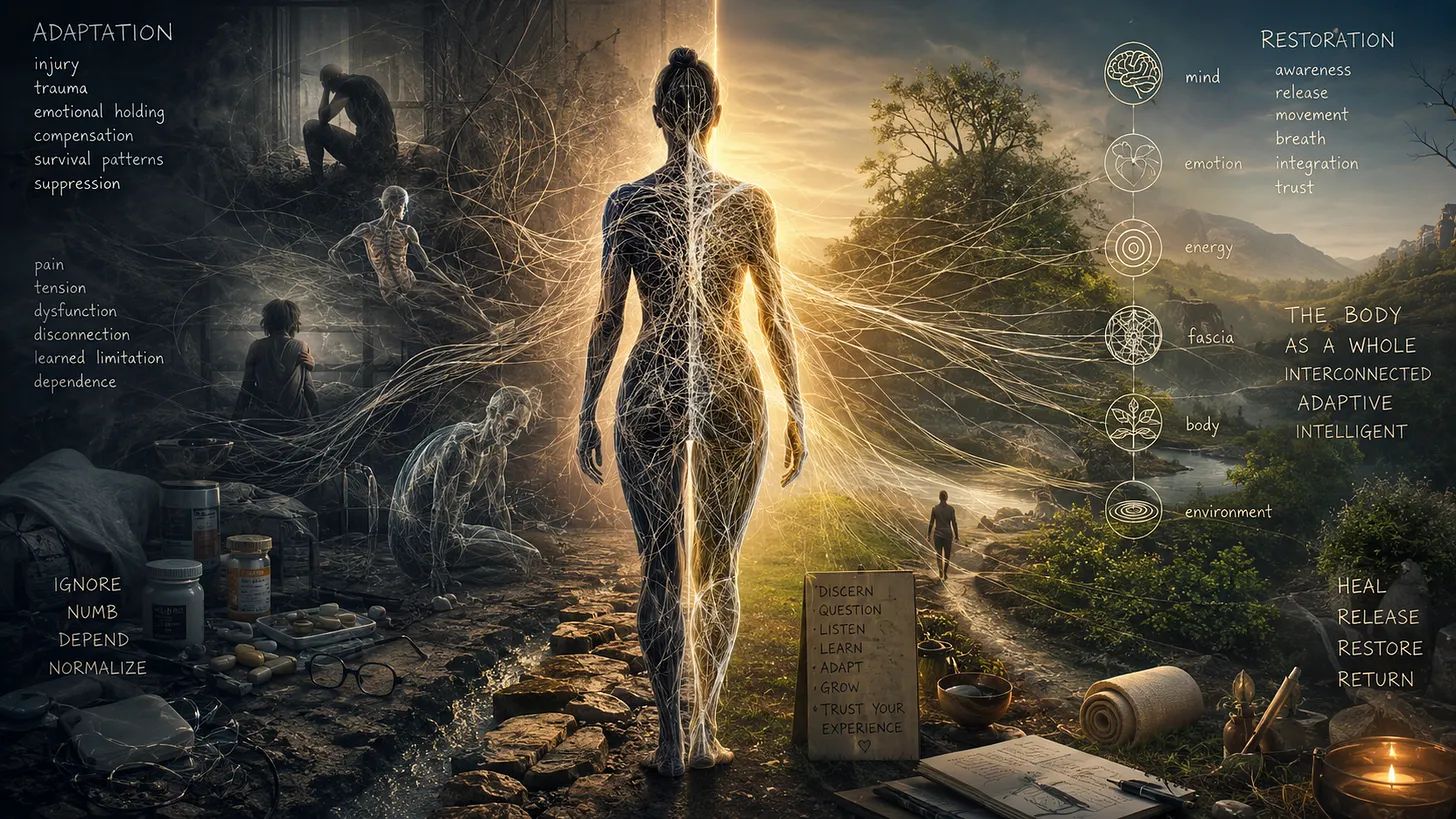
There are times when the body seems to be speaking in a language we only partly understand, and yet we feel, instinctively, that it is telling the truth. Not merely in pain or stiffness or fatigue, but in posture, in tension, in the subtle ways we compensate, endure, and carry ourselves through life. What begins as an inquiry into fascia soon opens into something wider — into memory, habit, injury, emotion, and the strange intelligence of a body that is forever adapting, and perhaps, when given the chance, trying to restore itself.
The Body Already Knows: Returning to Embodied Intelligence
There comes a point in a person’s life when the noise of the world no longer carries the same authority it once did. The constant messaging around sickness, fragility, intervention, and management begins to feel strangely inverted, as though the living intelligence of the body has been buried beneath layers of institutional conditioning and industrial abstraction. In stepping back from that atmosphere, even briefly, one may begin rediscovering something both ancient and immediate: the body is not separate from nature, and perhaps never ceased attempting to heal despite all the ways we have been taught to distrust it.