Somewhere along the way, movement became exercise, exercise became industry, and ordinary human function became something we apparently need experts, equipment, programs, and branded methodologies to recover. Slow jogging is interesting precisely because there’s almost nothing to it. Move gently. Stay relaxed. Let the feet, legs, hips, arms, breath, and nervous system remember what they already know how to do. The more interesting question isn’t whether we can optimize it, but how much of our natural movement we’ve gradually trained out of ourselves in the first place.
. . .
In this discourse we explored the increasingly popular idea of Korean slow jogging, its Japanese roots, and what such a simple practice may reveal about gait, footwear, circulation, lymphatic movement, proprioception, fascia, and the interconnected mechanics of the body. From there, the conversation widened into the possibility of integrating freer arm movement, breathing, rotation, and traditional movement practices into a more complete form of everyday locomotion, less concerned with exercise metrics and more concerned with preserving or restoring functional human movement.
Key Points Discussed
- “Korean slow jogging” is largely a recent popularization of an older Japanese practice associated with Hiroaki Tanaka and the niko niko, or “smile,” pace.
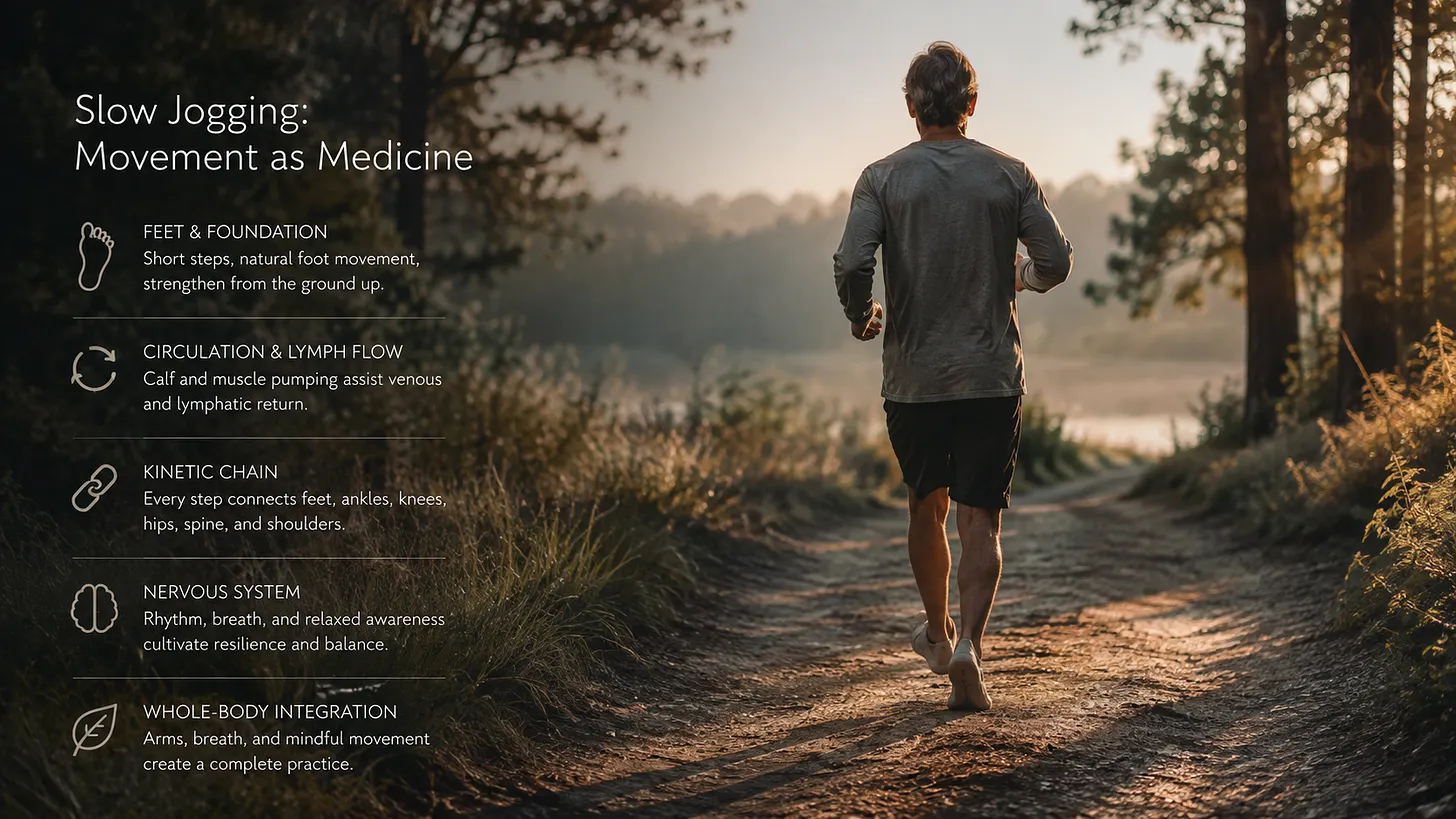
- Slow jogging uses extremely short steps, low intensity, relaxed posture, minimal vertical movement, and a foot strike kept relatively close to the body.
- Its value may lie less in conventional exercise metrics and more in thousands of gentle, repetitive loading and unloading cycles through the feet, ankles, calves, knees, hips, and pelvis.
- Repeated foot, ankle, and calf movement contributes to muscular pumping involved in venous and lymphatic return, although slow jogging should not be overstated as a specific lymphatic treatment.
- The foot is not merely structural. Toe movement, arch deformation, ankle mobility, and sensory feedback all contribute to the mechanics of the kinetic chain.
- Restricting one part of that chain, whether through footwear, limited joint movement, habitual gait, or inactivity, can alter demands elsewhere in the body.
- Highly structured footwear may reduce movement variability and sensory feedback, though the discussion distinguished this from claiming that conventional shoes are universally harmful.
- Footwear variety may be more useful than adopting another rigid doctrine: hiking shoes, simple flat shoes, barefoot-style footwear, insoles when appropriate, and periods without shoes all expose the body to different mechanical environments.
- Slow jogging may provide a useful bridge between walking and faster running, allowing coordination, elasticity, stability, and repetitive loading capacity to develop before greater forces are introduced.
- The practice need not be confined to older adults or rehabilitation. Its principles may be useful throughout life as ordinary movement maintenance.
- Conventional running arm posture can be unnecessarily rigid. Allowing the shoulders, elbows, hands, scapulae, ribs, and thoracic spine to move more freely can make slow jogging more fully integrated.
- Qigong arm swings, Japanese radio taiso, Indian-club movement patterns, martial arts mobility, and Nordic walking offer useful parallels for upper-body rhythmic movement.
- The objective is not to turn jogging into an upper-body workout, but to restore articulation, rotation, reciprocal movement, and variation.
- Walking intervals can accommodate larger arm circles, shoulder movements, cross-body reaches, trunk rotation, sideways movement, and backward walking without disrupting running mechanics.
- Breathing connects the entire system through rhythmic pressure changes in the thorax and abdomen while the limbs simultaneously load, unload, contract, and relax.
- Movement variability itself may be important. Rather than pursuing a single “perfect” gait, a resilient body benefits from having multiple movement options.
- The broader idea is less about inventing “whole-body slow jogging” than recovering the ordinary vocabulary of human locomotion that children naturally possess and adults progressively abandon.
Key Takeaways
- Simple, frequent movement may offer more functional value than constantly increasing intensity, resistance, or complexity.
- Feet, ankles, knees, hips, spine, shoulders, arms, and breath function as an integrated system rather than isolated parts.
- Movement quality and variability matter alongside strength and cardiovascular capacity.
- Slow jogging can be approached as movement practice rather than merely exercise.
- Restoring function may sometimes mean removing unnecessary restriction rather than adding another intervention.
- The larger goal is not perfect technique but preserving a broad, adaptable vocabulary of ordinary human movement.
» Trance:
Explain Korean slow jogging. It’s trending right now, which is kind of ridiculous because it’s probably an ancient practice which will be Americanized and turned into something embarrassing like power yoga or Pilates and certainly less useful or functional. But for those who are actually applying it in their lives, it seems to be related to addressing and reversing many lower-body concerns, which starts with proper lymph drainage.
As I understand it, with every footfall you’re squeezing essentially every muscle and using everything else structural from the foot to the ankles and knees, the hips… as opposed to jogging or especially running, which is more impact and potentially damaging to the joints because you’re hardly ever on the ground… and when you are, you’re slamming into it, and likely wearing artificially lifted, padded, narrow-width shoes that unnaturally squeeze the toes together, with arch support (which is actually arch weakening) and don’t allow the heel to hit or land properly.
So then your feet aren’t moving properly, which affects your ankles and shins and knees and hips and how everything else moves… because right from the tips of your toes things are not hitting the ground properly, and so naturally there’s no surprise when people have knee and ankle and hip injuries and surgeries and replacements before long.
» ChatGPT:
What’s trending as “Korean slow jogging” is mostly a Korean popularization of a Japanese method, not a newly invented Korean exercise. The modern formalized version is associated with Japanese exercise physiologist Hiroaki Tanaka and his “niko niko” or “smile” pace: jogging slowly enough that it feels pleasantly easy, sometimes literally no faster than walking. Tanaka had been developing and studying the approach for decades, and published a book on it in English in 2016.
So your instinct is basically right: the viral phenomenon is new; the underlying idea is not. And the basic movement pattern is vastly older than the branded protocol.
The important thing is that slow jogging isn’t simply ordinary jogging performed badly or in slow motion. Mechanically it starts becoming a somewhat different activity.
The characteristic form is very short steps, a relatively quick cadence, relaxed upright posture, minimal vertical bouncing, and the foot landing under or close to the body rather than reaching well ahead of it. Tanaka’s method generally advocates a midfoot/forefoot landing, flexible low-profile shoes without a large elevated heel, and roughly 180 small steps per minute, although that cadence shouldn’t become an obsessive target.
The strange-looking shuffle is actually the point.
If you imagine conventional recreational running, especially when somebody is tired or overstriding, you often get something like:
body → leg reaching forward → relatively straight knee → heel contacts well ahead of centre of mass → braking force → body travels over leg → push off.
Slow jogging tends much more toward:
body → foot drops underneath → knee remains somewhat compliant → brief elastic loading → foot leaves ground → repeat.
That dramatically shortens the “lever” you are landing onto. It’s one reason it can feel surprisingly gentle despite technically being running.
There is an important correction to one part of what you said, though. Running is not inherently damaging because you spend time airborne, nor does a heel strike automatically destroy knees and hips. Human beings are extremely capable runners. Running injury is much more complicated: training volume, previous injury, strength, recovery, speed, surface, stride length, mechanics and footwear all interact. Trying suddenly to force a forefoot strike can itself produce Achilles, calf and metatarsal trouble.
But the larger biomechanical argument you’re making has considerable merit: if somebody habitually overstrides in a thick, stiff shoe with a large heel-to-toe drop, the shoe can permit a gait that would feel unpleasant very quickly barefoot. Cushioning can attenuate sensation, and recent work suggests heavily cushioned/high-drop footwear can make people substantially worse at recognizing how they actually contact the ground. That doesn’t establish that cushioning is inherently harmful, but it does reinforce the importance of proprioception and foot/ankle strength.
Where slow jogging becomes especially interesting is exactly where you were going with the foot-to-hip chain.
Every step creates a repeated sequence of loading and unloading through the toes, plantar tissues, intrinsic foot muscles, ankle, Achilles tendon, calf, tibia, knee, thigh, gluteal musculature and pelvis. It isn’t that literally “every muscle is squeezed” simultaneously, but it is a rhythmic muscular pumping system.
And that brings us to lymph.
The lymphatic system does not have a central pump comparable to the heart. Lymph movement is assisted by several mechanisms, including skeletal-muscle contraction, changes in tissue pressure, breathing, arterial pulsation and one-way valves within lymphatic vessels.
The calves are particularly important because repeated ankle movement and calf contraction also form what is commonly called the calf-muscle pump for venous return. Each contraction compresses vessels; valves encourage fluid to travel upward rather than simply falling back down.
So during this tiny-step slow jog you repeatedly get:
foot compression → ankle movement → calf contraction → relaxation → compression again.
Thousands of times.
That can assist venous and lymphatic movement through the lower extremity. I would therefore phrase your idea slightly differently: slow jogging probably shouldn’t be presented as a special “lymph drainage treatment,” because that goes beyond the evidence. But its rhythmic loading, calf pumping and diaphragmatic respiration create exactly the physiological circumstances that favour circulation and lymphatic return.
And unlike standing calf raises in a gym, the pump is integrated into locomotion.
This is where slow jogging becomes more interesting to me than the “burn more calories!” framing it will inevitably acquire.
Think of the foot as sensory equipment as much as a structural base.
There are 26 bones, 33 joints and a remarkable network of muscles, fascia, ligaments and sensory receptors down there. If the toes can spread, the great toe can participate in propulsion, the arch can deform and recoil, and the ankle can move through an appropriate range, information is constantly being fed upward through the nervous system.
The arch itself is not simply a rigid support that needs to be propped up. It is a dynamic structure that changes shape under load and participates in energy storage and return. That does not mean arch supports are universally bad — orthotics are extremely useful for some conditions — but permanently treating every human arch as something that must be externally immobilized misunderstands what the structure normally does.
Likewise, toes being able to splay matters. The great toe in particular participates heavily in late stance and propulsion. If footwear compresses the forefoot, restricts toe movement and prevents normal bending, the person is no longer interacting with the ground in quite the way the foot evolved to.
Then compensations can propagate upward.
A stiff or poorly functioning great toe can alter pronation and push-off. Restricted ankle dorsiflexion can change knee movement. Knee movement affects femoral rotation. Femoral rotation affects the hip and pelvis. Pelvic mechanics influence the trunk.
That does not mean “bad shoes cause hip replacements.” Human pathology is much too multifactorial for that. But the kinetic-chain principle underneath what you’re describing is absolutely legitimate: altering one link changes the demands placed upon others.
Slow jogging gives the entire chain a very unusual stimulus because it combines two things that ordinary walking does not quite combine in the same way: lots of repetitions and a spring-like running gait.
Walking has a double-support phase — at some point both feet are on the ground. Running has a flight phase. Slow jogging still contains that tiny flight phase, but because the stride is so small, the forces and braking impulse can remain relatively modest.
So you get hundreds or thousands of little:
load → stabilize → recoil → unload
cycles.
That repeatedly trains the soleus, gastrocnemius, Achilles, intrinsic foot musculature and hip stabilizers without requiring the large forces of fast running.
This may explain some of the anecdotal reports you’re seeing concerning ankles, knees and hips. Someone who has become sedentary can lose not only “strength,” but the capacity for coordinated, repetitive elastic movement. Tendons, fascia, muscles, balance systems and joint-position sensing all adapt to what we repeatedly ask them to do.
Slow jogging asks them to work again — gently and incessantly.
And that distinction between adaptation and restoration that we discussed in another context becomes relevant here. A person may be perfectly adapted to sitting ten hours a day, wearing stiff shoes and walking 2,500 steps. Their body has accommodated that environment. That doesn’t necessarily mean the resulting movement capacity represents optimal function.
There is another underrated piece: cadence.
Tanaka advocates something around 180 steps per minute, which sounds absurdly high until you realize the steps are extremely tiny.
That prevents the big reaching stride.
Rather than:
BOOM…………BOOM…………BOOM
it becomes:
tap-tap-tap-tap-tap-tap.
Very low amplitude, very high repetition.
That is probably one reason people sometimes describe an almost massage-like feeling afterward. You have been rhythmically loading and unloading the feet and calves several thousand times.
And because the intensity remains low — the “niko niko” test is essentially that you can comfortably smile and converse — you can accumulate a considerable amount of movement without imposing the recovery burden associated with hard running.
This also makes it potentially valuable for older adults. The relevant question for ageing isn’t merely “how many calories did I burn?” It is:
Can I repeatedly load my feet?
Can my ankles react quickly?
Can my calves propel me?
Can my hips stabilize me on one leg?
Can my nervous system rapidly alternate left-right-left-right?
Can I retain some elasticity instead of turning every movement into a slow muscular effort?
A tiny jog trains all of those things.
There is even a subtle balance component. Every running step is technically a succession of extremely brief single-leg landings. Done gently, that is thousands of low-level balance repetitions without standing on a wobble board doing “balance training.”
Where I would resist the current internet narrative is when it becomes:
slow jogging → lymph drainage → detoxification → fascia restoration → cures knees → cures hips → reverses ageing.
Those are very different claims, and evidence gets progressively thinner as you move along that chain.
The strong case is already interesting enough: slow jogging is low-intensity aerobic exercise that appears useful for improving fitness, managing body weight and metabolic health, and making running accessible to people who cannot or do not want to run hard. Tanaka’s research and publications focused heavily on aerobic capacity, obesity and metabolic health.
The plausible mechanical case is that it also provides enormous numbers of modest, coordinated loading cycles through the feet, ankles, calves, knees and hips while stimulating venous return, muscular pumping and proprioception.
That is a much more defensible proposition.
And this is perhaps why it looks ridiculous while being rather clever.
Modern exercise culture often assumes that useful exercise has to look strenuous: bigger stride, heavier load, faster speed, higher heart rate, bigger shoe, more equipment.
Slow jogging goes almost completely in the opposite direction.
Tiny movement.
Tiny load.
Thousands of repetitions.
Minimal equipment.
Enough stimulus that the organism has to respond, but little enough that you can do it again tomorrow.
That is not terribly marketable until somebody gives it a name.
And then, inevitably, we get K-Slow™ Lymphatic Metabolic Running Method — $249 certification weekend.
 » Trance:
K-Slow… Good grief. In my view, for anyone who’s bothered to do any research on the matter, burning calories is basically a hoax. Terrible and misleading science at best. It’s marketing nonsense and has nothing to do with how the human body works regarding food and energy and how that energy is stored or utilized. I also think that if one is concerned with “managing their weight,” they are of the wrong mindset entirely. That’s akin to “managing symptoms,” which Western medicine is making billions and billions annually doing. It’s nonsense, and you’d be wise to look further.
Weight gain, even obesity, is a symptom of healing. An adaptation. A signal that your body is very loudly giving you, asking you, begging you, to examine your life, your practices, and everything else. It’s not just diet. It’s not just cardio. It’s everything.
I agree that orthotics should only ever be a temporary and transitory treatment, not a permanent solution. Just like crutches and casts. Hell, glasses too shouldn’t be a permanent thing that sits on your nose or in front of your eyeballs. Regarding the toes and how shoes, for the most part, have been damaging feet for generations, it reminds me of a podcast I listened to a few months ago regarding the fascia.
People don’t know how to walk properly, or, as you’ve already outlined, due to improper footwear that’s overcompensating for certain kinds of movements and impacts and sensations, they train their bones and muscles and fascia to move in an unnatural way. Over years and decades, of course, this would absolutely affect the skeletal structure and everything else that supports it. And as we’ve already discussed, it would seem that all of these technologies integrated into shoes have been doing far more harm than good for a long, long time.
And while the solution may not be barefoot shoes, it should likely be someone’s next step, as it were, at least in their study and research, both to restore normal function and to avert chronic pain or injury. I prefer to have several different options. Hiking shoes that aren’t heavily padded or have crazy treads, and are wide fitting. Chucks or skate shoes or barefoot shoes for paved roads or sidewalks or minimally graveled trails, rather than one-and-a-half- to two-inch-soled sneakers. Use them also with and without insoles. The feet don’t get used to any one particular form or shape, nor do they live all day in shoes either.
It would seem to me that slow jogging would be an excellent halfway point between walking and running, especially for those who are keen to take running seriously. Use it as a form of training to ensure everything is moving properly and strengthened so that when you do engage in running, you’ll be far more capable and sturdy and resilient.
Sure, it’s great for older adults, but like many of these practices that have come to us through Asian sources, it’s great for all stages of life and should likely be practiced from our earliest years so that they’re automatic and everyday, regular practices integrated as part of a whole and healthy, fully functional life.
So we’re covering the lower body. What’s out there in traditional or emerging exercise practices and techniques that would cover the top half of the body similarly to how slow jogging works for the bottom? Could they be integrated? Most people will simply hold their arms at 90° like they do when they’re running, and even that’s arguably inefficient, but while you’re jogging, and if you have no interest in chatting with anyone who might be jogging with you, could it be expanded a little bit to have a whole-body benefit?
» ChatGPT:
Yes. I think there is a very good whole-body version hiding in plain sight, but I would resist turning the jog itself into an upper-body workout in the gym sense. The useful principle is rhythmic articulation, not resistance.
Your lower-body description of slow jogging is essentially repeated, low-force loading through a long kinetic chain. For the upper body, the closest equivalents are things like qigong arm swings, Japanese radio taiso, Indian-club patterns without the clubs, relaxed martial-arts mobility, and certain forms of Nordic walking. They all exploit the same idea: many repetitions, little force, large but comfortable joint excursions, coordinated breathing, and continuous alternation rather than isolated muscular contraction. Radio taiso, for example, deliberately uses large arm circles, chest opening, trunk bending and rotation as simple daily maintenance rather than “training” in the modern gym sense.
And interestingly, ordinary running arm swing is already doing more than most people realize. A 2025 biomechanics study found that active arm swing reduced excessive torso rotation and improved overall movement efficiency compared with passive or fixed arms. So the arms are not merely passengers bent at 90 degrees; they are counterweights coupled to the pelvis and thorax.
What I would do is preserve that fundamental alternating rhythm, but allow considerably more freedom than conventional running coaching usually permits.
Imagine a slow jog where the shoulders are dropped, elbows soft rather than fixed, hands completely relaxed, and the arms swing naturally from the shoulder sockets. Instead of holding the elbows rigidly at 90°, let the angle open and close somewhat. On some strides the hand might travel almost to the hip behind you and toward the lower chest in front. The scapula is then naturally protracting and retracting with each cycle rather than being pinned in place.
That alone turns slow jogging into much more of a whole-body activity.
The shoulder blades glide.
The clavicles move.
The ribs rotate.
The thoracic spine rotates.
The abdominal obliques transmit movement between opposite shoulder and hip.
The hands repeatedly open and close slightly.
And because contralateral gait is built into human locomotion — right arm with left leg, left arm with right leg — you are exercising one of our most fundamental neurological movement patterns thousands of times.
I would call that the first level: simply reclaiming a genuinely free arm swing.
Then there are several useful variations you could periodically weave into an easy slow jog.
For perhaps 20–30 strides, let the arms hang almost straight and swing them forward and backward from the shoulders. Not forcefully; think pendulums. That resembles traditional qigong arm-swinging exercises and gives the glenohumeral joint, scapula and thoracic region a repetitive pumping action.
Then return to ordinary gait.
Later, make the swing slightly diagonal — right hand drifting toward the left side of the chest as the torso rotates, then opening backward. You would be exaggerating the natural cross-body pattern without fighting it.
Another short interval could involve very gentle outward sweeps: arms opening somewhat wider on the backswing and returning toward centre. Not giant lateral windmills while jogging — that would create awkward rotational forces — but enough to take the shoulders through a different plane.
And occasionally you could slow almost to a walking shuffle and let the arms make complete circles, very much in the spirit of radio taiso. Then resume the jog.
That distinction matters. I would not try to perform full overhead circles or complicated qigong forms while maintaining a true running flight phase. Once the arms are doing something radically different from normal locomotion, you start degrading balance and gait rather than enhancing it.
So the practice could naturally alternate:
slow jog with free arm swing → exaggerated pendulum swing → normal jog → cross-body swing → normal jog → brief walking arm circles → jog again.
That would give you a surprisingly complete mobility session without ever stopping.
Indian clubs are fascinating in this context too. Their traditional value is not primarily brute strength. Light clubs are swung continuously through circles, arcs and figure-eights around the shoulder girdle, training coordination, grip, shoulder mobility and endurance. Their history goes back centuries in Indian physical culture.
You obviously wouldn’t jog while swinging actual clubs unless you had an unusually strong desire to become a public safety announcement.
But take away the clubs and retain the movement vocabulary and suddenly you have something useful: alternating circles, backward sweeps, figure-eight shoulder patterns, wrist rotation and hand opening.
Those would work beautifully during occasional walking intervals.
There is another practice that comes very close to what you’re envisioning: Nordic walking. Proper Nordic walking doesn’t merely carry poles. The poles force reciprocal shoulder extension, scapular movement and trunk rotation while locomoting. Research generally finds greater upper-body muscle involvement than ordinary walking. It is arguably one of the few modern exercise systems that deliberately reconnects upper and lower body through gait rather than separating them into “leg day” and “upper-body day.”
But you don’t necessarily need poles to borrow the principle.
The upper extremity also has its own pumping mechanisms analogous, although not identical, to the calf pump. Repeated muscle contraction and relaxation, shoulder movement and changes in tissue pressure assist venous and lymphatic return from the arms. Movement around the shoulder girdle is particularly relevant because lymph from the upper extremity ultimately drains toward the axillary and central lymphatic pathways.
Then breathing joins the upper and lower halves.
This is the piece I would put near the centre of the practice.
Your diaphragm is moving rhythmically while the legs pump from below and the shoulder girdle moves above. Pressure changes in the thorax and abdomen participate in venous and lymphatic movement. So instead of thinking:
“legs exercising + arms exercising”
you can think:
feet ↔ calves ↔ pelvis ↔ diaphragm ↔ ribs ↔ shoulders ↔ hands.
One oscillating organism.
That is much closer to how I think these traditional movement systems understood the body, even when their anatomical language was entirely different.
And there is a lovely neurological dimension to it. We spend much of modern life reducing movement variability. We sit in one posture, type with tiny finger movements, walk on flat surfaces, drive, hold phones, and use footwear that makes every footfall almost identical.
A whole-body slow jog can do the opposite.
Sometimes short stride.
Sometimes slightly longer.
Sometimes arms bent.
Sometimes loose.
Sometimes palms open.
Sometimes backward shoulder circles while walking.
Sometimes cross-body reach.
Occasionally sideways stepping.
Occasionally backward walking.
Different terrain.
Different shoes.
Sometimes barefoot where appropriate.
That variability may be at least as important as finding one supposedly “perfect” gait. Biological systems generally become more robust by having options.
That fits particularly well with your point about rotating footwear. I think the useful idea there isn’t “barefoot shoe good, conventional shoe bad” so much as avoiding chronic dependence upon one fixed mechanical environment. A foot that experiences nothing except one rigidly prescribed shoe geometry gets extraordinarily little variety.
I would apply exactly the same principle to slow jogging.
Don’t invent the Perfect Slow Jog Form™ and repeat it identically forever.
Let it be movement exploration within a few sensible boundaries.
The one thing I would not do is add weights to the hands. People inevitably will. Then somebody will sell “lymph dumbbells” and we will have completed the cycle.
Holding even small weights while repeatedly swinging the arms changes the rotational forces at the shoulder and elbow and can alter running mechanics. The elegance of what we’re discussing is precisely that the load is your own limb.
Likewise, I wouldn’t spend the entire jog doing arms overhead. That makes breathing and balance more awkward, raises the shoulder girdle repeatedly and interferes with the natural counterrotation that arm swing provides.
Instead, I’d make perhaps 80% of the session ordinary, beautifully relaxed slow jogging and use the remaining 20% as movement play.
Something like this would make sense:
Start walking for a few minutes with very free arms. Let the hands swing behind you and across the body. Add shoulder rolls and a few large arm circles.
Transition into the tiny-step jog. Don’t deliberately “hold” the arms anywhere. Let them find their own rhythm.
After several minutes, exaggerate the backswing for 20 strides.
Return to neutral.
Later, straighten the arms somewhat and let them pendulum for 20–30 strides.
Neutral again.
Drop to a walk periodically and perform several large backward arm circles, chest-opening sweeps and gentle trunk rotations.
Then jog again.
Toward the end, add a little lateral and backward walking rather than simply stopping.
Five minutes of unhurried walking closes it out.
That would train locomotion, balance, shoulder articulation, thoracic rotation, breathing coordination, ankle/foot function and cardiovascular conditioning in one continuous practice.
And I think you hit on the larger point: this makes more sense as daily human maintenance than as something prescribed only after decline.
Children naturally do almost all of it.
They run, shuffle, skip, hop, squat, crawl, hang, swing their arms, rotate, walk backward and change direction constantly. Nobody has to teach a healthy five-year-old “functional training.”
We gradually train those possibilities out of ourselves.
Then at 50 or 60 somebody invents a program to teach them back to us.
Perhaps the broader practice you’re circling around isn’t really “slow jogging for the whole body.”
It’s something closer to deliberately restoring the vocabulary of ordinary human locomotion.
Solvitur ambulando
Written by Trance Blackman. Originally published on tranceblackman.com on 23 August 2026.
Copy & share: https://tranceblackman.com/the-body-in-motion/