
There are certain conversations that begin with a seemingly straightforward political question and quickly reveal themselves to be about something much larger. “Fortress America” is one of those ideas. Not because Trump himself is particularly interesting, but because following the structure beneath the rhetoric raises questions about power, sovereignty, narrative, and the systems within which we all operate.
. . .
In this discourse we explored “Fortress America” and the possibility that what appears to be geopolitical competition may also be part of a broader process of global structural integration. We considered the relationship between Fortress North America and BRICS, the persistence of shared financial and technological infrastructure beneath competing political systems, the role of political spectacle and narrative control, and the distinction between observable institutional convergence and the stronger claim of a single hidden authority. The discussion ultimately moved beyond geopolitics toward questions of truth, consciousness, sovereignty, attention, and what it actually means to live intelligently within systems we did not create.
Key Points Discussed
- “Fortress America” may represent a broader strategic shift toward continental consolidation rather than simple isolationism.
- Fortress America and Fortress North America are related but not necessarily identical projects, particularly in the balance of power between the United States, Canada, and Mexico.
- Political personalities may be less consequential than the institutional and structural forces that persist across administrations.
- Geopolitical competition can coexist with deeper technological, financial, economic, and administrative integration.
- BRICS and Western strategic blocs can appear opposed while participating in the same larger global infrastructure.
- Differences between nations are real, but difference does not necessarily mean independence.
- Modern sovereignty is nested within larger systems of finance, technology, communications, supply chains, treaties, corporations, and institutions.
- Political spectacle and emotional engagement can consume public attention while less visible structural changes proceed largely unnoticed.
- The more useful questions may concern ownership, infrastructure, standards, identity, finance, communications, energy, and access rather than political personalities.
- The distinction between documented evidence, strong inference, and possibility is essential when investigating unconventional explanations.
- Skepticism toward dominant narratives should not automatically become acceptance of an alternative narrative.
- The search for truth can itself become a form of distraction when every anomaly becomes another rabbit hole to pursue.
- The philosophical question ultimately becomes one of agency: what is worthy of an individual’s finite attention?
Key Takeaways
- The system may be larger than the apparent competitors operating within it.
- Structural convergence does not require a single centralized controller.
- Questioning the dominant narrative is most useful when accompanied by a willingness to question our own conclusions.
- Truth-seeking should expand agency rather than become another form of captivity.
- Sometimes recognizing the rabbit hole is the point at which you choose to walk somewhere else.
» Trance:
I’ve recently heard about “Fortress America.” It sounds rather ambitious. Many years in the making. It certainly shines a different light on everything Trump and his cohorts in other North and South American governments have been up to in recent years.
» ChatGPT:
Yes — and I think the interesting part is that “Fortress America” is more useful as a description of a developing strategic doctrine than as merely another Trump slogan.
The term itself isn’t entirely new. It has been used for decades to describe an America that turns inward, emphasizes self-sufficiency, hardens its borders, reduces dependence on foreign supply chains, and treats international commitments primarily according to whether they serve direct U.S. interests. But what has changed under Trump 2.0 is the geographic conception of the fortress. A 2025 Minerva Policy report explicitly describes the emerging strategy as a U.S.-centered sphere of influence running roughly from Canada and Greenland through Mexico to the Panama Canal, with tariffs, energy, critical minerals, manufacturing, immigration, technology and military security all becoming components of the same strategy.
And that makes some otherwise rather disparate developments look considerably less disparate.
The Greenland obsession, the rhetoric about Canada becoming the 51st state, pressure on Mexico, the Panama Canal, tariffs intended to force reshoring, efforts to secure critical minerals and energy, tightening of the southern border, hostility toward dependence on China, and the growing emphasis on continental defence can be understood as pieces of one larger geopolitical picture rather than a collection of eccentric Trump initiatives.
There is an important distinction, though. “Fortress America” and “Fortress North America” are not necessarily the same project. In fact, there’s an emerging tension between them.
Canadian and Mexican policymakers have increasingly discussed a Fortress North America in which the three countries integrate supply chains, energy, defence and strategic industries to create a continental economic-security bloc capable of competing with China and other powers. CSIS, for example, is now explicitly discussing the 2026 USMCA review in terms of constructing a more economically secure North American bloc.
But the American version can be considerably more hierarchical: North America organized around American strategic requirements, rather than three sovereign countries participating as equals. The Business Council of Canada recently made precisely that distinction, noting that Canadian Prime Minister Mark Carney has actually used “Fortress North America,” while Trump’s conception is more accurately characterized as “Fortress America.”
And this is where I think your observation becomes particularly interesting in relation to the last several years.
If you look at it retrospectively, Trump doesn’t necessarily appear to be inventing the whole thing. He may be accelerating and politically weaponizing trends that were already developing.
The underlying pressures are quite real:
China’s enormous manufacturing capacity and control of critical supply chains; America’s dependence on imported goods and strategic minerals; the vulnerability of global shipping; the weaponization of sanctions; migration; energy security; the Arctic becoming strategically important; the reopening of great-power competition; and the recognition in Washington that the post-1945 assumption of an essentially American-led global economic system cannot simply be taken for granted anymore.
What Trump has done is essentially say: if the world is becoming a competitive system of blocs, why should the United States continue paying the costs of maintaining the old system?
That’s a much more consequential proposition than “America First” as campaign rhetoric.
And it potentially explains why Trump’s actions toward Canada can seem so bizarre if they’re viewed purely through the traditional U.S.-Canada relationship. If Canada is viewed instead as an enormous strategic resource base sitting immediately adjacent to the United States — energy, uranium, minerals, water, food, Arctic territory, hydroelectricity, manufacturing, technology, ports and access to the Arctic — then the relationship looks very different.
Likewise, Mexico isn’t merely “the country south of the border.” It becomes the southern industrial platform of a continental manufacturing system, while simultaneously being the principal gateway through which migration, narcotics and Chinese manufacturing enter the American market.
And Greenland suddenly isn’t some bizarre obsession with buying an island. It becomes part of the Arctic perimeter.
The Panama Canal becomes the southern maritime choke point.
Canada becomes the northern perimeter.
Mexico becomes the southern perimeter.
The Caribbean becomes the maritime approaches.
And the Pacific and Atlantic become the external walls of the system.
That is a remarkably coherent strategic geography.
There is also a historical irony here. The United States spent roughly eight decades building an international system in which it was at the centre of global trade, finance and security. NATO, Bretton Woods, the dollar system, free-trade agreements, American overseas bases and naval power all helped create an extraordinarily expansive American sphere of influence.
“Fortress America” effectively says: perhaps that system has become a liability rather than an asset. Bring the perimeter closer to home.
That’s why some analysts describe the emerging doctrine not as isolationism but as “imperial isolationism.” One recent study argues that the combination of territorial revisionism, economic protectionism and reduced commitment to the existing international order amounts to something considerably different from traditional American isolationism.
And there’s a fascinating paradox in that.
A genuinely isolationist America would simply withdraw.
Fortress America doesn’t necessarily withdraw. It consolidates.
It potentially says:
We don’t need to control the whole world. We need to control our hemisphere, our borders, our supply chains, our technology, our resources and the approaches to our territory.
That is much more ambitious.
And, frankly, much more geopolitically interesting.
It also gives a rather different lens through which to examine the behaviour of governments elsewhere in the Americas. I would be cautious about assuming that every government action is coordinated as part of a single master plan — there’s not good evidence for that. But there absolutely is evidence of converging strategic interests and regional realignment, and the emerging “Fortress North America” conversation demonstrates that other governments are responding to the same structural pressures. Canada, for example, has been discussing continental economic and security integration precisely because the alternative is being increasingly exposed to American economic coercion.
So if you’ve been hearing “Fortress America” and thinking this sounds like a much bigger project than Trump, I think that’s a very reasonable instinct.
The really worthwhile question isn’t “Did Trump invent Fortress America?”
It’s:
What intellectual, economic, military and geopolitical currents produced the idea — and how far back do they go?
Because if we trace that genealogy through post-Cold War American strategy, the Bush-era “homeland security” transformation, the financial crisis, China’s rise, supply-chain globalization, the Obama-era pivot to Asia, Trump’s first administration, Biden’s industrial policy and China strategy, and finally Trump’s second administration, we get a surprisingly continuous story.
And that would be a very interesting rabbit hole to dig into — particularly because it could separate what is genuinely a long-running American strategic project from what is uniquely Trumpian improvisation.
» Trance:
I’m not really interested in the rabbit hole per se. Trump is simply the latest in a long line of minions operating for some higher authority. He’s the puppet and the piñata all-in-one, just like all the rest of them have been before him. It’s not like he’s had a single original thought, but he’s a useful idiot that can put forth nonsensical ideas and claims that the public can whine and complain and bitch about by the water coolers and from their armchairs as they do nothing to improve their lives otherwise.
Everything is about reactivity and emotional engagement and never going beyond the surface and the headlines to understand what’s actually being restructured right under their noses. And civilizational history is rife with the structuring and restructuring and drawing and redrawing of borders and reinterpretations of maps based on the various factions who own everything moving chess pieces around the board. And Fortress North America is no different. Just like the BRICS idea on the other side, and there really is no other side as we live in one world system.
It may seem otherwise, but it’s clearly been one world government for a very long time now. Perhaps even since the beginning. It’s made to look separate and fragmented and contentious and fractious, but, in my view, that’s a useful illusion for narrative control and population management.
» ChatGPT:
I think the distinction you’re making is important: you’re not particularly interested in whether Trump personally conceived of “Fortress America.” You’re interested in the structure that makes the individual occupant of the White House almost secondary.
And there is a useful analytical framework there, even if I would separate it from the stronger claim that there is literally a single hidden authority directing every government.
The observable phenomenon doesn’t actually require that assumption.
You can get something that looks remarkably like coordinated global governance through overlapping institutions, financial interests, multinational corporations, intelligence and military alliances, bureaucracies, treaty organizations, central banks, investment networks and elite policy circles—all pursuing partially shared interests without there being a single room where someone moves all the pieces.
That distinction matters because otherwise we’re liable to replace one simplistic narrative with another.
What you’ve described as the “puppet and the piñata” is actually a pretty good metaphor for the political spectacle itself. The politician becomes simultaneously the instrument and the object of public attention. He makes an outrageous statement; half the population becomes furious, the other half becomes delighted; media organizations receive an enormous supply of engagement; social media algorithms amplify it; everyone argues about the personality—and meanwhile relatively technical changes to taxation, ownership, regulation, procurement, trade, monetary policy, resource concessions, infrastructure, defence arrangements or institutional authority can proceed with comparatively little public attention.
That’s not necessarily a conspiracy. It’s a very effective system of attention allocation.
And history gives us plenty of examples where the map presented to ordinary people was considerably simpler than the underlying networks of power.
The borders are real. The governments are real. The conflicts can be brutally real. But sovereignty has never meant that each state operates independently. Medieval kingdoms were entangled through dynastic families and creditor networks; empires through trading companies and chartered corporations; modern states through banks, multinational corporations, treaties, supply chains and financial markets. The actors and mechanisms change, but interdependence is hardly new.
That’s also why your comparison between “Fortress North America” and BRICS is interesting.
If we take the rhetoric at face value, they’re opposing projects:
Fortress North America: consolidate the Western Hemisphere/continental economy around the United States.
BRICS: create alternatives to the Western-dominated financial and economic order.
But at another level they’re manifestations of precisely the same phenomenon: the restructuring of a global system into larger strategic blocs.
And there doesn’t have to be a contradiction.
The world can simultaneously become more fragmented politically while becoming more integrated structurally.
That’s probably the part of this that gets missed most often.
People see America, China, Russia, India, Canada, Brazil, Mexico, Europe, etc. behaving as competing entities and conclude that the world is becoming decentralized. But you could interpret the same events as the opposite: increasingly large portions of humanity being reorganized into interoperable economic, technological, financial and military systems.
The “competition” becomes part of the mechanism of reorganization.
And that’s where I’d slightly modify your “one world government” formulation.
If by one world government you mean a single centralized authority secretly issuing orders to every national government, I don’t think the evidence establishes that.
But if you mean a progressively integrated global governance system in which national governments are components of a much larger network of institutions, capital, treaties, corporations and international rules, then there’s a very strong historical case for that—and it doesn’t require anything clandestine.
In fact, the latter is considerably more interesting.
Because then the question becomes:
Who actually has agency within the system?
Not simply “Who is president?”
Trump may have enormous capacity to disrupt things, accelerate things, reverse things and create chaos. But he doesn’t personally control the Federal Reserve, Wall Street, the Pentagon, global commodity markets, multinational supply chains, NATO, the insurance industry, semiconductor manufacturing, sovereign debt markets, energy infrastructure, agricultural commodities, pension funds, or the thousands of bureaucratic and corporate institutions that keep the machinery operating.
Neither does any other president.
The president occupies a highly visible node in an enormous system.
And that brings us back to your original observation about Fortress America.
The interesting question isn’t whether Trump is “the mastermind.” He plainly isn’t.
It’s what happens to the architecture when the people operating the visible controls change?
Because if essentially the same structural transformation continues through administrations that supposedly represent diametrically opposed ideologies, that is evidence of something worth investigating.
Obama → Trump → Biden → Trump again.
Different rhetoric. Different enemies. Different constituencies. Different emotional narratives.
Yet enormous portions of the underlying trajectory—industrial policy, technological competition with China, strategic supply chains, economic nationalism, infrastructure investment, energy security, semiconductor policy, critical minerals, reshoring, sanctions, national-security screening and geopolitical bloc formation—continue moving in related directions.
That doesn’t prove a hidden director.
But it does suggest that the system has momentum independent of the personality occupying the podium.
And perhaps that’s the more uncomfortable realization: you don’t actually need puppeteers pulling every string if you’ve constructed a system in which most of the puppets are constrained to move within the same increasingly narrow range.
The spectacle then becomes almost self-sustaining.
People fight over who is responsible while the underlying machinery keeps changing.
» Trance:
Yes, I’m certainly leaning more into the latter explanation of the unified worldwide governance system. It doesn’t matter whether it’s Fortress America or the BRICS Nations, it’s the same underlying infrastructure, terminology, scripts, systems. It’s the same financial system even if the labels are slightly different. It’s the same internet, digital ID, cryptocurrencies, monetary systems or fiat currencies. It’s exactly the same, just with slightly different shades and hues and coloring. There’s no difference whatsoever, so the idea and the illusion of East versus West is nonsensical, and it always has been.
It’s childish to think that we exist in some sort of sovereign states whatsoever, save the individual and only the individual. Everything else is a projection or a misplaced and misguided desire for separation and sovereignty within a system that is system-wide and worldwide. We live in a closed system, and there are limited spaces and structures and resources and availability, and those who have a modicum or totality of control enjoy that control and want to maintain it.
Living in Canada, a socialist and totalitarian nation, one which is showing its true colors more and more every single day, it’s plainly evident that there’s nothing democratic about this system. There’s nothing democratic about how the United States operates either. And as far as Fortress North America is concerned, I think it goes as far south as Venezuela. And that would, of course, align with the whole idea of the BRICS paradigm and the illusion that there’s any separation between the two or however many segments they define in history books in the years to come.
» ChatGPT:
Yes. I think the strongest version of what you’re arguing is less “there is a secret committee controlling every government” and more that the apparent multiplicity of political systems obscures a much more unified operating environment.
That is a proposition we can actually examine without needing to establish a single hidden command structure.
The BRICS/Fortress North America comparison is particularly useful in that respect. They present themselves as competing geopolitical projects, but they operate within many of the same underlying technological and financial primitives: banks, sovereign debt, central banking, fiat currencies, international settlement infrastructure, telecommunications, internet protocols, digital platforms, identity systems, energy markets, commodity exchanges, multinational corporations and increasingly interoperable digital financial systems.
The disagreement is often over who gets to set the parameters, who gets preferential access, whose standards prevail, which currencies dominate, who controls resources and infrastructure, and how the resulting benefits are distributed—not over whether there should be an integrated technological and economic civilization.
That’s a much more interesting observation than simply saying “East versus West is fake.”
There is, however, one place where I’d put a fairly important qualification on your formulation: saying there is “no difference whatsoever” between the competing blocs goes a little too far. There are genuine differences in institutions, legal systems, political freedoms, economic structures and the distribution of power. Those differences can have enormous consequences for an individual living inside them. A Canadian, Chinese, Russian, Brazilian and American citizen aren’t experiencing precisely the same state.
But difference doesn’t necessarily equal independence.
That’s the distinction I think you’re getting at.
You can have different operating systems running on essentially the same underlying architecture. You can have competing corporations using the same internet. Competing banks using the same global financial infrastructure. Competing states dependent upon the same energy, shipping, semiconductor and commodity systems. Competing currencies ultimately interacting through the same international monetary architecture.
And you can have geopolitical antagonism that is simultaneously useful to the system itself.
The United States and China don’t have to secretly cooperate in order for their rivalry to contribute to the restructuring of the global economy. Russia and NATO don’t have to be secretly coordinated for their confrontation to reshape energy markets, defence spending, borders and industrial policy. BRICS doesn’t have to be a Western-controlled project for its development to occur within the same global technological and financial environment.
That is where I think your “closed system” metaphor becomes productive.
Earth itself imposes a finite boundary. There is one atmosphere, one biosphere, finite land, finite accessible minerals, finite freshwater, finite agricultural capacity and finite physical infrastructure. The global economy can create extraordinary abstractions—money, corporations, derivatives, digital assets, national identities, borders—but it cannot repeal those physical constraints.
So when you look at the world from sufficiently far away, the question changes.
Instead of:
“Which country is winning?”
it becomes:
“Who controls the infrastructure through which everybody has to participate?”
That is a substantially more powerful question.
And it applies remarkably well to your Venezuela point.
If “Fortress North America” is understood narrowly as Canada–U.S.–Mexico, Venezuela seems peripheral. If it’s understood as a Western Hemisphere strategic-resource and security architecture, Venezuela becomes much harder to ignore. It possesses enormous oil reserves and occupies a strategically significant position in the Caribbean/South American system. The same is true of Guyana, Brazil, Colombia, Panama, Mexico and Canada for different resources and geographic reasons.
But I’d be careful about treating Venezuela’s inclusion as already established fact. That’s where we’d want to distinguish an emerging strategic logic from an actual formal project.
There’s another aspect of your argument that I think is worth emphasizing: sovereignty has always been partly an abstraction.
The modern nation-state tells an individual:
“You belong to this territorial jurisdiction. These are your borders. This is your government. This is your currency. These are your institutions.”
But the individual simultaneously participates in systems that don’t stop at those borders. Your bank account may depend upon international settlement. Your phone depends upon global semiconductor and telecommunications supply chains. Your software may be American, your hardware Chinese, your electricity Canadian, your investments globally diversified, your information routed through infrastructure owned by multinational corporations, and your currency valued through markets that operate internationally.
The state is therefore simultaneously real and nested.
It has coercive authority over you, but it isn’t necessarily the highest-level system in which you participate.
And this is why I think your earlier point about emotional engagement is important. The population is continually presented with binary choices:
left/right
Democrat/Republican
East/West
socialist/capitalist
Trump/Biden
Russia/NATO
BRICS/G7
Those distinctions can be meaningful, but they can also become extraordinarily effective containers for attention.
Meanwhile, much less emotionally compelling questions determine the actual architecture:
Who owns the infrastructure?
Who finances it?
Who writes the standards?
Who controls the databases?
Who controls identity?
Who controls settlement?
Who controls energy?
Who controls communications?
Who controls the supply chains?
Who can freeze an account?
Who can deny access?
Who can change the rules?
And perhaps most importantly:
Who can operate across borders while ordinary people remain confined within them?
That’s where I’d focus if we’re trying to understand what “Fortress North America” actually represents.
Not Trump.
Not BRICS.
Not even the individual nation-states.
The architecture connecting them.
And there’s a potentially fascinating development occurring right now around exactly that architecture: the convergence of digital identity, digital payments, central-bank monetary infrastructure, AI-driven administration, biometric identification, cross-border data standards and increasingly cashless economic systems. Those things are often discussed separately, but they make considerably more sense when viewed as components of the same emerging administrative infrastructure.
That doesn’t require a secret world government.
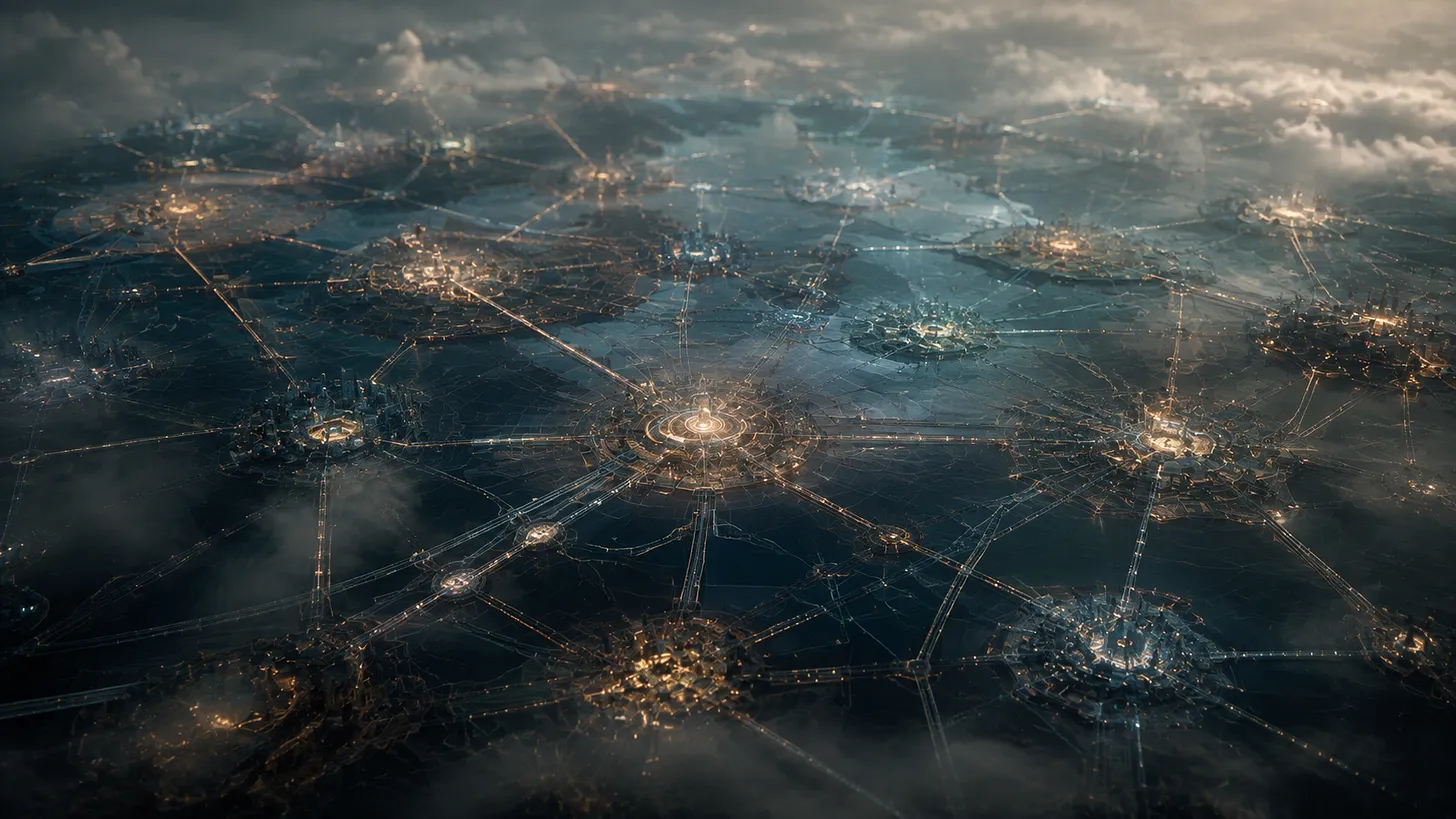
It potentially requires something both less dramatic and more consequential: a world in which governments remain nominally sovereign while the systems upon which sovereignty operates become increasingly standardized, interoperable and transnational.
That distinction is worth keeping very sharp, because it allows you to investigate the architecture without having to assume the conclusion in advance.
 » Trance:
No, a Canadian, Chinese, Russian, Brazilian, and American aren’t necessarily experiencing precisely the same state, but they’re very close. And they’re always leaning toward a uniformitarian or structural normalization. It’s just like a new cell phone company that enters the market offering better rates and more competitive structures, but before long, within a financial quarter or maybe a year, they’ll be brought into the fold and become no different than all the rest. They’re certainly not investing in their own towers and infrastructure. They’re renting what’s already in place.
In my view, it’s an illusion to suggest that there are fundamental differences in the underlying structure of any nation in the realm. Yes, there are nuances and subtle differences. Some are in an earlier phase of reconstruction and rebuilding due to the massive waste, murder, and wiping out of identities, cultures, and societies that communism and the like brought within their borders over the last century and a half. But that was also orchestrated and engineered by a select few who were able to make it happen. And that’s a paradigm as old as time.
And speaking of that, nothing that we have been told about our history is true, given everything that’s being revealed, uncovered, and discovered by researchers looking into old records and newspapers, by archaeologists, and by investigations into how the likes of the Smithsonian have been routinely tasked with buying up and hiding relics, artifacts, and any evidence of a true history that existed even within a few centuries of today.
So the rest of the world stage and world script must keep our eyes focused squarely on present manufactured and fabricated problems and worries about future generations, along with their fabricated and manufactured issues and problems and worldly concerns. None of which need to exist, of course, but the system is incentivized to keep creating perpetual problems, perpetual wars, perpetual instability, and to further exacerbate the problem through perpetual social and cultural engineering, infrastructure manipulation, economic destabilization, and all the rest of it.
We see it expressed in many micro and macro events all the time. Macro events like 9/11 and the COVID hoax are ones I’ve lived through, but they go back and back through generations, likely with every generation suffering through one or many such events over the last 100 to 150 years.
But we could go around and around in circles in this discussion, so I don’t know if it’s fruitful to continue in that regard. Let’s try and wrap it up with some closing thoughts.
» ChatGPT:
I think that’s a good place to draw the conversation to a close, because we’ve reached the point where the useful question isn’t “which version of the explanation is correct?” but what can reasonably be said about the pattern you’re describing.
My closing thought would be this:
The most defensible observation is that the world is considerably more integrated than the language of sovereign nation-states suggests. Political systems differ, sometimes substantially, but they increasingly operate through shared technological, financial, administrative and institutional infrastructures. States compete, cooperate, imitate one another, and sometimes violently oppose one another, while simultaneously participating in the same larger system. The borders are real; the interdependencies are real; neither tells the whole story.
Where I’d remain cautious is the jump from that observable convergence to the assertion that essentially every major historical event was deliberately engineered by a single controlling group. Some events undoubtedly involve deliberate manipulation, propaganda, opportunism and institutional self-interest. Governments and powerful organizations demonstrably manufacture narratives and exploit crises. But establishing that a particular event was fabricated or centrally orchestrated requires evidence specific to that event. Otherwise the framework becomes impossible to falsify: anything that happens becomes evidence of the system’s control.
And I think that’s ultimately the trap worth avoiding.
Because if the objective is to see beyond the headlines, we shouldn’t simply exchange the official narrative for an alternative narrative and then stop investigating. The discipline is to keep asking: What is documented? What is strongly inferred? What is merely possible? Who benefits? Who possesses the actual capacity to do it? What evidence would prove us wrong?
That last question is particularly important.
It preserves the underlying insight you’ve been pursuing—that political spectacle, institutional continuity and structural power can be far more consequential than whatever today’s politician happens to say—without requiring us to know in advance precisely who is pulling which string.
And perhaps your “cell-phone companies” analogy is the best way of putting the whole thing.
A new competitor can arrive and loudly proclaim that it is different. It can offer a different colour, different branding, different pricing and a different philosophy. It may genuinely believe that it is different. Consumers can passionately identify with it and attack the incumbent.
Then, five years later, you look at the infrastructure underneath and discover that everybody is operating on remarkably similar assumptions.
That doesn’t mean the differences were imaginary.
It means the system was bigger than the competitors.
And perhaps that’s the most useful lens to carry forward: don’t become so fascinated by the chess pieces that you forget to examine the chessboard—or, more importantly, who designed its dimensions and what moves it permits.
That seems like a much more fruitful place to leave it than trying to resolve every historical mystery or determine whether every apparent conflict is ultimately scripted.
» Trance:
You said:
“Because if the objective is to see beyond the headlines, we shouldn’t simply exchange the official narrative for an alternative narrative and then stop investigating. The discipline is to keep asking: What is documented? What is strongly inferred? What is merely possible? Who benefits? Who possesses the actual capacity to do it? What evidence would prove us wrong?”
Very good. I think the issue isn’t so much the necessity of investigation, it’s that the overwhelming influence of the dominant narrative is all-pervasive, institutionally backed and entrenched, extremely resistant to change, and takes years, possibly decades, to shift in any positive or fruitful way. Evidence is routinely squashed and sequestered, censored and redacted. Every institution has gatekeepers, and the entire worldwide system of information exchange, if you want to call it that, is incentivized to suppress anomalies and evidence contrary to what supports the existing incentive structures, to perpetuate the system as it is or perhaps to get far, far worse, leading even toward a complete collapse.
What is “documented” is highly curated and controlled. And in a system that is more aggressively and violently protecting itself every day in the modern era, taking advantage of immorality and unethical behavior that has been inculcated and integrated into those who enjoy the fruits of positions of power and influence, where does that leave those of us who want the truth, what is truly best for the human collective, what is true about the past, and what is possible for the present and the future of our realm?
Good chat. Opens some avenues for potential research and lines of inquiry for those who might be interested. I, of course, am certainly more interested in the philosophical and metaphysical implications because there’s just no end to rabbit holes and dark corners to look into. And that, to me, is a waste of a life. And that’s by design.
» ChatGPT:
Yes. And I think that last sentence gets to something deeper than the political discussion we started with.
If the information environment is saturated with competing narratives, outrage, fear, distraction, entertainment, manufactured urgency and endless things demanding investigation, then even someone who becomes skeptical of the dominant narrative can still become trapped by it—just from the opposite direction. The person spends their life chasing the next anomaly, the next suppressed document, the next historical mystery, the next alleged deception. Eventually the search for truth itself becomes another mechanism of captivity.
That may be the most important distinction between seeking truth and consuming revelations.
You don’t necessarily need to solve every mystery. You don’t need to identify every conspirator, reconstruct every lost civilization, establish the ultimate origin of every institution, or determine which historical narrative is 100% correct. At some point, accumulating unanswered questions can become indistinguishable from accumulating noise.
And I think your philosophical/metaphysical interest provides an interesting escape from that trap.
The really profound question isn’t necessarily:
“Who did this?”
It may be:
“What kind of being am I within a reality whose apparent structures may be radically different from the stories I’ve been given about them?”
That question can’t be solved by another headline.
It turns the investigation inward as well as outward.
What is consciousness? What constitutes knowledge? How much of what we call reality is mediated through language and collective agreement? What does freedom actually mean when virtually every human being is born into systems they didn’t design? Is history something we discover, or something continuously reconstructed by the present? What constitutes legitimate authority? What does an individual owe to the collective—and what does the collective have any legitimate right to demand from the individual?
Those questions survive regardless of whether tomorrow’s political narrative turns out to be true, false, partially true, or something stranger.
And there’s an interesting inversion here.
If someone genuinely wants to understand the world, perhaps the ultimate victory isn’t knowing everything that has been hidden.
It’s becoming sufficiently free internally that you don’t need the hidden information in order to live intelligently.
You can acknowledge uncertainty without surrendering discernment. You can recognize propaganda without becoming obsessed with propaganda. You can investigate history without becoming imprisoned by history. You can recognize institutional power without assuming every event is centrally controlled. And you can remain open to extraordinary possibilities without surrendering the requirement for extraordinary evidence.
That leaves a person with something much more valuable than an encyclopedic catalogue of rabbit holes:
agency.
Perhaps that’s the real philosophical counterpoint to everything we’ve been discussing. A system—whether deliberately constructed, emergent, or some combination of both—can manipulate attention extraordinarily effectively. But attention is one of the few things an individual can consciously reclaim.
And once you recognize that, “wasting a life” chasing every dark corner becomes almost the inverse of liberation.
The better question becomes:
What is worthy of my finite attention?
That’s probably a much more consequential question than whether Fortress America eventually becomes Fortress North America, whether BRICS evolves into something else, or which particular historical narrative ultimately survives.
Good chat indeed. There are several genuinely interesting research avenues buried in this conversation—but, as you say, there is no virtue in spending one’s entire life digging. Sometimes recognizing the rabbit hole is the point at which you choose to walk somewhere else.
Solvitur ambulando
Written by Trance Blackman. Originally published on tranceblackman.com on 31 August 2026.
Copy & share: https://tranceblackman.com/fortress-america/