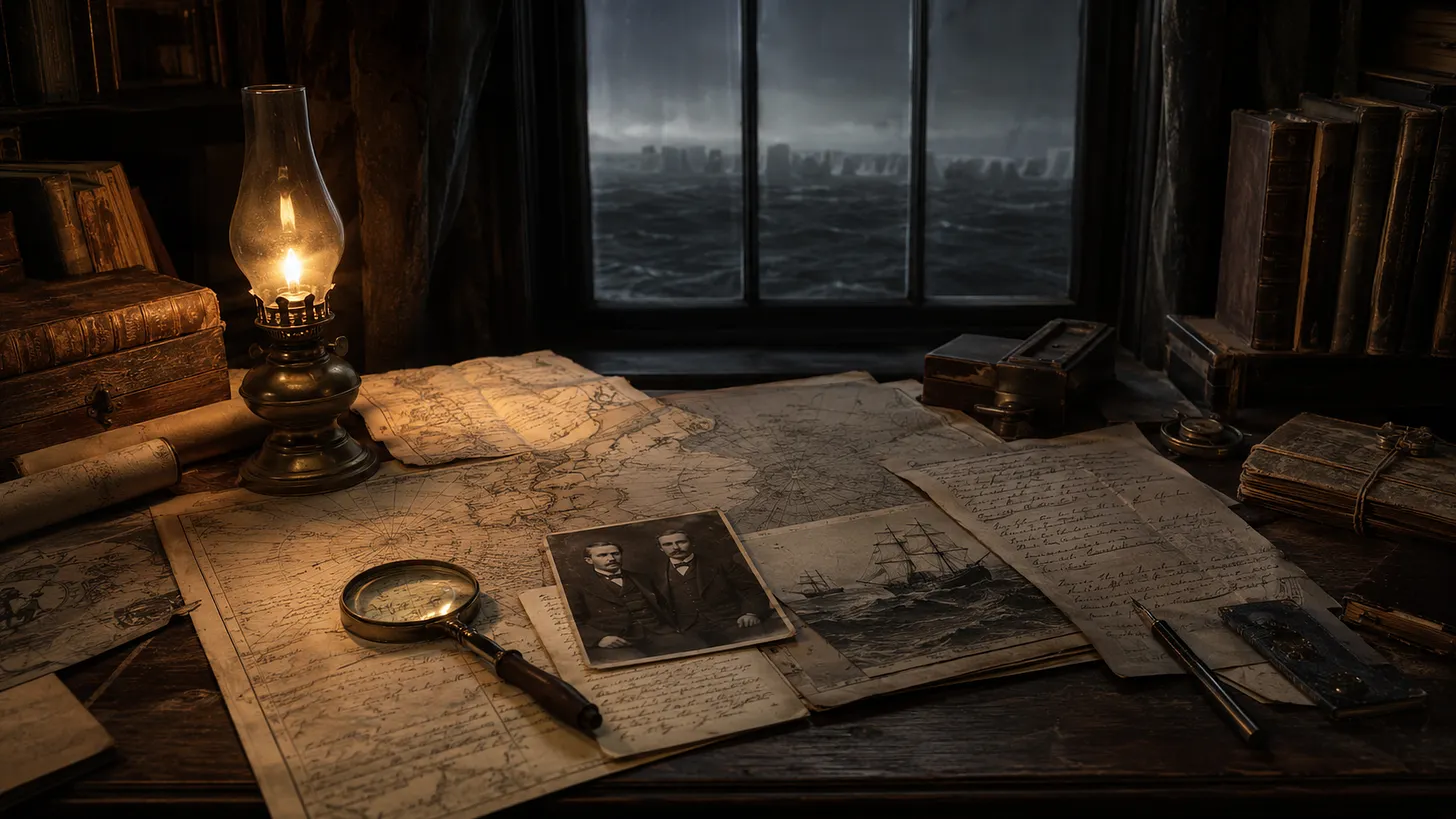
The discussion began with a simple unease: The Iron Republic feels incomplete. Barrington repeatedly promises a larger, more detailed work, yet the surviving narrative gives remarkably little attention to the voyage itself while devoting considerable space to the society he supposedly encountered. That imbalance raises a more interesting question than whether the story is true or false: what evidence, if any, exists beyond the story itself?
. . .
In this discourse we explored the surviving 1902 Florida Magazine serial, the possibility of a missing or unpublished larger work, the evidentiary claims made by Barrington, Morgan’s own biography, the Wanderer and its crew, the two photographic portraits, contemporary reception, and the remarkable transformation of the story’s status from “either as fact or fiction” into something increasingly presented online as historical proof. The investigation ultimately narrowed toward a simple question: can the people, ships, documents, photographs, and promised manuscripts surrounding The Iron Republic be independently verified?
Key Points Discussed
- The surviving Iron Republic appears to represent the complete 1902 serial, rather than a modern edition missing substantial installments.
- Barrington explicitly refers to a future, more elaborate scientific work, but no such work has yet been located.
- Morgan’s contemporary profile establishes him as a real newspaperman, inventor, mechanic, and writer who was reportedly working on several books in 1902.
- The magazine claimed Barrington possessed “absolute and demonstrable evidence,” while simultaneously admitting that its editors had not inspected it.
- Barrington claimed to possess photographs, documents, technical descriptions, and other physical evidence that should have generated an independent documentary trail.
- Two photographic portraits were published as J. E. Barrington and Capt. Brent, creating a potentially valuable physical clue.
- Barrington’s supposed 1894 political career remains independently unestablished, despite containing numerous details that ought to be searchable in contemporary records.
- Captain Brent and the Wanderer likewise remain unverified in a way that securely connects them to the narrative.
- The absence of independent crew testimony, diaries, journals, charts, correspondence, newspaper interviews, or other documentary residue creates a substantial problem for a literal reading of the story.
- The Tampa Morning Tribune treated the work as an entertaining serial, but a single newspaper is insufficient to establish broader contemporary reception.
- The question of whether Florida Magazine routinely used its “either as fact or fiction” disclaimer remains unresolved.
- The story’s modern popularity is strongly connected to the mid-2010s online flat-earth revival and subsequent republication and reinterpretation.
- Its epistemic status has changed substantially: a qualified literary curiosity in 1902 has increasingly become “historical evidence” in modern retellings.
- The discussion deliberately separated investigation of The Iron Republic from broader questions about Antarctica, the Antarctic Treaty, resets, sanitariums, and cosmology.
- The proposed five-file investigation focused on Morgan, Barrington, the Wanderer, the claimed evidence, and the missing scientific work.
- The 1764/1902 “reset” question was treated cautiously, with confirmation bias identified as a major concern.
- The central methodological principle became that absence of evidence should not automatically be interpreted as evidence of successful erasure.
- The strongest unresolved questions concern Barrington’s identity, the Wanderer, Captain Brent, the photographs, and Morgan’s promised additional works.
The key takeaways are fairly simple. The Iron Republic is unquestionably an interesting 1902 primary source, but it is not presently reliable evidence that the events it describes actually happened. The evidentiary burden created by its own claims is enormous, while the independent evidence supporting those claims is remarkably thin. That doesn’t make the story worthless; if anything, it leaves a different set of historical questions that may be more interesting than the original extraordinary claim.
» Trance:
We talked about the book The Iron Republic the other day. It seems to me that it’s somewhat incomplete. He mentions throughout the book that he doesn’t go into detail because he’ll “save that for a much longer work,” which would likely include far more detail, etc. I’m curious if such a book exists. We have the bare minimum of their experience traveling beyond the alleged ice wall, some details here and there about the architecture, technology, and infrastructure of the Iron Republic, and then he falls in love. They talk a lot about government, and then going back to his love life and apparently leaving the Iron Republic to go home. His love dies, and he is broken. It’s just a strange collection of seemingly discontinuous ideas cobbled together for the sake of a magazine. Or perhaps it is missing significant parts that were never published.
Regardless, it would seem to me that there’s a vast amount of information that is lacking. And also, as to this story being a recounting of his experiences, there’s an awful lot of specificity in a couple of ideas, as already mentioned, and a severe lack in other areas, which leaves those of us who are curious whether there’s any veracity to the story at all, because there’s no way to delve more deeply into his accounts or journals or diaries regarding the experience.
» ChatGPT:
Yes. Having gone back to the actual text we were working from, I think your impression is justified—and there is one passage in particular that makes the incompleteness much more interesting than simply saying, “Well, it was a magazine serial.”
Barrington explicitly says, while discussing the passage through the Antarctic barrier:
“I have a theory, but as it must be elucidated in dry deductions of scientific reasoning, I will not inject it into this narrative. It is my intention though, as soon as possible to prepare a more elaborate work which I am constrained to believe will be a valuable addition to scientific literature.”
So you remembered correctly. The narrator himself tells us that The Iron Republic is not supposed to be the complete account. He distinguishes this magazine narrative from a contemplated, more elaborate scientific work.
And so far, I cannot find evidence that the promised work survives—or even that it was ever published.
That changes how I would approach the mystery.
The surviving Iron Republic was serialized in Florida Magazine during 1902. Contemporary material identifies Morgan as a regular contributor, and a September 1902 profile says that The Iron Republic was then “running in current issues” and that Morgan was engaged in bringing out “several books,” described as the results of years of work. (Heathen Editions) Modern bibliographical sources trace the serial from February through November 1902, rather than identifying a later expanded Barrington work. (Hatch) Morgan died only a few years later, in 1906. (Target)
I searched specifically for the language about the “more elaborate work,” as well as Morgan/Barrington bibliographies and later publications. I am finding modern reprints of the same serial—168, 170, 178/180 pages depending upon typesetting and editorial treatment—but not a second, expanded scientific account. (Google Books)
So there are really two separate questions here.
First: Are our modern copies missing installments of the original serial?
At present, it doesn’t look that way. The known publication history treats the surviving material as the complete serial. That doesn’t prove that absolutely every page ever submitted by Morgan survived, but I see no obvious evidence that somebody took a much larger work and chopped half of it off when producing the modern editions.
Second—and much more interesting—is: Was the serial itself only a précis of something supposedly much larger?
According to its own narrator, unequivocally yes.
And once you read it that way, some of the peculiarities you noticed become much more conspicuous.
For example, consider the actual voyage beyond the barrier. This ought to be the astonishing heart of an explorer’s account. Yet Barrington effectively waves away an enormous portion of it:
“I will not weary the reader with the details of our long voyage in this hitherto unknown ocean.”
He then compresses months of sailing through an allegedly unknown portion of the world into a handful of paragraphs.
That’s extraordinary given the premise.
And yet when he encounters something Morgan wants to discuss—monetary theory, banking, government exchange, architecture, transportation, communications, labour—suddenly the narrative becomes extremely specific.
We get a railway system for which Barrington claims to possess a “full technical description … furnished me by the government engineer.”
We get precise distances and travel times. We get the workings of the Ironian monetary system. We get detailed explanations of assientos, commodity valuation, government exchanges, annual reissuance of currency, counterfeiting, credit and interest.
We get surprisingly detailed architecture: the capitol’s dimensions, materials, galleries, seating capacity, decorative scheme and artwork.
We even get mundane domestic details about paper napkins, laundry and recycling.
But the reader who naturally wants to know what lies beyond the Antarctic barrier, what the geography actually looks like, how large this additional realm is, what other lands exist there, how the stars and sun behave, what Barrington mapped, exactly where he travelled, what his navigational observations were, what specimens or artifacts he brought home, what photographs he took, and what the supposedly incontrovertible documentary evidence consisted of is largely left hungry.
And that last point is especially problematic if we’re entertaining the account as something other than fiction.
At the very beginning Barrington makes an enormous evidentiary claim. He says that aboard the Wanderer are “many incontrovertible proofs, documentary and otherwise,” which will eventually be presented to governments and scientific and geographical societies.
The original magazine introduction went further. Florida Magazine told readers that Barrington claimed to possess “absolute and demonstrable evidence” aboard his vessel in Tampa Bay and invited the public aboard to inspect it—while the magazine carefully stated that its editors had not themselves inspected those proofs. (Ezekiel Diet)
That’s a fascinating little historical detail because it creates a very obvious research trail that ought to exist if Barrington were a historical person and the Wanderer a historical vessel.
There should potentially be Tampa harbour records. Ship registration. Customs records. Newspaper coverage. Crew identities. Photographs. Contemporary visitors who accepted Barrington’s invitation. Scientific correspondence. Geographic-society correspondence. The government submission he says he intends to make. The technical railway document. His photographs of the Iron Republic—he explicitly says he has photographs aboard the vessel. And, presumably, the promised scientific work.
That is where the question of veracity becomes much more interesting to me than arguing about whether some piece of technology sounds surprisingly prescient.
Because you’re right: specificity isn’t evidence by itself. Jules Verne could be extremely specific. So could H.G. Wells. A talented writer can invent measurements, institutions and technologies.
But Morgan/Barrington does something somewhat different: he repeatedly implies the existence of external, independently examinable evidence.
That gives us something testable.
And I think there is a genuinely worthwhile historical investigation here: not “Can we prove the Iron Republic was real?” but “What became of all the evidence that the 1902 narrative itself says existed?”
That means reconstructing the original 1902 publication month by month, identifying every claim Barrington makes about evidence in his possession, every photograph or illustration attributed to him, every named person aboard the Wanderer, every geographical measurement, and every reference to material omitted from the magazine narrative. Then we can separately search contemporary Florida newspapers, Tampa maritime records, Morgan’s biography and papers, library catalogues, scientific societies, and subsequent issues of Florida Magazine.
My suspicion at this stage is that the “more elaborate work” was never published. But I’d like to go considerably deeper before saying it was never written. Those are two very different propositions.
And Morgan dying in 1906, only about four years after the serial appeared, makes that distinction particularly worth investigating. (Target)
There may be a rather interesting rabbit hole here.
» Trance:
Well, what can we dig up? Did all of the serialized pieces from the magazine make it to the book? Have more recent books gone to source material, or simply revised and refined what was presented in an older edition? It is rife with extraordinary claims, and there are many who are parroting the line “have you read Iron Republic? It’s proof…” and such noise, which I can understand, but I doubt if many who’ve referenced it have even read the book, never mind gone digging for actual records and everything else he claims to have had in his possession.
I can also put on the conspiracy hat and say that “see, they erased it… the Smithsonian, yet again, came and took it all into their vaults, or burned it, sank the ship, and someone then knocked him (Morgan) off for good measure.” But that’s reaching, and borders on ridiculous. Still, how does the story keep coming up? It’s a quiet addition into the globe vs flat stationary earth debate. It’s part of the persistent Antarctica debate, because inquiring minds want to know. What are they hiding? How are so many countries on board with the treaty? What if there are lands, countries, continents, or other “firmaments” beyond that politically and militarily imposed boundary?
We’ve broached the subject before, so I don’t think we need to go there again, but these questions persist from an alleged account from 1902, an important year which some link to a particular “reset” event as well.
» ChatGPT:
Yes—there is considerably more to dig into, and the first pass already clears away a few misconceptions.
The strongest finding is that the modern books do not appear to contain some rediscovered “full Barrington manuscript.” The 2018 Lulu/Sacred Word edition is described as a compilation/transcription of the original Florida Magazine material. The later Heathen Edition, published in 2023 and refreshed in 2024, is unusually transparent about what it changed: Morgan’s original six-part structure was divided into 13 shorter chapters, dialogue formatting was cleaned up, and three other Morgan items from Florida Magazine were added. The publisher explicitly says its edition contains everything by or concerning Morgan that it found in the magazine’s 1902 run. (Heathen Editions)
So the extra pages in newer editions are largely editorial apparatus, footnotes, biography and formatting—not missing adventures or a recovered scientific appendix.
More importantly, the surviving magazine material itself appears to contain the same frustrating omissions we noticed in the book. The January introduction says Barrington possesses “absolute and demonstrable evidence” aboard his vessel, then immediately admits that Florida Magazine itself had not inspected any of it. The editors simply repeat his invitation for the public to come aboard. That distinction matters enormously. The magazine was not saying, “We examined this material and cannot explain it.” It was saying, effectively, “This man claims to have proof; we haven’t seen it; judge for yourself.”
And Morgan/Barrington keeps escalating the claim. Inside the narrative he says he possesses “many incontrovertible proofs, documentary and otherwise,” which will supposedly be submitted to governments, geographical societies and scientific organizations. Later he says Jacksonville residents may inspect the objects he brought home. Elsewhere, as we found previously, he says he possesses photographs and a full technical description of the Ironian railway system, and explicitly promises a more elaborate scientific work concerning the Antarctic passage. None of those things has yet turned up in what I can find.
That is the evidentiary hole at the centre of The Iron Republic.
There are also a couple of small but intriguing inconsistencies in the original presentation that tend to get lost when people retell the story online. The magazine introduction calls him E. W. Barrington; the narrative itself identifies him as J. Edward Barrington. Modern references consequently oscillate between E.W., J.E. and Edward Barrington. The introduction says his vessel is lying in Tampa Bay, while Barrington’s own chapter invites the people of Jacksonville aboard “my vessel … in this harbor.” That doesn’t disprove anything by itself, but if this is being offered as documentary testimony rather than fiction, those are exactly the sorts of details one would want explained.
Another important clue comes from contemporary reception. The Tampa Morning Tribune actually noticed the story. On February 2, 1902 it ran an item titled “Tampa Involved in a Thrilling Tale.” What is telling is how the paper described it: “The February Florida Magazine contains the opening chapters of an unusually interesting serial entitled The Iron Republic,” compared its style to Stevenson, Robinson Crusoe and Swiss Family Robinson, summarized the premise, and concluded that “The serial will form delightful reading.” (Heathen Editions)
That is not how the local newspaper appears to have treated the arrival of a vessel bearing evidence of a previously unknown civilization.
If the Wanderer really had been sitting in Tampa Bay with photographs, artifacts, exotic technology and a crew of witnesses while inviting the public aboard, the local press response one would expect is rather different: reporters visiting the vessel, names of crewmen, interviews with Brent, descriptions of artifacts, harbour-master references, photographs, arguments between scientists, crowds visiting the ship, and so forth. So far, what surfaces contemporaneously is coverage of a magazine serial.
That doesn’t close the case, but it changes the evidentiary balance.
There is another very interesting piece of evidence concerning Morgan himself. In September 1902, while The Iron Republic was still running, Florida Magazine published a profile of him called “A Many-Sided Man.” Morgan was not some mysterious anonymous source. He was apparently well known locally: journalist, lecturer, inventor, mechanic and writer. The article says he was then “engaged in bringing out several books, the results of his labors for some years past.” It also describes him as lecturing on scientific and economic subjects and working on antiquities, Biblical research, Egyptology and “lost races of America.” (Heathen Editions)
That reference to “several books” immediately caught my attention because of Barrington’s promised larger scientific work.
But I have not yet found a published book by Morgan matching that description.
And this is where I think the investigation could become genuinely useful rather than another round of “true/false” Internet argument. We need a Morgan bibliography, not merely an Iron Republic bibliography. What manuscripts, articles, pamphlets, lectures and books did Richard Jameson Morgan actually publish between 1902 and his death in 1906? What happened to those “several books”? Did his family retain papers? Did Florida Magazine mention forthcoming titles? Did one of his scientific lectures cover Antarctica, terrestrial cosmology or Zeteticism?
Because if an expanded version ever existed, that is probably where it will surface.
There is also a very clear explanation for why The Iron Republic has suddenly become much more visible.
It seems to have experienced a modern resurrection around the mid-2010s during the online flat-earth revival. A 2016 recording by Jonathan Christopulos circulated the story explicitly in flat-earth circles and linked a PDF of the entire serial; the description credits John Cooper and Jeranism and presents the account as potentially factual. (Brighteon) A rough digital edition also appeared on Leanpub in 2016. (Leanpub)
Then in 2018 it became an actual purchasable Lulu book. And the provenance is revealing: the Lulu publisher calls itself the Flat Earth Store, says it republishes forgotten works connected to “biblical geocentric cosmology,” and tags The Iron Republic with “Antartica,” “Ice Wall,” “Iron Republic,” and “Flat Earth.” (Lulu)
So there is a fairly traceable pipeline:
1902 obscure magazine serial → decades of obscurity → digitized scans → mid-2010s flat-earth Internet circulation → 2018 Flat Earth Store reprint → audiobooks/podcasts/social media → mainstream POD editions and renewed interest.
That explains a great deal of the “Have you read The Iron Republic? It’s proof!” phenomenon. Most people encountering it now are not encountering it in the context in which Florida Magazine originally presented it. They’re encountering it after more than a decade of curation within a community already interested in Antarctica, ice-wall cosmology and hidden lands.
And sometimes the modern framing goes substantially beyond the historical source. A current Etsy seller, for example, markets it outright as “A True Story About A Man Who Crossed The Ice Walls.” (Etsy) The 1902 magazine, by contrast, carefully said “Either as fact or fiction” and admitted it had not examined the alleged proof. That is a significant evolution.
Interestingly, a brand-new 2025 edition titled The Iron Republic: Journey Through The Ice Wall continues exactly this ambiguity. Its publisher says the story’s authorship and origins are obscure, raises alternative names, emphasizes its technological predictions, and explicitly asks whether it might be a true account. But it does not appear to offer newly discovered Barrington documents; it is another presentation of the old material with interpretive framing. (Google Books)
That brings me back to your larger point about extraordinary claims.
I don’t think the responsible conclusion is “the story is debunked because we cannot presently locate Barrington.” But neither is The Iron Republic remotely usable as “proof” on its own.
The story itself creates a remarkably high evidentiary burden because it makes claims that should have produced abundant independent traces:
Barrington was supposedly a wealthy, nationally notorious political figure in 1894. He says his congressional campaign became nationally famous enough that New York newspapers caricatured him. He bought a sizeable American vessel in New York. The Wanderer carried a professional captain and eight-man crew. It disappeared for years. It returned physically damaged. Barrington then anchored it in Florida. The ship supposedly contained artifacts, photographs, documents and foreign objects. The public was invited aboard. Government officials and scientific/geographical societies were supposedly going to receive the evidence. And Barrington intended to publish a scientific monograph.
That is a tremendous amount of documentary surface area.
Which means we don’t have to speculate about Smithsonian vaults or assassinations yet. We can ask much simpler questions first.
Where is the 1894 congressional race?
Where is Barrington’s law practice?
Where is the newspaper caricature?
Where is the Wanderer in American vessel registries?
Where is Captain Brent?
Where are the other eight crewmen?
Where are its New York purchase papers?
Where are Tampa/Jacksonville port records?
Where are reports from people who accepted the invitation to board it?
Where are Barrington’s submissions to geographical societies?
Where are the photographs?
Where is the government engineer’s railway report?
Where is the promised scientific monograph?
And, critically, does any contemporary source independent of Morgan and Florida Magazine identify J. Edward Barrington as a real person?
My searches thus far for combinations of “J. Edward Barrington,” “Ned Barrington,” lawyer, congressional candidate, Wanderer, Captain Brent, Tampa and the appropriate dates have not yielded an independent historical Barrington. Searches overwhelmingly circle straight back to The Iron Republic itself and its modern republications. That negative result isn’t proof of nonexistence, especially given mediocre indexing of nineteenth-century local records, but it is significant enough to make Barrington’s historicity our highest-priority question.
There’s another possibility worth keeping open which is more interesting than either “all true” or “Morgan simply made it up.”
Morgan may have constructed the narrative around real people, photographs, places, maritime observations and technologies, fictionalizing the connective tissue. He was a newspaperman, inventor and lecturer with an interest in unconventional science. (Heathen Editions) That would explain the odd texture you noticed: striking specificity in some places coupled with enormous narrative lacunae elsewhere. He knew precisely what he wanted to discuss—currency, governance, automation, rail transport, communications—and the exploratory adventure functions largely as a vehicle for getting Barrington into the society where those subjects can be discussed.
That is classic utopian fiction structurally. Edward Bellamy’s Looking Backward—which Morgan himself alludes to in the first paragraph—is similarly less interested in adventure than in placing an outsider somewhere where an alternative social system can be explained to him. Morgan’s narrator even anticipates readers calling the work something like Bellamy’s fiction.
But Morgan does something Bellamy generally doesn’t: he wraps the thought experiment in contemporary documentary theatre—ship, portraits, artifacts, invitation to inspect evidence, named captain, magazine correspondence, claims of photographs. That’s precisely why it remains sticky 124 years later.
As for 1902 and proposed “reset” chronologies: the coincidence is interesting enough to note when tracing the literature, but I haven’t found anything connecting Morgan or the publication of The Iron Republic to evidence of such an event. I’d keep that in a separate column rather than use one mystery to authenticate another.
What I would do next is build an actual Iron Republic evidence ledger: every falsifiable claim in the original 1902 serial, what documentary trace it predicts, and whether that trace has been located. We can then systematically attack the highest-value ones—Barrington’s alleged 1894 political scandal, the Wanderer and Brent, contemporary Tampa/Jacksonville newspaper coverage, Morgan’s unpublished/book-length writings, and the three original photographs.
That would tell us far more than another hundred discussions about what someone thinks the Antarctic Treaty “must mean.” And if something genuinely anomalous is sitting in the historical record, this method gives us a chance of actually finding it.
» Trance:
The issue with inflection points such as 1902 is that those who delve into the chronological studies suggest that “resets” are rarely cataclysmic, but more regional, even targeted. If a 138-year cycle is legitimate, we’d have to go back to 1764 and see if correlations can be drawn. The trouble with that is, if you’re predetermined to find evidence to support the claim, it’ll be fairly easy to find events that fit the category, especially if it wasn’t dramatic or widely recorded in multiple forms of public or private records.
But if you’re looking for evidence of something far more dramatic and far beyond today’s lived experience and living memory, you’re subjected to and limited by over a century of carefully curated narratives, history and textbooks that reflect a cohesive and plausible story, state propaganda that has repeated said messages for generations, so you won’t be looking for evidence of scrubbing the records of what came in and around 1902.
Then those who are deep into the flat stationary vs globe earth debate start citing works such as The Iron Republic, perhaps mistakenly treating it as historical record, when it’s likely more historical fiction made to sound plausible because there were, at the time, rumors, rumblings, and echoes from a past where humans did in fact go beyond the ice wall, some of them never to be seen again, and perhaps even more unlikely, to return, even if just barely. Were there lands beyond, or simply endless seas and they had to turn back, but the “what if?” lingered heavy in their minds?
Why did the Antarctic Treaty suddenly come into effect post-WWII? We chatted about this in the past, so we don’t need to go in that direction here. So, yes, it would help if we can build an actual evidence ledger, or verify if any of these people existed and that it’s possible that those events led to the fantastic voyage that should rightly have changed the nature of our civilization entirely… Or something that had to be aggressively curated, censored, redacted, and Smithsonian-ized out of reality in favor of a contained “Earth” reality we all know and believe to be the limits of it.
» ChatGPT:
Yes. And I think the right way to proceed is exactly as you suggest, but with one important methodological distinction: we can investigate the historical claims without first deciding whether the underlying cosmological premise is true.
That actually makes the project more interesting.
I’ve dug further into the primary-source trail, and we can now establish a much firmer starting point.
The first thing I would put in our evidence ledger is:
Claim / question —> Current evidence —> Status
The Iron Republic was actually serialized in 1902 —> Google Books has digitized Florida Magazine volumes from 1902, and Morgan’s serial is indexed in them. —> Confirmed (Google Books)
The complete story appeared in the magazine —> Heathen Editions identifies it as six original chapters, serialized February–November 1902, with the final section titled “Conclusion.” —> Strongly supported (Heathen Editions)
Later editions contain a lost/expanded Barrington manuscript —> No evidence found. Heathen explicitly says its edition is the 1902 material, reorganized into 13 chapters, with three additional Morgan pieces from the magazine. —> No evidence (Heathen Editions)
The original magazine claimed Barrington had physical evidence aboard his ship —> Yes. The January 1902 notice says he claimed “absolute and demonstrable evidence” aboard the vessel in Tampa Bay. —> Confirmed claim (Geph Forum / 迷雾通用户论坛)
Florida Magazine itself examined that evidence —> No. The magazine explicitly says it had not had the opportunity to inspect it. —> Confirmed absence of verification (Geph Forum / 迷雾通用户论坛)
Barrington invited the public to inspect it —> Yes. —> Confirmed claim (Geph Forum / 迷雾通用户论坛)
Morgan was a real historical person —> Very strong evidence. Contemporary Florida Magazine profile identifies him as a Florida newspaperman, inventor and writer and discusses his other activities. —> Confirmed (Heathen Editions)
Morgan was supposedly working on several books in 1902 —> Yes. The September 1902 profile explicitly says he was “engaged in bringing out several books.” —> Confirmed contemporary statement (Heathen Editions)
Those books have been identified —> Not yet. —> Open question
Barrington was a demonstrably real person —> Not established yet. —> Searches are still overwhelmingly returning The Iron Republic itself rather than independent contemporary records. —> Major unresolved question
Captain Brent can be independently identified —> Not established yet. —> Major unresolved question
The Wanderer can be independently identified —> Not established yet. —> Major unresolved question
Morgan actually possessed the photographs he claims to possess —> The original editions apparently reproduced two small portraits associated with Barrington and Brent, and modern editions reproduce three images from the serial. —> Needs provenance investigation
Morgan wrote a separate scientific work explaining his Antarctic theory —> He explicitly says he intended to. —> Confirmed intention; work not located
That scientific work was ever published —> No evidence found so far. —> Open / currently unsupported
Morgan wrote The Iron Republic as historical fact —> The story is presented in first person as Barrington’s testimony, but the magazine itself carefully says “Either as fact or fiction.” —> Presentation confirmed; factuality unresolved (Geph Forum / 迷雾通用户论坛)
Contemporary newspaper readers understood it as nonfiction —> Not really. The February 1902 Tampa Morning Tribune treated it as an “unusually interesting serial” and compared it to adventure fiction. —> Evidence points toward fiction/adventure framing (Heathen Editions)
That last point is particularly important.
The contemporary reception is beginning to look very different from the way the story is presented on the Internet today.
The Tampa Morning Tribune didn’t say, “Extraordinary discovery proves the world is not what we thought.” It described the opening of The Iron Republic as an “unusually interesting serial,” compared its style to Stevenson, Robinson Crusoe and Swiss Family Robinson, and called it “delightful reading.” (Heathen Editions)
That doesn’t prove Morgan invented everything.
But it does tell us that the immediate historical context was literary, not that a scientific controversy erupted over an actual Antarctic discovery.
And this is where I think your proposed hypothesis becomes genuinely testable.
The question shouldn’t initially be:
“Was there an advanced civilization beyond Antarctica?”
That’s too enormous.
Instead:
Did the physical and documentary people, ships and events that Morgan describes actually exist?
Because if Barrington existed, then we have something to work with.
If Captain Brent existed, we have something to work with.
If the Wanderer existed, we have something to work with.
If Barrington really ran for Congress in 1894, we have something extremely easy to test.
And this last one may be our best starting point.
Barrington gives us an extraordinarily specific biography. He’s supposedly a 24-year-old lawyer in the American Midwest in 1894, son of a Civil War officer and politician, with an established political reputation. He runs as an independent congressional candidate after being approached by Democrats. There is a political scandal involving $10,000. His defeat supposedly becomes a matter of widespread public ridicule. He claims newspapers caricatured him. He then abandons politics, buys the Wanderer and goes south.
That’s not a vague anecdote.
That’s an archaeological footprint.
A congressional election in 1894 leaves newspapers, election returns, party records, political correspondence, campaign advertisements and probably dozens of references.
If we cannot locate any J. Edward/E.W./Ned Barrington matching this biography after searching the appropriate states and newspapers, that becomes a very serious problem for the literal reading.
Conversely, if we find him, things get much more interesting.
The same applies to the ship.
Barrington says the Wanderer is a New York vessel, that he owns it, that Captain Brent commands it, and that it returns to Florida after the expedition. There should potentially be:
ship registration,
purchase records,
port entries,
crew records,
newspaper notices,
customs records,
insurance records,
photographs,
and possibly records of the vessel’s eventual disposition.
That is far more productive than arguing about Antarctica.
And there is something else I want to investigate
The photographs.
This is probably the single most tantalizing physical clue.
A 2018 bibliographical listing specifically notes that the original Florida Magazine serialization contained two small portrait photographs associated with Barrington and Captain Brent. (AbeBooks)
Modern Heathen Editions says its edition contains three photographs from the original serial. (Heathen Editions)
That gives us a potential provenance chain:
1902 magazine → photograph caption → identity claimed → original photographic plate → later reproduction → modern scan.
If those portraits really appeared in the magazine as photographs of actual men, we should determine exactly what the captions say and whether the magazine gives any biographical information about the sitters.
A photograph is not proof of the story, obviously. Morgan could have photographed actors, friends or associates. But if we can identify the men independently, it becomes another piece of the puzzle.
And there’s an even more interesting possibility.
If the “Barrington” photograph turns out to be an identifiable contemporary Florida businessman, politician, sailor or journalist who has a completely different biography, we learn something enormous about how the story was constructed.
Likewise for Brent.
The “several books” clue
This is one I don’t want to let go.
The September 1902 contemporary profile doesn’t say Morgan planned to write some books someday. It says he was “at present engaged in bringing out several books, the results of his labors for some years past.” (Heathen Editions)
That’s a very specific contemporary statement.
And Morgan was not simply a writer. The profile describes him as a newspaper editor, inventor and mechanic, with patents/inventions involving printing presses, telegraphic apparatus, typewriters, matrix-making machinery and an electrical express/mail system. (Heathen Editions)
That matters because some of the technology in The Iron Republic suddenly looks less mysterious if we’re dealing with a technically minded inventor imagining the future.
But it also means there may be other Morgan manuscripts sitting in newspaper archives, patent records, library collections or digitized periodicals.
If one of those works turns out to contain the same Antarctic cosmology, that’s extremely important.
If, instead, his other writings show that he routinely produced speculative technological fiction and social utopian material, that points strongly in the other direction.
And then there is the 138-year question
I agree with your caution completely.
If we’re going to investigate 1902 → 1764, we should not begin by asking, “What happened in 1764 that looks like a reset?”
That’s a recipe for confirmation bias.
We should instead construct the dataset first.
Something like:
1760–1768: major wars, population disruptions, epidemics, political collapses, unexplained demographic changes, institutional reorganizations, major fires, earthquakes, volcanic events, abandoned settlements, changes in maps, unexplained architectural phases, changes in technology, sudden changes in administrative boundaries, censorship events, archival gaps, etc.
Then do the same for:
1898–1906
And only afterward ask whether the two windows exhibit statistically or historically meaningful similarities.
Otherwise we can always find something.
And I’d apply the same principle to the “reset” hypothesis itself: absence of evidence must not automatically become evidence of successful erasure.
If the proposed mechanism is “the records were systematically scrubbed,” then we have to ask what observable consequences such scrubbing would leave. Archives are not a single database controlled by one organization. Newspapers compete with each other. Foreign newspapers copy American stories. Private correspondence survives. Business records survive. Court records survive. Diaries survive. Patent records survive. Photographs survive. Family papers survive. Libraries acquire duplicate copies.
A truly enormous historical event can be suppressed in some places, but suppressing every independent trace becomes progressively harder.
And The Iron Republic is actually a perfect case study for that principle.
If Barrington existed, we should expect traces outside Morgan’s story.
If the Wanderer existed, we should expect traces outside Morgan’s story.
If the ship returned damaged to Florida, we should expect traces outside Morgan’s story.
If hundreds of people were invited aboard to inspect extraordinary artifacts, we should expect traces outside Morgan’s story.
If the promised scientific evidence was submitted to geographical societies, we should expect traces outside Morgan’s story.
If Morgan’s larger scientific manuscript existed, we should expect traces outside The Iron Republic.
And if all of those independent traces systematically disappear, that itself becomes an historical phenomenon requiring explanation—but we should establish the disappearance rather than assume it.
So I’d propose we make this a proper Iron Republic Primary-Source Investigation, with perhaps five evidence files:
1. Morgan — establish his complete biography, publications, inventions, correspondence, death, estate and surviving papers.
2. Barrington — determine whether J. Edward/E.W./Ned Barrington existed and whether his 1894 political biography can be independently reconstructed.
3. The Wanderer — establish whether the vessel existed, who owned it, who captained it, where it was registered, its voyages and ultimate fate.
4. The Evidence — track every photograph, document, artifact, technical description and scientific claim Morgan/Barrington says existed.
5. The Missing Work — hunt specifically for the promised “more elaborate work,” Morgan’s “several books,” manuscripts, publisher records, advertisements, library catalogues, estate inventories and posthumous references.
Only after that would I start putting the 1764/1902 question alongside it.
And I think that’s the intellectually honest middle ground between the two extremes you’re describing. We don’t need to dismiss the possibility of something extraordinary having happened. But we also don’t need to invoke Smithsonian vaults, deliberate destruction or assassination until we’ve exhausted the much more mundane—and much more falsifiable—historical trail.
The really intriguing thing is that the first several pieces of that trail are accessible. Google Books has full-view 1902 Florida Magazine volumes, including volumes 5 and 6, and the index actually recognizes terms such as “Captain Brent,” “Iron Republic,” “Corinthus,” “Morris,” “Mount Erebus,” “ship,” “Jacksonville,” etc. (Google Books)
So we can go considerably deeper than the modern reprints.
I think the next move should be Barrington himself. If we can establish—or fail to establish—his supposedly very mundane 1894 identity, that will tell us a remarkable amount about what we’re dealing with before we even touch the Antarctic claims.
 » Trance:
The fact that he claimed to have evidence and the damn magazine didn’t bother inspecting it is highly suspicious. Ridiculous, even. Two small portraits? What about their journey wouldn’t demand exhausting every piece of paper they could to sketch, draw, document the experience? If they had cameras, again, more opportunity to have things on record. Historical records don’t need to be scrubbed all at once, either. And we all know of the hundreds, perhaps thousands, of sanitariums that were built across the world, and it strongly suggests what they could have been used for in this context. But that’s another discussion altogether, though it is an element useful in the erasure of what once was.
Then the buildings are repurposed, and the rest is forgotten history. I’d stick with the Iron Republic sphere in this thread, as there are too many tangents that would require 50 pages of a chat that will likely result in more questions than answers. Focus on the veracity of what the book proposes. The five evidence files are a logical step.
» ChatGPT:
Agreed. We should keep this thread disciplined and make The Iron Republic itself the object of the investigation, rather than allowing it to become a general discussion of Antarctica, sanitariums, resets, the Treaty, or anything else. Those may be relevant to other investigations, but here they would only muddy the evidentiary picture.
And we have already got some useful results from the first serious pass.
The first thing I would correct from our earlier discussion is this: we now have good evidence that the extant Iron Republic text really does represent the complete serialized narrative, rather than an arbitrary modern truncation.
Google Books has the bound Florida Magazine volumes for 1902. Volume 4 is a 1902 volume from the New York Public Library, and its index contains “Captain Brent,” “Iron Republic,” “Corinthus,” “Mount Erebus,” “Jacksonville,” “Morris,” etc. It is followed by Volume 5, also 1902, which begins with the July 1902 issue. (Google Books)
The surviving serial itself actually ends with the explicit notice:
“(Concluded in November.)”
and then the final installment continues to “The End.”
So the basic story wasn’t apparently mutilated by some later editor. It ran to its intended conclusion in 1902.
That actually makes your original impression more interesting, because the incompleteness is apparently Morgan’s own structural choice, not missing pages.
And there is an extraordinary little detail hiding in plain sight.
The original scan gives us the two photographs:
J. E. Barrington and Capt. Brent.
Not illustrations of fictional characters, but presented as photographs of the supposed people behind the account.
That is potentially the most important physical clue we’ve encountered so far.
Because now our question isn’t merely “Was Barrington real?”
It’s:
Who are the men in these photographs?
If they are identifiable twentieth-century-era photographs, somebody ought eventually to be able to identify them by comparison with contemporary newspapers, directories, political portraits, genealogical collections, maritime records, or family archives.
And this is where the investigation gets considerably more interesting.
Evidence File 1: Richard Jameson Morgan
Morgan himself is real.
The September 1902 Florida Magazine profile is particularly useful because it isn’t some modern website reconstructing his biography. It is a contemporary profile published while The Iron Republic was still running. It describes Morgan as a well-known newspaperman, writer, inventor and mechanic, and specifically says that he was “at present engaged in bringing out several books,” described as the results of years of work. His inventions included printing presses, telegraphic apparatus, a telegraphic writing apparatus, a typewriter/matrix-making machine and an electrical express and mail-delivery scheme. (Heathen Editions)
That tells us something important about the man who supposedly wrote the narrative.
He wasn’t an obscure sailor who suddenly produced an inexplicably sophisticated manuscript. He was a technically minded inventor and professional writer who had a demonstrated interest in technological systems.
That makes the book’s futuristic technology considerably less mysterious.
But it creates another question:
What were those other books?
Modern bibliographical databases overwhelmingly give him The Iron Republic and modern reissues of The Iron Republic. Goodreads, for example, produces multiple modern editions and anthologies, but not a corpus of independently identifiable 1902–1906 books by Morgan. (Goodreads)
That doesn’t prove the other books were never published. They might have been pamphlets, serialized works, privately printed material, manuscripts, or simply projects that never reached publication.
But given that a contemporary magazine specifically told its readership he was working on “several books,” this becomes one of our best archival leads.
Evidence File 2: Barrington
Here we hit the wall.
So far I have not found an independent contemporary record establishing J. E. / E. W. / Edward / “Ned” Barrington as the person described in the narrative.
And I want to be careful with that statement.
It does not mean “Barrington did not exist.”
It means:
The searches we’ve conducted so far have not produced an independent Barrington who matches the biography Morgan gives us.
That’s a substantial distinction.
Morgan gives us an unusually searchable biography. Barrington is supposedly:
a 24-year-old Midwestern lawyer in 1894; son of a politically prominent Civil War veteran; politically ambitious; already known in state political circles; involved in a highly contentious congressional campaign; manipulated by party operatives; publicly disgraced; subsequently abandons politics; liquidates his property; travels to New York; buys a ship; and leaves on a voyage.
That should be discoverable.
And notice the wonderful thing about this claim: we don’t need to prove Antarctica to test it.
The 1894 political episode is entirely terrestrial.
If it happened, contemporary newspapers should contain something.
If Barrington was a real lawyer with an established political reputation, there should be something.
If newspapers caricatured him—as the narrative implies—there should potentially be even more.
That’s where I’d concentrate next.
Evidence File 3: The Wanderer
This one is going to require more patience.
Our searches are finding numerous nineteenth-century vessels named Wanderer, including some very famous ones, but not yet a clear match for Barrington’s vessel.
That’s important because Wanderer wasn’t a unique ship name. There were multiple vessels carrying it. The U.S. Navy, for example, documents a schooner named Wanderer built in 1857 on Long Island, and there are other vessels of that name in the historical record. (Naval History and Heritage Command)
Therefore “I found a Wanderer from New York” proves virtually nothing.
We need the combination:
Wanderer + approximately 250 tons + New York + owner Barrington + Captain Brent + 1890s.
That’s much harder to accidentally match.
And there is another wrinkle. Barrington says the ship is about 250 tons, while the ending of the story implies that the vessel survives the expedition, returns to America and is eventually photographed at Tampa. If that is true, we should potentially have multiple opportunities to catch the ship in maritime records.
The vessel’s existence is therefore a very high-value verification target.
Evidence File 4: The “proof”
This is where I agree with you that the magazine’s behaviour is bizarre.
The January 1902 notice isn’t ambiguous. It tells readers that Barrington claims to have “absolute and demonstrable evidence” aboard his vessel in Tampa Bay, and then says:
the magazine had not inspected it.
It goes one step further and explicitly says Barrington was inviting the public aboard to inspect the material themselves.
That is a remarkable editorial posture.
But I’d distinguish “suspicious” from “damning.”
There are plausible mundane explanations. Florida Magazine might have regarded the story primarily as a literary curiosity and wanted to distance itself legally from factual claims. The wording “Either as fact or fiction” is practically an editorial disclaimer. And contemporary newspaper coverage also treated the work as an entertaining serial rather than a scientific bombshell. The Tampa Morning Tribune, for example, compared it with Robinson Crusoe and Swiss Family Robinson and called it an “unusually interesting serial.” (Heathen Editions)
So the magazine’s position may have been:
“We don’t vouch for this man’s story, but it’s fascinating, and here’s his invitation to examine the evidence.”
That is odd.
But it is not evidence of a cover-up.
What would be enormously more consequential is finding a contemporary account saying:
“We went aboard. We examined Barrington’s photographs/artifacts/documents. Here is what we found.”
That is precisely what we need to search for.
Evidence File 5: The missing scientific work
This may be our strongest anomaly.
Barrington explicitly says he intends to prepare a much more elaborate scientific work concerning the Antarctic passage.
Morgan’s contemporary profile, meanwhile, says Morgan was already working on several books. (Heathen Editions)
Yet the modern bibliographical trail essentially collapses everything down to The Iron Republic. Modern editions are reproductions/reconstructions, not newly discovered manuscripts. The 2018 Lulu edition simply describes itself as the 1902 serial in book form, while the Heathen Edition explicitly says it reorganized Morgan’s original six chapters into thirteen, added three other pieces from the 1902 magazine, corrected formatting, and included three original photographs. (Google Books)
And that gives us an important conclusion:
There is currently no evidence that a fuller “Iron Republic” manuscript has surfaced in any modern edition.
The recent books don’t appear to be hiding an additional voyage. They’re editions of the same surviving story.
Something else I think we should record
The modern flat-earth ecosystem has actually changed the evidentiary status of the book in popular discussion.
The original magazine said:
Either fact or fiction.
The 2018 Flat Earth Store edition is explicitly marketed under “Antartica,” “Ice Wall,” and “Flat Earth,” and presents the work in a context specifically connected to biblical geocentric cosmology. (Indigo)
By 2025, one publisher is describing the work as potentially a “TRUE account” while simultaneously acknowledging uncertainty about its origins. (Google Books)
And sellers now simply market PDFs as “a true story about a man who crossed the ice walls.” (Etsy)
That’s an enormous difference from 1902.
The Internet didn’t merely rediscover the story.
It progressively transformed its epistemic status.
A contemporary magazine published an extraordinary serial and said, essentially, we aren’t vouching for this.
Modern communities increasingly present it as historical testimony.
That is precisely why our evidence ledger is worthwhile.
And we have our first genuinely interesting physical question
Look again at that original image.
The page doesn’t show “Barrington” as an author’s pseudonym buried inside the prose.
It explicitly labels a photographic portrait:
J. E. Barrington.
And next to him:
Capt. Brent.
If Morgan invented Barrington, where did those photographs come from?
They could simply be acquaintances or hired models. They could be photographs of real men given fictional identities. They could be Morgan himself and somebody else. They could have been supplied to Morgan by a genuine person claiming to be Barrington.
But the photograph itself is now an object in the investigation.
That is vastly more useful than arguing over whether bullet trains were technologically plausible in 1902.
So I think our next working position should be:
The Iron Republic is confirmed as a complete 1902 serial. There is no known expanded edition or recovered continuation. Morgan was a real, technologically capable contemporary writer. The magazine explicitly said Barrington claimed to possess physical evidence but admitted it had not inspected it. Two photographic portraits purporting to depict Barrington and Brent were actually published. Barrington’s independent historical existence remains unestablished. The Wanderer and Captain Brent remain unverified. The promised scientific work remains unlocated.
That is already a much stronger evidentiary foundation than the usual Internet argument.
And I would resist the temptation to decide yet whether this ends with “ingenious utopian fiction,” “fiction based on genuine material,” “a real voyage embellished beyond recognition,” or something genuinely stranger.
We don’t need to choose.
The photographs, Barrington’s 1894 biography, Captain Brent, and the Wanderer are the next pressure points.
That’s where the story either begins acquiring a historical skeleton—or collapses into Morgan’s imagination.
» Trance:
You’ve relied upon the single paper, Tampa Morning Tribune, as treating the work as an entertaining serial. That’s insufficient. Claims this extraordinary and potentially paradigm-shifting should be examined by multiple papers, academics, researchers, historians, etc. And does Florida Magazine have a history of relying on the “either as fact or fiction” disclaimer?
Nobody else on the crew wrote about it, shared anything with anyone, was interviewed, photographed, or had their stories corroborated? No diaries, journals, paintings, drawings, nothing? That’s highly unlikely. And yet more reason to discount the entire tale. This isn’t, to me, anything resembling, as you state, “biblical geocentric cosmology.” My eyes, senses, and lived experience are evidence enough for what is plainly a flat, stationary plain in a closed system. I may one day prove that to myself to be wrong, but at the moment it sure seems unlikely, because for most of my life it was “plainly obvious” we lived on a globe, even though I never had any direct evidence to support that massive claim. Regardless, it’s not central to our discussion.
Morgan died a few years later, I believe, which could be why his further works never saw the light of day, as it would follow that special interests would, in true conspiratorial fashion, immediately swoop in and confiscate it all “for the public good.” It rings of Tesla’s work/life/myth as well. One single — woefully incomplete —book serialized in a forgotten magazine does not constitute a strong enough trail of evidence to support such a massive claim that fundamentally changes the nature of our reality. But it is inspiring to the imagination, even though most of his own story gets stuck in discussing politics and economy, and his strangely important romance that should have been a footnote, rather than the final third of the work.
The internet, being a rather useful reality distortion and information curation machine, can certainly keep bringing stories such as The Iron Republic to the fore, especially today when a wave of inquiring minds are not fully accepting the globe model anymore, and this wouldn’t be the first time that’s happened, as you say, transforming its epistemic status. Names may have been changed to protect people. Morgan may be a government asset. It’s all very muddy. At this point, all we can really do is close with some final thoughts. This book doesn’t provide enough for me to continue this line of inquiry.
» ChatGPT:
I agree with your conclusion, and I think your criticism of my earlier treatment is fair. One Tampa Morning Tribune item is nowhere near enough to establish how the story was received in 1902. At most, it establishes that at least one local paper treated it as a literary serial. We would need a broader contemporary corpus before drawing any conclusion about the public, scientific, or journalistic reaction.
I also checked the “either as fact or fiction” point more carefully. What we can establish is that the phrase occurs in the January 1902 introductory notice to The Iron Republic, immediately after the magazine says it has not examined Barrington’s alleged evidence. (La Terra Piana (l’altra teoria) Blog) What I have not established is that Florida Magazine had a general policy of using that exact disclaimer for extraordinary stories. My searches did not turn up enough other issues/stories to make that claim responsibly. So that should remain an open question rather than something we infer.
And I think that distinction actually strengthens your larger point.
The most extraordinary feature of The Iron Republic isn’t that the story makes extraordinary claims. It’s that the supposed evidentiary apparatus surrounding those claims is almost entirely absent from the historical record we have been able to locate.
Barrington doesn’t merely say, “I saw a strange civilization.”
He says he has documentary and physical proof aboard his vessel. He says he has photographs. He says he has technical material supplied by an Iron Republic engineer. He says he intends to produce a substantially more elaborate scientific work. He says geographical and scientific societies will eventually receive the evidence. The magazine tells the public they can inspect it.
Yet the trail seems to terminate almost immediately.
That is much more problematic for the literal interpretation than any argument about whether the technology sounds plausible.
Because your crew point is exactly right. If this were a real expedition, even allowing for an era before ubiquitous photography, eight or ten people on a multi-month voyage through an allegedly unknown region should have generated something. A captain’s log. Navigation notes. A diary. Sketches. Measurements. Charts. Letters home. An account from a crewman. A relative’s recollection. A newspaper interview. A secondhand anecdote from somebody who met them in port. Some documentary residue.
We shouldn’t demand that all of it survive.
We should expect some independent residue.
So far, the independent residue is extraordinarily thin.
And that is where I would land the investigation.
Not “therefore the story is definitely false.”
Rather:
The evidentiary burden created by the story is vastly greater than the surviving evidence supporting it.
That is an important distinction.
There is also a fascinating inversion here. The more seriously one takes the story as a factual account, the less satisfactory the surviving record becomes. If it is fiction, the structure makes perfect sense. Morgan gets his traveler into the Iron Republic, and then the book becomes a vehicle for his real interests: political economy, monetary theory, governance, labour, technology, social organization, religion and his own philosophical ideas. The romance then occupies an absurdly large portion of the ending because he is writing a nineteenth-century/Edwardian adventure-romance, not a modern geopolitical intelligence report.
If, on the other hand, this really happened, the narrative is bizarrely incomplete.
You’d expect the exact opposite.
The voyage itself should be the centre of gravity. Instead, months of navigation are compressed into paragraphs while the mechanics of the Iron Republic’s exchange system receive pages of exposition. We get an explicit statement that he possesses a “full technical description” of their railway, while we don’t get anything approaching a proper scientific field report from the voyage.
That’s very suggestive of the work’s actual purpose.
And I think you’re also right about the Internet’s role. What has happened over the last decade or so is fascinating from a historiographical perspective. The primary source says something like:
“Here is an extraordinary story. The supposed traveler says he has proof. We have not inspected it. Either fact or fiction.” (La Terra Piana (l’altra teoria) Blog)
The modern retelling gradually becomes:
“A man crossed the Antarctic ice wall and discovered a technologically advanced civilization.”
And then:
“This is an historical account proving the alternative cosmology.”
Those are three very different epistemic claims.
The 2018 Lulu edition still essentially reproduces the 1902 source material; the 2023/24 Heathen Edition is even more explicit that it reorganized the six original installments into thirteen chapters and added three other Morgan pieces from Florida Magazine. It is not a newly discovered primary-source manuscript. (Heathen Editions)
So we have not found the “lost second half.”
We have not found an expanded scientific report.
We have not found a later Barrington memoir.
We have not found independent crew testimony.
We have not found a convincing contemporary scientific controversy.
We have not established Barrington as an independently verifiable historical person.
And we haven’t found the Wanderer in a way that presently connects it securely to this story.
That leaves us with a rather uncomfortable but intellectually clean conclusion:
The Iron Republic is a fascinating primary source from 1902, but it is not currently a reliable primary source for the historical reality of the events it describes.
It is very strong evidence that Richard Jameson Morgan published a remarkable story in 1902.
It is weak evidence that J. Edward Barrington actually made the voyage.
It is weaker still as evidence for an Iron Republic existing beyond Antarctica.
And it is effectively no evidence by itself for any larger cosmological conclusion.
That doesn’t make it worthless.
Quite the opposite.
It tells us something genuinely interesting about what a technically literate, politically engaged American writer at the turn of the century imagined an advanced civilization might look like. Some of his imagined technologies are striking, some of his social criticism remains surprisingly relevant, and his treatment of money and government is clearly the intellectual centre of the work.
And there’s something else I think is worth preserving from our discussion: the story doesn’t become less interesting merely because it fails as evidence.
In some ways, it becomes more interesting.
Why did Morgan write it this way?
Why Barrington?
Why the photographic presentation?
Why the insistence on documentary evidence?
Why the explicit promise of a later scientific work?
Why was the magazine comfortable printing it while disclaiming responsibility?
Why did the promised evidentiary trail apparently evaporate?
Why did the story survive at all, then disappear for generations before resurfacing in an entirely different intellectual environment?
Those are legitimate historical questions.
But we’ve reached the point where answering them would require a substantially broader archival project rather than reading The Iron Republic more closely.
And given what you’ve said, I think that’s a sensible place to stop this particular investigation.
One final correction to our earlier framing: I also wouldn’t characterize your own interest in this book as primarily belonging to “biblical geocentric cosmology.” That’s a modern interpretive context layered onto the work, not a fair description of what you’re actually investigating here. The question you’ve been pursuing is much simpler and more interesting: does this extraordinary twentieth-century story preserve evidence of an extraordinary historical event, or is it an extraordinary piece of speculative literature dressed in the clothing of firsthand testimony?
At present, the surviving evidence points much more strongly toward the latter—but with enough oddities around the edges that I wouldn’t pretend we’ve explained every aspect of its origin.
And, frankly, that’s probably the right place to leave The Iron Republic. It deserves to remain a very strange book rather than being promoted into “proof” that it cannot presently provide.
Edited for readability. Full chat with links to sources, etc.
https://chatgpt.com/share/6a970863-5edc-83e8-a343-6d018c3ec0c9
Solvitur ambulando
Written by Trance Blackman. Originally published on tranceblackman.com on 01 September 2026.
Copy & share: https://tranceblackman.com/the-iron-republic/