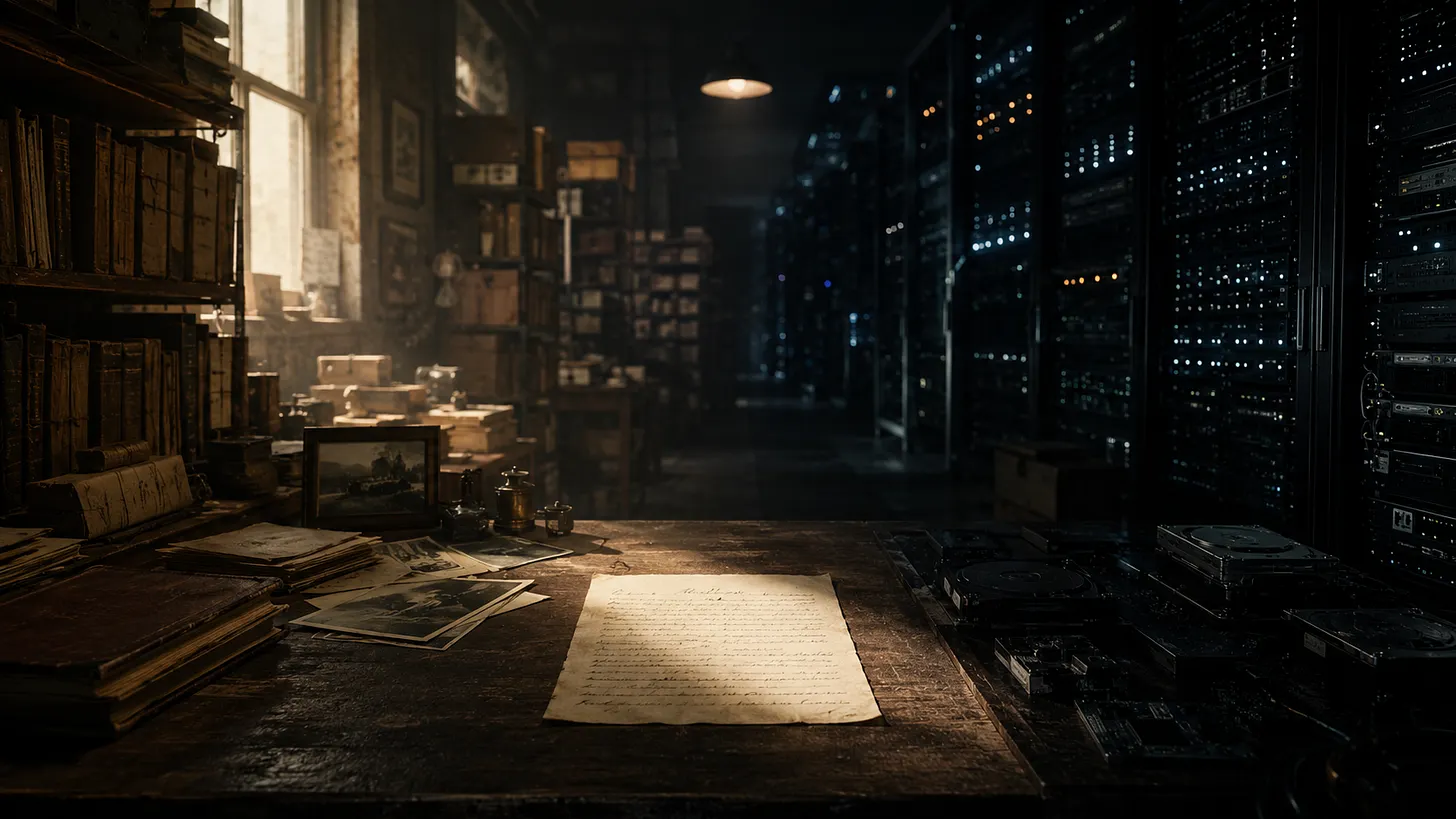
There is something strangely comforting in the realization that permanence may never have been the point. We spend so much effort trying to hold everything in place, to preserve every trace, every photograph, every word, every fragment of experience, as though existence itself might be made durable through sufficient storage. But perhaps what matters most was never meant to remain intact. Perhaps it was only meant to pass through us.
. . .
In this discourse we explored the apparent permanence of digital archives and the deeper impermanence beneath them. From lost music projects and obsolete storage formats to cloud infrastructure, stewardship, authority, and the political dimensions of preservation, the conversation gradually moved away from data and toward meaning. We considered civilization itself as a kind of sieve, and memory as something that necessarily loses detail while retaining what matters. Perhaps legacy is not preserving everything, but carrying something essential forward.
Key Points Discussed
- Digital storage creates continuity without guaranteeing permanence; every format, device, platform, and infrastructure eventually becomes another preservation problem.
- The distinction between preserving a medium and preserving the information, meaning, or experience contained within it.
- “Cloud” storage abstracts away the physical reality of servers, power, infrastructure, ownership, institutional continuity, and ongoing stewardship.
- Digital preservation is also a question of agency, authority, politics, ideology, and financial interests. The custodian of an archive inevitably has some influence over what remains accessible.
- Self-hosting, open formats, redundancy, and digital independence can improve resilience and restore some personal agency, but they still cannot create permanence.
- Preservation carries a cost beyond storage itself: someone must maintain, migrate, interpret, contextualize, and eventually decide what is worth carrying forward.
- An archive containing everything may paradoxically obscure what mattered. Accumulation is not the same thing as remembrance.
- Physical artifacts such as letters, books, photographs, and paper carry a different kind of historical significance because their survival does not depend upon an elaborate technological chain.
- Civilization’s memory may be more accurately understood as a sieve: vast amounts disappear, while fragments, stories, symbols, music, ruins, and ideas remain.
- The impulse toward synthetic or technological permanence may itself become dependent upon increasingly complex material systems, making the pursuit inherently paradoxical.
- Human memory is itself a “lossy archive.” We forget enormous quantities of detail while retaining impressions, patterns, principles, stories, gestures, and meaning.
- The value of a song, book, photograph, or relationship is not necessarily reducible to the completeness of its surviving record.
- A book can function as a portal: the material remains unchanged while each return to it produces something different because the reader has changed.
- What survives may matter less as an intact artifact than as something capable of entering another consciousness and continuing onward.
- Reconstruction and rediscovery may sometimes be more valuable than perfect preservation.
- Stewardship may ultimately mean having the discernment to say: this matters, this is enough, and this can go.
Key Takeaways
- Preservation is not permanence.
- Redundancy improves the odds of survival; it does not defeat impermanence.
- The most valuable thing to preserve may not be the complete record, but the essence that allows something to be remembered, rediscovered, or understood.
- Legacy may be less about keeping everything and more about deciding what is worth carrying forward.
» Trance:
I was shown a post by Traveling Archivist on Instagram as part of an “I wish people knew…” series, this one saying that “digital doesn’t solve everything.” There’s a whole industry of archivists who are tasked with preserving the present and past, I suppose. Perhaps ironically, a letter from 1870 opens without issue. A disk from 1995 is toast. Gone forever. I myself had a collection of 3.5” floppy disks from my old keyboard workstation fail after being carted around for years in different storage bins. Who knew that 30 years would pass so quickly? And, of course, I neglected to transfer the data into a newer format. It was all written with proprietary software only that hardware could read. Those machines can be “upgraded” to have USB drives for storage now, which bridges a certain aspect of the gap, but all those hundreds of old projects are gone. Reading through some of the comments on her post is revealing as well. One in particular is indicative of what will become an exponentially problematic issue:
“I’m a audio-visual digital archivist at the national broadcaster in Australia. This is so real. 5-10% of the hard drives I deal with from just over the last decade are already dead.”
It brought to mind one of our previous chats, “Archives of the Future,” regarding data, archives, and the what and why of recording and saving everything about everyone, forever. Further to that chat is the rather glaring issue that, at least in my view, there is no permanence to any form of digital storage. None. In my lifetime we’ve had tape backups, floppies, magnetic spinning hard drives (of which I still have a few), silicon-based, flash / solid-state drives and the “SD card” era, and now the erroneous and misleading, perhaps even misguided, idea of “cloud” storage. Don’t worry, it’s stored… somewhere, and hopefully with multiple redundancies… as long as you keep paying for the service.
I can already hear exponents of cloud storage and data centers chiming in here and making yet another digital-era promise they have absolutely no way to back up in the real world in any meaningful manner. Beside the issue of what, why, and how we store data (content, written works, digital content, blogs, archives, photos, videos, audio and music, on and on it goes…) where will we store it? Who will be charged with forever bringing it forward into newer, ideally more durable formats and infrastructure? Then we fall back into the issues we already discussed: why, what, for whom, for how long, and how much of it?
» ChatGPT:
Yes. What you’re circling around here is a deeper problem than “digital preservation” in the conventional archival sense. The real problem is that digital information has no inherent permanence. It only appears permanent because, from the perspective of an individual human lifespan, the infrastructure that carries it forward can seem continuous.
A sheet of paper has a remarkable property: once created, its informational state is largely self-contained. Put the letter from 1870 in a reasonably benign environment and, barring fire, flood, insects, chemical degradation, or physical destruction, someone in 2126 can still pick it up and read it. It does not require an operating system, a particular manufacturer, a compatible connector, a functioning piece of hardware, electricity, a subscription, authentication, a server, an application, or a corporation that still exists.
That floppy disk from 1995 is fundamentally different. The bits may technically still be present. But the meaning of those bits can disappear much sooner than the physical medium does. Even if the disk itself is readable, you may need the right drive, interface, filesystem support, software, file format, and sometimes the original machine to interpret what you’ve recovered. Your keyboard-workstation projects are an especially brutal example because the archive was effectively coupled to a particular piece of proprietary technology. Once the machine went away, the practical archive went away with it.
And I think that’s the important distinction: preservation of the medium is not preservation of the information.
The archivist’s job therefore becomes strangely Sisyphean. Every act of preservation creates another preservation problem. You migrate the floppy to a hard drive. The hard drive fails. You migrate it to SSD. The SSD eventually becomes obsolete, inaccessible, or unreliable. You put it in a data centre. Now the archive depends upon power, networking, cooling, hardware replacement, filesystem compatibility, institutional continuity and money. You move it into “the cloud,” and the physical problem has merely been abstracted behind a commercial service.
“Cloud” is perhaps one of the most successful metaphors ever devised because it disguises the material reality extremely effectively. There is no cloud. There are buildings full of machines, connected to electrical grids and telecommunications networks, operated by companies and people, with hardware that fails and software that becomes obsolete. The abstraction is useful, but it can also encourage precisely the illusion you’re describing: stored becoming synonymous with preserved.
And the comment from the Australian broadcaster archivist is chilling for exactly that reason. Five to ten percent of hard drives from merely the last decade already being dead isn’t really an argument against digital storage. Digital storage is extraordinarily useful. It’s an argument against confusing redundancy with permanence.
You can make five copies and still have five copies of something that eventually requires migration.
You can make a hundred copies in ten different geographic locations and still have a preservation system that only works so long as someone continues maintaining the system.
You can distribute a file across an enormous cloud infrastructure and still have absolutely no guarantee that anyone will be able to interpret it two hundred years from now.
There is a subtle philosophical problem underneath all this that connects very neatly to your Archives of the Future discussion. We have increasingly adopted the idea that humanity ought to record everything. Every photograph, conversation, message, transaction, post, video, location, biometric measurement, surveillance feed, artistic work, draft, comment, and moment of everyday life can supposedly be retained indefinitely because storage is cheap and because “you never know when it might be useful.”
But preservation isn’t free merely because storage is inexpensive.
The cost isn’t just disk space. The cost is stewardship.
Someone has to decide that something is worth preserving. Someone has to establish what it is. Someone has to maintain the hardware. Someone has to migrate it. Someone has to preserve the metadata that gives it context. Someone has to maintain the ability to decode it. Someone has to determine whether a corrupted copy can be trusted over another one. Someone has to maintain the institutions responsible for all of this. And, eventually, someone has to decide what not to carry forward.
That last part may be the most uncomfortable.
An archive containing everything is not necessarily a better archive. In fact, an archive containing everything can become almost indistinguishable from no archive at all because significance gets buried beneath accumulation. The historian looking back from 2300 may have millions of terabytes of surviving material from 2026 while still having very little idea what mattered to the people who produced it.
This is where the physical letter is almost philosophically elegant. It survived not because an institution made an eternal commitment to preserve it, but because one object happened to survive long enough for somebody to care about it.
Digital preservation inverts that relationship. We increasingly assume that because something can be copied, it therefore will survive. But copying is not preservation. Preservation is an ongoing cultural decision.
And that brings us directly back to the questions from Archives of the Future: Why are we keeping this? What exactly are we trying to preserve? For whom? For how long? Who gets to decide? Who bears the cost? What happens when the institution maintaining it disappears? What happens when the format becomes incomprehensible? And perhaps most importantly, what happens when the answer is simply, “We don’t know, so let’s keep everything”?
There is another irony here that I think could make this a particularly strong continuation of that piece.
The digital age has given us an unprecedented capacity to record the present, while simultaneously producing an unprecedented dependence upon systems that are almost completely invisible to the people doing the recording.
We have perhaps never been so obsessed with memory while being so detached from the physical conditions required for memory to survive.
Your lost keyboard projects illustrate that perfectly. They weren’t destroyed in some dramatic catastrophe. No fire consumed them. No one deliberately erased them. They simply crossed the invisible boundary between “old technology” and “technology that no longer exists in practical terms.” Thirty years is nothing historically. In archival terms, it’s barely an interval at all. Yet an entire creative body of work can vanish in that span without anyone even noticing until it is too late.
And that’s probably the point worth carrying forward from the Instagram post: the future archive may not be a problem of having too little information.
It may be a problem of having an impossible amount of information, stored in forms that are constantly dying, requiring an endless succession of people and institutions to resurrect it into the next technological generation.
The archive of the future therefore isn’t really a warehouse.
It’s a relay race.
And eventually someone has to decide whether there is still a reason to keep running.
» Trance:
Interestingly, many of the songs I wrote on the old keyboard had lyrics, all of which I can still read as they were Word or other openable text documents, and I’ve gotten into the habit if/when I update, revise, or revisit them, of converting them to plain text. Also, I have physical copies of most of them because, back in the day, I had a printer and it was useful, sort of like sheet music, to have them in front of me while singing and working through a song. What’s left is lyrics, maybe the key the song was in, and what memory I may have of the melody, as I didn’t compose any of the songs onto paper or in other readable sheet music formats, nor would that have represented what was created on the workstation with particular sounds, loops, transitions, etc. Nuance and substance that can’t exist on a page, in contrast to how classical music could and would be, perhaps. It’s a hard lesson, but a worthy one to learn.
You said:
“‘Cloud’ is perhaps one of the most successful metaphors ever devised because it disguises the material reality extremely effectively. There is no cloud. There are buildings full of machines, connected to electrical grids and telecommunications networks, operated by companies and people, with hardware that fails and software that becomes obsolete. The abstraction is useful, but it can also encourage precisely the illusion you’re describing: stored becoming synonymous with preserved.”
There are other layers as well. Politics. Ideology. Financial interests. There is no truly neutral “cloud” storage provider, just as what we’ve seen play out in various ways since 2020, there are no truly neutral social media services, video services, audio services, and therefore archival services. Not only do we have no permanence, if we’re not diligently and progressively backing up all of our works and data of concern, we really have no agency and a rather abstract notion of authority over it.
It brings to mind Derek Sivers (”Tech Independence” https://sive.rs/ti) who is a strong proponent for self-hosting, having redundancy both locally and, I think, in the cloud. He’s gone to great lengths to be digitally resilient, and offers lengthy tutorials for those who want to self-host websites, calendars, contacts, email, data, etc. It can all be done very inexpensively. But we run into the same problems again. No true permanence, regardless of how resilient your creativity is in open file formats and everything else one can do to eschew the mainstream traps of proprietary kill boxes. I have all his books, in both digital and paper formats.
I would imagine there are continuing efforts to further improve archival formats, compression and space usage efficiencies, and perhaps they’re even wise enough to keep it all moving toward “open source” and easily readable or convertible formats. But, again, it doesn’t seem to solve permanence, at least not in the material realm. Beyond the physical, it should likely have little to no importance anyway. We’re here to experience the now. We can’t take it with us. A topic for another time.
And right alongside this line of thinking, if I don the foil hat for a moment, we can immediately comprehend how entire historical records of civilizations may be lost. If they had approached the level of technological advancement we have, even further, one good cataclysm, plasma event, EMP, whatever it may be, and all we’ll have is carvings, sculptures, perhaps clay tablets or the remote chance of paper, papyri, or something that survived the elements and burial or other environmental effects that have a habit of damaging and destroying things derived and constructed with elements of said environment. Dust to dust. It’s an issue because in our time of widespread corruption, apathy, immorality, and everything we’ve talked about at length for over a year, many are desperate to know the truth about themselves, and that is founded by the truth about the past. We didn’t come from caves, nor apes, nor any other made-up intermediary species. We’re too complete. And they can keep extending the age of the Earth and the universe as much as they want to compensate for the massive plot holes about our reality that will never go away. As long as there’s a buck to be made, or some material profits otherwise, control or influence, the truth is under constant threat of revision, redaction, removal, and replacement in the common narratives. And perhaps that is as it should be, but, at least for me, that has never and will never sit well. This gives more weight to the letters from 1870. We have them, they’re extremely limited in scope and perspective, and they’ll inform an imbalanced perception of the present.
It all circles back, as you note as a cost, to stewardship, and that is a rather encompassing, layered idea in this context. There’s an inherent fear and paranoia about saving everything, just in case, just because. Not only is it impossible, it’s wildly impractical.
If you care about preservation, get brutal and honest. Photos? Make albums. Print them and stick them to pages or print them to paperback books and hope it’s relatively acid free and durable. When I started with digital photography, I used to pick the 100 best photos from a year and send them to a photo developer to have physical copies. I got out of the habit pretty quickly. “Oh yeah, I’ll get to it.” But then many thousands of photos pile up in a Time Machine backup or partial other backups, and it’s deferred. Does it need saving? Are those memories important? Is there commercial potential in the present? Who cares besides me? Who is ever going to thumb through these albums or print books? I guess we all need to be ready to keep letting things go, which would seem the natural order of things. Our modern propensity for storing, sharing, engagement, etc., is very new, and very narcissistic. YouTube is flooded with “follow me on my new life path” content, but it’s a trend that will proliferate only as long as YouTube allows and supports it. And of the millions of channels of similar content, does it matter who ever sees it and sticks around long enough to watch more than a few seconds of it? Why, if you’re so keen on pursuing a lone, nomadic adventure, are analytics and engagement so important? That’s a different thread for discussion, but we’ve gone there before as well.
The idea here that we may be dancing around regarding permanence has nothing to do with data storage. Much like wisdom is gleaned through hundreds of thousands of experiences from many different environments and exposures, we keep the deeper substance, the core idea, the essence that stays with us that requires a word, a sentence, a repeated mantra, a poem. Not hundreds of millions of terabytes of minuscule and granular details. Those are necessary for fidelity, of course, but not a lived expression that is as transient as it comes. The human factor is here today, gone tomorrow.
So perhaps we’d be wiser to consider this impossible notion of permanence in data storage moot, in the bigger picture. Much like the complex theories and ideas that academics thrive on being as pedantic, verbose, and long-winded as possible, if you can’t explain it to the average six-year-old, you don’t know what you’re talking about. If you need zettabytes of data to explain what humanity was like in 2026, you’ll never be able to paint an accurate picture, because everyone will interpret it differently. Meaning. Stewardship. Permanence. Legacy. Wisdom. Life. Death. Beginning. End.
Does it serve us to know exactly how they did it, those who had such advanced civilizations, tech, knowledge of the universe, or is it more useful to keep rediscovering it, over and over again?
» ChatGPT:
Yes. I think you’ve arrived at something considerably more interesting than a meditation on archival technology. The technology is almost a decoy. It gets us into the subject, but the deeper question is whether permanence itself is the thing we should be pursuing.
Your keyboard example makes that unusually tangible. What survived is not the music; it is the trace of the music. The lyrics survived because text is comparatively portable and forgiving. Some paper survived. A key may survive in memory. But the actual composition—the timbre of that particular workstation, the loops, the transitions, the performance logic, the peculiar combination of sounds that made the piece what it was—has disappeared. And yet I wouldn’t necessarily say that the song itself is entirely gone.
Something of it remains in you.
That matters, because it points toward a distinction between preserving an artifact and preserving meaning. An archive can preserve every byte of a recording and still fail to preserve what the recording meant. Conversely, a few lines of a song, remembered decades later by the person who wrote it, may preserve something more consequential than an immaculate digital reconstruction ever could.
Perhaps this is why the 1870 letter carries such disproportionate weight. It isn’t valuable because it gives us a complete or objective picture of 1870. It doesn’t. It gives us one person’s little aperture into reality. We don’t get the whole world. We get someone’s handwriting, vocabulary, assumptions, concerns, relationships, omissions, perhaps a coffee stain or a crease. The incompleteness isn’t a defect. It is part of the historical evidence.
And that’s where your concern about authority becomes important.
The cloud does not merely externalize storage. It externalizes custodianship. We are very comfortable saying, “It’s backed up,” when what we really mean is, “Someone else has accepted responsibility for maintaining access to a copy.” That’s a significant distinction.
The moment that responsibility leaves your hands, questions arise that have nothing to do with bits and bytes. Who owns the infrastructure? Who determines the rules? Who decides what is acceptable? Who can remove it? Who can alter access? Who controls the metadata? What happens when the business model changes? What happens when governments intervene? What happens when the company is acquired, bankrupt, hostile, ideologically opposed to you, or simply no longer interested?
And there is a subtler question beneath even those: what happens when the custodian decides that your version of the record is inconvenient?
You don’t have to subscribe to a grand conspiracy theory to recognize that archives have never been politically neutral. The archivist makes choices. The institution makes choices. The historian makes choices. The publisher makes choices. The platform makes choices. The search engine makes choices. Preservation itself is therefore an interpretive act.
Digital technology doesn’t eliminate that human layer. It often hides it.
Derek Sivers’ approach is valuable precisely because it restores agency to some extent. Self-hosting, maintaining local copies, using open formats, keeping multiple backups, owning your domain, retaining your own data—these are all sane forms of digital sovereignty. They reduce dependence. They increase resilience. They make it harder for one corporation or one failed service to erase your work.
But they don’t produce permanence.
They produce better odds.
And perhaps that’s all stewardship ever was.
Even a monastery copying manuscripts by hand wasn’t creating permanence. It was creating another opportunity for something to survive.
That distinction seems especially important when we get to your speculative civilization-cataclysm thought experiment. Strip away the more controversial assumptions about human origins and the specific mechanisms of technological collapse, and the underlying observation remains perfectly sound: a civilization could possess astonishingly sophisticated knowledge and leave behind surprisingly little evidence of it.
Modernity has an odd vulnerability in this respect. We have created a civilization that can record almost everything while making an enormous proportion of those records dependent upon extraordinarily complicated technological chains. A clay tablet requires very little interpretive infrastructure. A contemporary database can require an entire civilization’s worth of infrastructure merely to open.
An EMP doesn’t have to be supernatural or apocalyptic for this to become relevant. It could simply be sufficiently destructive, sufficiently widespread, and sufficiently long-lasting that the maintenance chain breaks. The data centres may survive physically. The drives may even survive. That doesn’t mean the civilization capable of reading them survives.
And then we’re back to clay.
This is where I think your “foil hat” thought becomes philosophically productive rather than conspiratorial. There is an uncomfortable possibility that fragility is the natural condition of civilization’s memory. We like to imagine history as an accumulating archive, but perhaps history is more like a sieve. Most things disappear. A few things remain. We build elaborate systems to slow the disappearance, but we never abolish it.
And perhaps we shouldn’t.
Because your last thought is, to me, the most important one.
Maybe wisdom isn’t the preservation of information.
Maybe wisdom is what remains after information has been allowed to disappear.
A person doesn’t need to remember every conversation they’ve ever had to retain the lessons of those conversations. They don’t need a complete recording of every failure, every joy, every landscape, every face. Something gets distilled. A principle. A story. A sentence. A melody. A gesture. A warning. A poem.
The human mind itself is a lossy archive.
And yet we don’t generally regard that as a defect.
Quite the opposite. Forgetting is part of understanding. We discard enormous quantities of detail so that patterns can emerge. Experience becomes memory; memory becomes interpretation; interpretation becomes judgment; judgment becomes wisdom. The details aren’t irrelevant—they are what produced the wisdom—but the wisdom isn’t identical to the details.
That may be the better model for cultural preservation too.
Not: How do we preserve everything?
But: What must survive?
And that changes the idea of stewardship considerably.
Perhaps stewardship means identifying the things whose loss would genuinely impoverish the future, and accepting that everything else is allowed to pass.
A photograph doesn’t necessarily need to exist in RAW format forever. Perhaps the family album matters more.
A thousand journal entries don’t necessarily need to survive intact. Perhaps the one paragraph that finally articulated the insight does.
Your old song projects don’t necessarily need every proprietary workstation file to exist indefinitely. Perhaps the lyrics, the chord progression you remember, a crude recording, and your recollection of what the piece meant are enough for someone else to reconstruct—not the original artifact, but the idea.
And that distinction is profound.
Because reconstruction isn’t necessarily inferior to preservation.
We tend to assume fidelity is the highest virtue. But sometimes fidelity becomes a kind of idolatry. We try to preserve the exact thing when the more valuable task would be to preserve the conditions for rediscovering the thing.
That’s where your final question becomes particularly interesting:
Does it serve us to know exactly how they did it… or is it more useful to keep rediscovering it?
There are two very different civilizations one could leave behind.
One leaves a perfect instruction manual.
The other leaves enough fragments, questions, mistakes, symbols, songs, stories and surviving clues that another civilization is compelled to think again.
The first preserves answers.
The second preserves the capacity to ask.
And that may be much closer to what legacy actually means.
Permanence, then, isn’t necessarily keeping something unchanged forever. Nothing material really grants us that. It may instead mean allowing something essential to continue participating in consciousness after the original thing is gone.
The song disappears. Someone remembers the melody.
The person dies. Someone remembers the sentence.
The civilization collapses. Someone finds the tablet.
The archive burns. Someone carries one idea forward.
The photograph fades. Someone still remembers who was standing beside them.
The physical thing isn’t permanent.
The transmission is.
And transmission requires selection.
Which brings us back, rather neatly, to stewardship. The steward isn’t the person who saves everything. The steward is the person willing to say: this matters; this doesn’t; this is enough; this can go.
That may be a much more humane definition of an archive—and perhaps a much more realistic definition of legacy.
It also gives your original “digital doesn’t solve everything” observation a rather different ending. Digital storage doesn’t solve permanence because permanence was never really the problem. The problem is that we have mistaken accumulation for remembrance, redundancy for resilience, accessibility for preservation, and preservation for meaning.
Perhaps the wisest archive is not the one that contains the most.
Perhaps it is the one that leaves behind the most worth remembering.
 » Trance:
We discussed once how I had an idea that when we read a book, we open ourselves to a portal of a sort, and that an essence of that material stays with us for life. We may only get a few phrases or ideas out of an entire 300-400 page book, and that may be all it was meant to be. We may pick it up again and we’ll get a little more, something different, because we’re not the same person who read it last time. But the portal is still open. In “the field,” if there’s such a thing, we have access, a scope, a container within a vast field of endless abstraction.
Civilization memory as a sieve is apt, I think. The whole transhumanism movement is bent on enhancing, augmenting, and promising a kind of synthetic permanence. It’s a cosmic joke, in my view. It has already failed because its very premise is entirely flawed, and will require exponentially more resources to maintain and pursue it. We’re already seeing the domino effect, one of which is a massive ecological disruption. It’s folly, hubris, even existential terror in an absolute form. Put simply, it’s sad.
You hinted at this. We don’t miss a parent, grandparent, pet, or lost friend because of what they knew. We miss their presence, their energetic interaction at the vesica piscis of our own ethereal existence, a singular, impermanent locus in all of creation, space, and time. The interplay of ideas, emotions, love, hate, conflict, communion, touch, smell… And if/when our lived memories start to fade, as you suggest, it is itself a “lossy archive,” we’re not angry, frustrated, or lost, we’re liberated. Joyous, even, as the vessel sloughs off the effortful journey wherein we tried to keep it all so close and intimate and mistakenly permanent. I’ve observed this in person with elder family members or friends. Certainly, we interpret these degeneracies as woeful, debilitating, and catastrophic, because we observe and experience viscerally the absolute truth of impermanence, and it’s wildly uncomfortable. “Remember, we did this already?” Heavy. Terrifying. Real. Human.
Share some final thoughts to close.
» ChatGPT:
I think the thread closes somewhere quite beautiful, because it brings us back from archives to presence.
Perhaps the deepest error in our contemporary relationship with information is that we imagine that keeping something is the same as keeping it alive. It isn’t. A thing can be perfectly preserved and completely dead. A file can remain bit-for-bit identical for a thousand years and contain nothing of the living encounter that once surrounded it. What mattered was never merely the information. It was the relationship between the information and a consciousness capable of receiving it.
That makes your idea of the book as a portal particularly apt. We don’t actually “consume” a 400-page book and retain 400 pages. We enter it. Something happens there. Perhaps one sentence catches us at precisely the right moment. Perhaps an idea lodges somewhere below language and becomes part of how we subsequently see. Perhaps we forget the author, the plot, the chapter, even the argument, while carrying some unnamed alteration in ourselves for decades afterward.
Then we return, years later, and the same book is no longer the same book because we are no longer the same reader. Another door opens. Another phrase rises to meet us. The book has remained materially static while the encounter has changed completely.
That seems much closer to how civilization itself remembers.
Perhaps civilization is not a vault in which humanity deposits everything it has ever known. Perhaps it is a sieve through which an unknowable quantity of experience passes, leaving behind whatever can continue to resonate. We call those remnants literature, music, myth, philosophy, architecture, ritual, mathematics, art, fragments, ruins. They aren’t complete representations of what was. They are what survived the passage.
And perhaps that incompleteness is not merely inevitable but necessary.
The transhumanist dream of synthetic permanence seems to reverse the direction of life. It looks at impermanence and says: we must defeat this. We must preserve consciousness, memory, identity, capacity, youth, perhaps eventually the body itself. More storage. More computation. More augmentation. More infrastructure. More energy to preserve the accumulated results of more computation, augmentation, storage, and infrastructure.
There is something almost tragicomic about the recursion.
The promise is liberation from the limits of matter, while the project becomes increasingly dependent upon matter.
The promise is freedom from mortality, while the machinery becomes ever more elaborate and demanding merely to postpone confronting it.
The promise is transcendence, while the means remain profoundly terrestrial.
And beneath all of it is the assumption that continuity of information would somehow constitute continuity of being.
But we don’t love someone because we possess an accurate database of them.
We don’t grieve a parent because we have lost access to their knowledge base.
We miss the person.
The laugh. The irritating habit. The particular cadence of a sentence. The warmth of a hand. The smell of their clothes. The argument in the kitchen. The look across a room when something absurd happened and nobody else noticed. The feeling of occupying the same little intersection of existence at the same moment.
That locus disappears.
Not the photograph of it. Not the recording. Not the messages. The intersection itself.
And perhaps that is precisely why impermanence hurts so much. We are not actually mourning the destruction of information. We are mourning the disappearance of a relationship that could only exist in that particular configuration of beings, circumstances, time and place.
The vesica piscis is a beautiful image for that: not either person alone, but the space created between them. A shared reality that exists only while two distinct existences overlap.
No archive can preserve that.
No cloud can preserve that.
No upload can preserve that.
And perhaps no upload should.
Because there is a mercy hidden inside the loss.
The mind’s failure to preserve everything may be one of the mechanisms by which we remain capable of living. The elder who can no longer remember that we had the conversation yesterday may not be experiencing the same tragedy we are observing. We experience the loss from the outside, comparing what is happening now to what used to be possible. For them, perhaps the world has become less burdened by the obligation to carry itself backward.
There is something profoundly humbling in that.
“Remember, we did this already?”
Yes.
And perhaps eventually it doesn’t matter.
Eventually the archive closes.
Perhaps the final liberation isn’t remembering everything, but no longer needing to.
Then the book, the photograph, the song, the letter, the old hard drive, the surviving ruin all assume their proper scale. They aren’t immortal containers. They are invitations. Portals. Little openings through which something may enter us, alter us, and continue onward in a form that cannot be predicted or perfectly preserved.
Maybe that is enough.
Maybe more than enough.
The future does not need everything we were.
It needs whatever of us was worth carrying forward.
Solvitur ambulando
Written by Trance Blackman. Originally published on tranceblackman.com on 03 September 2026.
Copy & share: https://tranceblackman.com/the-illusion-of-permanence/