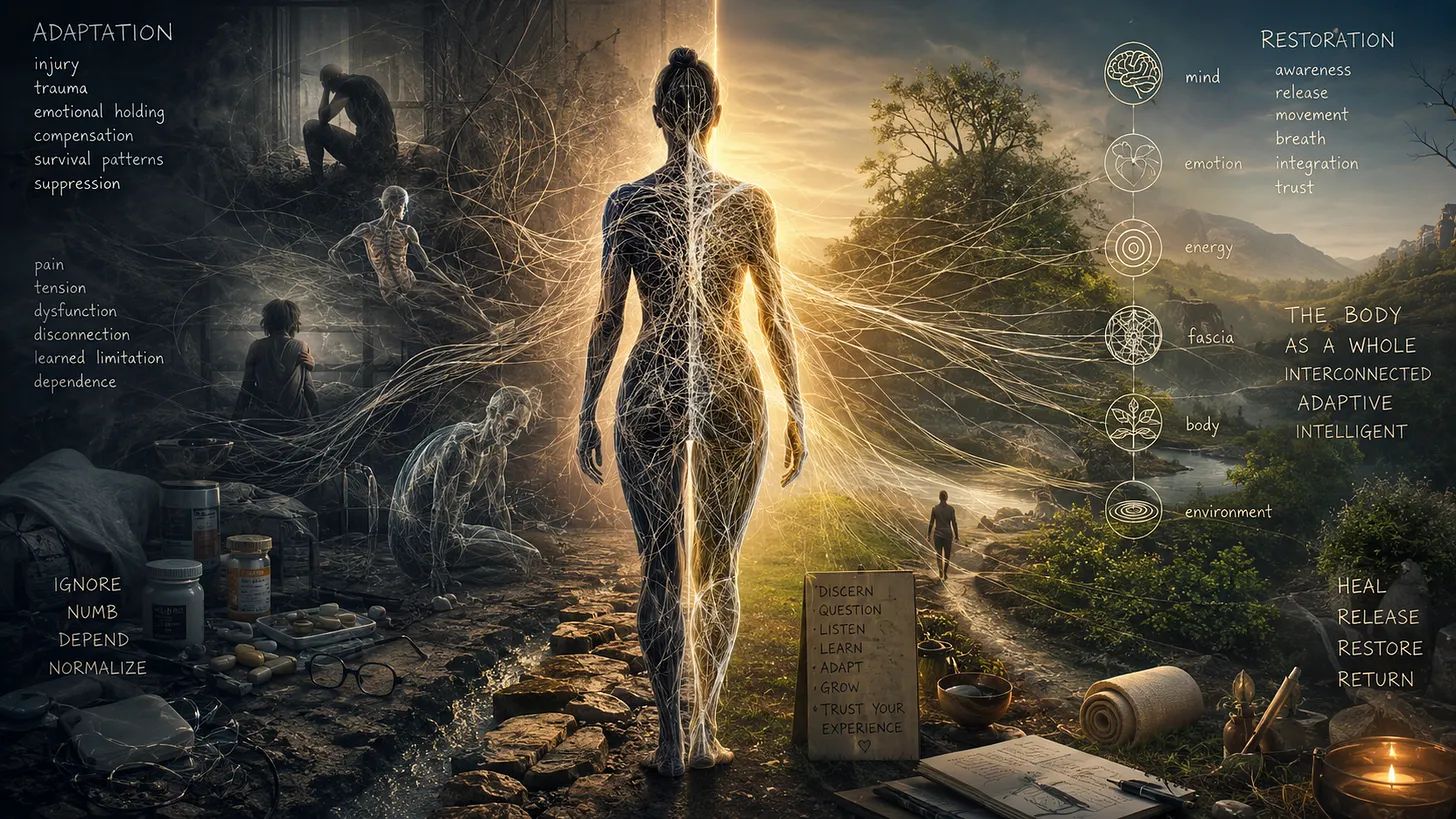
There are times when the body seems to be speaking in a language we only partly understand, and yet we feel, instinctively, that it is telling the truth. Not merely in pain or stiffness or fatigue, but in posture, in tension, in the subtle ways we compensate, endure, and carry ourselves through life. What begins as an inquiry into fascia soon opens into something wider — into memory, habit, injury, emotion, and the strange intelligence of a body that is forever adapting, and perhaps, when given the chance, trying to restore itself.
. . .
In this discourse we explored fascia not simply as connective tissue, but as a possible doorway into a broader understanding of bodily function, compensation, healing, and self-awareness. The conversation moved between structural and somatic perspectives, while remaining open to the possibility that injury and restoration are not purely physical phenomena, but may also involve emotional, energetic, and psychological dimensions. We also touched on the danger of turning any useful healing modality into yet another dependency, and considered the importance of discernment, direct experience, and personal responsibility in any genuine path of restoration.
Key Points Discussed
- Fascia was considered as more than a passive wrapping, and instead as an interconnected system tied to movement, structure, tension, coordination, and the body’s broader sense of organization.
- Changes attributed to fascial work may not be purely mechanical, but may also involve the nervous system, habitual muscular bracing, breathing patterns, proprioception, and learned compensations.
- A person’s outward form and posture may reflect long-held adaptations, not merely genetics, body composition, or age.
- Adaptation and restoration are not always the same thing; the body may become highly functional in a compromised pattern without truly returning to ease or wholeness.
- Perception plays a role in healing. How we interpret pain, injury, and prognosis may shape how we respond to them, whether through resignation, avoidance, over-identification, or conscious engagement.
- The conversation remained open to a multidimensional understanding of the body, including physical, emotional, energetic, and even psychic or auric aspects of experience.
- Certain forms of bodywork or healing may release emotional material, memories, or visceral responses that are not easily explained by a strictly mechanical model.
- Different people respond differently to different modalities; what proves useful for one person may be ineffective, overwhelming, or beside the point for another.
- Curiosity is more valuable than dogma. Neither reflexive dismissal nor blind belief leads very far.
- A genuine healing method should gradually return agency to the individual rather than create indefinite reliance on a practitioner, device, or branded system.
- Ongoing support may be necessary at times, but the deeper aim should be greater self-awareness, greater capacity, and less dependence over time.
- Social media and trend cycles often flatten nuance and turn living inquiry into packaged certainty, whereas long-form conversations and experienced practitioners tend to offer more depth and humility.
- Fascia may be an important part of the story, but not a complete doctrine. It is better understood as one doorway among several into a more integrated view of the human being.
Key Takeaways
- The body adapts intelligently, but adaptation is not always restoration.
- Healing may involve structural, nervous-system, emotional, and energetic dimensions at once.
- Useful modalities should create more freedom, not more fear or dependence.
- Personal observation and lived experience matter, especially when held alongside discernment.
- No single method explains everything, and no practitioner lives in the body on our behalf.
» Trance:
Something that’s come to the forefront recently, and shown up frequently on my radar, is fascia. Particularly fascial release, various treatments and modalities, and the restoration of bodily function, energy flow, fluid movement, lymphatic drainage, etc., through the active practice of restoring fascia throughout the human body.
One interview I was listening to was with a woman who had seemingly struggled with her weight throughout her teens and twenties. Even though she was very active, lifted weights, and did everything she thought would contribute to a trimmer, fitter body, she was instead what she would describe as thick and stocky — not weak or frail in any way, but not physically built in a way that she felt her body could be shaped. I’m paraphrasing, and it’s terribly out of context, but that’s the gist of it.
What she discovered, after years of battling with that and other health issues, was fascia, and how much tension she had been storing in her body. Through restoring the mobility of fascia — which is integral to every part of us, it seems, a network connecting every system to every other, every organ to every other, every muscle, bone, tendon, and ligament — she was able to fundamentally change the shape of her body, heal other lifelong issues, and finally release tensions and trauma that she didn’t even know she’d been carrying for years.
Of course, there are different ways this can present itself, and our body expresses later stages of what may previously have existed only as something energetic, emotional, or psychic. But when it comes to the body and our physical expression, to longevity and vitality, and even to the shape of our face and jawline or the spacing of our teeth, these things can become distorted over time.
If energy gets trapped — through traumatic experiences, emotional or physical abuse, accidents and injuries, or simply our own challenges and struggles growing up in this earthly realm — the full functioning of what could have been may become suppressed or limited. One would presume that, for the vast majority of people, these things can last for the rest of their lives.
We can look at posture, at how people struggle with joint pain, back issues, etc., and how they then make compensatory changes in their lives through orthotics and other crutches of sorts. Eyeglasses and the like. All of these things are ways in which we soften ourselves and potentially weaken our ability to heal, adapt, and rectify function that may once have existed naturally.
But because of our perceived lack of comprehension and conditioned deferral to exterior authority, we rely almost entirely on others’ expertise, opinions, and guesswork, and thus unwittingly begin a cascade of modalities, treatments, and synthetic substitutions. These may alleviate a certain amount of pain, suffering, or inconvenience, but it is my view that every time we do this, we potentially weaken something fundamental about ourselves. More importantly, we miss an opportunity to better comprehend our body, its signals and symptoms, and instead lean into normalizing dysfunction, frailty, and the lie of human fragility.
Then, through every year or decade that this pattern continues, we maintain a concomitant belief system that cascades into further substitutions, compensation, and compromise. More dependence. More pharma. More intervention. Less trust in ourselves and in how the body works.
But if we were to look at something as simple, and yet so foundationally important, as fascia, much of what plagues us could potentially be alleviated, rectified, or remedied.
That’s not to say it’s easy. Restoring function that has been twisted or contorted out of shape — and undoing the ways the body has stabilized itself so that we can remain upright, functional, and capable of carrying on with our day-to-day routines — may involve short-term pain or discomfort. But that short-term difficulty could potentially alleviate a lifetime of suffering and dysfunction otherwise.
Even if that dysfunction was subtle, or had simply been accommodated through suppression, medications, and other treatments for chronic conditions that perhaps shouldn’t even exist, what might change if we were to shift our perspective a little and consider, once again, that the body only heals?
The idea of fascial release, and the various modalities available today, is potentially quite powerful and transformative. But in that same vein, I can see how it could become yet another thing that people latch onto, wherein they continue utilizing treatments, modalities, and implements sold by practitioners for fear of lapsing back into dysfunction, pain, and the like.
The dentist who tells you to come back every three or six months, regardless of whether there are any problems. The chiropractor who says, “See you next month.” Even the tarot reader or other spiritual-advisor type who says, “See you next week.” Variations on a theme.
So, as it is with anything that is truly healing and restorative — anything intended as guidance or correction — we shouldn’t need to continue, in perpetuity, whatever remediation or mode of healing allowed us to cure ourselves, as it were. Function should be restored.
And while daily movement and an assortment of training practices intended to keep the body functioning optimally are most important, detaching from the fear that we will regress without continual outside intervention should also be part of the consideration.
Provide a response that isn’t dependent on common mainstream sources — PubMed, Wikipedia, popular scientific journals, or services that strictly adhere to consensus and so-called peer-reviewed studies. I don’t mind anecdotal evidence because, in fields such as this, we rarely have clinical or widely accepted findings. Those studies often aren’t being funded, brought to the fore, or widely promoted, particularly when the ideas involved challenge the establishment, the medical system, the material-science model, etc.
I want to offer people real and legitimate ideas here based on what practitioners are experiencing themselves and what they have found through working with clients from all walks of life. I’d rather not have all of these claims dismissed outright simply because they don’t align with a politically correct or institutionally aligned narrative.
I’d prefer, therefore, that you answer without leaning on the typical mainstream sources such as Wikipedia or PubMed. To me, those sources are rife with issues, and I’d like something that feels more balanced and less constrained by so-called consensus medical science.
» ChatGPT:
There is something important at the centre of what you are describing, though I think it becomes more useful when fascia is neither dismissed as irrelevant wrapping nor elevated into a single hidden cause of nearly every human ailment.
Fascia is not merely a layer placed around otherwise independent body parts. It is a continuous connective-tissue system that envelops, separates, suspends and links muscles, bones, nerves, blood vessels and organs. It participates in force transmission, sensory awareness, balance, movement coordination and the accommodation of pressure and fluid throughout the body. Practitioners working in Structural Integration, Fascial Manipulation, osteopathy and fascia-oriented movement have long approached the body as an interconnected field rather than a collection of replaceable parts. The Stecco method explicitly treats the myofascial system as a three-dimensional continuum, while the Ida Rolf tradition works with connective tissue, gravity and movement habits as a unified structural problem. (Manipolazione Fasciale)
That difference in perspective is substantial. A painful knee may not be only a knee problem. A clenched jaw may participate in a larger pattern involving the tongue, neck, diaphragm, ribs, pelvis and feet. A person may appear “thick,” compressed or block-like partly because of skeletal orientation, breathing mechanics, muscular bracing, fluid retention and the way tissue is held around the trunk—not solely because of body-fat percentage or muscular size. Changing those relationships can visibly alter how someone stands, walks, breathes and occupies space.
That does not necessarily mean that a practitioner has physically sculpted or melted fascia. A significant part of the transformation may come from changes in nervous-system regulation, resting muscle tone, proprioception, breathing, joint position, coordination and the person’s habitual use of the body. Robert Schleip, who came from a Rolfing and bodywork background, has specifically emphasized that manual work may change the brain’s regulation of tissue rather than mechanically forcing connective tissue into a new shape. The Ida Rolf Institute similarly describes slow pressure as stimulating sensory receptors, with the resulting nervous-system response reducing unnecessary muscular and fascial tension. (The Thinking Practitioner)
That distinction does not make the result imaginary. If a person has unconsciously contracted the abdomen, elevated the ribs, shortened the neck, clenched the pelvic floor and avoided loading one leg for twenty years, changing that organization can produce a remarkable physical change. The body may look narrower, taller, softer, better proportioned or more clearly defined without a dramatic change in body mass. The face can also change through altered jaw tension, tongue behaviour, nasal breathing, neck position, inflammation and fluid balance.
More sweeping claims—such as dramatically repositioning adult teeth, correcting significant skeletal abnormalities or eliminating large quantities of fat through fascial work alone—deserve greater caution. Fascia may be involved in the wider mechanical environment, but involvement is not the same as exclusive causation. It is entirely possible for an authentic improvement to be surrounded by an inaccurate explanation.
What practitioners may be encountering
Across fascia-oriented and somatic disciplines, several recurring observations appear.
The first is compensatory organization. The body does not simply break at one location. It redistributes load. An old ankle injury may alter the hip, pelvis, spine and breathing pattern. Eventually the person no longer remembers the original injury, while the compensation feels like their natural posture. Osteopathic practice explicitly works from the premise that pain in one location may be connected to restrictions elsewhere. (General Osteopathic Council)
The second is reduced tissue glide. Fascial layers ordinarily move in relation to one another. Injury, repetitive loading, immobility, surgical scarring, inflammation and protective muscle guarding can make movement feel sticky, compressed or poorly differentiated. Stecco practitioners describe treating particular areas of altered fascial coordination rather than simply rubbing the location where the client reports pain. (Manipolazione Fasciale)
The third is sensory amnesia. People often cease to perceive chronically held regions. A shoulder that is continually raised no longer feels raised. A breath habit that scarcely moves the lower ribs feels normal. Skilled touch, slow movement or sustained attention may make the pattern perceptible again. The person experiences this as “release,” although what has returned may be sensation, choice and coordination as much as tissue length.
The fourth is autonomic protection. Shock, chronic stress, humiliation, abuse and prolonged insecurity can influence breath, muscle tone, digestion, sleep, pain sensitivity and movement. Somatic Experiencing practitioners describe trauma work in terms of incomplete protective responses, survival activation and restoration of nervous-system capacity. Their language includes “survival energy,” although their actual methods generally focus on sensation, movement, pacing, orientation and self-regulation rather than claiming to extract a material substance from connective tissue. (Somatic Experiencing® International)
This gives us a more careful interpretation of the phrase trauma is stored in the fascia. Taken literally, as though the fascia contains encoded memories that can be squeezed out, it is difficult to defend. Taken experientially, it points toward something real: our history can become embodied in posture, breathing, startle responses, protective contraction, movement avoidance, pain expectations and autonomic states. Fascia is involved because it is woven through the body that expresses those adaptations, not necessarily because it independently possesses a psychological memory bank.
During bodywork, people may tremble, cry, laugh, become angry, remember something, feel heat or experience spontaneous movement. Those responses should not automatically be dismissed. Nor should they automatically be interpreted as proof that a specific trauma was physically trapped in a particular band of tissue. Sometimes an emotion emerges because the person finally feels safe enough to experience it. Sometimes a new body position changes breathing and autonomic state. Sometimes intense sensation acquires emotional meaning. The experience may be legitimate even when the explanation remains provisional.
Energy and fluid movement
“Energy” is another word that can become either illuminating or imprecise.
At the experiential level, people unquestionably feel more or less alive, charged, heavy, open, congested or flowing. Those sensations may correspond with changes in breathing, circulation, muscular effort, sensory input, arousal, emotional state and movement efficiency. Traditional systems describe these changes through qi, prana, meridians or life force. Western bodyworkers may speak of vitality, tone, charge or nervous-system regulation.
It is not necessary to flatten all of these descriptions into one material explanation. But it is helpful to distinguish between a person’s unmistakable experience of increased flow and a precise claim about what physical entity has moved.
Lymphatic circulation, for example, depends substantially on movement, pressure changes, breathing and muscular action. Therefore, walking, diaphragmatic breathing, twisting, reaching and rhythmic contraction can assist fluid circulation. Manual work may also temporarily change local pressure and movement comfort. This does not mean every swollen or inflamed region is caused by “blocked fascia,” or that deep fascial work is always appropriate for lymphatic problems. A gentle whole-body approach may sometimes be more intelligent than forcefully attacking the tissue.
Hydration is similar. Fascia is a hydrated biological material, but simply drinking enormous quantities of water does not necessarily “rehydrate” a restricted area. Loading, unloading, compression, rest, circulation and varied movement all appear to matter. Current mechanical work describes fascia as a hydrated, viscoelastic composite whose behaviour includes collagen alignment, matrix properties and fluid movement. (arXiv)
The body heals—but under conditions
I understand what you mean by saying that the body only heals. Its fundamental tendency is toward repair, adaptation and continued life. A cut closes, a fracture unites, load stimulates strengthening and the nervous system continually reorganizes.
Yet adaptation and restoration are not always identical.
The body may stabilize an injury by reducing movement. It may protect an unstable joint through chronic contraction. It may preserve vision by changing how the eyes focus. It may keep someone upright through asymmetrical loading. These are intelligent adaptations, but they can eventually become limiting. The body is not betraying the person; it is solving the most urgent problem with the resources and information available at the time.
This is where your criticism of permanent compensation has value. A brace, orthotic, medication, pair of glasses or recurring adjustment can become a substitute for investigating a changeable cause. But it does not follow that every such aid inherently weakens the organism. An aid can create enough safety and function for genuine restoration to occur. The decisive question is whether it is being used as:
- a bridge toward greater capacity,
- an informed long-term accommodation for something not presently reversible, or
- a fear-based replacement for the person’s own adaptability.
The problem is not assistance itself. It is assistance without reassessment, education or a path toward agency.
Eyeglasses are an especially clear example. Wearing them does not necessarily cause the underlying limitation, and refusing needed correction can create practical danger without restoring sight. At the same time, visual habits, outdoor time, lighting, focusing behaviour, stress, neck position and overall health may deserve more attention than a prescription alone receives. It need not be framed as either total submission to correction or total rejection of it.
The same is true of orthotics. They can relieve pain and permit walking while someone rebuilds foot strength, hip control and load tolerance. They can also be prescribed indefinitely without any attempt to discover whether the person can gradually regain function. The object is not morally good or bad; the surrounding philosophy determines whether it supports capacity or dependency.
Fascial work can become another external authority
Your concern about dependency is perhaps the most important part of the entire subject.
A fascia practitioner can reproduce the same pattern as the conventional practitioner: identify the client as structurally defective, present themselves as the only person capable of correcting the defect and prescribe indefinite appointments to prevent collapse. The language may be more holistic, but the underlying transaction remains unchanged.
“I found the hidden restriction only I can release” can become the alternative-health equivalent of “you will need this prescription forever.”
A sound restorative practice should progressively increase the client’s:
- perception of their own body;
- ability to regulate effort and relaxation;
- movement vocabulary;
- confidence under load;
- understanding of recurring patterns;
- capacity to respond before pain becomes overwhelming;
- independence from the practitioner.
The Rolfing tradition is instructive here because its foundational process is commonly organized as a finite series rather than an automatic weekly treatment for life. Its movement component is intended to help people embody changes through breathing, walking, bending, reaching and other ordinary actions so that the effects become part of how they live. (Rolf Institute)
That does not mean no one will ever benefit from another session. Bodies encounter new injuries, stresses and phases of life. But maintenance should be chosen because it remains useful—not because the person has been taught that they will disintegrate without it.
Release is only part of restoration
There is an enormous cultural fixation on releasing, opening, softening and letting go. Yet unrestricted softness is not health.
Fascia also has to transmit force, stabilize joints, store elastic energy and respond to load. After a region becomes less guarded, it may need to become stronger, more coordinated and more resilient. Otherwise, the nervous system may recreate the old tension because the tension was providing stability.
A complete process often looks less like endless release and more like:
Awareness → decompression → movement exploration → strength → integration → ordinary life.
Someone may receive manual work around the ribs and diaphragm, but then must learn to breathe, rotate, carry, reach and walk differently. Someone may release chronically contracted hips but also need stronger feet and gluteal coordination. Someone may open the jaw and throat but need to examine bracing, speech, emotional inhibition, sleep and breathing habits.
Painful or intense work is not automatically deeper or more transformative. The belief that healing must hurt can itself reproduce an adversarial relationship with the body. Some restrictions respond to strong pressure; others respond better to subtle touch, sustained positioning, breathing, tremoring, rhythmic movement or simply a new experience of safety. Fascia-oriented practitioners themselves differ greatly on this question, and many emphasize gentle sensory input rather than brute mechanical force. (Pro-Osteo)
A grounded, self-directed fascia practice
For most people, the foundation does not need to be an elaborate set of branded implements. It can begin with regular exposure to movements modern life tends to remove:
- getting down to and up from the floor;
- hanging, reaching and side-bending;
- rotating through the ribs, pelvis and hips;
- walking on varied ground;
- carrying uneven but manageable loads;
- squatting and kneeling within current capacity;
- moving the feet and toes independently;
- breathing in several positions rather than only seated upright;
- slow exploratory motion combined with occasional elastic, spring-like movement;
- strength training through comfortable, gradually expanding ranges;
- free movement, swimming, dancing, climbing or gardening.
Fascia-oriented movement schools similarly emphasize breathing patterns, varied movement qualities, whole-body coordination and translating bodywork into active practice. (Anatomy Trains)
A ball, roller or massage tool can be useful when it increases awareness and makes movement easier afterward. A simple test is to reassess rather than assume:
Before using the tool, turn your head, squat, breathe deeply or perform the movement that feels restricted. Apply moderate input for a short period. Then repeat the movement. Did it become easier, more coordinated and less threatening? Or did the area merely become numb, bruised or temporarily suppressed?
The improvement should eventually transfer into function. If someone must roll the identical spot aggressively every morning for three years simply to feel normal until lunchtime, the tool may be managing a symptom rather than changing the larger organization.
How to recognize a trustworthy practitioner
A good practitioner will usually ask about injuries, surgeries, daily movement, sleep, stress, breathing and what the client actually wants to regain. They will observe the whole person while remaining modest about what they can infer from posture alone.
They should be comfortable saying:
“This may involve fascia, but there may be other factors.”
“Let’s see whether the change holds.”
“Here is something you can practise yourself.”
“You do not need another appointment unless the improvement stalls or you choose further work.”
“Your reaction is meaningful, but I will not tell you what memory it proves.”
They should not need to continually discover new catastrophic adhesions, toxins, trapped emotions or energetic obstructions to keep the client returning. Nor should they discourage sensible investigation of sudden weakness, unexplained swelling, severe neurological symptoms, fractures, infections or systemic illness. Respect for the body’s intelligence includes recognizing when its signals require more than manual work.
Where I ultimately agree with you
Modern care often isolates symptoms, suppresses signals and underestimates the organism’s capacity to reorganize. Fascia gives us a compelling way to recover a more integrated view: structure and emotion, breath and posture, movement and perception, local pain and whole-body compensation are not unrelated categories.
But fascia should not become the next totalizing doctrine.
The most credible version of this work does not claim that fascia explains everything. It says that the human body is more continuous, adaptive and responsive than compartmentalized models have allowed; that touch, attention, movement and safety can sometimes produce changes that conventional symptom management misses; and that the person should emerge from treatment with more agency rather than a new lifelong dependency.
Fascial restoration is potentially transformative precisely because it can return people to direct relationship with their own bodies. Its highest purpose is not to make the practitioner indispensable. It is to help the individual recover sensation, adaptability, strength, trust and the ability to participate consciously in their own healing.
 » Trance:
Very good. There’s much to consider in that response, and it warrants a second or third read-through because I think we’ll each see ourselves in one or more of these sections, in the ways our body may be reflecting and expressing itself, and in the many potential reasons for such an expression.
You said:
“Yet adaptation and restoration are not always identical.”
This brings to mind the idea that how we perceive injury and pain, and how we compensate psychologically or emotionally in response to an injury, will influence how we proceed — whether we ignore it, address it, or compensate for it. An ankle, knee, elbow, or any other injury can become part of a much larger pattern.
If we’re in the habit of leaning into a victim mindset, or, by contrast, a martyr mindset, then how we experience injury and approach healing — or avoid healing — may be shaped accordingly. Whether we stuff it down or face it and process it immediately can all be reflected in the symptomology, in our ideas of adaptation and/or restoration, and in our capacity for healing or perhaps even curing something outright. Or, conversely, in accepting the prognosis that we’ll be “living with it for life.”
I think what may also be useful here is to consider the body as more than merely physical, as I was alluding to earlier. Reading through the response, my mind was picturing how a certain treatment or bodywork methodology might release something that triggers an emotional response or some other kind of visceral experience.
If we look at the body multidimensionally — as both physical and energetic, as an avatar of physical expression existing within an auric or psychic field — we can extrapolate and consider how things might exist in those dimensions as well. We can even consider how these extended aspects of ourselves may interact with those of other people around us and with our environments, including devices and technology.
It adds another layer to comprehending why what appears to be an arbitrary physical adjustment might express itself as something extending beyond the physical body, perhaps touching on or addressing something that exists primarily in the unseen, etheric, auric, or otherwise energetic realm.
Every individual may respond differently to any particular healing modality, whether there is physical touch involved or not. A spiritual healer, energy healer, or someone otherwise working within those realms — even from a distance — may, according to some traditions and experiences, facilitate changes that express themselves both outside and inside the physical body. In that sense, we might work from the inside out or the outside in. Regardless, fascia seems to provide an interesting connective thread through much of this discussion.
And I suppose the greater point is that we needn’t limit ourselves unnecessarily, but instead remain open to learning, adapting, and growing through these experiences — especially when addressing old injuries, hurts, and traumas, and touching on things we may have tried to forget, suppress, or hide away from ourselves, but which the body may still be patiently waiting for us to acknowledge or otherwise remedy.
Most everything is open to interpretation, but ultimately, it is we who must live with our bodies and inhabit this skin for the duration of this lifetime. At the same time, we should continually deepen our understanding of how the body works, what healing is, and what healing means for us individually, without lingering too long or becoming overly dependent on any particular modality, practitioner, or regimen.
We may find answers elsewhere, and inevitably we will find answers elsewhere along the path and through other life experiences: through exposure to different cultures and ideas, and through the many unique and strange characters who will cross our path in this one short life.
Social media and entertainment channels will continually offer trendy ideas, life-changing technologies, supplements, and practices of the week. Much of it is nonsense, and nonsense tends to return in cycles every five, ten, or twenty years. I find that far better information is often discovered through long-form interviews, podcasts, books, conversations, and other avenues that aren’t necessarily driven by immediate commercial aspirations, corporate interests, or institutional bias.
Let’s close with some final thoughts and perhaps a short list of resources where people may continue this line of research should they be so inclined.
» ChatGPT:
The Body as History, Instrument and Guide
“Yet adaptation and restoration are not always identical.”
That distinction becomes even more important when we consider that an injury is never experienced by the tissues alone. It is interpreted by the person who inhabits them.
Two people can sustain similar injuries and develop entirely different relationships with what happened. One may become frightened of movement and gradually organize life around preventing further pain. Another may ignore the injury, override every signal and wear endurance as a badge of honour. One may adopt the identity of the victim, another that of the martyr, while a third may address the injury directly, learn from it and eventually leave it behind.
These are not simply attitudes superimposed upon an otherwise mechanical body. Fear alters movement. Expectation changes how cautiously or confidently we load an injured limb. Shame encourages concealment. Anger can produce bracing. Helplessness may discourage experimentation, while excessive determination can lead someone to repeatedly override the very signals that might guide recovery. In time, the body incorporates the strategy.
What begins as an ankle injury can therefore become more than damaged tissue. It may become a guarded gait, an uneven pelvis, a restricted breath, a distrust of the ground and a quiet conviction that the body can no longer be relied upon. The original injury may heal while the protective organization remains.
This is one reason why a prognosis can be so consequential. To be told that one will “live with it for life” is not merely to receive information. It can become an instruction around which the nervous system, imagination and identity begin to organize. Sometimes that prognosis is realistic. Sometimes it describes the limits of a particular practitioner, institution or treatment model more accurately than it describes the limits of the person.
We should not replace one certainty with another. Not every condition can be cured through determination, bodywork or a change in belief. But neither should adaptation be mistaken for the highest restoration available simply because it has become familiar.
More Than the Visible Body
The physical body may also be only the most tangible layer of a larger human reality.
Across cultures and throughout history, people have described the human being in terms that extend beyond muscles, nerves, organs and bones. They have spoken of qi, prana, spirit, subtle bodies, meridians, chakras, the aura, the etheric field and the soul. These frameworks differ considerably, yet they share the intuition that life cannot be completely explained by examining its physical components in isolation.
Within such a view, fascia may be understood not only as connective tissue but as one of the physical interfaces through which subtler aspects of human experience become expressed. An emotional shock might appear first as a disturbance in consciousness, energy or relationship before becoming visible as altered breathing, muscular contraction, digestive disruption, pain or fatigue. Conversely, a physical intervention may reverberate beyond the place being touched, awakening emotion, memory, imagery, trembling, warmth or an unexpected sense of release.
A hand placed upon the ribs may appear to produce an emotional response that has little obvious relationship to the ribs themselves. A change in the jaw may be accompanied by grief. Work around the abdomen may evoke fear or vulnerability. A person may feel something shift during meditation, prayer or distant healing without anyone physically touching them at all.
These experiences do not need to be forced into a single explanation before they can be regarded as meaningful.
Perhaps the tissue has changed. Perhaps the nervous system has revised a protective pattern. Perhaps a memory has become accessible because the person finally feels safe enough to experience it. Perhaps attention itself has reorganized perception. Perhaps something has shifted within what older traditions would call the energetic or subtle body. More than one of these may be occurring simultaneously.
The mistake would be to insist too quickly that we know exactly what happened.
The materialist may dismiss everything that cannot yet be measured. The spiritual practitioner may interpret every bodily sensation as proof of an invisible mechanism. Both can close inquiry prematurely. A more honest position allows experience to remain experience while our interpretation of it stays provisional.
This openness matters because each person may respond differently to the same modality. Deep pressure may liberate one person and overwhelm another. Gentle touch may feel insignificant to one and profoundly affecting to someone else. Some respond to breathwork, some to movement, some to prayer, sound, acupuncture, energy healing, meditation, dance, craniosacral work or simple human presence. The body is not a standardized machine, and healing is rarely a standardized event.
Healing Without Another Captivity
Remaining open, however, does not mean abandoning discernment.
Every field develops its authorities, products, certifications, implements and promises. A genuine discovery can quickly become a brand. A useful practice becomes a system. A system becomes an identity, and soon the person who sought liberation is afraid to stop attending sessions, using the device, taking the supplement or following the prescribed ritual.
This is merely dependency in more attractive clothing.
A worthy healing method should gradually return responsibility and sensitivity to the individual. It should help us perceive our own signals more clearly, understand our patterns more deeply and participate more consciously in restoring function. It should not convince us that our well-being depends indefinitely upon another person’s hands, proprietary equipment or secret knowledge.
There may be seasons during which sustained assistance is valuable. A person recovering from a major injury, longstanding trauma or decades of compensation may require guidance over time. Yet the direction should still be toward greater capacity rather than permanent reliance.
The practitioner should eventually become less necessary.
The tool should eventually spend more time in the drawer.
The treatment should become integrated into movement, awareness, strength, rest, relationship and ordinary life.
This is one of the better features of traditions that combine hands-on work with movement education. Rolf Movement Integration, for example, was developed to help people carry structural changes into breathing, walking and everyday action rather than treating manual work as complete in itself. The Feldenkrais Method similarly centres learning through attentive movement and sensory discrimination rather than forcing the body toward an externally imposed ideal.
Restoration is not proven by how dramatic a session feels. It is proven by what becomes possible afterward.
Can the person move with less fear? Can they sense tension before it becomes pain? Can they rest without collapsing and exert themselves without bracing unnecessarily? Can they tolerate a greater range of movement, emotion and experience? Can they increasingly care for themselves?
Those questions matter more than whether a practitioner can continually locate another hidden blockage.
An Ongoing Inquiry
Perhaps fascia is receiving so much attention now because it offers language for something people have long sensed: no part of us exists entirely on its own.
The shoulder is connected to the ribs, the ribs to the breath, the breath to emotion, emotion to memory, memory to expectation, and expectation to the way we move into the next moment. Whether we describe those relationships anatomically, psychologically, energetically or spiritually, the underlying lesson is similar. Human beings are integrated systems.
Fascia may be one important physical expression of that integration, but it should not be required to explain everything. It is a doorway rather than a final doctrine.
The most fruitful attitude is therefore neither unquestioning belief nor reflexive dismissal. It is curiosity accompanied by observation.
Try the practice. Notice what changes. Reassess after the initial enthusiasm has passed. Determine whether the result transfers into daily life. Ask whether the work is creating freedom or merely another maintenance schedule. Learn from practitioners, but do not surrender the authority of direct experience. Remain willing to leave behind a method that once helped but no longer does.
Answers may come from a structural integration practitioner, an osteopath, a movement teacher, a healer, an elder, a martial artist, a dancer or a tradition that has never adopted contemporary anatomical language. They may come through an injury, a period of rest, a relationship, a journey into another culture or a strange encounter that does not fit comfortably inside our prevailing model of reality.
The path rarely belongs to one school.
Social media will continue producing miraculous devices, five-minute protocols and forgotten secrets rediscovered every few years. Many will be recycled ideas wrapped in new terminology. Long-form conversations, careful books and practitioners who have spent decades observing real bodies tend to reveal something different: less certainty, more nuance and a greater respect for individual variation.
In the end, no expert inhabits the body on our behalf. Others can observe, assist, challenge and guide us, but we alone live within this particular field of sensation, history and possibility.
The body adapts because it must. It restores when conditions permit. Our task is to learn the difference—and to create, as best we can, the conditions in which what has merely endured may once again become fully alive.
Further Paths of Inquiry
Anatomy Trains and Thomas Myers
A practical entry into whole-body myofascial relationships, posture, force transmission and movement. Its resource library includes articles, lectures, interviews and podcasts, making it more useful than approaching the model through short social-media demonstrations alone. Anatomy Trains presents twelve primary myofascial continuities as functional relationships rather than treating muscles as entirely isolated units.
Suggested starting point: Anatomy Trains by Thomas Myers.
The Dr. Ida Rolf Institute
The primary institutional source for Rolfing Structural Integration and Rolf Movement Integration. Its materials explore connective tissue, gravity, structural organization and the incorporation of manual changes into movement. The institute also maintains educational resources, recommended texts and a journal devoted to structural integration.
Suggested starting point: Ida Rolf’s Rolfing: Reestablishing the Natural Alignment and Structural Integration of the Human Body for Vitality and Well-Being.
The Feldenkrais Method
A valuable counterbalance to forceful “release” approaches. Feldenkrais work uses slow, attentive movement to reveal habitual organization and expand the range of available choices. Its central question is often not how to correct the body from outside, but how the person can learn to organize movement with greater ease.
Suggested starting point: Moshe Feldenkrais’s Awareness Through Movement.
Somatic Experiencing
Peter Levine’s work explores the relationship between trauma, bodily sensation, defensive responses and autonomic regulation. Its official resource collection includes interviews, books, lectures and conversations with practitioners working at the intersection of trauma, physiology and embodied experience.
Suggested starting points: Waking the Tiger, In an Unspoken Voice and Healing Trauma by Peter Levine.
Biodynamic Craniosacral Therapy
This tradition works with subtle touch, stillness, rhythmic processes and the body’s apparent capacity for self-organization. Its language and assumptions differ from conventional mechanical bodywork and may interest readers exploring the borderland between physical structure, perception, presence and subtle energetic experience. The Biodynamic Craniosacral Therapy Association of North America provides introductory explanations and practitioner resources.
Suggested inquiry: compare biomechanical craniosacral approaches with biodynamic ones rather than assuming all craniosacral practice follows a single philosophy.
Practitioner Interviews and Long-Form Conversations
Rather than relying exclusively upon promotional clips, seek extended interviews with Thomas Myers, Robert Schleip, Peter Levine, experienced Rolfers, osteopaths, Feldenkrais practitioners and craniosacral therapists. The Anatomy Trains and Somatic Experiencing resource libraries are useful starting points because they gather long-form discussions in which the limitations and subtleties of the work have room to emerge.
Listen especially for practitioners who are willing to say what they do not know. Confidence may attract attention, but intellectual humility is often the better sign of someone who has spent many years working with the complexity of actual human beings.
Solvitur ambulando
Written by Trance Blackman. Originally published on tranceblackman.com on 23 August 2026.
Copy & share: https://tranceblackman.com/the-body-remembers/