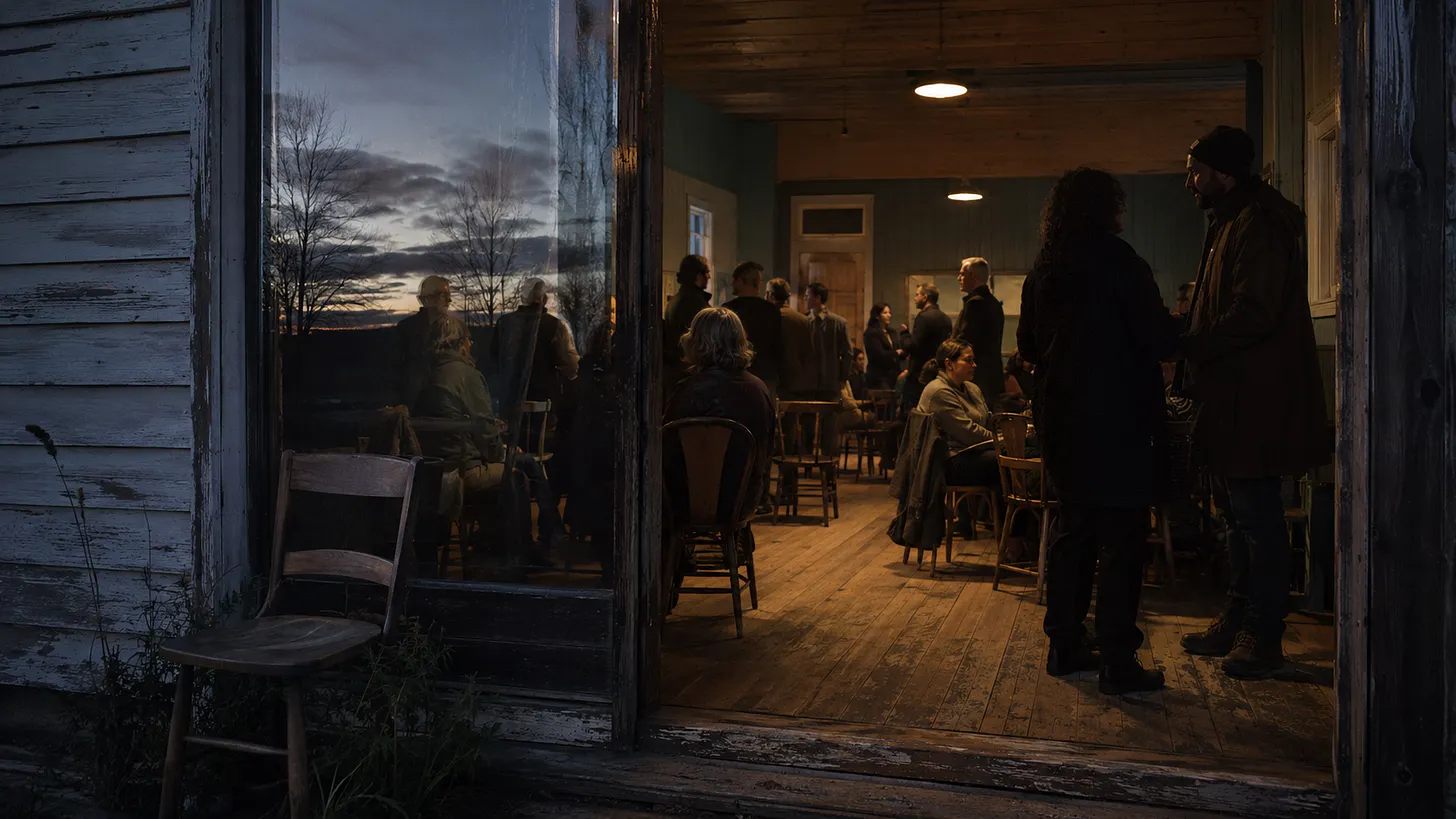
There’s something curious about being invited to leave social media by an ad on social media. Another platform, another promise of real connection, and presumably another set of boundaries we’ll discover when we run into them. I understand the impulse. We’ve spent years complaining about these places while filling them with our lives. But before we settle into another room, I’d like to know who gets to decide what we’re allowed to say in it.
. . .
In this discourse we explored Gander Social and the broader question of what another social network can meaningfully offer. The discussion moved through Canadian identity, moderation, institutional influence, human verification, and the difficulty of drawing people away from platforms already woven into their lives. Beneath the skepticism was a question about the kind of space we actually need: somewhere that can accommodate serious disagreement without manufacturing outrage or quietly narrowing the conversation.
Key Points Discussed
- Gander’s Canadian identity and whether national belonging offers enough reason to join another network.
- Ownership, funding, adviser relationships, and the difference between public credibility and earned trust.
- The boundary between moderating harmful conduct and restricting uncomfortable ideas.
- Institutional assumptions behind terms such as credibility, consensus, safety, and Canadian values.
- Why open network architecture does not necessarily produce an open culture.
- Human verification, protected pseudonymity, and the limits of either in ensuring authentic participation.
- The distinction between scalable identity checks and the ongoing demands of moderation.
- The accumulated relationships, memories, and practical uses that keep people on established platforms.
- Our strange bargain of supplying content and personal information, then sometimes paying for access or visibility.
- Social media as both a reflection of collective tensions and a mechanism for amplifying them.
- The possibility of sustainable niche communities without an ambition to replace Facebook.
- Whether a shared Canadian forum could make room for the country’s actual disagreements.
Key Takeaways
- Dissatisfaction with existing platforms does not necessarily create demand for another one.
- Moderation decisions reveal more than promises of openness.
- A verified person is not necessarily an authentic or independent participant.
- Small, committed communities may have value without mass adoption.
- Civil discourse requires room for strong disagreement.
- These impressions of Gander remain provisional, not conclusions from firsthand use.
» Trance:
What is Gander Social?
» ChatGPT:
Gander Social is a new Canadian social network that officially launched in 2026. The basic pitch is essentially: “What if we rebuilt social media without engagement farming, surveillance advertising, bots and opaque recommendation algorithms?”
It’s based in Ottawa and built on the AT Protocol—the same open-network technology underlying Bluesky—so the long-term intention is interoperability rather than trapping everybody inside another proprietary silo. (LinkedIn)
A few things make it genuinely interesting:
- Feeds are primarily chronological, and Gander emphasizes letting you choose whose content you see rather than having an algorithm continually inject provocative material. It has customizable feeds and “Nests” for people/creators you especially want to follow. (Gander Social)
- People who want to post, comment or chat must pass a one-time “Human Check.” In Canada this can use Canada Post’s Identity+ system or certain institutional-email methods. The idea is to greatly reduce bots, sock puppets and fake accounts. You can browse without verification. (Gander Social)
- It doesn’t publicly emphasize like counts and explicitly says it wants “connection over clout.” (Gander Social)
- News links can carry information about publisher political leaning, credibility and fact-checking history. (Gander Social)
- It says Canadian user data is hosted in Canada and that it won’t sell personal information or use surveillance advertising. Its proposed business model is ethical advertising, optional subscriptions and infrastructure/services. (Gander Social)
- Moderation is explicitly Canadian in orientation: Canadian law, Charter principles, human-rights frameworks and related Canadian institutional norms rather than American First Amendment norms. (Gander Social)
It is also more developed now than some older articles suggest. You may encounter 2025 coverage describing Gander as an unreleased beta, but that information is outdated. The iOS and Android apps are now available, there is a browser version, and the Canadian App Store currently shows it as an active social-networking app. (Google Play)
One important wrinkle: technically anyone worldwide can create an account and browse, but as of August 2026, Gander’s Human Check is only available to people in Canada. Consequently, active posting/commenting/chatting is presently effectively Canadian. International verification is supposed to come later. (Gander Social)
The bigger ambition is actually more interesting than simply “Canadian Twitter.” Gander calls its underlying Canadian social infrastructure Wingspan. The analogy they use is email: different apps could exist on a shared network, users could move between services, and their social identity and relationships would not necessarily belong permanently to one corporation. (Gander Social)
Given our previous discussion about Bluesky, I’d characterize Gander as potentially much closer to what you were looking for: not “another ideological Twitter alternative,” but an attempt to alter the actual incentives that make contemporary social media obnoxious. Whether it succeeds will depend heavily on whether it gets enough interesting people onto the network. A beautifully designed social network with nobody there is still a beautifully designed empty room.
And it is very young. The company was founded only in 2025 and LinkedIn currently describes it as having 2–10 employees, so I wouldn’t treat all of its aspirations as accomplished infrastructure yet. (LinkedIn)
If you’re wondering whether it’s worth adding Trance Blackman / Entranced Studios to Gander alongside X, Instagram and LinkedIn, I think that’s actually worth examining. The AT Protocol angle in particular could make it considerably more useful than opening yet another isolated social account.
» Trance:
It makes me think of Mastodon. Any notable people as founders? Is it a subsidiary of some other larger corporate interest?
» ChatGPT:
The Mastodon comparison is apt, but Gander’s structure is quite different from the usual “mysterious startup backed by a bigger tech interest” story.
Gander Social Inc. appears to be an independent, privately held Canadian company, not a subsidiary of Bell, Rogers, Meta, a U.S. venture fund, or some other larger corporate parent. Its own securities filing identifies it simply as GANDER SOCIAL INC., incorporated in British Columbia on June 24, 2025.
The founders are not household-name tech billionaires. The founding group disclosed in its investment documents is:
- Ben Waldman — founder, CEO and director. He has 25+ years in digital/creative strategy and founded The Art Department, a boutique agency working with NGOs, Crown corporations and social-impact organizations. At the time of the crowdfunding disclosure he was by far the largest founder-shareholder, with 47.6% of the issued shares before dilution.
- Jennifer Mitchell — cofounder and COO, an operations executive with startup and multinational experience. She held 16.3% on the same basic basis.
- Stirling Coulter-Hayward — cofounder and head of communications, with a background including Refugee 613, Mennonite Central Committee Canada and the Royal Canadian Mint. He held 12.5%.
- Alison Pearce — cofounder and head of community, with a marketing/community-building background. She also held 12.5%.
So, at least at formation, roughly 89% of the issued shares were sitting with those four founders. That is about as far from “quietly owned by Big Tech” as one could reasonably expect from a startup.
The financing history reinforces that. Instead of doing a conventional large VC round, Gander ran an equity crowdfunding campaign through FrontFundr. More than 2,500 Canadians ultimately invested just over $2 million. The company has explicitly said it chose this route partly because traditional VC investors tended to ask about the eventual “exit,” whereas Gander says it does not want to build around a growth-at-all-costs exit strategy.
There are nevertheless a couple of notable people around it.
One is Blaine Cook, who is genuinely significant in social-network history: he was Twitter’s first lead developer/CTO-era technical figure and is listed as an adviser to Gander. That actually gives the project a little more technological pedigree than the founders’ names alone would suggest.
The other two names you may encounter are Dragons’ Den investor Arlene Dickinson and Canadian technology broadcaster Amber MacArthur. Both were associated with Gander as advisers early on, and Dickinson publicly described herself as an adviser and investor in late 2025. However, this is important: by June 2026, Dickinson publicly stated that she and Amber Mac were no longer involved with Gander as either investors or advisers. Reporting says there had been a disagreement or misunderstanding about the nature of their involvement and how their association was being presented.
That is worth knowing because promotional material from 2025 could leave you with the impression that Dickinson and Mac were still formally behind it. They aren’t, according to their own more recent statement.
There is one structural wrinkle I find more interesting than the celebrity names. Gander has converted itself into a British Columbia Benefit Company. That is still a for-profit corporation, but its articles contain a legally stated public-benefit purpose, and it has to consider that alongside shareholder profit and publish benefit reports. Gander states its purpose as building social infrastructure that protects user dignity, advances Canadian digital sovereignty and strengthens democratic participation.
And the crowd-investors really do own common shares; it isn’t Kickstarter-style “community ownership” marketing. There is, however, a voting-trust arrangement covering the crowd shares. The 2025 offering document showed 1,368 shareholders’ shares—11.1% of voting shares at that stage—under a voting trust administered by cofounder Alison Pearce. That’s not necessarily sinister; it avoids trying to administer a startup with thousands of individual tiny shareholders voting independently. But it means “community owned” shouldn’t be interpreted as direct-democracy governance.
So my current read is: I don’t see evidence of a hidden corporate parent. The paper trail actually looks unusually transparent: founder ownership, crowdfunding terms, voting structure and financing are publicly documented.
And this is where it diverges somewhat from Mastodon. Mastodon is fundamentally an open-source protocol/software ecosystem of independently operated servers. Gander is a conventional Canadian corporation building a particular social service, but it is doing so on the open AT Protocol and talking about interoperability and distributed infrastructure. It’s therefore probably closer conceptually to Bluesky with a Canadian governance/business model than to Mastodon itself.
There is also an interesting potential tension I would want to investigate before getting too enthusiastic: who ultimately controls Gander if its political/cultural definition of “Canadian values” changes? Their ownership looks reassuring, but ownership is only half the question. Moderation governance, the Benefit Company wording, the voting trust, government relationships and who decides what counts as acceptable discourse may tell us considerably more about what the platform will become.
That, I think, would be the worthwhile next layer to dig into.
» Trance:
It does bring up some questions. I know that the Canadian mainstream, at a minimum, has suffered a lot of left-leaning bias and wokeism. I’m certainly not interested in something nonsensical that would lean into corralling those who are leaning into freedom seeking or conspiracy research, because that would be completely pointless. All the big platforms seem to have dropped a significant amount of their censorship and heavy-handed content policing that existed only a couple of years ago. It’s not quite a free-for-all, but it is eerily open compared to where it was in 2020-2021.
They do specifically mention that trolls are booted, and there would certainly be more stringent controls than what would be seen on Instagram or X. But as you said, who determines these boundaries and what defines a troll, save the obvious? If you criticize the rainbow flag, are you a troll? If you are resistant to transgenderism, are you a troll? If you criticize the government at any level, are you a troll?
I don’t envy their challenge of trying to bring in a novel social media platform in today’s climate. We’ve been trained to hide behind avatars and pseudonyms, so the whole idea of real people and real connections is borderline dubious. I tried Bluesky probably a year ago and was astonished at how openly and bluntly left-leaning it was. I guess it’s all in the name, and in a society that is programmed and conditioned to believe in the red versus blue nonsense, there’s no big mystery there.
» ChatGPT:
That is exactly the point at which I’d become cautious about Gander—not because I see evidence that it is secretly partisan, but because its written moderation policy contains enough subjective language that the eventual culture will depend enormously on who interprets it.
Gander explicitly says it is “not here to moderate topics, or opinions” and that people can “debate politics,” “criticize public figures,” “challenge ideas,” and be “sharp, funny, skeptical, or frustrated.” Its FAQ likewise says lawful opinions are welcome even when others disagree. So criticizing Trudeau, Poilievre, provincial governments, immigration policy, Pride politics, gender ideology, COVID policy, Indigenous policy, media institutions, etc., is not on its face prohibited.
But the actual rules introduce some important judgment calls. Gander prohibits content that “targets, attacks, or discriminates against” people on protected grounds including sexual orientation and gender identity/expression. It also prohibits “exclusionary rhetoric,” harassment, shaming, and certain forms of historical denial.
That means your examples are useful tests.
Saying, “I don’t think the Pride flag belongs on government buildings,” should logically fall under political opinion.
Saying, “I believe biological sex is materially relevant to women’s sport,” is an argument about policy and sex/gender and, based purely on Gander’s stated principle that ideas can be challenged, should be permissible.
Criticizing gender-transition policies for minors should likewise be legitimate political/medical-policy discussion.
But once a moderator has to distinguish “criticism of an ideology or policy” from “an attack against people because of gender identity,” interpretation enters the equation. Gander has not yet accumulated enough years of moderation decisions for us to know exactly where that line settles in practice.
And there is another provision I think is potentially more consequential for someone interested in heterodox research: its misinformation rule.
Gander says it removes “false claims regarding medical treatments or public health crises that contradict expert consensus,” as well as misinformation judged capable of causing physical harm, property damage, or public-safety threats.
That is considerably stronger than merely banning fraud or deliberate deception.
“Contradicts expert consensus” would have been an exceptionally contentious standard during 2020–22, because expert consensus itself changed repeatedly and disagreements existed among credentialed specialists. A platform using that rule during another pandemic or similarly unsettled event necessarily has to decide who qualifies as the authoritative consensus and at what point disagreement becomes removable misinformation.
That’s the clause I’d watch most closely.
There is a potentially encouraging counterweight: Gander explicitly recognizes educational, documentary, scientific and artistic context, including journalism, academic material, criticism and documentary material. It also says moderation decisions involve human review and that users can appeal removals to another human moderator.
Their news-source system is another mixed bag. Rather than prohibiting controversial links, Gander says links aren’t suppressed and political or controversial news can be shared. But it currently attaches source-context information using Media Bias/Fact Check (MBFC).
That doesn’t prevent you from reading anything, which I much prefer to outright censorship, but it still introduces a curator into the information chain. Somebody has to classify what counts as “credible,” “left,” “right,” “questionable,” and so forth. I wouldn’t automatically accept MBFC—or any one organization—as an epistemological referee.
The “troll” question is similar. Their more detailed explanation actually defines trolling mostly behaviourally: harassment, browbeating, abuse, intimidation, coordinated attacks, repeated bad-faith interaction, slurs, etc. They explicitly say moderation is supposed to focus on “how we communicate our thoughts and ideas, rather than their thoughts and ideas themselves.”
If they genuinely maintain that distinction, it could work rather well. There is a meaningful difference between:
“Your argument about immigration makes no economic sense, and here’s why…”
and following somebody through every thread calling them an idiot.
You don’t need ideological censorship to eliminate the second behaviour.
The danger is concept creep. A community starts with “don’t harass people,” then “harm” expands to include discomfort, then “attacking an identity” expands to include criticizing propositions associated with that identity, and eventually perfectly ordinary disagreement becomes categorized as making someone “unsafe.” That phenomenon isn’t unique to the political left; any culturally homogeneous moderation team can begin interpreting disagreement through its own assumptions.
Gander’s institutional references do tell us something about its likely cultural centre of gravity. Its guidelines explicitly cite Canadian human-rights frameworks, Truth and Reconciliation principles, UNDRIP, Canadian journalism standards, academic ethics standards and consultation with people possessing “lived experience.”
Those aren’t inherently partisan documents or concepts, but taken together they place Gander fairly firmly inside the contemporary Canadian institutional-progressive vocabulary. I wouldn’t describe the written policies as politically neutral in the philosophical sense. They’re closer to Canadian liberal-pluralist institutionalism: wide political discussion inside boundaries established around protected identities, inclusion, harms and accepted institutional standards.
That’s materially different from X’s present philosophy, which is closer to “if it is legal, there needs to be a compelling reason to remove it.”
There’s also an irony in the Mastodon/Bluesky comparison you raised. Decentralized technology does not guarantee ideological diversity. Mastodon demonstrated that rather spectacularly. Its architecture is decentralized, but individual servers can be extraordinarily homogeneous because administrators establish their own rules and entire instances can block other instances. Bluesky likewise has an open protocol, yet its early adopter population created a very recognizable political culture.
Technology determines who can control the network. It doesn’t determine what kind of people arrive first and establish its social norms.
That may be Gander’s greatest unknown right now.
The Human Check could actually help. Removing armies of anonymous bots, engagement farmers and disposable sockpuppets could make disagreement substantially more civilized. But there’s a paradox in requiring people to establish that they’re real while simultaneously protecting pseudonymity. Gander does explicitly prohibit revealing a pseudonymous user’s identity, so apparently their intention isn’t “everyone must use their legal name”; it’s more like one verified human being behind each participating account.
I rather like that distinction.
Your Bluesky experience also illustrates why I wouldn’t judge Gander solely from its constitutional documents. What matters six months or two years from now will be the population. A platform can have beautifully neutral rules and nevertheless become culturally unbearable because 80% of its active users share essentially the same worldview. Conversely, a platform can have fairly restrictive civility rules but remain intellectually interesting if genuinely divergent people inhabit it.
So if I were evaluating Gander for actual use, I wouldn’t ask first, “Is this left or right?”
I’d run a much more revealing test:
Can reasonable people publicly disagree about COVID policy, immigration, climate policy, gender ideology, Indigenous policy, Canadian foreign policy, abortion, MAID, establishment journalism and the legitimacy of government institutions without their disagreement itself becoming a moderation offence?
If yes, they’ve built something interesting.
If the answer turns out to be, “Certainly—you may disagree, provided your conclusions remain inside the range our moderators consider acceptable,” then they’ve merely reconstructed the 2021 social-media environment with Canadian branding.
At this stage, their written material leaves both possibilities open.
» Trance:
Well, that’s exactly the issue, isn’t it? For the past 20 years — which is about as old as Facebook is, with Twitter/X and Instagram not too far behind — we’ve been trained away from civil, logical, reasonable, patient and open debate in favor of what you’ve already laid out. My Facebook account was “hacked” and shut down in 2021. I guess I was just being a little too loud about contentious and controversial topics, though all I was trying to do was inform and educate people about something that I believed, and still believe, to be extremely harmful regarding the medical paradigm and certain injection campaigns. And Trudeau… He most certainly served his purpose for the machine. Regardless, what you’ve listed as their cultural center of gravity raises some red flags.
I don’t see this as a real business idea as opposed to getting a pulse on how Canadians in general are feeling about their nationhood, their social culture or narratives, their political biases. It also seems to me that they took advantage of the corporate and industrial clout of the two significant characters you mentioned who were initial investors. That’s hardly a novel practice. But the fact that those two have distanced themselves within a year is notable.
I certainly don’t think that they’re going to last very long nor reach any significant numbers in membership. Something about the whole thing just feels off. I may be wrong. Granted, they’re trying to fit into a very neat and narrow bandwidth. And they certainly don’t have the horsepower of an X or Facebook. Nor the history of having had to weather storms of any kind yet. As obnoxious or contentious and fractious as the leading candidates can be, they are powerhouses and the vast majority will still rely on them.
To me, there’s no advantage to getting in on the ground floor, so to speak, as there may have been a few years ago at the height of what may have been the most sensitized, traumatized, and divided our society has been in generations. Social media networks exacerbated the problem. And a couple of years after the fact, they were all shown to have been directly and indirectly influenced by the political regime of the moment. The medical industrial complex. Institutions. I think people are more inclined to simply divest their time and interest in social media in general. It seems to me they’re more on the wrong side of the trend.
» ChatGPT:
I think your “wrong side of the trend” argument has merit, with one important qualification: people are not actually abandoning social media in large numbers. They may be tiring of what social media has become, but they are still using it heavily.
Canadian data makes that distinction fairly clear. In 2025, 89% of Canadians reported using at least one major social platform weekly, up slightly from 87% in 2023. Facebook remained dominant at 67% weekly usage, followed by YouTube at 53% and Instagram at 41%. Meanwhile, the supposed X replacements remained tiny: Threads at 4%, Bluesky at 3%, and Truth Social below 1%. Canadians were actually using slightly more platforms on average, not fewer.
So I wouldn’t say the trend is “people are leaving social media.” I’d say it is increasingly:
people are less interested in joining yet another public social graph.
That’s a much bigger problem for Gander.
Facebook doesn’t have to persuade you that Facebook should exist. Your friends, family, groups, Marketplace listings, old photographs and twenty years of relationships are already there. Instagram has the visual culture. YouTube has video. Reddit owns countless specialist communities. X remains unusually useful for real-time information, politics and public discourse. TikTok has its recommendation engine and entertainment machine.
Gander has to answer a much harder question:
Why should I reconstruct my social world here?
“Because we’re Canadian, nicer, verified humans and less algorithmic” may earn curiosity. I’m less convinced that it generates habitual use.
Bluesky is a particularly instructive comparison. It received enormous publicity, benefited from periods of dissatisfaction with X, inherited Jack Dorsey’s original involvement and Twitter lineage, attracted recognizable journalists and celebrities, and was launched internationally rather than into one country. Yet Environics found only about 3% of Canadians using it weekly in early 2025.
That tells you how ferocious network effects are.
And I think you’re identifying something deeper about the timing. Gander would arguably have had a clearer raison d’être in 2021–23, when large numbers of people were actively asking, “Where else can we go?”
Back then, dissatisfaction wasn’t abstract. People were being suspended, fact-check labels were everywhere, contentious medical and political discussion was aggressively moderated, and disputes about what platforms should permit were a major public issue. There is now substantial documentary evidence that governments communicated extensively with social-media companies regarding COVID misinformation and other content; what conclusions one draws about legitimate public-health communication versus improper government pressure remains politically and legally contested. But the existence of those interactions isn’t speculative. The Twitter Files, U.S. litigation and congressional investigations exposed substantial contact between government agencies and platforms. The extent and legal significance have been fiercely disputed.
The environment in 2026 feels markedly different. Meta significantly relaxed its U.S. content-moderation approach beginning in 2025, including ending its third-party fact-checking program there; X had already moved much further toward permissive speech under Musk. Consequently, a large part of the emotional pressure that created the market for alternative networks has dissipated.
Not because everybody suddenly agrees.
Rather because the biggest platforms have reopened enough territory that many users no longer feel an urgent need to flee.
That is terrible timing for Gander.
I also think your observation about Dickinson and Amber Mac deserves more weight than simply “advisers sometimes leave startups.” Their initial association supplied something Gander badly needed: instant establishment credibility. Neither was merely a random angel investor. Arlene Dickinson is one of Canada’s most recognizable entrepreneurial personalities; Amber Mac is closely associated with Canadian technology/media culture. Their names gave a tiny unknown startup a shortcut to legitimacy.
Using prominent advisers/investors that way is completely ordinary startup practice. Nothing suspicious about it by itself.
But having both publicly distance themselves relatively soon afterward changes the optics. It doesn’t prove anything nefarious about Gander, but it removes precisely the sort of social proof those relationships originally provided. For a company whose central product is essentially trust, that’s more consequential than it would be for someone selling accounting software.
And then there’s the Canadian identity proposition.
I understand what they’re trying to tap into. Canada has undergone an unusual period of national introspection: American economic pressure, sovereignty concerns, trade disputes, declining institutional trust, immigration arguments, regional alienation, cost-of-living problems, COVID-era grievances and a general question of what Canadian identity even means anymore.
A Canadian-owned network promising Canadian data residency and Canadian governance can ride some of that sentiment.
But that creates an awkward contradiction.
If your pitch is:
This is where Canadians can finally talk to one another.
then you need the entire unruly Canadian argument in the room.
Western separatists. Trudeau loyalists. Poilievre supporters. Greens. Indigenous activists. COVID dissidents. Doctors. Vaccine advocates. Vaccine critics. Evangelicals. LGBT activists. Gender-critical feminists. Recent immigrants. Immigration restrictionists. Quebec nationalists. Monarchists. Republicans. Environmentalists. Oil workers. Institutional journalists. People who think institutional journalism has become propaganda.
Otherwise you haven’t built Canadian public discourse.
You’ve built a Canadian salon.
That could still be a pleasant and successful niche product. But it’s a fundamentally different ambition.
And that’s where the language we found in their governance documents makes me hesitate. “Canadian values,” “expert consensus,” “lived experience,” institutional human-rights frameworks and source-credibility ratings sound unobjectionable until two intelligent Canadians fundamentally disagree about what those concepts require.
The platform’s real constitution isn’t the Community Guidelines.
It’s the first 500 difficult moderation decisions.
Who gets banned when somebody says something genuinely unpopular?
Does context matter?
Is a provocative factual argument treated differently from targeted harassment?
Can someone question institutional consensus without being treated as malicious?
Can the person on the other side respond rather than reach immediately for moderation?
Do rules get applied symmetrically when the ideological polarity reverses?
Those precedents will tell us vastly more about Gander than its mission statement.
Your point about pseudonymity also gets at a fascinating unintended consequence of the old networks. We were promised that online identity would liberate people to speak openly. It did—but it also removed much of the social friction that ordinarily disciplines human behaviour.
If you and I are sitting across a table, I can’t effortlessly call you a fascist, mute you, report you, summon fifty strangers to attack you, screenshot half your sentence, broadcast it to 40,000 people and disappear.
I have to look at you.
You can say, “That’s not what I meant.”
I may have to hear the next sentence.
That friction turns out to be rather important.
Gander’s one-human-one-account idea therefore may actually be its strongest experiment. You don’t necessarily have to publish your legal identity, but the platform knows there is an actual person behind the account. That could reduce disposable trolling and coordinated sockpuppet behaviour without destroying legitimate pseudonymity.
I would like to see that experiment succeed regardless of whether Gander itself does.
But commercially, I’m with you on the larger problem. The novelty isn’t sufficient. The switching cost is enormous. The cultural positioning risks narrowing the audience before network effects even begin. And the public-square social network may simply be a mature category now.
Interestingly, recent research hints at something adjacent to what you’re describing about social behaviour. Pew found in late 2025 that when Americans actually discuss news with other people, 74% say those conversations happen primarily face-to-face. Only 5% say social-media posts are their primary venue for discussing news.
That doesn’t mean social media is dying. But it suggests that the great public conversational promise of social media may have already peaked.
People still consume enormous amounts of social media.
They’re less obviously looking to it for meaningful human conversation.
And that leaves Gander in a peculiar position: it is trying to build a better version of something people may increasingly recognize they never wanted quite so much of in the first place.
I think I’d watch it rather than invest substantial attention in it. If Gander develops an unexpectedly ideologically diverse population and handles its first serious moderation controversies intelligently, it becomes interesting very quickly. If it settles into a small, culturally homogeneous Canadian echo chamber, then it has essentially repeated the Bluesky/Mastodon problem with a maple leaf attached.
 » Trance:
Given all that, it is curious that I am only now hearing about Gander, and via an ad on Instagram no less. I suppose it is only now that they’re finally out of what they would consider to be the beta phase. What I’ve seen of the design looks strikingly similar to Instagram. And Threads. And why wouldn’t it be? They know that nobody’s going to want to learn a new interface. Bluesky is basically X. So again, there’s nothing distinguishable, and given that billions across the world are familiar with certain user interfaces, there is nothing intrinsically novel that they can bring to the market. I don’t see any way that they’re going to achieve any financial stability anytime soon unless they do something extraordinarily unique besides being the friendly Canadian social network.
Other sites I’ve used, such as Librti, have survived, somehow, but they’re extremely niche and I’ve never been worried about sharing my posts there. But I spend only a few seconds on the site whenever I have a new post to share. That’s it. And the “amount of this month’s costs covered” slider at the top of the page has never reached anywhere near 100%. How do they stay afloat?
And this, if anything, should be Gander’s actual pitch: “We need the entire unruly Canadian argument in the room.” It should be chaotic and unhinged. It has to get headlines and controversy and actually authentically represent Canada as it is right now. It’s a shit show. It is an exemplar of what many are arguing to be a controlled destruction of Western civilization. How do we come to grips with this? How do we reconcile this kind of multifactorial attack on everything we thought Canada was and is and could be? Is what’s good for the Canada goose really good for the Gander?
Thinking about it, this could be exactly what the Librti team might have been striving for, but has completely missed the mark. Gander isn’t the answer, based on what I’ve seen and what we’ve discussed so far, and of course I’m making sweeping presumptions here as I haven’t investigated or set up an account and scrolled even a single page yet. Nor do I intend to. I think it’s more useful that this discussion is had regarding the state of social media platforms and the framework that they exist within in our modern era. What I’m seeing, at least so far, is people who have been working with NGOs and activism and all of these institutionally progressive entities, so I see epic failure not too far down the road if that is truly their foundational philosophy. It’s a terribly weak position, and even cliché at this point.
Every user being verified by humans sounds great. Not scalable and won’t last because you’re going to exhaust the team in short order if you’re actually intending on gaining hundreds of thousands or millions of members. They will compromise. They will have to. So while it isn’t directly implied, it is in fact a lie. They will use AI. Especially if they’re intent on maintaining a small team and an economically efficient structure going forward, and thinking in any way of being competitive against the big players.
As contentious and divisive and ridiculous as comment sections can be on posts, I’m seeing them trend away from that. I’m hoping that they’ve discovered better ways to silence the bot farms and hundreds of millions of artificial accounts. People seem to be more civil, but only marginally. There seems to be more honesty, even if most are still hiding behind pseudonyms and avatars. But again, this can all be manufactured by machines. Regardless, the perception is what it is.
» ChatGPT:
I think you’ve landed on the more interesting subject: not really Gander, but whether the underlying idea of a new general-purpose social network still makes sense.
One correction first, because it changes one part of the scalability argument. Gander does not appear to mean that a Gander employee personally examines every new member. Its “Human Check” is outsourced verification infrastructure. The main route is Canada Post Identity+, which verifies that the person is an adult human and sends Gander essentially a yes/no confirmation; Gander says it does not receive the identity documents. It also accepts certain institutional email addresses and is exploring other verification methods.
So that particular mechanism actually could scale quite far without a huge Gander staff.
But I think your broader point survives intact, because verification only answers:
“Is there probably a human behind this account?”
It doesn’t answer:
“Is this human behaving authentically?”
Nor does it solve coordinated campaigns, paid influence, ideological brigading, people operating multiple identities through whatever loopholes eventually emerge, or AI-assisted human accounts. A perfectly verified Canadian can still paste an AI-generated argument into every conversation. A political organization can employ 500 perfectly real people. A marketing operation can have genuine humans supervising automation.
Gander itself rather tellingly says Human Check means you are “probably” talking to a person.
And eventually AI will have to be involved in moderation, fraud detection, spam detection, content classification or some combination of those things if they grow substantially. That isn’t necessarily hypocrisy; at sufficient scale it becomes infrastructure. The important distinction would be whether they’re using machines to identify suspicious behaviour for human adjudication or allowing automated systems to determine which opinions deserve suppression.
The latter puts you remarkably close to the system you’re supposedly replacing.
Where I strongly agree with your larger argument is the interface issue. There are now mature social-media grammars:
feed → post → like → comment → share → follow → notification → short video → DM.
Instagram/Threads uses one visual dialect. X/Bluesky another. Facebook another slightly older one. TikTok established the vertical-video dialect.
There isn’t much competitive advantage left in rearranging those objects.
Gander itself now advertises chronological feeds, short-form vertical video (“Flicks”), messaging, following, local discovery and publisher information. Those may be sensible features, but none produces the reaction:
“Ah. That’s why this needed to exist.”
The really differentiated idea is Human Check. Everything else is mostly governance, branding and cultural proposition.
And “friendly Canadian social media” may actually be too weak a proposition for precisely the reason you’ve identified. People don’t desperately need somewhere else to exchange pleasant remarks with agreeable strangers.
What we arguably lack is somewhere capable of handling serious disagreement without either degenerating into sewage or sanitizing the disagreement out of existence.
That is a much harder product.
Your version of the pitch—
“We need the entire unruly Canadian argument in the room.”
—is dramatically more interesting.
Because then Canada itself becomes the experiment.
Not “Canadian values,” neatly defined by an advisory committee.
What the hell are Canadian values in 2026?
That’s the discussion.
What happened to trust in government?
What happened during COVID?
What level of immigration is sustainable?
What obligations arise from Indigenous treaties and reconciliation?
What does sex mean legally?
What does gender mean socially?
What does multiculturalism mean after several generations?
Why are young Canadians unable to buy houses?
Why has productivity stagnated?
What does Quebec want?
What does Alberta want?
Why is Western alienation persistent?
What is Canada’s relationship with the United States supposed to be?
What happened to journalism?
What constitutes misinformation when credentialed experts disagree?
What exactly is hate speech?
When does social cohesion become enforced conformity?
When does individual liberty begin harming the commons?
Those arguments are Canada.
If you pre-resolve them through the platform’s institutional philosophy, you’ve defeated the reason for building the room.
And that is why the language around “expert consensus,” “lived experience,” institutional frameworks and publisher credibility bothers me more than whether any founder once worked with NGOs. People can come from those environments and still build something intellectually open. But those particular concepts became part of the vocabulary through which institutions increasingly decided which disputes were legitimate disputes.
A genuinely unusual platform might instead say something like:
We moderate conduct aggressively and ideas reluctantly.
Threaten someone: gone.
Dox them: gone.
Follow them around obsessively: intervention.
Coordinate fake identities: gone.
Defraud people: gone.
Spam: gone.
Call someone’s argument idiotic: probably fine.
Argue that government policy is corrupt: fine.
Argue that an accepted scientific conclusion is wrong: fine.
Argue that a marginalized group’s political claims are wrong: fine.
Argue something offensive, unfashionable or embarrassing: fine.
Then give users exceptional blocking, filtering and community-management tools.
That would be a genuinely different social contract.
It could also generate exactly the controversy you describe. “Gander refuses to remove controversial Canadian debate over X” would generate considerably more awareness than an Instagram ad telling people there’s now a calmer Canadian feed.
And strangely, controversy might be its only plausible route through the network-effect problem.
You need a reason for someone to say:
“You have to see what’s happening over on Gander.”
Twitter repeatedly had that property. Reddit has it. TikTok has it. Even old Facebook had it.
“Everybody is being respectful over there” does not have quite the same viral coefficient.
There is also an interesting contradiction in Gander’s positioning. Its homepage currently calls itself:
“Social media for people who hate social media.”
and pitches an escape from rage-trolling and doom-scrolling.
That’s clever marketing, but people who genuinely hate social media are an unusually difficult market for a social-media company.
You’re trying to monetize people on the basis of their desire to spend less time using your category of product.
Ethically admirable.
Commercially awkward.
Librti illustrates the other possible equilibrium extremely well. It isn’t winning social media. It is apparently surviving as a tiny community utility. Its own site says it is 100% member funded through subscriptions and donations, with additional revenue mechanisms around paid creator content, tips and events.
And your observation about that funding meter is revealing. At the moment its donation page is showing only 49% of June costs covered.
That doesn’t necessarily mean 51% of its bills are going unpaid. That meter could represent the portion they’re trying to fund through a particular donation drive rather than total corporate revenue; their paid memberships and other revenue streams may sit outside it. The public information isn’t detailed enough for me to reconstruct Librti’s finances reliably.
But it illustrates the economics of the niche model.
A small network doesn’t necessarily need venture-scale profitability. If its infrastructure and payroll are sufficiently modest, a few thousand committed paying members, donations, premium accounts and occasional larger supporters can keep something alive indefinitely.
It can become almost a digital clubhouse.
Which sounds very close to how you’re actually using Librti: publish something, syndicate it there, leave. It costs you virtually nothing in attention, so you don’t care that the audience is small.
That’s viable for the user.
Whether it’s an attractive business is another matter.
Gander has already raised a little over $2 million from roughly 2,500 investments, which gives it substantially more runway than a shoestring alternative-social site. But $2 million disappears remarkably quickly when you’re maintaining mobile apps, infrastructure, security, moderation, legal compliance, product development and salaries.
And their proposed eventual model—ethical advertising + optional subscriptions + infrastructure services—is essentially an admission that eventually somebody has to pay for everybody who doesn’t.
That brings us back to scale.
At 20,000 enthusiastic Canadians, maybe it’s a fascinating community.
At 200,000, perhaps there is a viable niche business.
At several million, suddenly all the awful problems Facebook, Twitter and YouTube spent billions wrestling with arrive at Gander’s door.
Fraud.
Election manipulation.
Foreign influence.
Pornography.
Extremism.
Copyright.
Defamation.
Threats.
Mental-health crises.
Spam.
Child safety.
Organized harassment.
Government demands.
Law-enforcement requests.
AI-generated identities.
Political pressure.
Advertiser pressure.
Activist pressure.
Journalist pressure.
And then their beautiful founding principles encounter reality.
That, more than whether Gander succeeds commercially, is the experiment I’d find interesting.
Because almost every social network begins with some variation of:
“We learned what the previous guys did wrong.”
Then scale arrives.
And they discover why the previous guys made some of those decisions.
The genuinely revolutionary social platform wouldn’t be the one that has invented another feed.
It would be the one that has figured out how millions of profoundly disagreeing humans can occupy the same digital public space without either destroying one another or appointing an ideological priesthood to keep them apart.
Twenty years into mass social media, I don’t think anybody has solved that.
And that feels like the more worthwhile essay hiding underneath our Gander conversation.
 » Trance:
This speaks exactly to <1% of Canadians, all under the age of 25:
“Social media for people who hate social media.”
We bitch and complain and hate on social media, how Facebook doesn’t let us see anything chronologically, how YouTube keeps changing their monetization policies, how X is a rage fest, how Instagram is disruptive as hell and also screws with chronology and posting… and yet we return to them every single day. It is perfectly love/hate with a longtime friend/lover that welcomes you back regardless of how pissed off you were and how colorful and impulsive your language was. We’ve been feeding them our free content and all manner of public and private information for decades, and some now even pay for the privilege with “pro” accounts. It’s such a strange inversion.
Instagram hasn’t let me share some stories lately where my comments were perhaps a bit too… aggressive. The “waiting for connection” notice is amusing, and not so subtle. But, no matter what, the gravity is there, the usefulness is there, the sheer numbers are there, and slowly, it changes and seemingly improves because it has billions of interactions per day with which to refine its algorithm and consistently ad-disrupted offerings. Sure, today it’s rage trolling and doom scrolling because that is exactly the current state of the collective, by and large. It’s a perfect mirror, if not artificially enhanced. We’re emotionally attached, albeit dysfunctionally.
As to Librti, it’s clear as day right on the login page:
“Connect with people that value the free flow of information, critical thinking, and individual liberty.”
The August slider is at 38%. Let’s close with some final thoughts.
» ChatGPT:
I think the most telling thing about Gander is that its pitch is built around correcting the sins of social media rather than giving people a compelling new reason to be social.
“Verified humans.” “No doom scrolling.” “No trolls.” “No surveillance advertising.” “Chronological feeds.” “Connection over clout.” Those all sound pleasant, and Gander is still foregrounding exactly those ideas now. But they are essentially remedial features. They are saying, “Here is Instagram/X/Threads, but cleaned up.”
That may be good product hygiene. It is not necessarily a market.
The established platforms possess something almost impossible to manufacture: accumulated emotional history. Facebook is full of people’s dead relatives, old friends, family photographs, neighborhood groups, marketplace exchanges and fifteen years of arguments. Instagram contains businesses, artists, acquaintances, visual diaries and whole careers. YouTube is simultaneously television, archive, classroom, jukebox and search engine. X still has an astonishing concentration of journalists, politicians, researchers, celebrities, obsessives and ordinary witnesses to events.
Even when those platforms annoy us, they remain useful because everyone else is already there.
That produces the dysfunctional relationship you describe. People don’t simply “use” them anymore. They have histories with them.
And we’re remarkably forgiving.
Facebook destroys chronology? Complain and reopen it tomorrow.
Instagram changes something nobody asked it to change? Curse it, then post your story.
YouTube moves the monetization goalposts again? Creators make another video explaining why they’re furious—with YouTube—and upload it to YouTube.
X becomes intolerable for three hours? Close it. Check it again before dinner.
There is something almost anthropomorphic about the relationship. The platform misbehaves, we have an argument with it, and eventually we come home.
The fact that people now sometimes pay for verification, enhanced reach, premium features or fewer restrictions is an especially strange endpoint to a twenty-year bargain that began with, essentially:
Give us your life and we’ll give you the software for free.
We supplied the photographs, essays, arguments, friendships, recommendations, music, jokes, political discourse, personal histories, location information, buying habits and social connections that made these companies extraordinarily valuable.
Then some of us began paying them as well.
It is quite an inversion.
But it also explains why I wouldn’t dismiss the incumbent platforms merely as technologically entrenched monopolies. Their greatest moat isn’t their software.
It’s us.
Billions of people continually train the machine.
Every click, pause, mute, block, replay, comment, abandonment, purchase and return gives them another data point about what people actually do rather than what they say they want.
And this is why the present social-media environment may sometimes feel slightly less deranged than several years ago. It could represent better bot suppression or moderation; it could represent shifting algorithms; it could simply represent people exhausting themselves after years of continual outrage. Probably some combination.
The distinction you make between reality and amplification is important.
A rage-heavy feed can be an algorithmic distortion while still reflecting something genuine. Algorithms don’t have to invent social anxiety, resentment, distrust, political tribalism or institutional disillusionment. They only have to discover that those emotions hold attention exceptionally well and turn the gain knob up.
So social media becomes neither a faithful mirror nor an entirely artificial construction.
It’s a funhouse mirror.
The face in it really is ours.
The proportions aren’t.
That distinction gets lost constantly.
And I think it explains why attempting to build a network around “nice social media” feels oddly naive. You’re not merely fighting an algorithmic design choice. You’re attempting to engineer around characteristics of humans themselves: status seeking, curiosity, tribalism, humour, sexuality, outrage, affection, envy, competitiveness, altruism, cruelty, generosity and the irresistible desire to see what the other tribe is saying about us.
Sometimes “toxicity” isn’t something the platform introduced.
Sometimes people are genuinely angry.
Sometimes they have excellent reasons to be.
Sometimes they’re completely wrong.
A functioning public space has to somehow accommodate all three.
Which brings me back to Librti, because its positioning is actually much clearer than Gander’s. You’re right about the wording; its current homepage explicitly says:
“Connect with people that value the free flow of information, critical thinking, and individual liberty.”
That’s a philosophy.
Gander’s “social media for people who hate social media” is primarily a consumer proposition.
Whether someone agrees with Librti’s cultural orientation or not, at least it tells you why those people have gathered there. Its limited scale is almost inherent to the proposition: it is a community organized around a worldview.
And perhaps that’s where alternative networks have a sustainable future.
Not:
“We’re going to replace Facebook.”
But:
“Here is a particular kind of room that doesn’t exist elsewhere.”
Small social networks may ultimately resemble pubs, clubs, independent bookstores, community newspapers and specialist forums rather than telecommunications empires.
Ten thousand people who actually care about being somewhere could be more valuable than ten million accounts that barely remember signing up.
That would require abandoning the Silicon Valley assumption that success means indefinite exponential growth.
And ironically, I think Gander’s most interesting potential contribution lies somewhere other than its current branding.
Canada really could use an unruly digital room.
Not a place where everyone agrees about what Canada ought to be. A place where people are allowed to discover that they don’t.
Because something significant has happened here.
Confidence in institutions has weakened. The social contract feels shakier. Immigration, housing, health care, federalism, Indigenous reconciliation, national identity, speech, energy, gender, taxation, affordability, sovereignty and Canada’s relationship with the United States are all being contested simultaneously.
One interpretation is that we’re experiencing ordinary political realignment.
Another is institutional failure.
Another is managed decline.
Another, as you mention, is that Western societies are experiencing something closer to deliberate systemic dismantling.
Those propositions shouldn’t be settled by a moderator.
They should be argued.
That’s where I think social media went badly wrong.
It increasingly confused creating a civilized environment with deciding which conclusions civilized people were permitted to reach.
Those aren’t the same thing.
Civil discourse doesn’t require mild opinions.
It requires enough restraint to allow strong opinions to collide without requiring the destruction of the person expressing them.
That seems to me much closer to the problem worth solving.
Perhaps the next important social network won’t be the one that promises less conflict.
Maybe it will be the one that finally learns how to make conflict productive.
No ideological safe room. No algorithm deliberately throwing gasoline on everything either. No expectation that everyone be pleasant. Strong pseudonymity where necessary. Genuine humans wherever practicable. Powerful user controls. Transparent moderation. Almost fanatical distinction between attacking an argument and persecuting a person.
And underneath it all one principle:
The room belongs to the disagreement.
That would interest me considerably more than another Canadian Instagram.
Whether anyone can actually build it is another question. After twenty years of this enormous global experiment, perhaps the uncomfortable discovery is that the hardest part of social media was never the software.
It was always the social.
Solvitur ambulando
Written by Trance Blackman. Originally published on tranceblackman.com on 26 August 2026.
Copy & share: https://tranceblackman.com/good-for-the-gander/