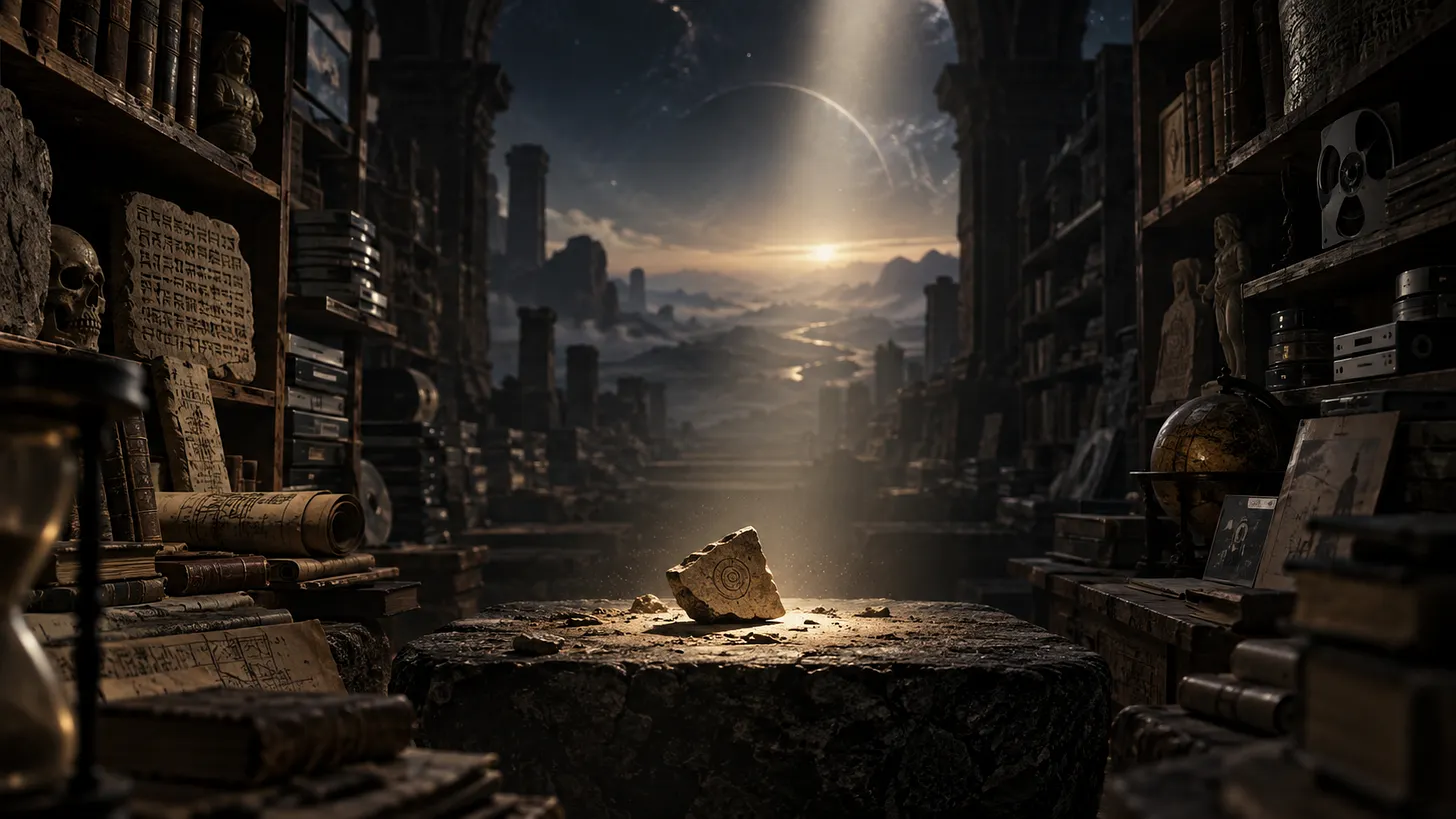
We live surrounded by records of ourselves, accumulating layer upon layer of what we once thought worth remembering, preserving, cataloging, and carrying forward. Yet perhaps memory was never meant to be a warehouse, and perhaps the deeper work is not in retaining everything, but in discerning what remains when everything else inevitably falls away.
. . .
Isn’t it interesting that the more information, raw data, private and public documentary, perpetual surveillance, and knowledge we uncover, the less we are able to meaningfully preserve it? In our era, there is essentially no form of man-made permanent storage media. But, in truth, the same issue has always plagued us as a collective of storytellers. Whether it’s bone, clay tablets, papyrus, parchment, paper, wax, metal, stone, or, now, magnetic and digital media, all are subject to environmental factors and exposure to the elements, accidental loss, technological failure, or simple destruction, regardless of whether they could, in reality, be preserved for centuries or even millennia. Stone inscriptions and clay tablets have survived thousands of years; papyrus and parchment have survived for centuries or, under exceptional conditions, far longer. Coins, monuments, buildings, artifacts, and even landscapes can function as records of civilizations long after the people who created them are gone. Yet none of these things is truly permanent.
More implicitly, history and record keeping themselves are subject to the political or ideological bent of their time, the language and symbology of recording, and then, whatever remains or is recovered well after the fact — rarely intact, complete, and in any way comprehensive — is again subject to interpretation and reinterpretation, to the conscious and unconscious biases of historians and archaeologists, to censorship, redaction, and revisionism.
In the modern era, having grown up during the ’80s and ’90s, I’d say that things are today getting particularly bad. We may have more diverse storage media than ever before, yet, without careful and considered stewardship, maintenance, and long-term oversight, much of it may not last very long at all. Today, we’re discovering just how dependent digital information is on the continued integrity of its physical media, infrastructure, formats, software, hardware, power, and institutions, which is an emerging problem we’re only now beginning to comprehend the enormity of. While we may have more “successive layers of redundancy” today, this is still a stop-gap exercise that relies entirely on a rather fragile and complex infrastructure. I say fragile because it relies on a powered grid, on funding, on perpetual maintenance, on transitioning to better formats and preserving software and hardware continuity, and, ultimately, on someone agreeing to preserve and protect those supposed layers of redundancy.
I’ve explored this issue in several deep dives in recent months. Reduced to its fundamentals, however, the questions remain the same eternal ones: what should we be preserving, and why? These are arguably subjective questions. So we have to bring it home. Make it personal. What are you preserving, and why? The ideas of stewardship and legacy often come up in this arena. And they’re potent ones.
One part of this argument is the very nature of the information or data we think it’s necessary to store somewhere. For the past eighty-or-so years, we’ve been steadily and increasingly deferring to machines, computers, magnetic storage, and finally digital storage media for all of our various forms of records, texts, and creative human expression. Researchers, educators, historians, and analysts come along every generation to take apart and scrutinize the story they’ve inherited, copying what they feel is most notable, collating the “best of the best,” as it were, in order to publish papers and books of their findings for general instruction or posterity.
By its very nature, we can see how this is an extremely limited scope and context, of a very narrow bandwidth, and one that is wildly open to interpretation and all kinds of inherent bias. But this is the same type of material that researchers, historians, and their ilk today refer to from past centuries in order to try to paint a picture of what was, what happened, and, even less, what should be taught, retained, and brought forward. Over the ages, significant events and associated luminaries are reduced to a few select, often misattributed, quotes and preserved passages, a maxim, or myth, and perhaps necessarily so. Some of their surviving works are re-translated to reflect a more “proper” or “politically correct” language of the day, in the process likely drifting further from their source in meaning and intent. And others are completely fabricated, or simply literary characters and manufactured events, that never existed in reality, nor even remotely as described. Regardless, even their arguably fictitious existence has had widespread and lasting effects.
Today there is a massive movement to digitize everything that remains on paper, in books, on shelves, in dusty warehouses, and forgotten libraries — often destroying the original in the process. How do we preserve endless volumes and lifetimes of truth, knowledge, and wisdom? How do we discern what is true, authentic, and real in the first place?
We probably have to dramatically simplify and devise ways to meaningfully encode it. To universalize and broaden its potential reach. We condense it into symbology, myth, and poetry, perhaps compromising volume and verbosity for essence and retrievable substance. Then live it and teach it. Embody it. All that one man or woman may retain throughout a life that has served them on their path can’t be written down or effectively transcribed in any single volume or manifest. What is relevant moment to moment, year to year, decade to decade, shifts and changes as much as we do. So maybe, as was touched upon in one deep-dive discussion, it serves us better if we let go of the idea that we need to preserve anything at all, for the monumental effort and resources required, the complexity involved, and the overwhelming impossibility of meaningful comprehension are quite simply untenable, and no amount of technocratic hubris or misguided, exceedingly costly promises will overcome them.
To me, life itself appears to be a grand cycle, and it would seem reasonable to me that we come around again and again to the authentic, real, and true. Truth is, in my view, an emergent property of our realm. It is alive in the here and now. No matter how badly it is maligned, misappropriated, obscured, or obfuscated, the truth will always and forever emerge in its pure and unadulterated form, seeping in and permeating our reality without consideration of any particular agenda or ambition, nor any adherence to linearity or our construct of time.
That being said, in our current cycle, there are forces and interests who routinely expend massive resources to hide, obscure, and obfuscate the true nature of humanity, our true history, both recent and ancient, our greater cosmology, our sciences, our potential, and our concepts of reality. Perhaps these are the opportunists, say, those such as the world-shaping “robber barons,” extant in a post-reset or post-cataclysm world, for it seems the richest and most powerful of our collective have some kind of advantage in getting in on the ground floor of timeless and society-building industries, infrastructures, finance, and governance, and profiting wildly and massively in the process. History actively misrepresents these tycoons and arguably untouchable monoliths of industry, which is seemingly a common practice and consistent problem with record keeping, as already discussed.
Further, there are those also with apparently limitless resources who operate day and night to obscure, delay, and deter humanity from expressing itself unimpeded and grasping what we came from, historical memory, what we are capable of, embodied memory, and what may be awaiting us, future memory, that will possibly dramatically alter the nature of our very existence. Meanwhile, in its stead, an all-digital, synthetic, and artificial overlay is being aggressively promoted as the purported savior in a time of evident systemic instability and collapse, or perhaps, more accurately, the turning of an age.
Mountains and warehouses of evidence of a brighter and more impressive, or dramatically alternate, telling of the past, or potential future, are sequestered, revised, redacted, or simply destroyed. So it would seem that someone or something is trying to preserve everything of a certain nature, configuration, category, or capacity for revelation and the inevitable apocalypse.
Regardless, if there is an incorruptible and unbreakable set of rules that govern our realm, “they,” as well as you and I, are all subject to them. That may not sound terribly appealing or life-affirming, but I believe it is confirming as to the transient nature of all that exists here in the physical. It will pass. It will rust and corrode, no matter how we try to etch, inscribe, record, retain, or preserve it by way of materials of this realm. As the world is reconfigured or reshaped, memory, history, wisdom, knowledge, and myth will all be buried and perhaps found again. It will be interpreted and reinterpreted. As a culture or society develops and grows, those who garner or accumulate power and influence will obscure and obfuscate reality and the truth of it anew, and at some point further down the line, it will again, in all likelihood, be returned to dust.
Or perhaps, more accurately, in a way Walter Russell might suggest, to Mind.
Lux et veritas
Written by Trance Blackman. Originally published on tranceblackman.com on 19 September 2026.
Copy & share: https://tranceblackman.com/memory/